Table of Contents
- What Is a Child-Resistant Spout Pouch?
- Child-Resistant Packaging Requirements and Certification
- Pouch Material and Structure Considerations
- Child-Resistant Caps and Fitments for Spout Pouches
- How to Specify a Child-Resistant Spout Pouch
- Common Child-Resistant Pouch Specification Mistakes
- Specifying Child-Resistant Spout Pouches with Confidence
A practical B2B guide to child-resistant spout pouches for liquid chemicals and cannabis products, covering regulatory standards, pouch materials, CR closure systems, and key specification factors.
What Is a Child-Resistant Spout Pouch?
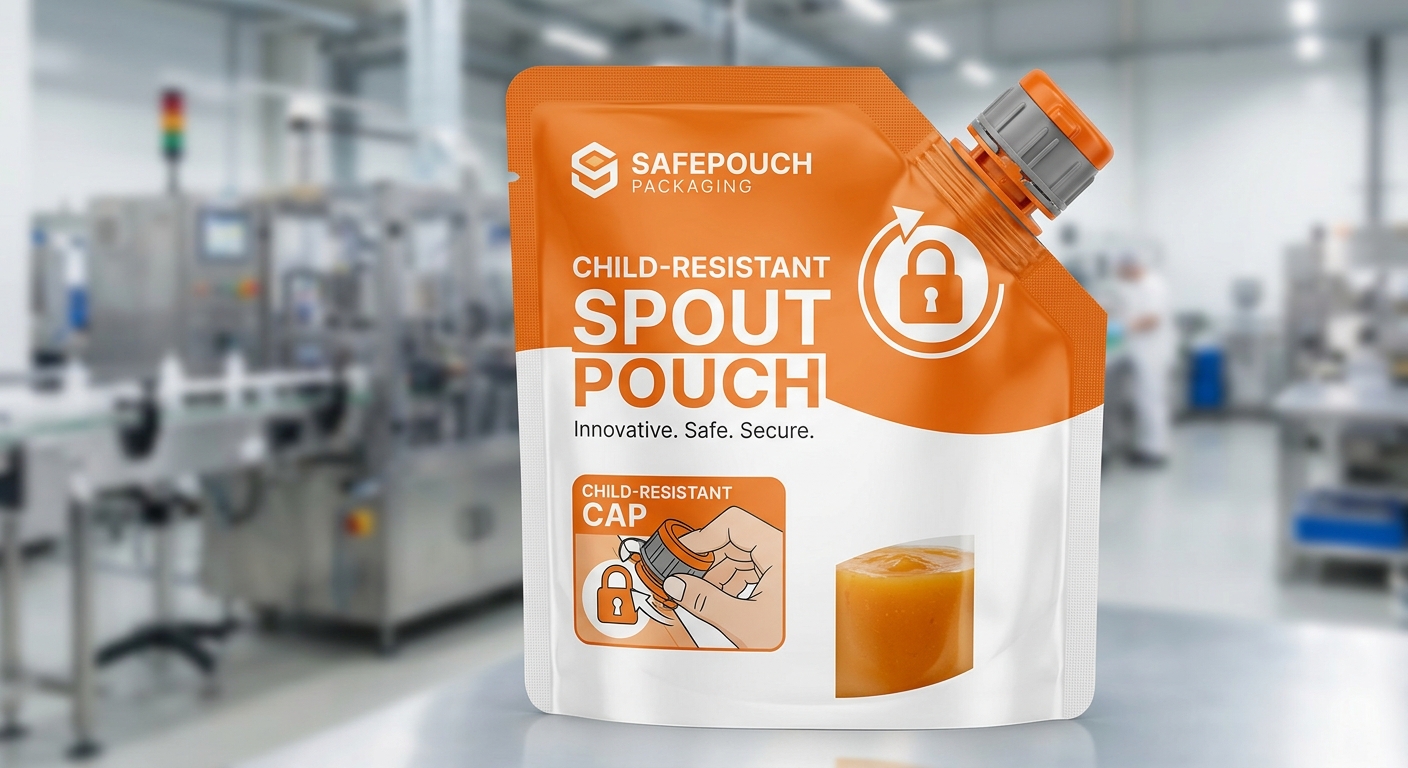
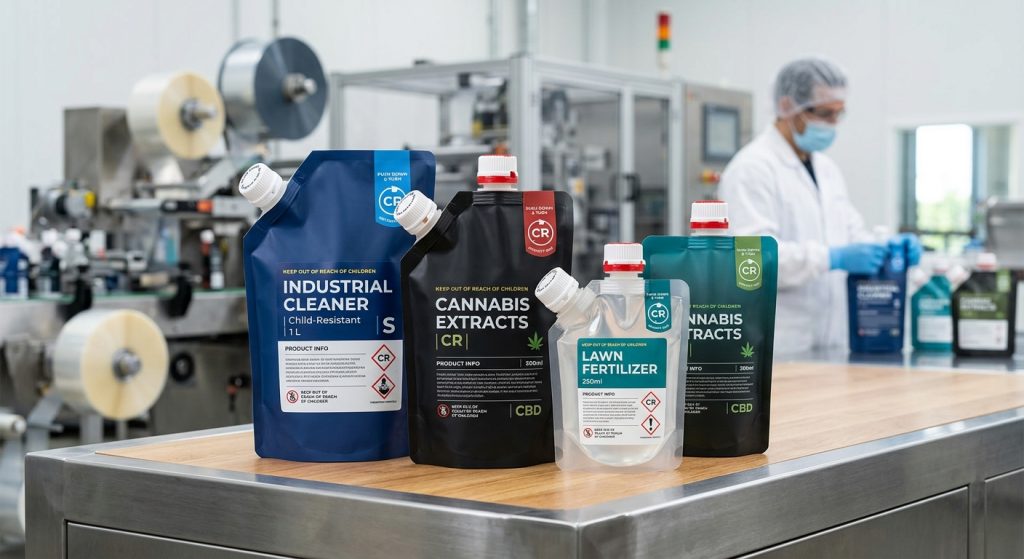
A child-resistant spout pouch is a flexible stand-up pouch fitted with a spout and cap system that has been tested and certified to resist opening by young children while remaining accessible to adults. The pouch body is typically a multi-layer laminate engineered for chemical resistance or aroma barrier, and the closure is a specially designed cap that requires a sequence of motions—such as push-and-turn or squeeze-and-turn—to open.
These pouches are used for liquid chemicals, cannabis-infused beverages, tinctures, and concentrates where accidental ingestion by children is a regulatory and safety concern. The child resistance comes primarily from the cap and fitment combination, but the entire package must be evaluated as a system.
For B2B buyers, specifying a child-resistant spout pouch means confirming three things: (1) the pouch film is compatible with the product, (2) the spout and cap meet the relevant child-resistant packaging standard for the target market, and (3) the filled pouch passes the required protocol testing.
Child-Resistant Packaging Requirements and Certification
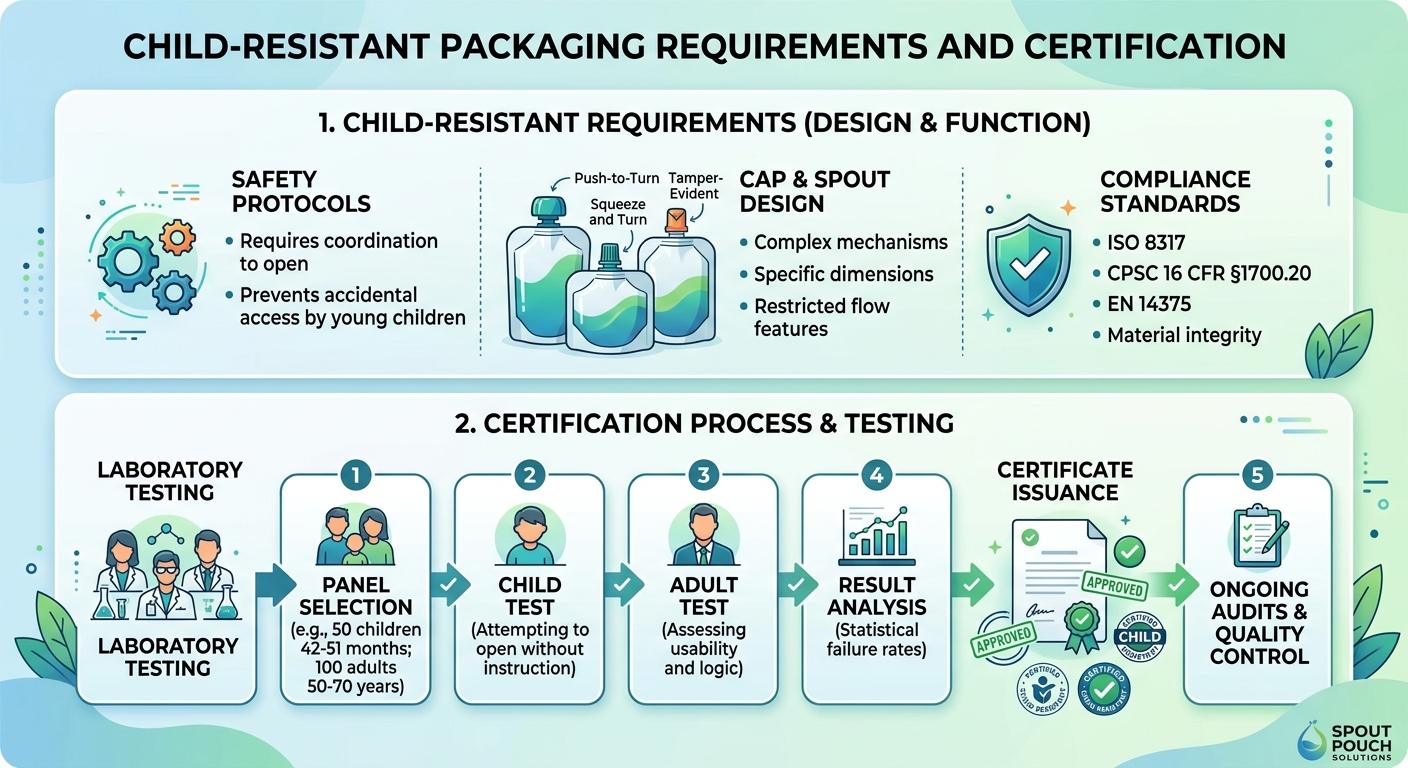
Child-resistant packaging requirements differ by product category and jurisdiction. In the United States, the Poison Prevention Packaging Act (PPPA) mandates child-resistant packaging for certain household chemicals and pharmaceuticals. Cannabis products are regulated at the state level, but most states require packaging that meets or exceeds the performance standards in 16 CFR § 1700.20, ASTM D3475, or ISO 8317.
The common certification pathway involves testing by a third-party laboratory with panels of children and adults. A package is considered child-resistant if at least 85% of children cannot open it within a defined test period, and at least 90% of adults can open and properly resecure it. Specific protocols vary, so buyers must confirm which standard applies to their product and target market.
| Standard/Regulation | Typical Application | Key Test Elements |
|---|---|---|
| 16 CFR § 1700.20 | US household chemicals, pharmaceuticals | Child-resistant effectiveness, senior-use effectiveness |
| ASTM D3475 | Standard classification for child-resistant packages | Package classification by type of resistance |
| ISO 8317 | International child-resistant packaging | Child test and adult test with specific age groups |
| State cannabis regulations | Cannabis products (varies by state) | Often reference one of the above plus labeling and opacity requirements |
For cannabis, many states require the packaging to be child-resistant, tamper-evident, and opaque so contents are not visible. Chemical products may fall under CPSC regulations or DOT requirements for hazardous materials. Always confirm the exact regulation with your legal or compliance team before selecting a pouch.
Certification is not a one-time event. Production samples must continue to meet the standard, and suppliers should provide a certificate of compliance or test report for each production run if required.
Pouch Material and Structure Considerations
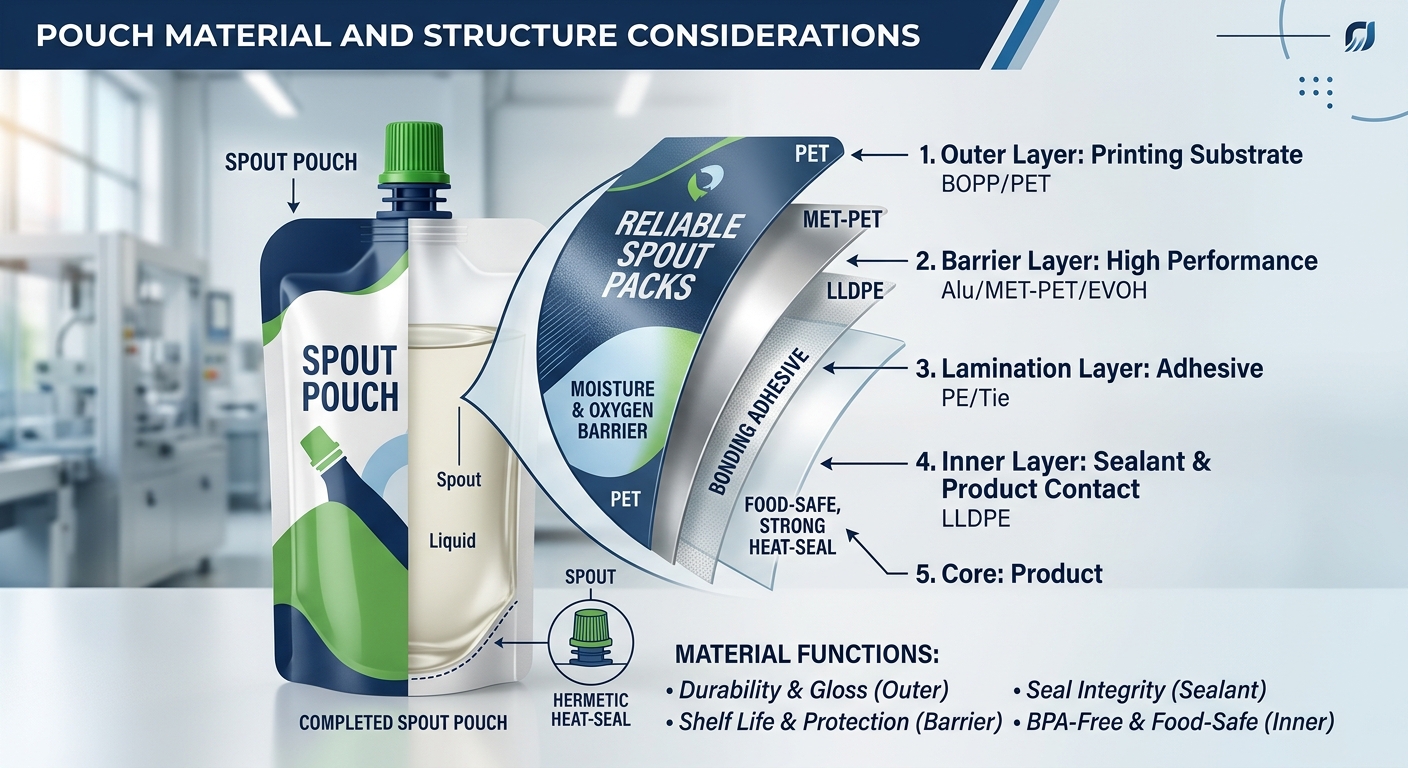
Child-resistant spout pouches for chemicals and cannabis require barrier properties that go beyond standard food pouches. The laminate must protect the product from oxygen, moisture, and light, and it must resist chemical attack or flavor scalping. Common film structures include:
- PET / AL / PE – excellent oxygen and moisture barrier, suitable for aggressive chemicals and cannabis oils.
- PET / EVOH / PE – transparent option with high oxygen barrier where metal foil is not desired.
- Nylon / PE – puncture resistance for products with sharp particles or heavy handling.
The total laminate thickness typically ranges from 90 to 150 microns (3.5 to 6 mil), depending on pouch size, product weight, and drop performance requirements. For chemical products, the inner sealant layer must be selected for chemical compatibility—polyethylene works for many mild acids and bases, but stronger solvents may require polypropylene or specialty films.
In addition to the film, the spout material and seal must be compatible. Spouts are usually made from polyethylene or polypropylene, and the fitment’s base must seal securely to the pouch film. A poor fitment-to-film seal can compromise both child resistance and leak integrity.
When specifying the laminate, confirm the total thickness in both mil and micron, and verify the sealant layer. See our guide on spout pouch material thickness for conversion and specification tips.
Child-Resistant Caps and Fitments for Spout Pouches
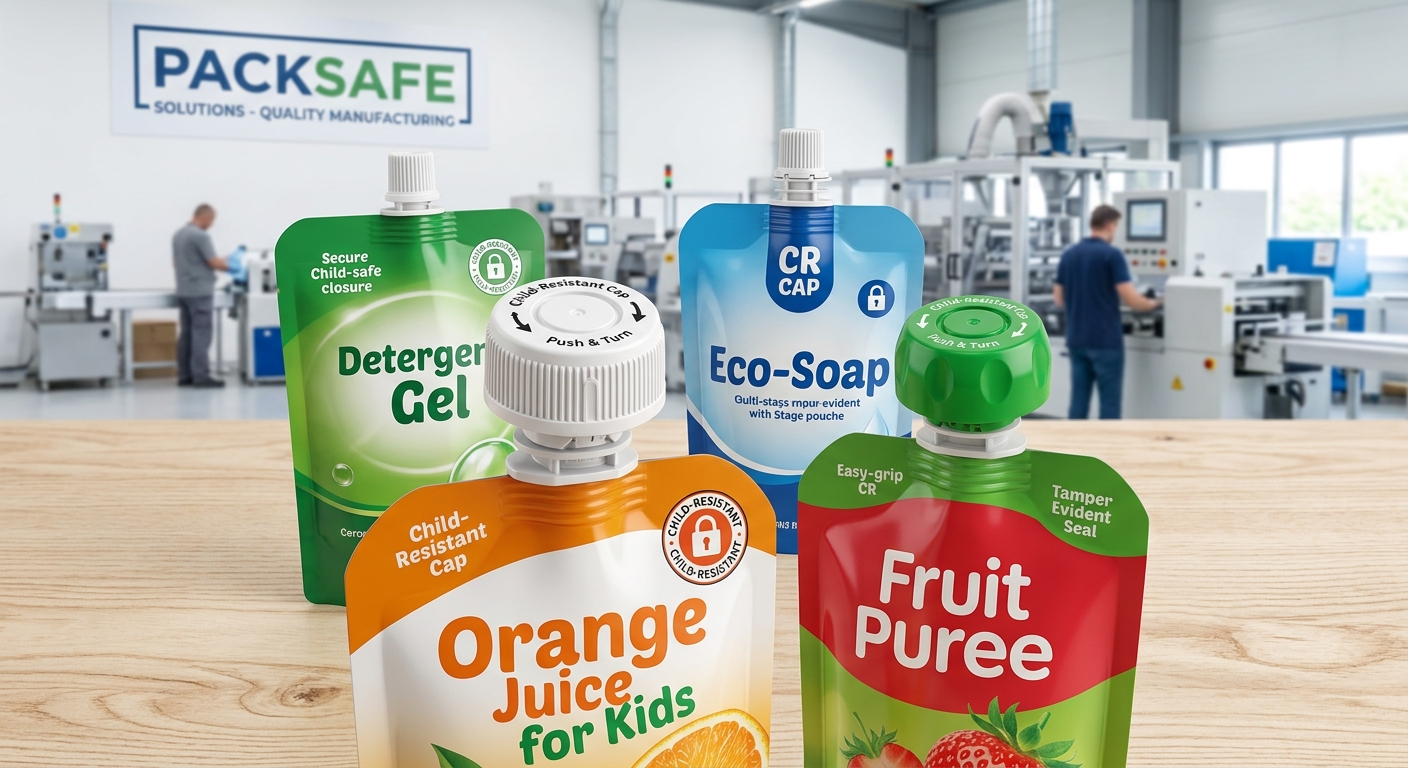
The child-resistant mechanism is usually built into the cap rather than the pouch. Common CR cap styles for spout pouches include:
- Push-and-turn caps – require downward pressure while rotating to disengage a locking mechanism.
- Squeeze-and-turn caps – have side tabs that must be squeezed to release internal lugs.
- Dual-action caps – combine push-down and turn with a tamper-evident breakaway band.
The cap must match the spout finish and thread profile exactly. A mismatched cap can be easy for a child to open or can leak. The spout opening diameter affects dispensing flow rate and the child-resistance challenge: larger openings may be easier for children to manipulate, so the cap design must compensate with more complex motion sequences.
When selecting a CR cap, verify that the cap and spout have been tested together as a system. The fitment includes the spout and flange that heat-seals to the pouch film; if the flange material is incompatible or the seal is weak, the entire package may fail leak tests or be easily torn open by a child. Always request a certificate of compliance for the specific cap-spout combination, not just the cap alone.
Some CR spout pouches also incorporate a foil induction seal or a tamper-evident band for additional safety and security. These features can alert the consumer if the product has been opened before purchase.
How to Specify a Child-Resistant Spout Pouch
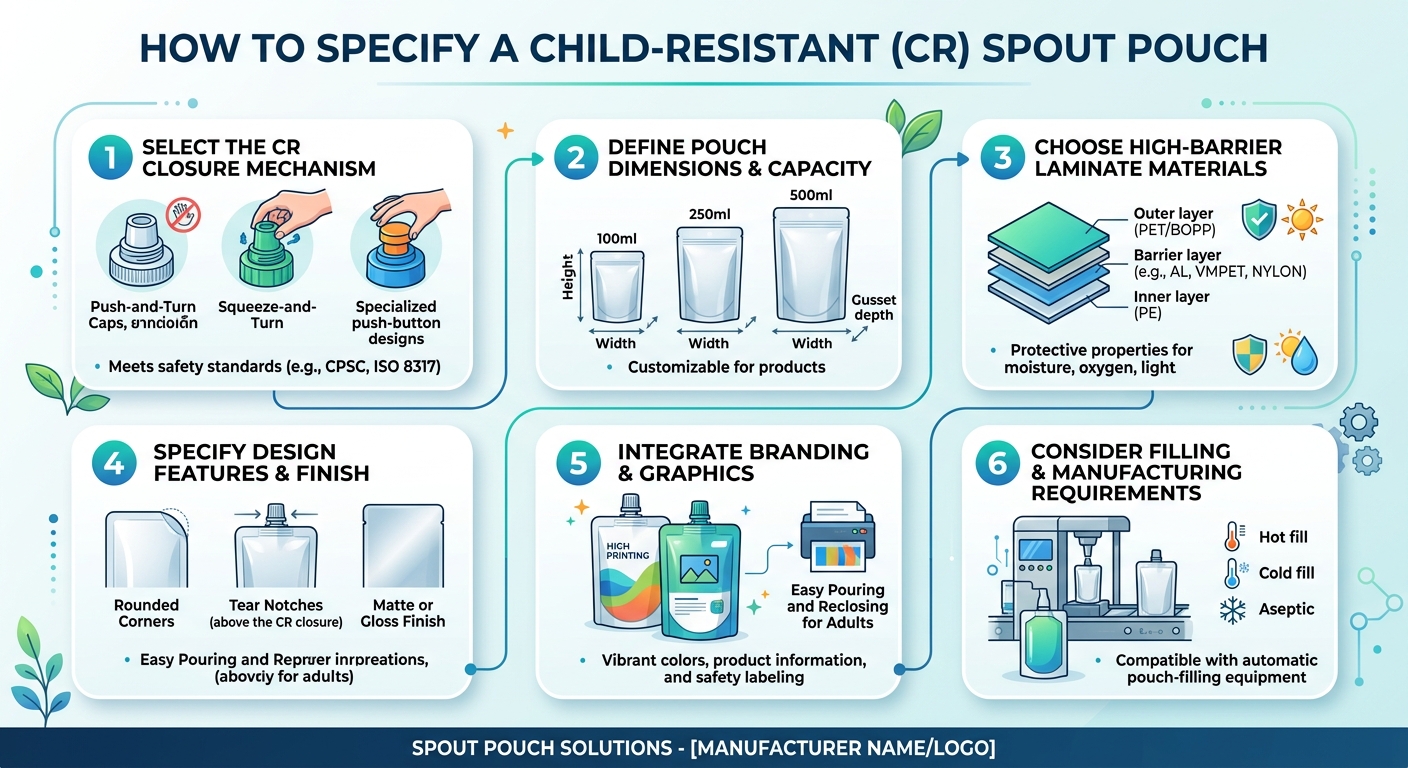
To specify a child-resistant spout pouch that meets both performance and regulatory requirements, follow these steps:
- Define the product and fill volume. Know the liquid’s viscosity, chemical composition, and target fill size. This determines the pouch dimensions, spout diameter, and laminate barrier needs.
- Identify the target market and regulatory standard. Confirm whether the package must meet 16 CFR § 1700.20, ISO 8317, ASTM D3475, or a specific state regulation. Specify both the child-resistance and adult-use effectiveness requirements.
- Select the pouch structure and film. Choose a laminate that provides adequate barrier (e.g., oxygen, moisture, light) and chemical resistance. Verify the sealant layer is compatible with both the product and the spout material.
- Choose the CR closure system. Select a cap and spout that have been certified together. Ensure the cap’s opening motion is appropriate for the target adult demographic (e.g., senior-friendly) and that the spout size matches dispensing requirements.
- Plan for testing and certification. Arrange for third-party testing on filled, production-representative samples. Include tamper-evident features if required. Keep documentation for each production run.
Work closely with your packaging supplier to validate the complete package before full-scale production. A sample run with the actual product is essential because filling conditions, seal parameters, and product contact can affect performance.
Common Child-Resistant Pouch Specification Mistakes
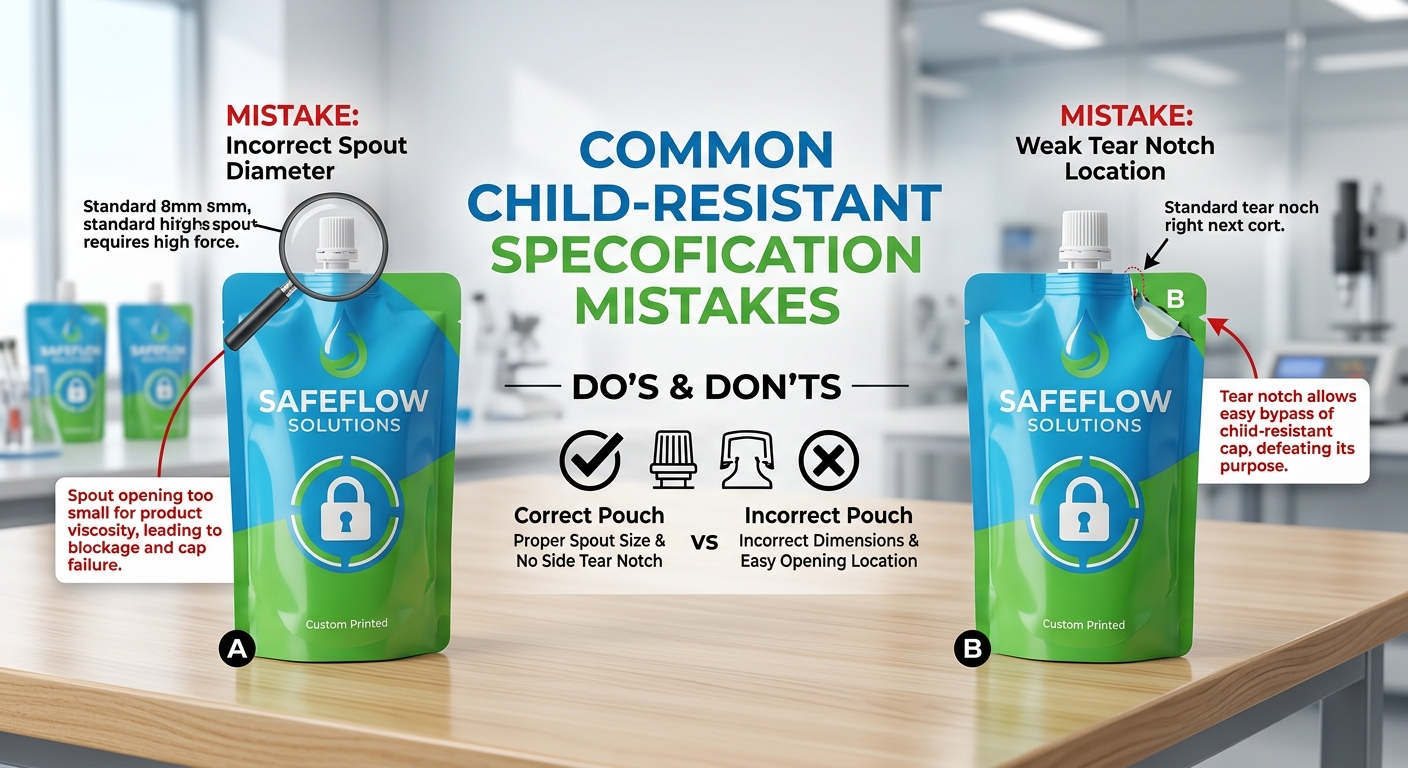
Even experienced buyers can make mistakes when specifying child-resistant spout pouches. Avoid these common pitfalls:
- Assuming the cap alone provides child resistance. The entire package—pouch, spout, and cap—must function as a CR system. A weak pouch seal or a spout that can be pulled from the film defeats the cap’s resistance.
- Not verifying the specific standard. Different standards (16 CFR 1700.20, ISO 8317, ASTM D3475) have different test protocols and passing criteria. Using the wrong standard can lead to non-compliance.
- Ignoring product compatibility. Some chemicals or cannabis oils can degrade the sealant layer or spout material over time, compromising both barrier and CR performance. Always test with the actual product.
- Choosing a cap that is too difficult for adults. If the cap is too complex for adults, especially seniors or those with limited dexterity, the package may not meet adult-use effectiveness requirements (e.g., 90% of adults must open it).
- Skipping production-level testing. Certification on prototypes does not guarantee production units. Variations in film, sealing temperature, or cap molding can affect results. Test regularly on production samples.
Specifying Child-Resistant Spout Pouches with Confidence

Child-resistant spout pouches are an excellent choice for liquid chemicals and cannabis products that require both convenience and safety. By understanding the regulatory landscape, selecting the right materials and closure systems, and testing the complete package, B2B buyers can avoid compliance failures and costly recalls.
Work with a packaging supplier that has experience in child-resistant certification and can provide documented compliance for each component and the finished package. Request samples, conduct real-world testing, and maintain open communication with your compliance team to ensure your product meets all requirements.
For more information on spout pouch specifications, explore our guides on material selection, spout fitment options, and custom printing for flexible packaging.