Table of Contents
- FDA Food Contact Requirements for Spout Pouches
- What FDA Compliance Means for a Spout Pouch
- Food Contact Pouch Documentation Checklist
- Comparing Food-Contact Evidence
- Review Every Pouch Component
- Define Conditions of Use Before Approval
- When Food Packaging Migration Testing Is Needed
- Buyer Qualification Workflow
- Control Design and Material Changes
- Conclusion
A practical guide to evaluating FDA regulatory status, supplier declarations, conditions of use, migration evidence, and change controls for food-contact spout pouches sold in the United States.
FDA Food Contact Requirements for Spout Pouches
FDA food contact requirements for spout pouches apply to every material that may reasonably contact food or transfer substances into it. A buyer should verify the regulatory basis for the food-contact film, sealant, adhesive, ink system, spout, cap, gasket, and any other relevant component under the pouch’s actual filling, processing, storage, and distribution conditions.
The FDA generally does not issue a blanket approval or certificate for a finished spout pouch. Instead, each food-contact substance must have an applicable regulatory basis, such as a provision in Title 21 of the Code of Federal Regulations, an effective Food Contact Notification, a Threshold of Regulation exemption, a prior sanction, or another valid status. The finished article must also be manufactured under suitable good manufacturing practice and used within applicable limitations.
Key takeaways for packaging buyers
- Evaluate the complete pouch construction, not only the inner film.
- Match every declaration to a named material grade, supplier, and intended condition of use.
- Treat “FDA compliant” as a claim that requires supporting records, not as an FDA-issued certification.
- Determine whether migration or extraction testing is legally required, contractually requested, or appropriate for risk assessment.
- Reassess compliance after changes to resin grade, adhesive, ink, fitment, layer thickness, or process conditions.
What FDA Compliance Means for a Spout Pouch
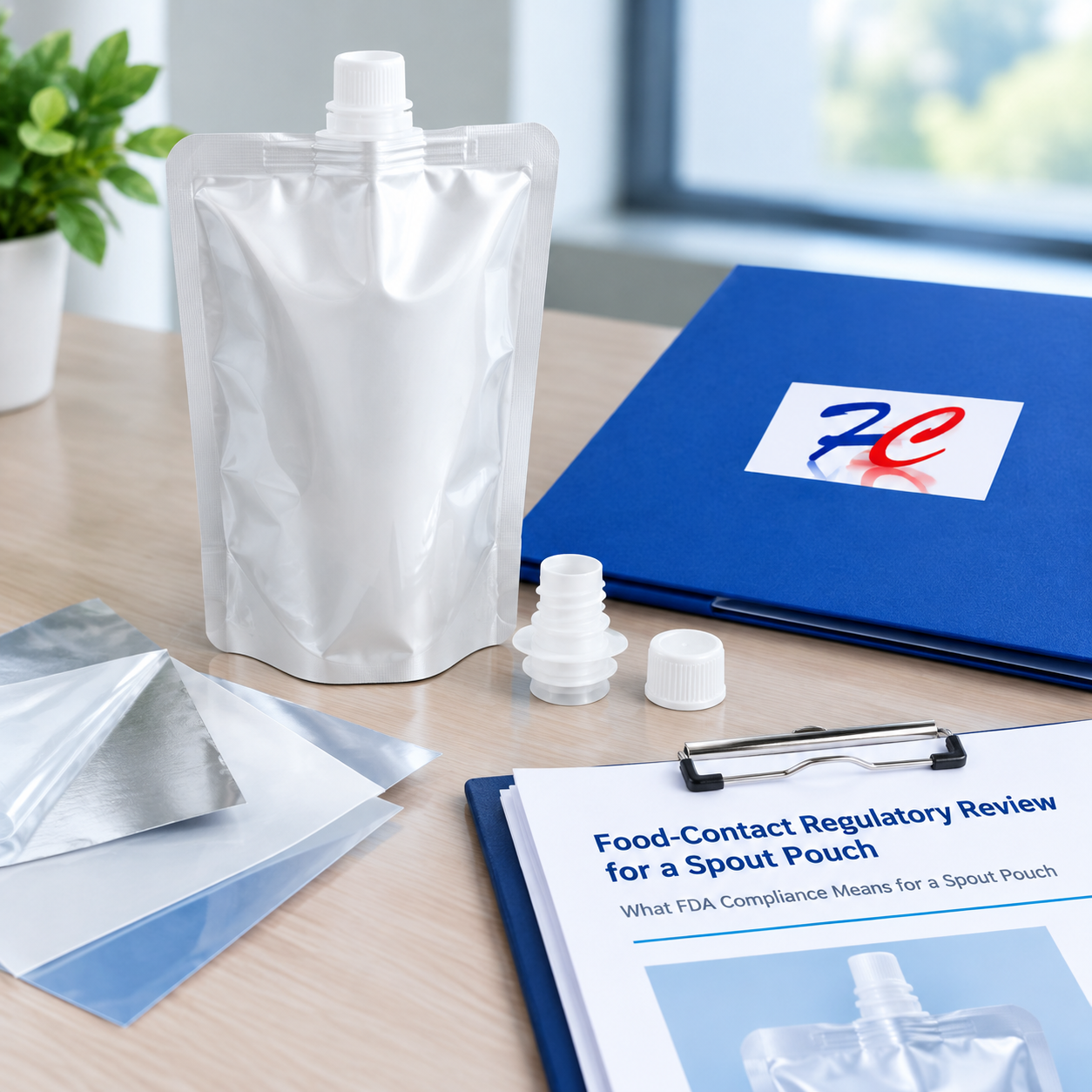
FDA compliant food packaging is packaging made from substances that have an appropriate regulatory basis and are used within the restrictions attached to that basis. The finished package must not cause food to become adulterated, and food-contact materials should be produced in accordance with good manufacturing practice.
For a multilayer spout pouch, compliance is established through a chain of evidence. A polyethylene sealant might rely on a polymer regulation, an adhesive might rely on an adhesive regulation or Food Contact Notification, and a fitment resin might have its own authorization and limitations. A functional barrier can affect the assessment of a non-food-contact layer, but its effectiveness should not simply be assumed.
FDA status is also different from suitability. A material can have a regulatory basis yet still be unsuitable for a fatty sauce, high-temperature fill, long ambient shelf life, or retort process. Mechanical integrity, barrier performance, organoleptic effects, leakage, and shelf life require separate engineering and validation.
Important assumption: this guide addresses packaging for food marketed in the United States. It does not replace legal advice or determine the requirements of Canada, the European Union, the United Kingdom, or another destination market.
Food Contact Pouch Documentation Checklist
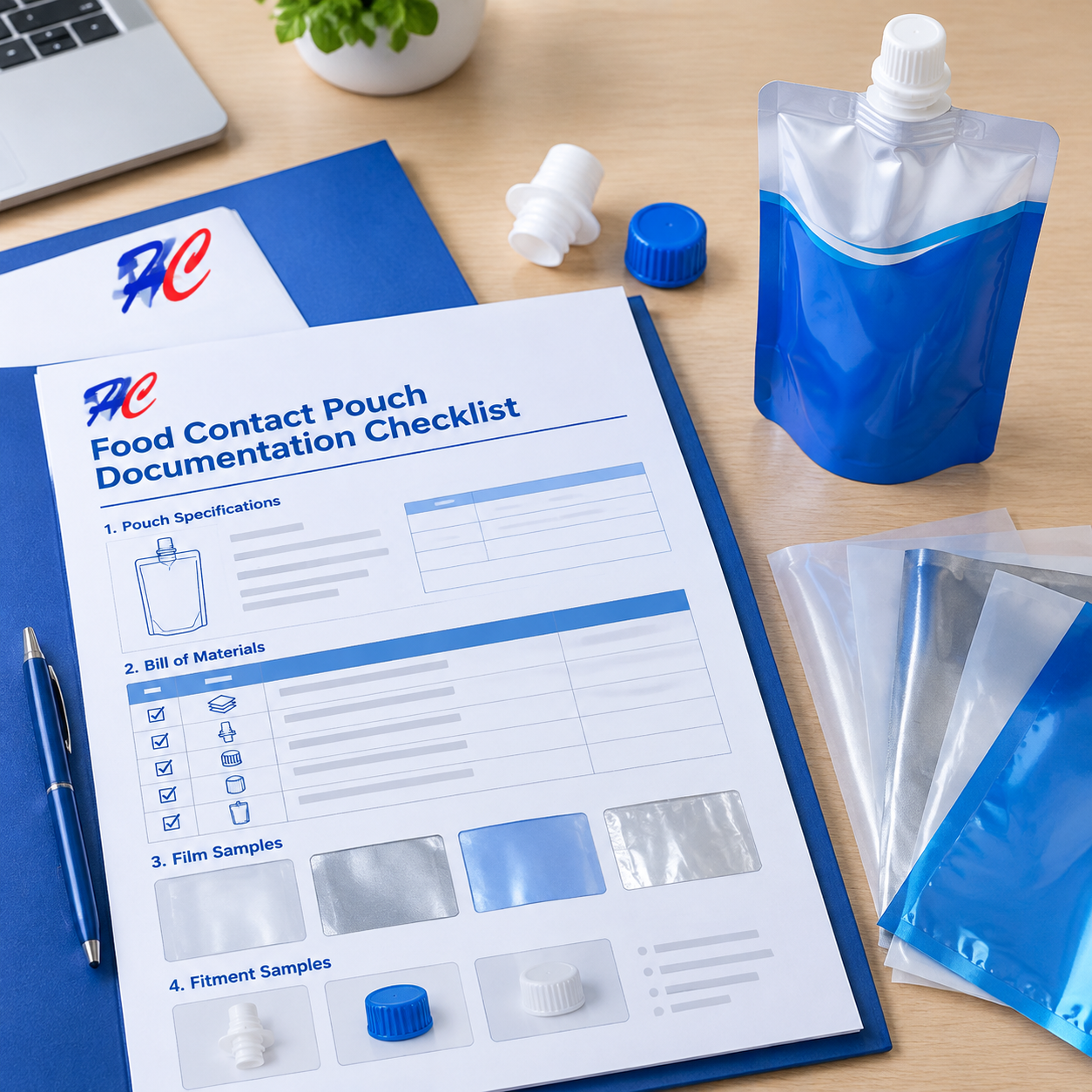
A buyer file should connect the finished pouch specification to evidence for each material and component. Request documents before commercial approval and confirm that their product codes match the bill of materials.
- Finished pouch specification: dimensions, capacity, layer structure, nominal thicknesses, spout and cap codes, print configuration, filling method, and seal requirements.
- Bill of materials: traceable identification of films, resins, adhesives, coatings, inks, fitments, gaskets, and lubricants relevant to food contact.
- Supplier compliance statements: the cited 21 CFR provisions, Food Contact Notification numbers, or other regulatory bases, including restrictions and intended conditions of use.
- Technical data and safety information: documents that identify the supplied grade and help confirm composition, processing limits, and handling controls. A safety data sheet alone does not prove food-contact compliance.
- Migration or extraction evidence: reports required by an applicable authorization or generated to support exposure and suitability assessments.
- Manufacturing controls: lot traceability, incoming-material verification, curing controls, contamination prevention, and change-notification procedures.
- Finished-package validation: seal, leak, drop, transportation, filling-line, shelf-life, and sensory evaluations appropriate to the food and distribution route.
A flexible packaging declaration of compliance is normally a statement from a supplier or manufacturer; it is not a certificate issued by the FDA. It should identify the product, intended use, regulatory references, limitations, date, and responsible issuer. Broad statements such as “made with FDA-approved materials” are not enough to connect an exact pouch to an exact application.
Comparing Food-Contact Evidence
No single document answers every compliance question. Buyers should understand what each record establishes and where additional confirmation is necessary.
| Evidence type | What it can establish | Key limitation | Buyer check |
|---|---|---|---|
| 21 CFR citation | A substance or material may be used under the cited regulation | Identity, additives, extractives, food type, temperature, or other limits may apply | Match the exact grade and use to the full provision |
| Effective Food Contact Notification | A notified substance has an effective authorization for the manufacturer or supplier and uses described in the notification | An FCN is manufacturer-specific and condition-specific | Confirm supplier identity, substance, food types, and conditions of use |
| Supplier declaration or letter of guaranty | The supplier’s statement concerning regulatory status and specified use | Quality depends on scope, accuracy, and supporting evidence | Verify product code, revision date, citations, and restrictions |
| Migration or extraction report | Measured transfer or extractives under defined test conditions | Results apply only to the tested sample and protocol | Compare sample construction, food simulant, time, temperature, and analytical limits |
| Third-party test summary | Independent testing against a specified method | Laboratory testing does not create regulatory authorization | Review the complete report, accreditation scope, and sample identity |
| Certificate of analysis | Lot-specific values for listed quality characteristics | It may not address food-contact status | Confirm which characteristics were tested and whether limits are relevant |
Review Every Pouch Component
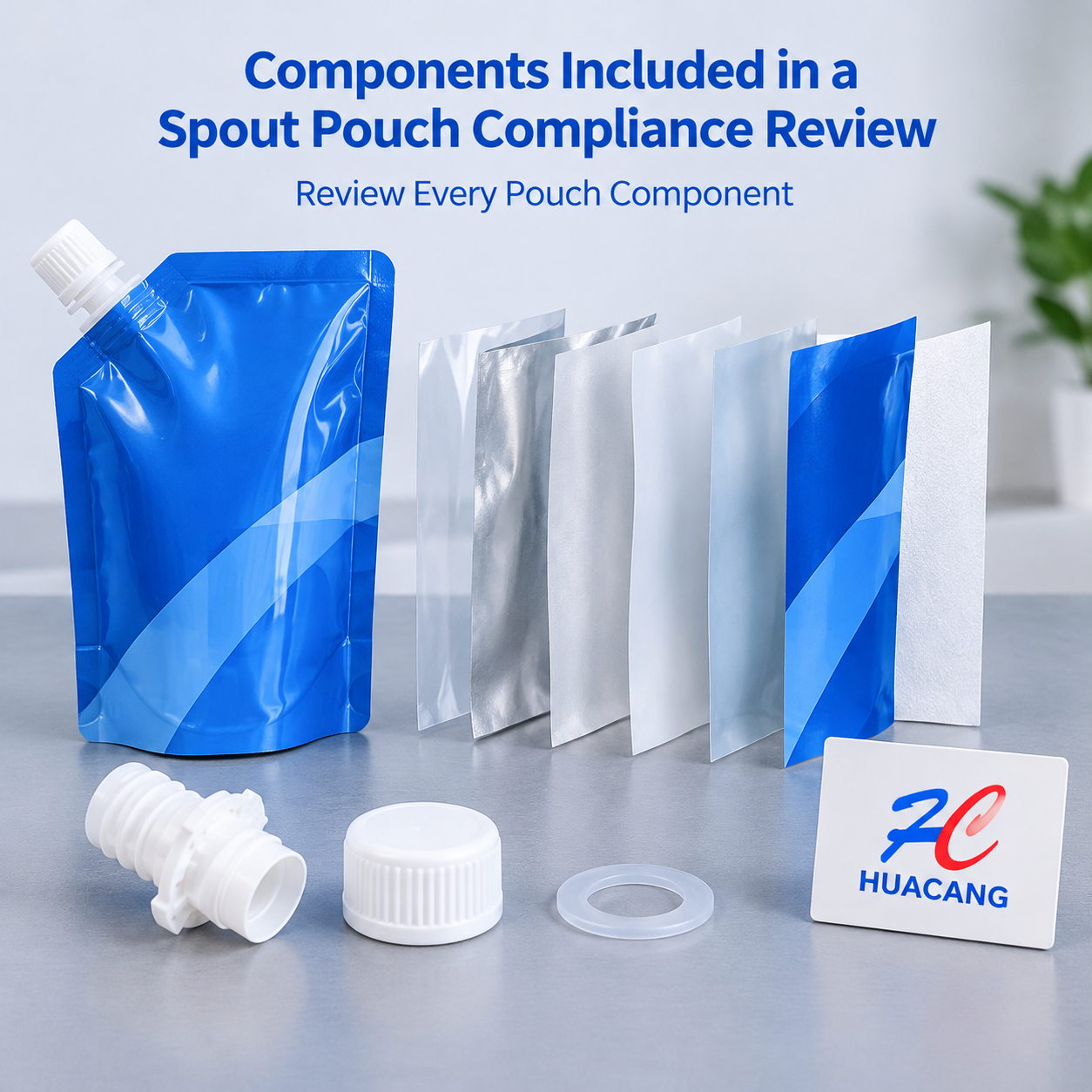
The food-contact assessment should follow the complete material path from the packaged food to the outside of the pouch. Indirect contact and foreseeable migration must also be considered.
| Pouch element | Typical function | Compliance question | Evidence to request |
|---|---|---|---|
| Inner sealant layer | Direct food contact and heat sealing | Is the exact polymer and additive package authorized for the food and temperature? | Grade-specific declaration, regulatory citations, and applicable extraction data |
| Barrier and structural films | Oxygen, moisture, light, and puncture control | Can substances transfer through the sealant, edges, or other pathways? | Layer specification, regulatory status, and barrier rationale where relevant |
| Laminating adhesive | Bonds film layers | Is the adhesive permitted for the construction, and is cure completion controlled? | Adhesive declaration, mix and cure requirements, and residual testing where justified |
| Printing ink and coating | Graphics and surface protection | Is ink prevented from direct contact, set-off, or unintended migration? | Ink statement, print-side specification, set-off controls, and risk assessment |
| Spout, cap, and gasket | Filling, dispensing, and reclosure | Do all wetted materials have a basis for the intended food and use? | Component drawings, resin grades, colorant status, and supplier declarations |
| Handle or added feature | Carrying, pouring, or user convenience | Does the feature add food-contact material or create a new transfer pathway? | Updated bill of materials and component-specific evidence |
Colorants, slip agents, antiblock additives, tie layers, sealants, gaskets, and masterbatches should not disappear into a generic resin description. Exact grade identification is essential because two visually identical polymers may use different additive systems.
Define Conditions of Use Before Approval
Regulatory status cannot be evaluated without a precise use case. Give the pouch converter and each material supplier a written application profile before requesting a compliance statement.
- Food characteristics: aqueous, acidic, alcoholic, fatty, dry, dairy-based, or another relevant category.
- Fill conditions: cold fill, ambient fill, hot fill, aseptic filling, or retort processing, including target and maximum temperatures.
- Contact duration: processing time, expected shelf life, and whether storage is refrigerated, frozen, or ambient.
- Consumer use: reheating, microwaving, freezing, repeated dispensing, or direct consumption from the spout.
- Package geometry: capacity, surface-area-to-food ratio, headspace, spout dimensions, and whether food remains in the fitment during storage.
- Distribution: expected temperature excursions, compression, vibration, light exposure, and secondary packaging.
Conditions of use attached to a regulation or FCN must cover the intended application. For example, evidence supporting room-temperature contact should not automatically be extended to hot filling or retort. A technically conservative test can be useful, but the selected protocol should still represent the relevant food type and contact mechanism.
When Food Packaging Migration Testing Is Needed

Food packaging migration testing measures substances that transfer from packaging into food or a selected food simulant under specified conditions. It may support an authorization, verify a restriction, investigate a potential migrant, or provide application-specific evidence. It is not a universal substitute for confirming the regulatory status of each substance.
Unlike some other regulatory systems, US FDA requirements do not impose one universal overall-migration test on every finished food package. Testing needs depend on the applicable regulation or FCN, the chemistry of the materials, potential exposure, conditions of use, supplier evidence, and the buyer’s risk or customer requirements.
A defensible test plan should define:
- The exact production-representative pouch, including print, adhesive cure, fitment, and color.
- The target analytes or extraction requirement and the reason for selecting them.
- Food simulants representing the intended food categories.
- Time and temperature conditions representing or conservatively bracketing actual use.
- The surface-area-to-volume relationship and the portion of the fitment exposed.
- Analytical methods, detection and quantitation limits, blanks, controls, and acceptance criteria.
Common triggers for additional testing include a new adhesive or ink system, an unusually high filling temperature, fatty or alcoholic foods, prolonged storage, an incomplete supplier data package, or a customer specification. Sensory testing may also be appropriate because an acceptable migration result does not by itself rule out odor or flavor changes.
Buyer Qualification Workflow
Use a gated approval process so that commercial production does not begin before documentation and application requirements are aligned.
- Describe the food and process. Record formulation characteristics, fill method, maximum temperature, shelf life, storage, and dispensing behavior.
- Freeze a preliminary pouch specification. Define dimensions, layer structure, thickness, print, fitment, cap, and any gasket or valve.
- Collect grade-specific evidence. Obtain current declarations and regulatory references for every relevant component.
- Map restrictions to the application. Check food type, temperature, duration, concentration limits, extractives limits, and supplier-specific FCN coverage.
- Identify evidence gaps. Determine whether supplier clarification, migration modeling, extraction testing, chemical analysis, or legal review is needed.
- Validate production samples. Use samples made with the intended films, adhesive, ink coverage, spout, curing process, and converting conditions.
- Approve a controlled specification. Record document revisions, approved suppliers, material codes, acceptance criteria, and change-notification requirements.
- Maintain the file. Review expiring or revised documents and reassess changes before the affected production lot is accepted.
The regulatory review and physical validation should run in parallel. A complete declaration does not demonstrate leak resistance, while a pouch that passes leak testing does not prove that every food-contact substance has an appropriate regulatory basis.
Control Design and Material Changes
A compliance decision applies to a defined construction, not to every pouch made by the same factory. Seemingly minor design changes can introduce a new material, alter migration pathways, or change the applicable conditions of use.
For example, a transparent spout pouch structure may use different barrier and sealant layers from an opaque foil laminate. Its documentation should identify the actual clear-film grades rather than borrowing evidence from another structure.
Similarly, spout pouches with carrying handles can introduce additional components or welded areas. Buyers should confirm whether the handle has any direct or indirect food-contact relevance and update the bill of materials accordingly.
A custom-shaped spout pouch may retain the same materials but change edge geometry, seal width, exposed laminate edges, or product-to-package ratio. Compliance documentation should therefore remain connected to physical testing and the approved drawing.
Require advance notice before substitutions involving resin grade, colorant, film source, adhesive, ink, coating, fitment, recycled content, thickness, or manufacturing location. The change review should document whether previous declarations and test results remain applicable. Packaging artwork should also avoid unqualified wording such as “FDA approved” unless the legal basis and claim language have been reviewed.
Conclusion
Meeting FDA food contact requirements for spout pouches is a specification and evidence exercise, not a search for one universal FDA certificate. Buyers should define the food, process, temperature, storage period, and pouch configuration; verify the regulatory basis of every relevant component; review restrictions; and commission testing when required by an authorization or justified by the application.
The final compliance file should stay linked to the approved bill of materials, drawings, supplier declarations, test reports, and change history. That traceability makes it easier to review new colors, fitments, laminate structures, filling conditions, and supplier substitutions without treating each project as an undocumented assumption.
FAQ
Does the FDA certify finished spout pouches?
The FDA generally does not issue a blanket certificate for a finished spout pouch. The manufacturer and buyer must establish that relevant food-contact substances have an applicable regulatory basis and are used within all restrictions. Supplier declarations and test reports are supporting records, not FDA approval certificates.
What should a food-contact declaration include?
It should identify the exact product or grade, manufacturer or supplier, regulatory basis, intended food types, conditions of use, applicable limitations, issue date, and responsible issuer. It should also be traceable to the pouch bill of materials. A general statement covering unspecified materials is less useful.
Is migration testing mandatory for every food pouch?
No universal finished-package migration test applies to every US food pouch. Testing may be required by a specific authorization or used to address exposure, restrictions, material changes, customer requirements, or application risk. The protocol must represent the intended food, contact time, temperature, and package construction.
Do inks and adhesives need food-contact review?
Yes. Adhesives, inks, coatings, and their components require evaluation for their intended use. The assessment should consider transfer through films, exposed laminate edges, set-off from printed surfaces, incomplete adhesive cure, and unintended direct contact during converting, filling, or use.
Does an FDA-compliant material guarantee the pouch is suitable for hot fill or retort?
No. Regulatory status does not by itself establish thermal, seal, barrier, or mechanical suitability. Hot-fill and retort applications require application-specific material selection and validation under the intended processing, cooling, storage, and distribution conditions.
Need Custom Spout Pouch Packaging?
Share your product, fill volume, filling conditions, pouch structure, spout fitment, artwork, MOQ, sample needs, and quote requirements. HUACANG Packaging can review the project and recommend a suitable custom pouch specification.