Table of Contents
- What Is AQL and Why It Matters for Spout Pouches
- Defect Classification for Spout Pouches
- Choosing an AQL Level for Your Spout Pouch Order
- Sampling Plans: Lot Size and Sample Size (ANSI/ASQ Z1.4)
- Practical AQL Table for Spout Pouches
- How to Inspect Spout Pouches Against AQL
- Communicating AQL Requirements to Your Spout Pouch Supplier
- Common Mistakes When Setting AQL for Spout Pouches
AQL sampling for spout pouches gives packaging buyers a measurable way to accept or reject a production lot. This guide explains how to classify spout pouch defects, choose AQL levels, and apply ANSI/ASQ Z1.4 or ISO 2859-1 sampling plans.
What Is AQL and Why It Matters for Spout Pouches
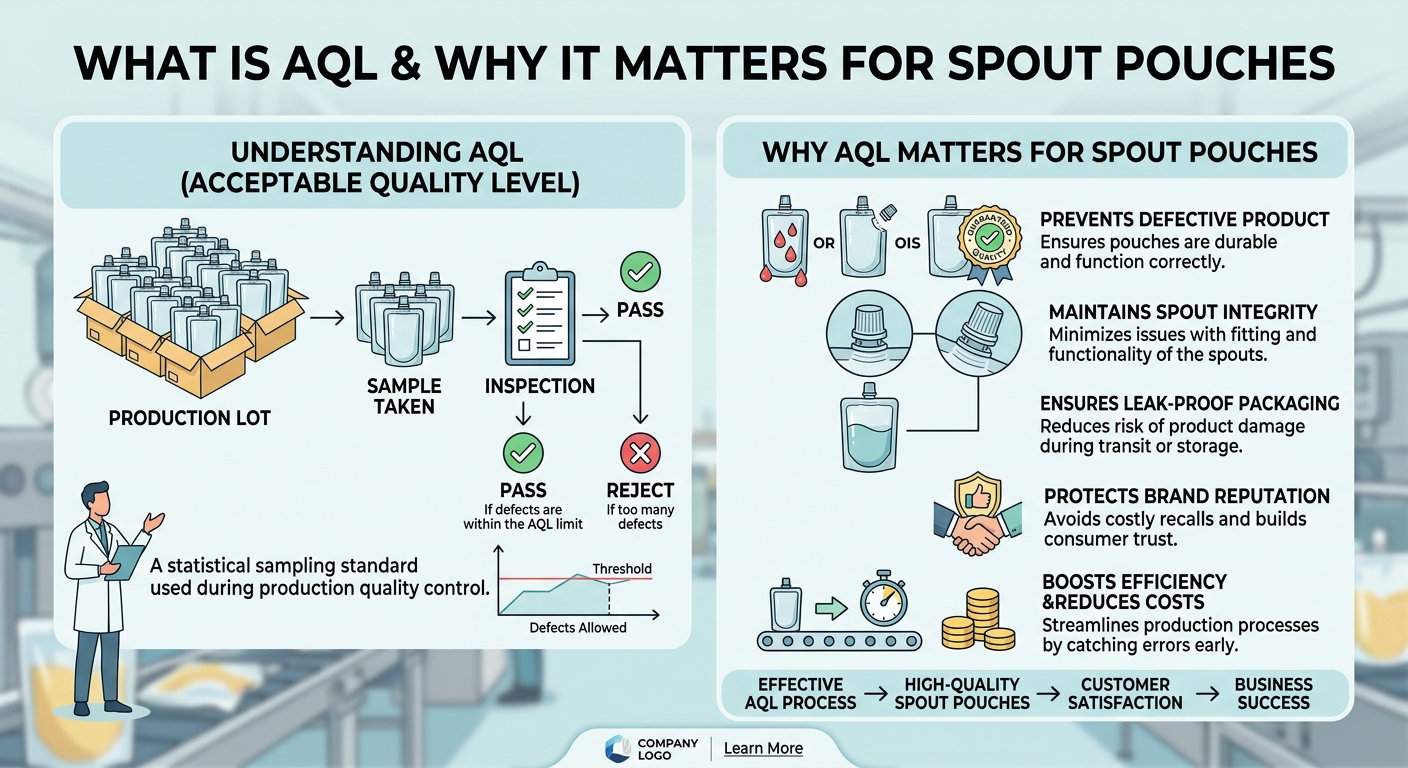
AQL, or Acceptable Quality Limit, is a statistical sampling standard that defines the maximum percentage of defective units you are willing to accept in a production lot. For spout pouches, AQL sampling gives you a repeatable, defensible method to decide whether a shipment meets your quality requirements. Instead of inspecting 100% of pouches—which is impractical for orders of tens or hundreds of thousands—you inspect a statistically determined random sample and compare the number of defects found in each category to the agreed AQL limits.
AQL matters especially for spout pouches because a single critical defect—a leaking seal, a detached spout, or a puncture—can lead to product loss, contamination, or a failed filling line. Spout pouch leak testing is a separate validation step, but AQL inspection identifies visually or functionally defective units before they ship. By setting clear AQL standards, you give your supplier a measurable target and give your receiving team an objective basis for acceptance or rejection.
AQL is not a guarantee of zero defects. It is a risk-based agreement. If you set a very tight AQL (e.g., 0.65 for critical defects), you accept a very low probability that a defective pouch slips through. If you set a looser AQL (e.g., 2.5 or 4.0), you tolerate more defects, which may be fine for cosmetic issues but unacceptable for seal integrity.
Defect Classification for Spout Pouches
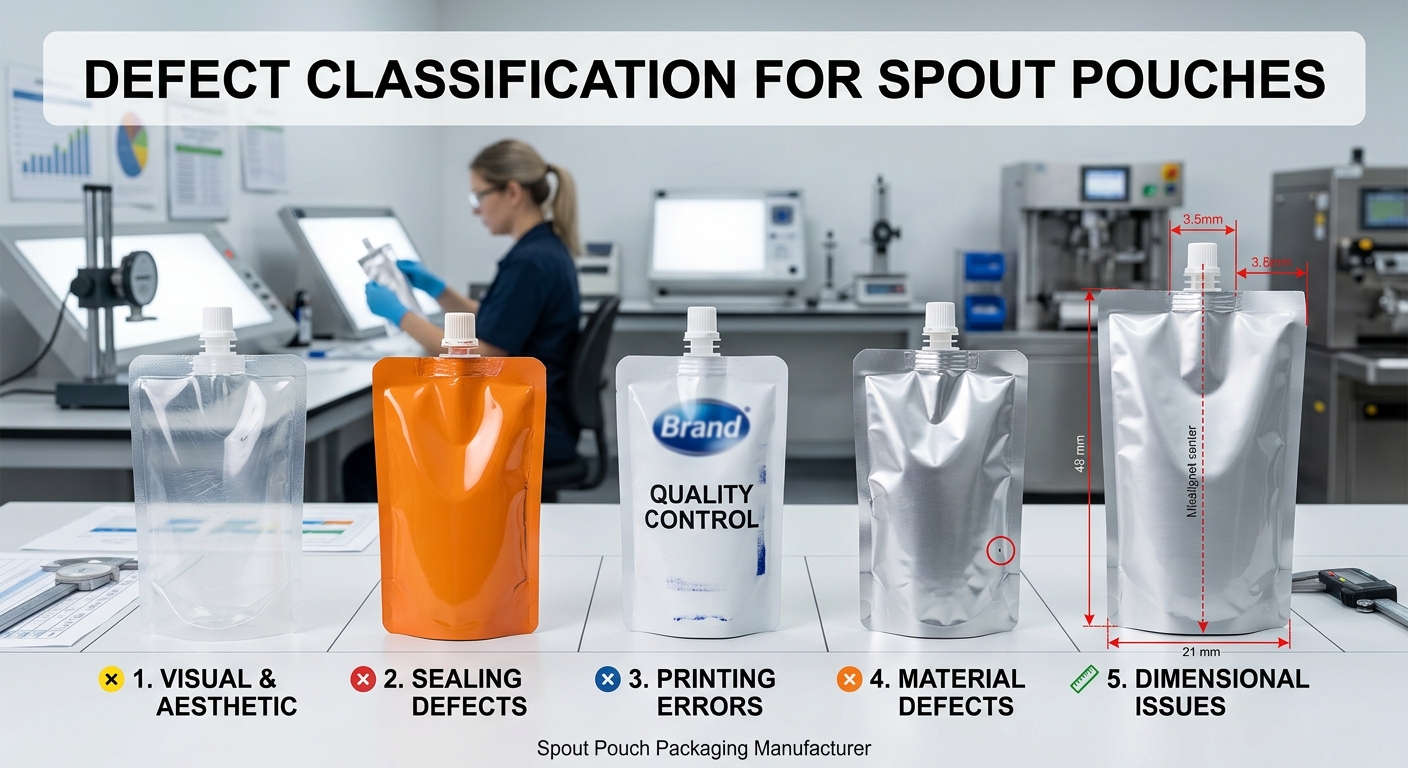
The first step in spout pouch AQL sampling is to define what counts as a defect and to categorize defects by severity. Industry practice uses three standard classes: critical, major, and minor. These classifications should be written into your quality agreement so that everyone—your supplier, your quality team, and any third-party inspectors—uses the same language.
Critical Defects
Critical defects are those that render the pouch unsafe, unfit for use, or likely to fail in the field. For spout pouches, critical defects include:
- Leaking seals or pinholes that compromise product integrity
- Detached or loose spout fitment
- Pouch burst under normal handling
- Foreign material inside the pouch
- Incorrect barrier properties (e.g., wrong film structure)
A critical defect may cause product spillage, contamination, or regulatory non-compliance. Most buyers set the AQL for critical defects at 0.0 (accept on zero) or no more than 0.065.
Major Defects
Major defects reduce the usability or marketability of the pouch but do not necessarily create a safety risk. Examples include:
- Print misregistration beyond tolerance
- Dimensional deviations that affect filling line performance
- Cap torque too high or too low (opening difficulty or leakage risk)
- Incorrect spout orientation
- Wrinkles or delamination in seal areas
Major defects often cause line stoppages or customer complaints. A typical AQL for major defects is 1.0 to 2.5.
Minor Defects
Minor defects are cosmetic imperfections that do not affect function or safety. These may include slight scuffing, minor ink smudges, or small surface scratches. AQL for minor defects is often set at 2.5 or 4.0.
For more detail on identifying specific spout pouch defects, refer to our spout pouch leak testing guide, which covers the functional tests that complement visual inspection.
Choosing an AQL Level for Your Spout Pouch Order
After classifying defects, you need to assign an AQL value to each category. The AQL number is the maximum percentage of defective units that can be considered acceptable during random sampling. The lower the number, the stricter the quality requirement.
Common AQL levels used in flexible packaging are:
- 0.065 or 0.1 – reserved for critical defects on safety-related items, such as baby food pouches, pharmaceuticals, or retort applications.
- 0.65 – used for critical defects on standard consumer products.
- 1.0 – typical for major defects on premium or high-value products.
- 1.5 – common for major defects on standard consumer goods.
- 2.5 – widely used for major defects on general packaging and for minor defects on premium products.
- 4.0 – often used for minor cosmetic defects on cost-sensitive products.
The right AQL depends on your product, market expectations, and the cost of a defect. For example, a baby food spout pouch should have a critical AQL of 0.0 or 0.065 because a leak could harm an infant. A promotional shampoo refill pouch might use 1.5 for major defects and 4.0 for minor defects.
You should also consider the General Inspection Level (I, II, or III) from ANSI/ASQ Z1.4. Level II is the default and is appropriate for most spout pouch inspections. Level III gives a larger sample size and is used when you need a higher degree of assurance. Level I is smaller and may be used for low-risk, low-value items or for ongoing supplier relationships with proven quality.
Sampling Plans: Lot Size and Sample Size (ANSI/ASQ Z1.4)
Once you have set AQL values, you need a sampling plan to determine how many pouches to inspect from each production lot. The most widely used standard is ANSI/ASQ Z1.4 (equivalent to ISO 2859-1). It defines sample sizes based on lot size and inspection level.
Here is a simplified example for General Inspection Level II:
| Lot Size (pouches) | Sample Size Code Letter | Sample Size (single normal) |
|---|---|---|
| 2 to 8 | A | 2 |
| 9 to 15 | B | 3 |
| 16 to 25 | C | 5 |
| 26 to 50 | D | 8 |
| 51 to 90 | E | 13 |
| 91 to 150 | F | 20 |
| 151 to 280 | G | 32 |
| 281 to 500 | H | 50 |
| 501 to 1,200 | J | 80 |
| 1,201 to 3,200 | K | 125 |
| 3,201 to 10,000 | L | 200 |
| 10,001 to 35,000 | M | 315 |
| 35,001 to 150,000 | N | 500 |
| 150,001 to 500,000 | P | 800 |
| 500,001 and over | Q | 1250 |
Note: This table shows the single sampling plan for normal inspection. The standard also provides reduced and tightened inspection options, as well as double and multiple sampling plans. For most spout pouch buyers, single normal inspection with Level II is sufficient.
After drawing the sample, you count defects per category and compare them to the acceptance and rejection numbers given in the standard for your AQL. If the number of defects found is equal to or less than the acceptance number, the lot passes. If it equals or exceeds the rejection number, the lot fails.
For very small lots, such as a first article run of 1,000 pouches, the sample size may seem small. This is normal; AQL sampling is statistically valid, but it assumes the supplier maintains consistent process control. You can supplement AQL with spout pouch drop testing or 100% leak testing on critical orders.
Practical AQL Table for Spout Pouches
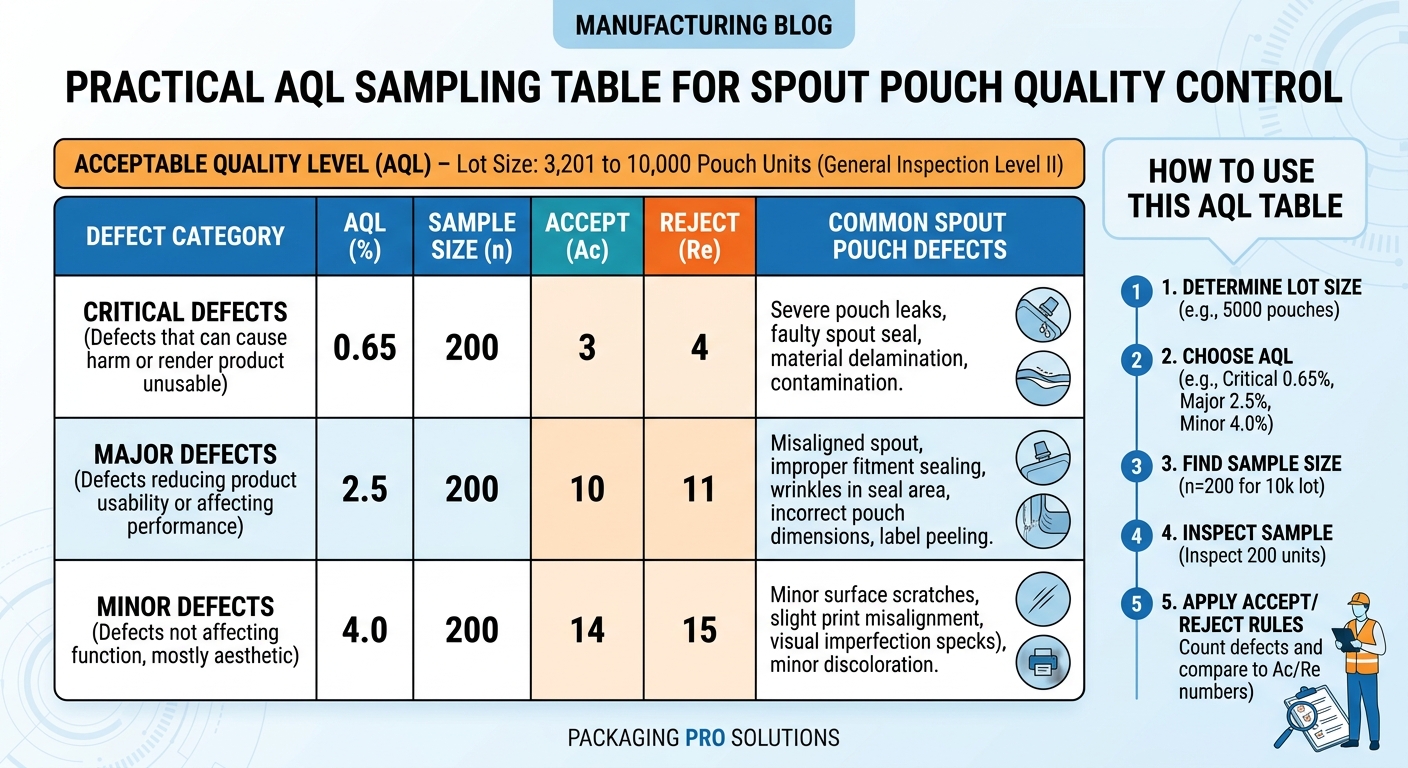
To make AQL settings actionable, many buyers create a matrix that combines defect classification with AQL values. The following table is a common starting point for a standard liquid product in a spout pouch (non-retort, non-baby food).
| Defect Category | Typical AQL | Example Defects |
|---|---|---|
| Critical | 0.0 – 0.065 | Leak, spout detachment, foreign material, incorrect film |
| Major | 1.0 – 1.5 | Print misregistration >2mm, cap torque failure, dimension out of tolerance, seal wrinkles |
| Minor | 2.5 – 4.0 | Light scuffing, minor ink smudge, slight surface scratch |
Adjust these numbers based on your product and market. For retort pouches, hot-fill applications, or customer-specific requirements, you may tighten the critical AQL to 0.0 and major AQL to 0.65. For commodity items with high volume and low unit cost, you might relax minor AQL to 6.5.
Remember that AQL applies to the inspection of finished pouches. In-process controls, such as seal strength testing and material thickness verification, are separate but complementary.
How to Inspect Spout Pouches Against AQL
Conducting a spout pouch AQL inspection involves more than counting visual defects. Follow this sequence:
- Define the lot. Confirm the lot size and ensure the sample is randomly drawn from the entire production or shipment.
- Select the sample size using ANSI/ASQ Z1.4 based on lot size and inspection level.
- Perform visual inspection under adequate lighting. Check print quality, pouch dimensions, spout placement, cap fit, and overall appearance.
- Conduct functional tests on a sub-sample or all sampled pouches. Common tests include: leak testing, cap torque measurement, drop testing, and seal strength evaluation.
- Record defects per category. Use a tally sheet or digital form. Be consistent in classifying borderline defects.
- Compare to AQL limits. For each category, if the defect count is ≤ acceptance number, pass; if ≥ rejection number, fail. If between (for double sampling), proceed to second sample.
- Document results and communicate with the supplier. If the lot fails, specify the defects found and request corrective action.
For spout pouches, functional tests are critical because many defects are not visible. A pouch may look perfect but leak under pressure or cap torque may be off. Always combine AQL visual inspection with appropriate functional sampling. Many third-party inspection companies offer combined protocols for flexible packaging.
Communicating AQL Requirements to Your Spout Pouch Supplier
Your AQL plan only works if your supplier understands and agrees to it. Include AQL requirements in your purchase order, quality agreement, or technical specification sheet. Be explicit about:
- The defect categories and their definitions
- The AQL for each category
- The inspection level (I, II, or III)
- The sampling standard (ANSI/ASQ Z1.4 or ISO 2859-1)
- Who performs the inspection (your team, third party, or supplier self-inspection)
- Consequences of failure (rework, sort, replacement)
Ask your supplier to provide a pre-shipment inspection report that includes the AQL results, defect tallies by category, and the lot acceptance status. This report gives you evidence that the inspection was performed according to the agreed plan and helps resolve any disputes. If your supplier does self-inspection, periodically verify their results with a third-party audit.
Common Mistakes When Setting AQL for Spout Pouches
Even experienced buyers make errors when setting AQL for spout pouches. Avoid these pitfalls:
- Not classifying defects properly. If you lump all defects together, you may accept too many critical defects or reject lots for minor issues.
- Using the wrong inspection level. Level III is not always better; it may increase inspection cost without meaningful benefit.
- Ignoring functional tests. AQL visual inspection alone misses many spout pouch failures.
- Forgetting to update AQL over time. As your supplier improves, you may tighten AQL; as your product line changes, adjust defect definitions.
- Failing to communicate. If the supplier doesn’t know the AQL, they can’t meet it. Put AQL in writing.
A well-designed AQL program is a living part of your quality system. Review it regularly and align it with your risk tolerance and customer expectations.