Table of Contents
- What Is Spout Pouch Quality Control?
- Key Spout Pouch Defects to Watch For
- AQL Sampling for Pouches: How to Build an Inspection Plan
- Seal Integrity Testing Methods
- Dimensional and Functional Checks
- Documentation and Supplier Communication
- Pre-Shipment Inspection Checklist for Spout Pouches
- Summary: Building a Repeatable QC Process
Spout pouch quality control is the systematic verification that finished pouches meet material, dimensional, seal, and functional specifications. This guide explains key defects, AQL sampling, seal integrity testing, and documentation for packaging buyers.
What Is Spout Pouch Quality Control?
Spout pouch quality control is the set of inspection and testing activities used to verify that finished spout pouches meet agreed specifications for film structure, dimensions, seal strength, spout fitment, closure torque, print quality, and barrier performance. For packaging buyers, effective QC reduces the risk of field failures such as leaking pouches, delamination, cap pop-off, or filling line jams. A practical program combines incoming material certificates, in-process checks at the converter, and final random sampling based on Acceptable Quality Limit (AQL) standards. Because spout pouches are often used for liquids, pastes, or high-value food products, even a single defective unit can cause product loss, contamination, or regulatory issues. This guide walks through the main defect categories, how to set up an AQL inspection plan, and which seal integrity tests to request. For a deeper look at test methods and standards, see our guide on spout pouch leak testing before finalizing a QC checklist with your supplier.
Key Spout Pouch Defects to Watch For
During pre-shipment inspection, classify defects into three categories: critical, major, and minor. Critical defects render the pouch unusable or unsafe, such as leaking seals, broken spouts, or missing barrier foil. Major defects reduce usability or shelf appeal, including weak seals, misaligned spouts, or print smudging. Minor defects are cosmetic and may not affect function, like slight color variation or minor scratches. Common defect examples are listed below.
- Seal defects: incomplete, weak, or channeled seals; seal contamination; delamination at seal area.
- Spout fitment defects: spout not seated correctly, tilted spout, cracked or deformed spout, poor heat seal between spout and film.
- Closure defects: missing or loose cap, cap threading issues, tamper-evident band broken.
- Print defects: misregistration, smearing, ghosting, incorrect colors, missing text.
- Dimensional defects: pouch dimensions out of tolerance, gusset misalignment, uneven bottom.
- Material defects: pinholes, scratches, lamination voids, film wrinkles.
Work with your supplier to establish a defect classification list with clear photographs and accept/reject limits. Include this list in the inspection plan so all parties use the same criteria.
AQL Sampling for Pouches: How to Build an Inspection Plan
Acceptable Quality Limit (AQL) sampling is a statistical method defined in ISO 2859-1 (ANSI/ASQ Z1.4) used to decide whether a production lot meets quality requirements. For spout pouches, a typical plan uses General Inspection Level II and the following AQLs:
- Critical defects: 0 (zero tolerance)
- Major defects: 2.5
- Minor defects: 4.0
Determine the sample size from the lot size and inspection level using standard AQL tables. For example, a lot of 10,000 pouches at Level II requires a sample size of 200 pouches. Accept the lot if critical defects = 0, major defects ≤ 10, minor defects ≤ 14. Always agree on the AQL plan before production and include it in the purchase order. For more details, refer to our AQL sampling guide for flexible packaging.
Seal Integrity Testing Methods
Seal integrity is the most critical quality attribute for spout pouches, especially for liquid products. Common test methods include:
- Vacuum leak test (ASTM F2338): pouches are placed in a vacuum chamber with water; bubbles indicate leaks.
- Dye penetration test (ASTM F3039): a dye solution is applied to the seal edge; penetration indicates channel leaks.
- Burst test (ASTM F2054): internal pressure is increased until the seal fails; minimum burst pressure must be met.
- Seal strength test (ASTM F88): measures the force required to peel apart a sealed strip; verifies seal strength per specification.
- Torque test for caps: verifies the removal torque is within specified range (e.g., 1.5–2.5 N·m).
Request your supplier to perform these tests on a defined sample size and provide test reports. For in-depth methods, see our guide on spout pouch leak testing.
Dimensional and Functional Checks
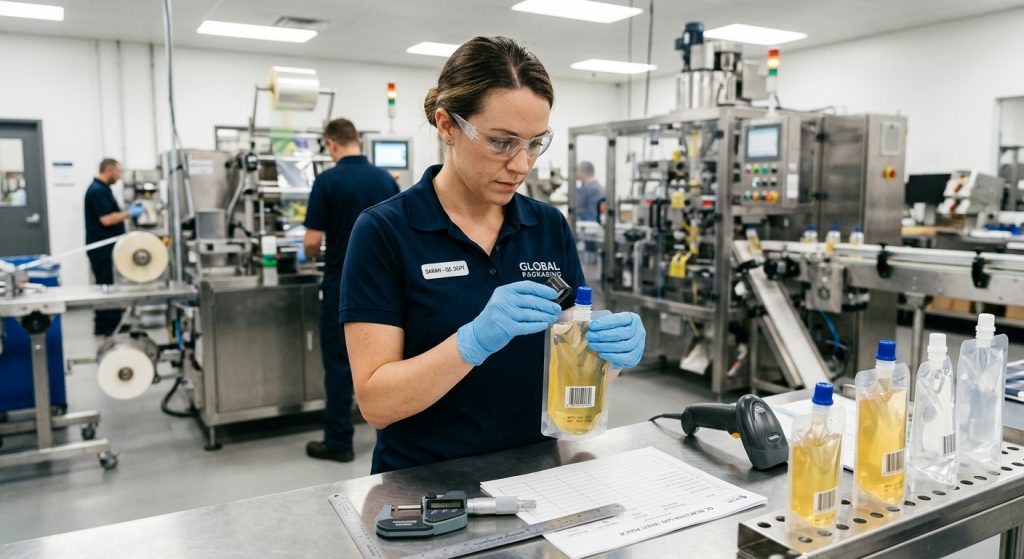
Beyond seals, verify that pouch dimensions meet specifications to ensure filling line compatibility. Key measurements include overall width and height, gusset depth, bottom fold alignment, and spout position (distance from edges). Use calibrated calipers and gauges. Functional checks include:
- Drop test: filled pouches are dropped from a specified height to check for burst or leakage.
- Cap application/removal torque: verify cap can be applied and removed without damage.
- Filling line simulation: check that pouches can be opened, filled, and sealed on target equipment.
Document all measurements and compare against approved spec sheets. Any deviation outside tolerance is a major defect.
Documentation and Supplier Communication
Clear documentation reduces misunderstandings and builds a repeatable QC process. Request the following from your supplier:
- Material certificates: film structure, barrier properties, FDA compliance.
- First Article Inspection (FAI) report: dimensions and test results from the first production run.
- In-process inspection data: seal strength, torque, and visual checks recorded during production.
- Final test reports: AQL sampling results, seal integrity test data.
Communicate specifications via a detailed drawing, a QC checklist, and approved golden samples. Hold regular production meetings and require corrective action reports (CAR) for any deviations.
Pre-Shipment Inspection Checklist for Spout Pouches
Use this checklist during final inspection:
- Sample selection per AQL plan (record lot size, sample size).
- Visual inspection under good lighting for print, color, and surface defects.
- Seal integrity test (vacuum leak test on all samples).
- Seal strength test on a minimum of 5 samples per lot.
- Dimensional measurement of 10 random samples for width, height, gusset, spout position.
- Cap torque check on 10 samples.
- Drop test on 5 filled samples if applicable.
- Verify barcode/QR code readability and content.
- Check packaging: carton markings, quantity per carton, palletization.
- Review all test reports and certificates for completeness.
Record results on an inspection report with pass/fail disposition.
Summary: Building a Repeatable QC Process
Effective spout pouch quality control requires clear specifications, agreed AQL sampling, rigorous seal integrity testing, and thorough documentation. Start by defining defect classifications and tolerance limits with your supplier, then implement a pre-shipment inspection checklist that covers visual, dimensional, and functional checks. Request test reports and material certificates to verify compliance. Use the data from each inspection to drive continuous improvement and reduce defect rates over time. For more resources, explore our packaging QC guides.