Table of Contents
- How Spout Pouch Sizes Are Defined
- Capacity Versus Finished Dimensions
- Typical Spout Pouch Size Planning Ranges
- Choosing the Right Spout and Fitment
- Product and Filling Factors That Affect Size
- How to Specify a Custom Spout Pouch
- Common Spout Pouch Sizing Mistakes
Spout pouch size is determined by more than nominal volume. Buyers must match the pouch dimensions, usable fill capacity, headspace, product viscosity, filling equipment, spout position, and closure fitment. This guide explains how to specify spout pouch sizes for sampling, quotation, artwork, and production.
How Spout Pouch Sizes Are Defined
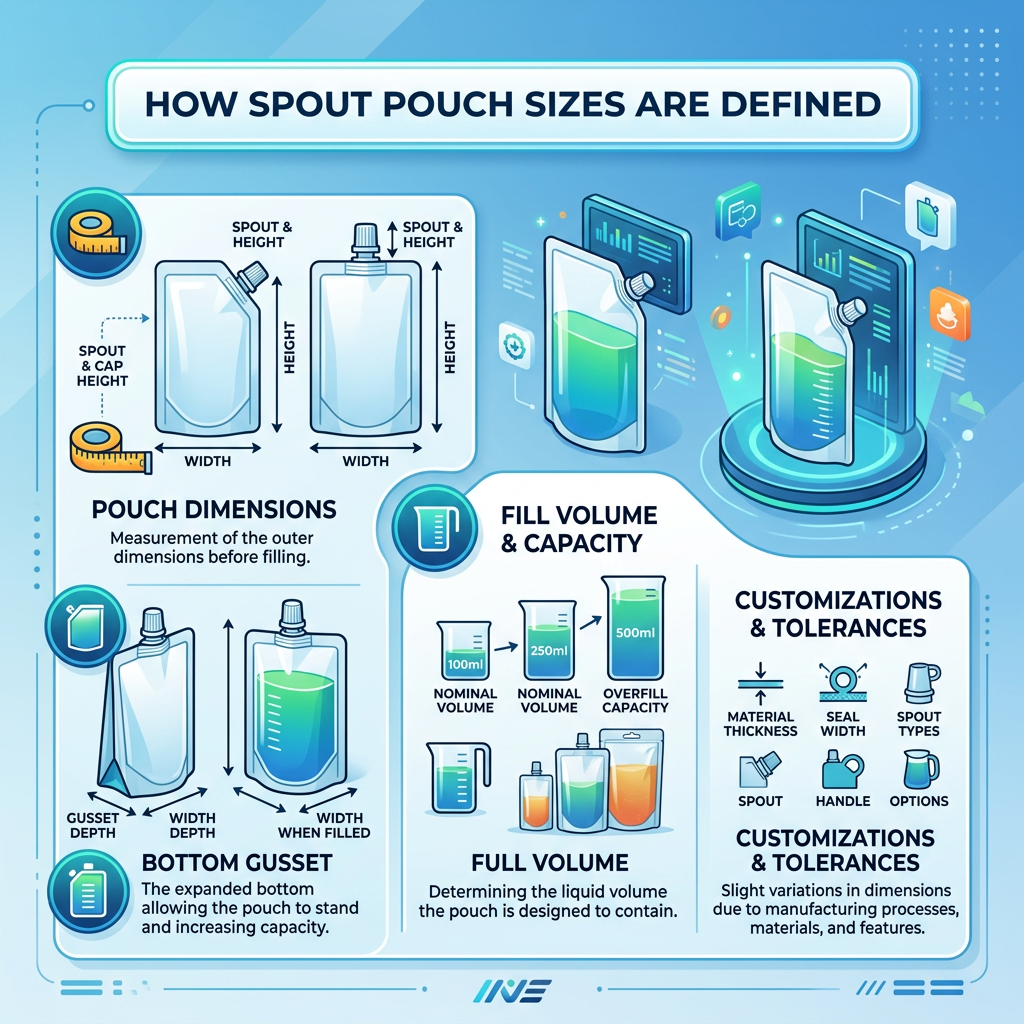
Spout pouch sizes are selected by matching the target fill quantity with the pouch’s usable internal volume, finished width and height, seal layout, and fitment configuration. A pouch marked for 500 ml, for example, may require different finished dimensions for water, thick sauce, edible oil, or a product filled with significant headspace. The correct size must also run reliably on the intended filling and capping equipment.
For B2B purchasing, “size” should therefore be treated as a group of related specifications rather than a single number. The key inputs are:
- Nominal fill capacity: the target quantity of product, expressed in milliliters, liters, grams, or another commercial unit.
- Finished dimensions: pouch width, pouch height, bottom gusset or side gusset dimensions if applicable, and the dimensions of the top seal area.
- Usable volume: the volume available after accounting for seals, corners, the fitment, and the required headspace.
- Fitment: the spout, cap, valve, dispensing opening, and fitment position used with the pouch.
- Construction: the laminate, sealant, thickness, and mechanical requirements needed for the product and distribution conditions.
The figures in this article are planning guidance, not universal industry standards. Final dimensions should be confirmed through a technical drawing, prototype, or filling trial because laminate thickness, pouch geometry, product density, and machine settings can change the result.
Capacity Versus Finished Dimensions
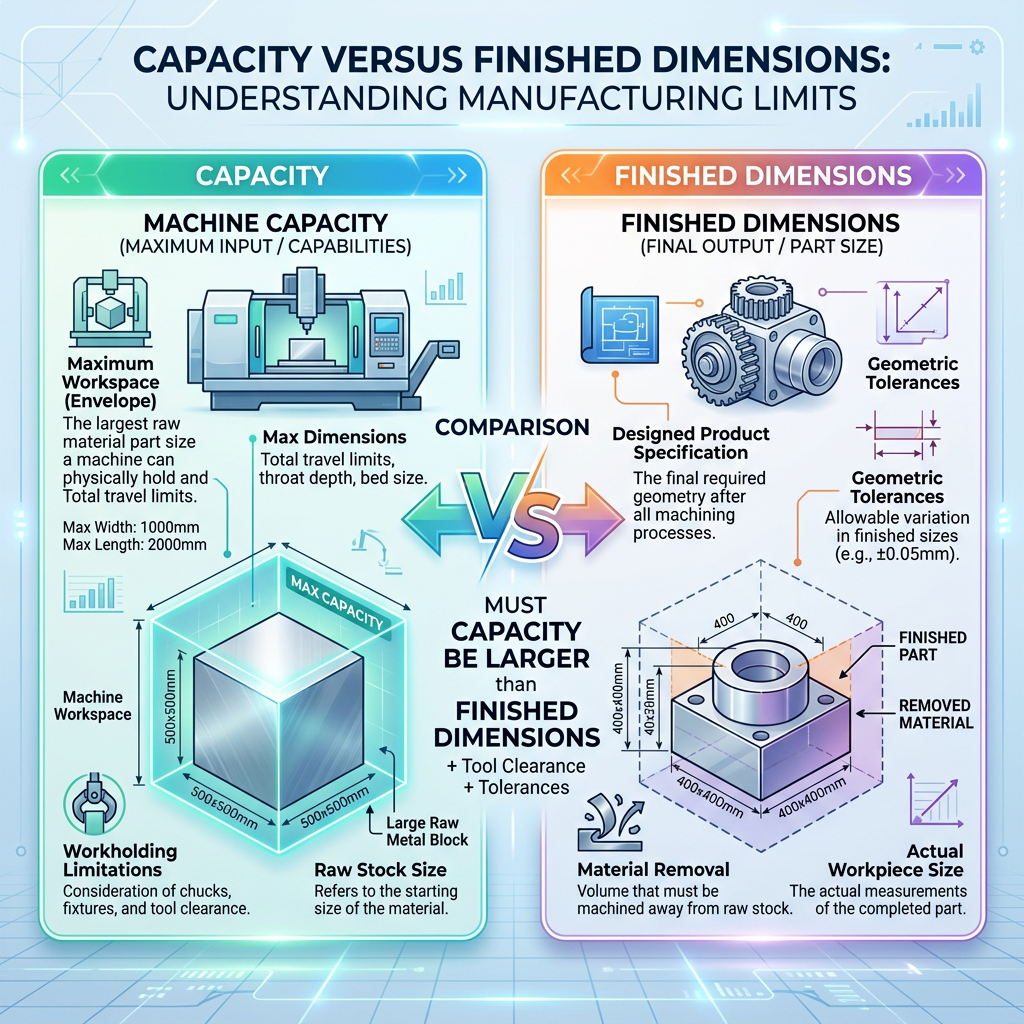
Capacity and external dimensions are related, but they are not interchangeable. Two pouches with the same nominal capacity can have different widths, heights, gussets, and fitment locations. A wide, low pouch may be easier to display or pour, while a taller, narrower pouch may suit a carton, shelf, or filling line with different handling limits.
Nominal capacity usually describes the intended commercial fill. It does not necessarily describe the pouch’s maximum physical volume. A package may need extra volume for headspace, product movement, thermal expansion, settling, or a clean seal. Overfilling can contaminate the seal area, interfere with cap application, increase leakage risk, or cause the pouch to stand and handle differently from the approved sample.
When reviewing a supplier drawing, ask the supplier to identify whether each dimension is measured before or after forming and sealing. Confirm the following points:
- Overall finished width and height, including or excluding the spout and cap.
- Seal width and the usable panel area inside the seals.
- Bottom gusset dimensions and the expected filled footprint.
- Spout center position, fitment angle, and clearance from the top or side seal.
- Recommended fill range rather than only a maximum volume.
- Measurement tolerances for pouch dimensions and fitment placement.
For products sold by weight, such as powders, pastes, or dense concentrates, capacity should be converted using the product’s actual density. A 500 g fill is not automatically equivalent to 500 ml. Buyers should provide the target weight, approximate density, viscosity, and filling temperature when requesting a size recommendation.
Typical Spout Pouch Size Planning Ranges
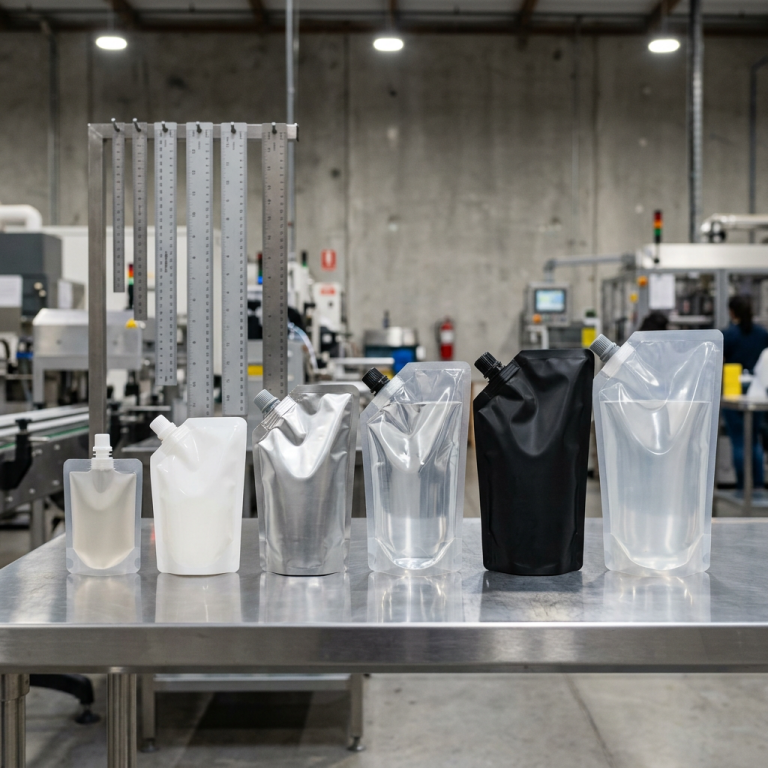
There is no single dimensional standard for every spout pouch manufacturer. However, buyers can use broad capacity groups to organize early discussions with a packaging supplier. The following ranges are indicative planning categories only. Actual dimensions depend on pouch style, laminate thickness, bottom construction, fitment size, seal design, and the product’s filling characteristics.
- Small single-use formats, approximately 50–150 ml: often used for samples, condiments, supplements, sauces, travel products, and single-use personal-care products. The limited panel area makes spout placement and artwork clearance especially important.
- Convenience formats, approximately do not include invalid syntax. Need fix in final.