Table of Contents
- What Are Spout Pouch Defects and Why They Matter
- Common Spout Pouch Defects at a Glance
- Seal Defects: Identification and Causes
- Spout Leakage Causes and Prevention
- Print Defects on Pouches: How to Spot Them
- Lamination Defects: Delamination, Tunneling, and Bubbles
- Other Structural and Dimensional Defects
- How to Prevent Spout Pouch Defects: A Buyer's Checklist
A practical guide for packaging buyers on identifying and preventing common spout pouch defects, including seal failures, spout leakage, print misregistration, lamination problems, and dimensional errors.
What Are Spout Pouch Defects and Why They Matter
Spout pouch defects are any nonconformities in a finished pouch that compromise package integrity, appearance, or functionality. Common defects include seal failures, spout leakage, print misregistration, lamination problems, and dimensional errors. For B2B buyers, identifying these defects early is critical: they can lead to product loss, contamination, consumer complaints, regulatory issues, and costly recalls. This guide explains how to identify the most frequent spout pouch defects and what prevention measures to require from your supplier.
Most defects originate during film extrusion, printing, lamination, pouch making, or filling. A defect that appears minor at receiving inspection can become a field failure after distribution. The goal is not just to reject bad pouches but to work with a supplier that has robust process controls and a documented quality system.
Common Spout Pouch Defects at a Glance
The table below summarizes the most common spout pouch defect categories, their typical appearance, and the usual root cause. Use this as a quick reference during incoming inspection or supplier audits.
| Defect Category | Typical Appearance | Most Common Root Cause |
|---|---|---|
| Seal defects | Weak seal, channel leaker, burnt seal, seal creep | Incorrect sealing temperature, pressure, dwell time; contamination; incompatible sealant film |
| Spout leakage | Liquid seepage at spout flange, cap, or insert | Poor spout-to-film seal, cap torque issues, material incompatibility |
| Print defects | Misregistration, color shift, smearing, ink rub-off | Printing machine setup, ink system, film surface treatment |
| Lamination defects | Delamination, tunneling, bubbles, blisters | Insufficient adhesive, solvent retention, tension mismatch, moisture |
| Structural/dimensional defects | Wrinkles, off-center spout, out-of-spec dimensions | Film handling, pouch machine calibration, tooling wear |
Each category is covered in detail below, including identification methods and prevention strategies.
Seal Defects: Identification and Causes
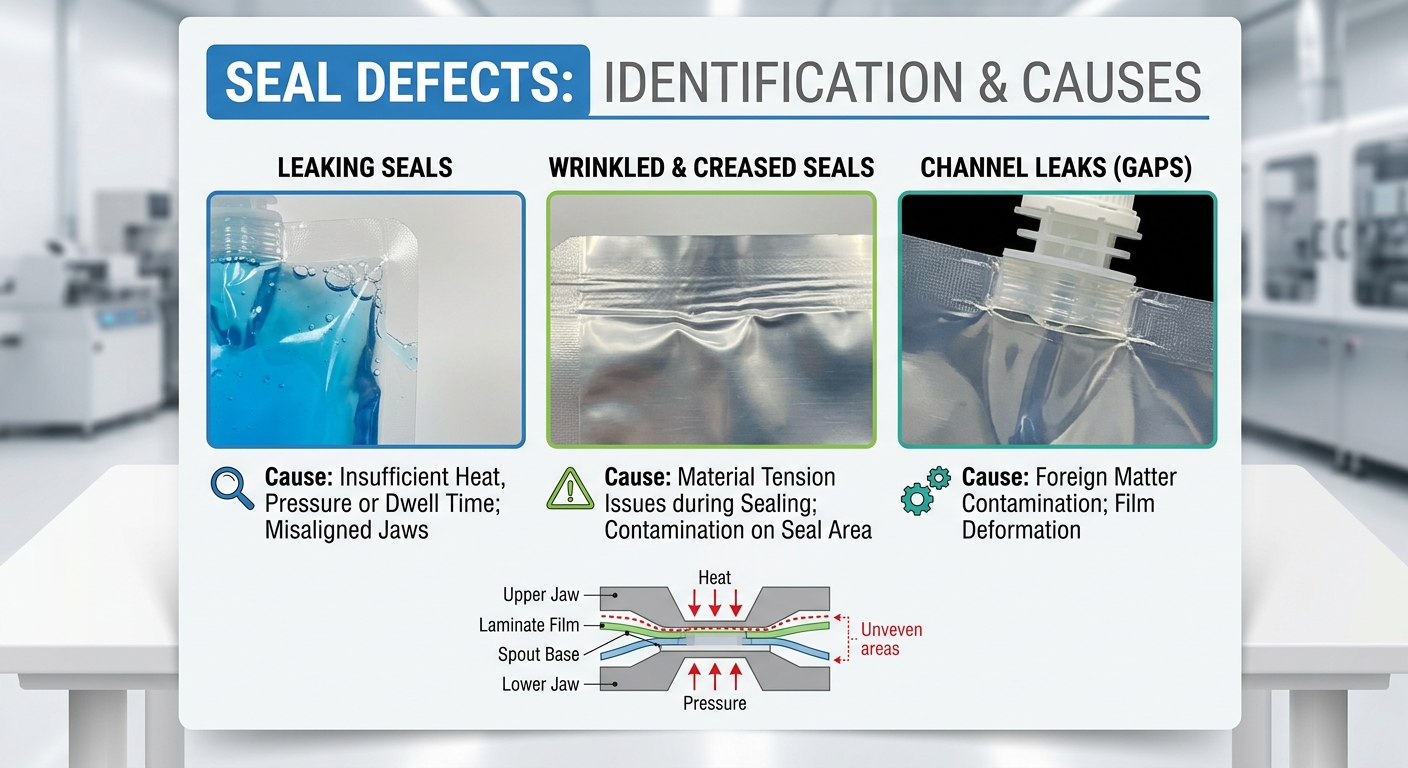
Seal defects are the most serious spout pouch defects because they directly affect package integrity. A pouch with a weak or channeled seal may not leak immediately but can fail under pressure, during drop, or in transit. Common seal defects include:
- Weak seal: The seal strength is below specification. Causes include low sealing temperature, insufficient dwell time, low pressure, contaminated sealant layer, or use of an incompatible film structure.
- Channel leaker: Visible or microscopic channels run through the seal area, allowing liquid or gas to escape. Causes include wrinkles in the seal area, product contamination, or particles trapped between the film layers.
- Cold seal: The seal looks normal but has not been fully fused because the sealant did not reach its melting point. This often results from a drop in sealing temperature or an increase in line speed.
- Overheated seal: The seal area appears burnt, brittle, or shrunk. Excessive heat or dwell time degrades the sealant and weakens the bond.
- Seal creep: The seal area deforms or stretches under internal pressure, especially in hot-fill applications. This indicates insufficient hot tack or seal strength.
To identify seal defects, visually inspect the seal for uniformity, wrinkles, and discoloration. Perform a seal strength test using a tensile tester and compare results to your specification (typically ≥ 20 N/15 mm for a strong pouch seal). For quantitative validation, use standardized spout pouch leak testing methods such as vacuum decay or burst testing. In hot-fill applications, seal integrity is even more critical; refer to our guide on hot-fill spout pouches for material and process recommendations.
Spout Leakage Causes and Prevention
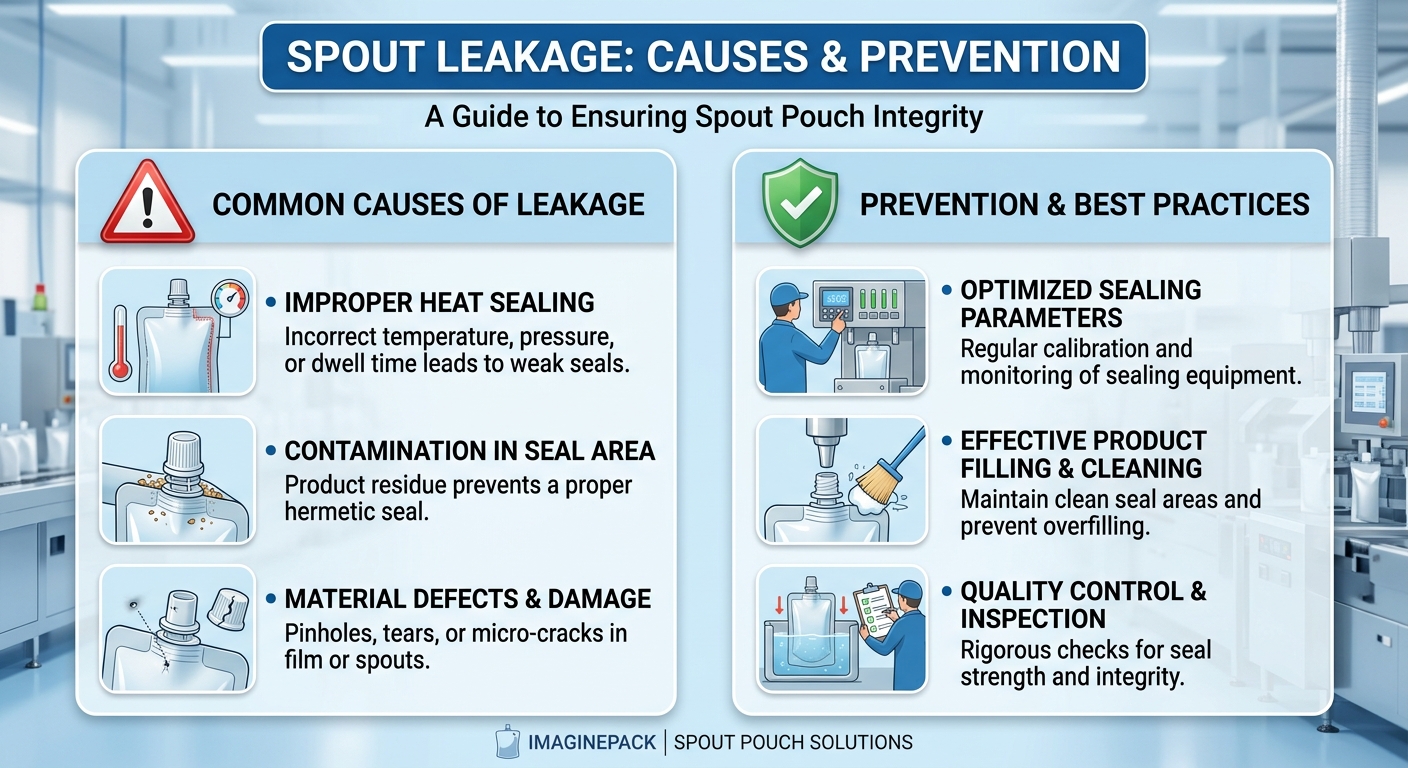
Spout leakage is one of the most visible and damaging spout pouch defects. It can occur at three points: the spout flange-to-film seal, the cap/closure, or the spout insert (if used). Common causes include:
- Flange seal failure: The spout flange does not bond adequately to the pouch film. This can result from insufficient sealing temperature or pressure, contamination on the flange or film, or use of a spout material that is incompatible with the pouch sealant layer (e.g., polyethylene spout on a polypropylene sealant).
- Cap leakage: The cap may not seal properly due to a damaged liner, incorrect application torque, or defective threads. Over-tightening can crack the cap; under-tightening leaves a gap.
- Insert leakage: For pouches with valve inserts or dispensing fitments, leakage can occur if the insert is not fully seated or if the insert material deforms under heat or pressure.
To prevent spout leakage, specify the exact spout material and grade, and require your supplier to perform a 100% spout seal integrity test (e.g., burst or vacuum test) on every production lot. Selecting the correct fitment is critical; refer to our guide on spout pouch fitments for compatibility guidance. You can also implement a practical spout pouch leak test at incoming inspection using a vacuum chamber or manual squeeze method.
Print Defects on Pouches: How to Spot Them
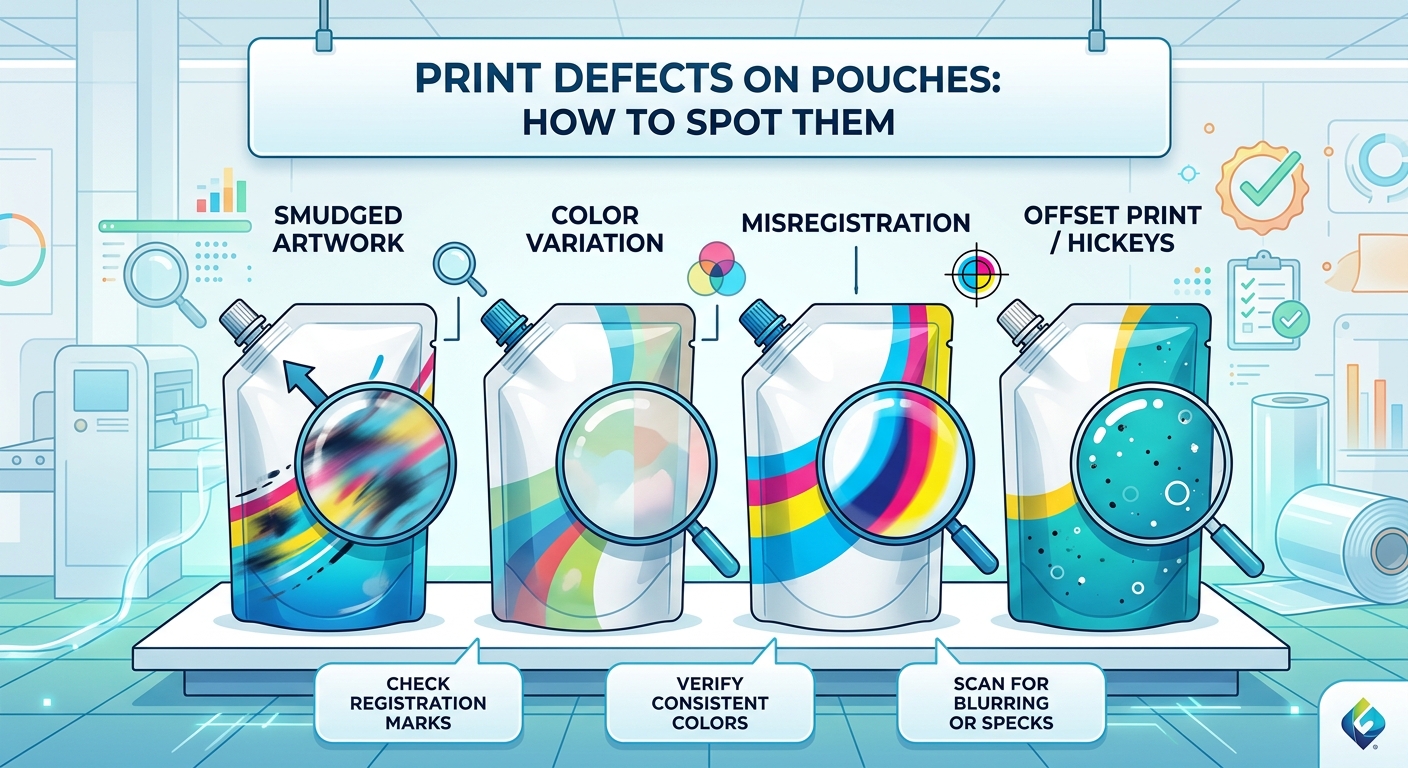
Print defects on spout pouches affect brand appearance and can lead to rejection even if the pouch is functional. Common print defects include:
- Misregistration: Colors are shifted relative to each other or to the die line, causing blurry or offset graphics. Causes include plate/cylinder misalignment, film tension variation, or registration mark issues.
- Color variation: Inconsistent color density across the print run. Causes include ink viscosity changes, anilox roll wear, doctor blade pressure, or incorrect drying temperature.
- Smearing or setoff: Wet ink transfers to the back of the film or adjacent pouches. Causes include insufficient drying, excessive ink film weight, or blocking in the rewound roll.
- Ink adhesion failure: Ink rubs off easily, indicating poor corona treatment of the film or use of an ink system incompatible with the substrate.
To identify print defects, compare printed pouches against an approved color proof under standard lighting (D65). Use a spectrophotometer to measure color difference (ΔE) and set a tolerance, typically ΔE ≤ 2 for brand colors. Perform a tape test for ink adhesion: apply and remove a piece of pressure-sensitive tape; no ink should transfer. Require your supplier to run a first article print approval and maintain color density records.
Lamination Defects: Delamination, Tunneling, and Bubbles
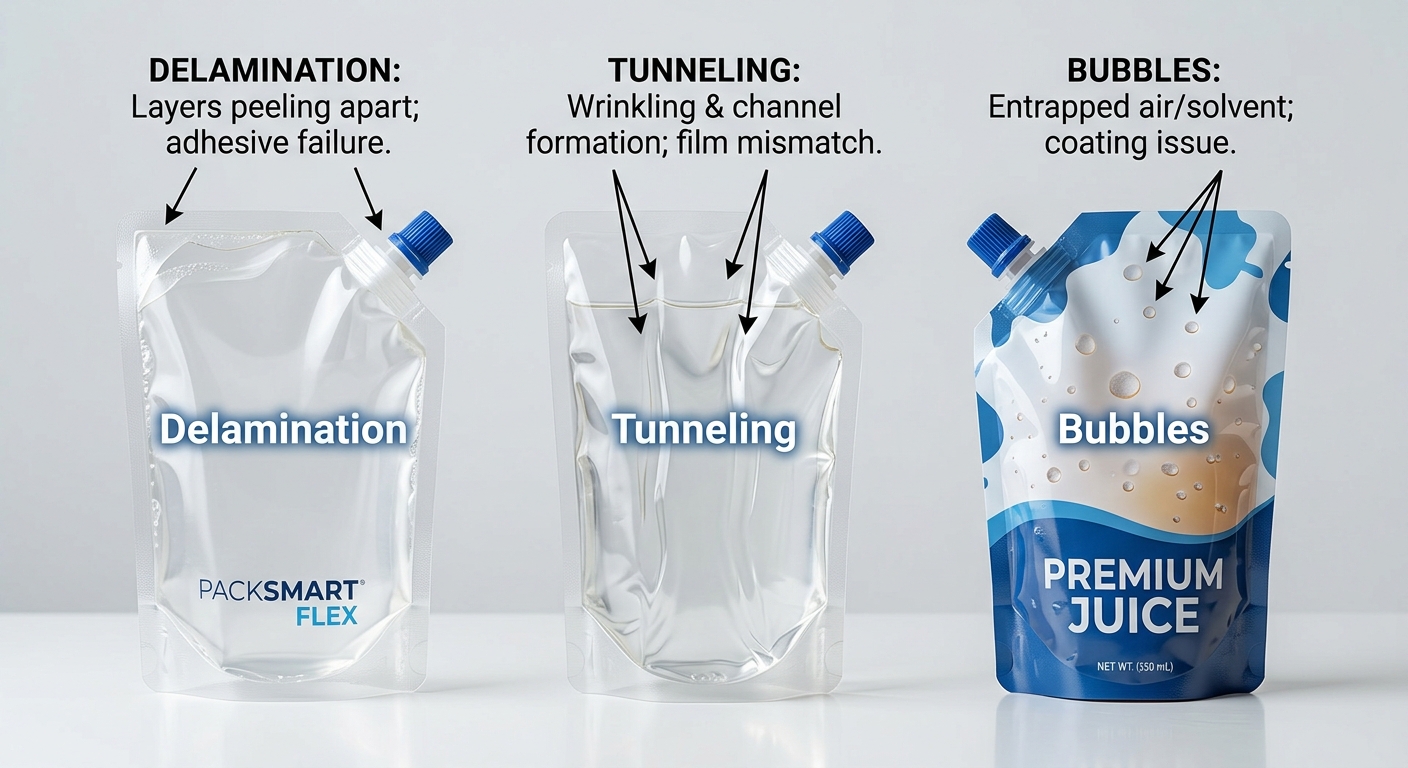
Lamination defects weaken the pouch structure and can lead to barrier loss, leakage, or a poor hand feel. The three most common lamination defects are:
- Delamination: The bonded layers separate, often visible as peeling or a whitish haze. Causes include insufficient adhesive application, incorrect curing time or temperature, solvent retention, or incompatibility between film and adhesive.
- Tunneling: Air pockets or channels form between layers, usually in the seal area or along the spout. Causes include tension mismatch during lamination, inadequate adhesive coverage, or film shrinkage.
- Bubbles or blisters: Small raised areas caused by trapped air, moisture, or adhesive foaming. Causes include excessive solvent retention, high lamination nip temperature, or contamination on the film surface.
To identify lamination defects, examine the pouch under good lighting and gently flex the material; delamination may become evident as a crackling sound or visible separation. For quantitative assessment, perform a bond strength test (ASTM F904) and require a minimum peel strength. Prevent lamination defects by controlling adhesive application, curing conditions, and tension through the lamination process.
Other Structural and Dimensional Defects
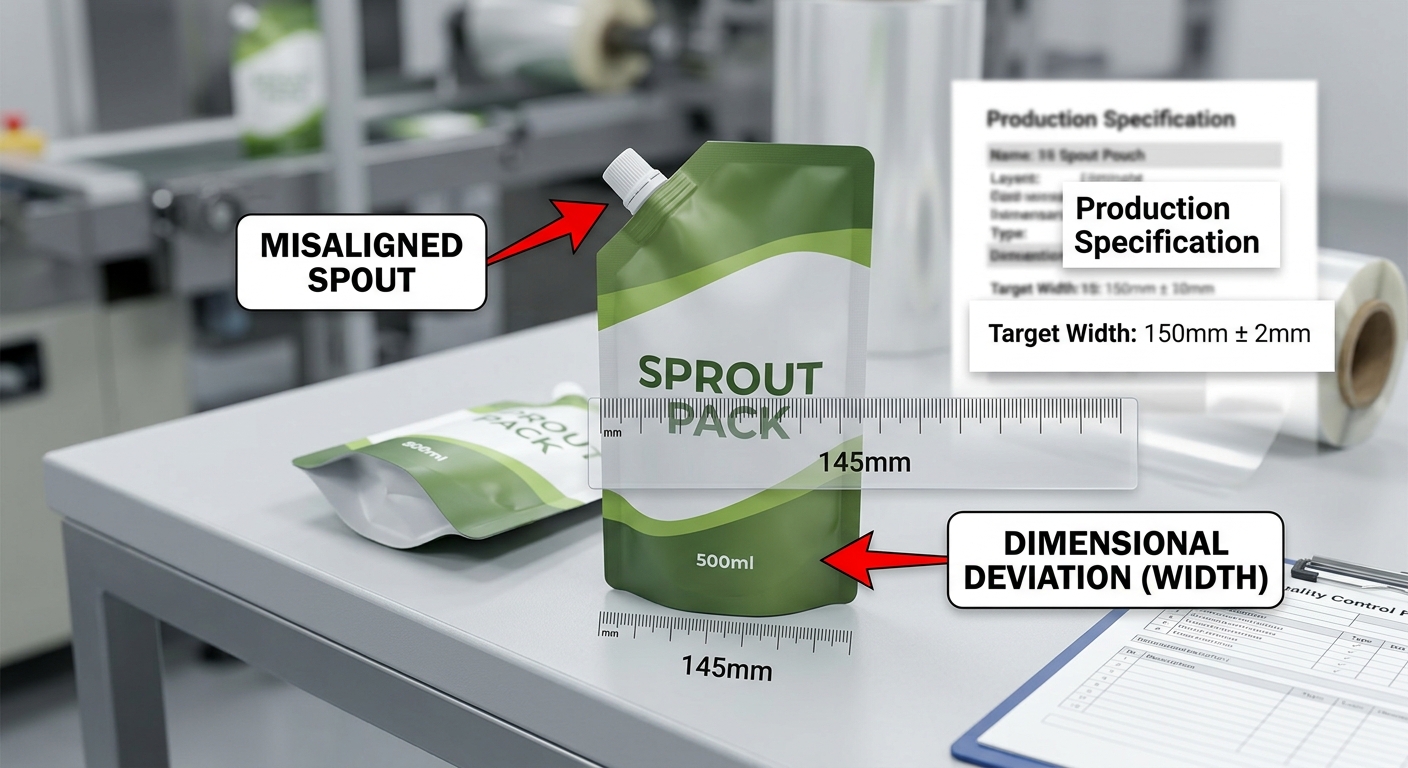
Beyond seals, spouts, print, and lamination, spout pouches can exhibit other structural or dimensional defects that affect filling line performance or consumer usability:
- Wrinkles: Film wrinkles anywhere on the pouch, especially near the spout or gussets, can weaken the structure and create channels. Causes include uneven film tension, misaligned guides, or incorrect forming settings.
- Off-center spout: The spout is not positioned according to specification, causing handling or filling issues. Causes include worn sealing tools, incorrect spout insertion alignment, or film drift.
- Dimensional errors: Pouch width, length, gusset depth, or spout position fall outside tolerance. Causes include improper cutting, film shrinkage, or machine calibration drift.
To identify these defects, use a calibrated ruler or vision system to measure critical dimensions against the approved drawing. Require your supplier to perform regular dimensional checks during production and provide a first article inspection report. For spout placement, a simple go/no-go fixture can verify spout location and angle.
How to Prevent Spout Pouch Defects: A Buyer's Checklist
Preventing spout pouch defects starts with selecting a supplier that has a robust quality management system and proven process controls. Use this checklist when qualifying and auditing spout pouch manufacturers:
- Material qualification: Require documented specifications for all films, adhesives, inks, and spouts, including compatibility testing between sealant and spout material.
- Process control: Confirm that sealing temperature, pressure, and dwell time are monitored and recorded for each production lot; request statistical process control data if available.
- In-line inspection: Ask about in-line vision systems for print registration, seal integrity, and spout placement; these systems catch defects before they leave the factory.
- Finished product testing: Require batch testing for seal strength, leak (vacuum/burst), and bond strength according to industry standards (ASTM, ISO).
- Corrective action process: Ensure the supplier has a documented system for root cause analysis and corrective action when defects are found.
- First article approval: Always approve a first article sample before mass production, and retain it as a reference.
By implementing these preventive measures and maintaining open communication with your supplier, you can significantly reduce the risk of receiving defective spout pouches and protect your product quality and brand reputation.