Table of Contents
- What Are Spout Pouch Fitments?
- Caps for Spout Pouches
- Pumps for Spout Pouches
- Dispensers and Controlled-Flow Closures
- How to Select the Right Fitment
- Technical Specifications Buyers Should Confirm
- Fitment Testing and Production Approval
Spout pouch fitments determine how a liquid product is filled, sealed, opened, dispensed, and resealed. This guide explains how to match caps, pumps, and dispensers with product viscosity, dosage requirements, pouch dimensions, filling equipment, and distribution conditions.
What Are Spout Pouch Fitments?
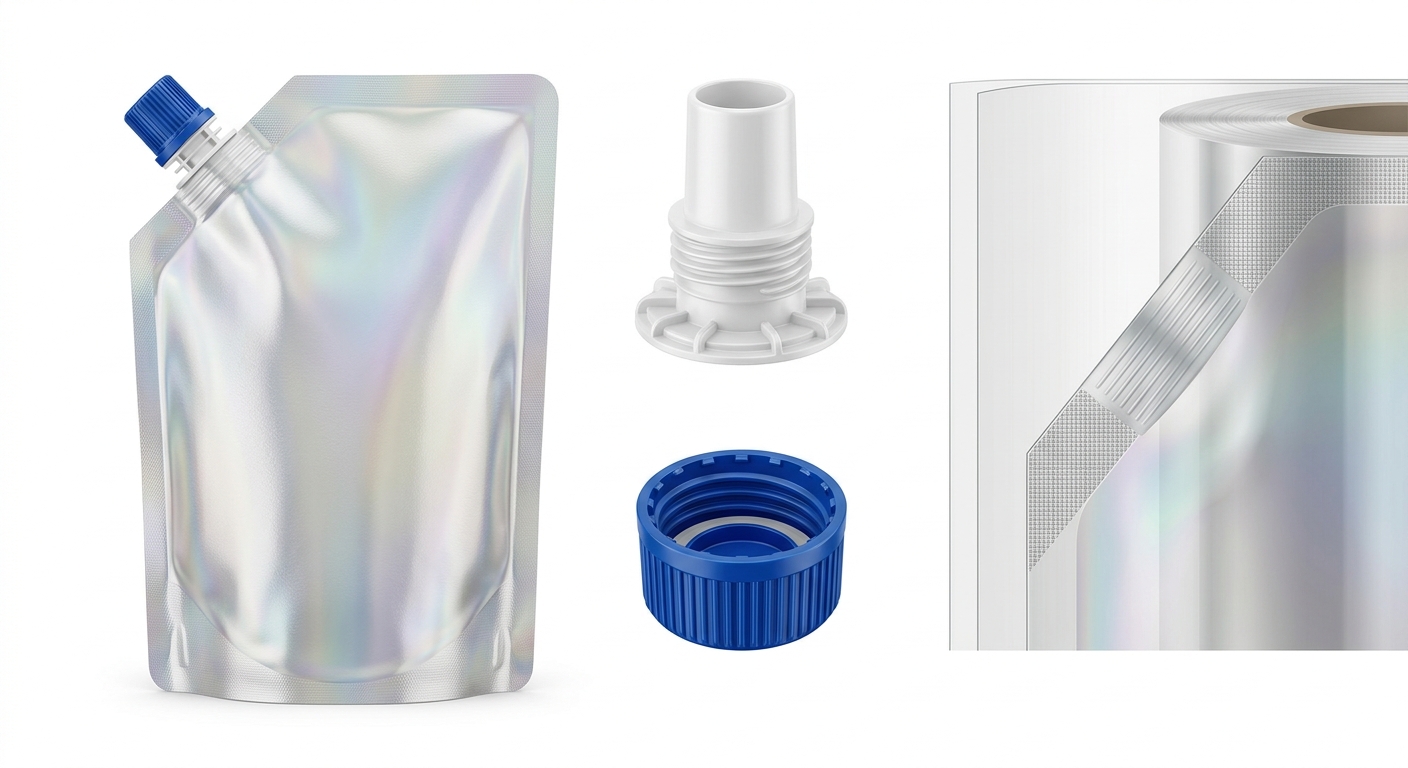
Spout pouch fitments are the rigid components attached to a flexible pouch to support filling, opening, dispensing, and resealing. The most common options are screw caps, flip-top caps, pumps, and specialized dispensers. The right choice depends on the product, target dose, pouch orientation, filling process, storage conditions, and expected consumer or professional use.
A fitment is not simply a decorative closure. It forms part of the pouch’s functional package system. Its opening diameter affects filling speed and product flow; its closure affects resealability and leakage control; and its attachment area must work with the pouch film, seal design, and converting process.
For buyers, fitment selection should begin before artwork and final pouch dimensions are approved. A closure that works for a thin beverage may not be suitable for a viscous sauce, cosmetic gel, detergent, or concentrated chemical product. Fitment dimensions also influence the usable pouch area, headspace, filling clearance, and carton arrangement.
For a broader review of dimensions, capacity, and fitment placement, see the guide to spout pouch sizes and fitments.
Caps for Spout Pouches
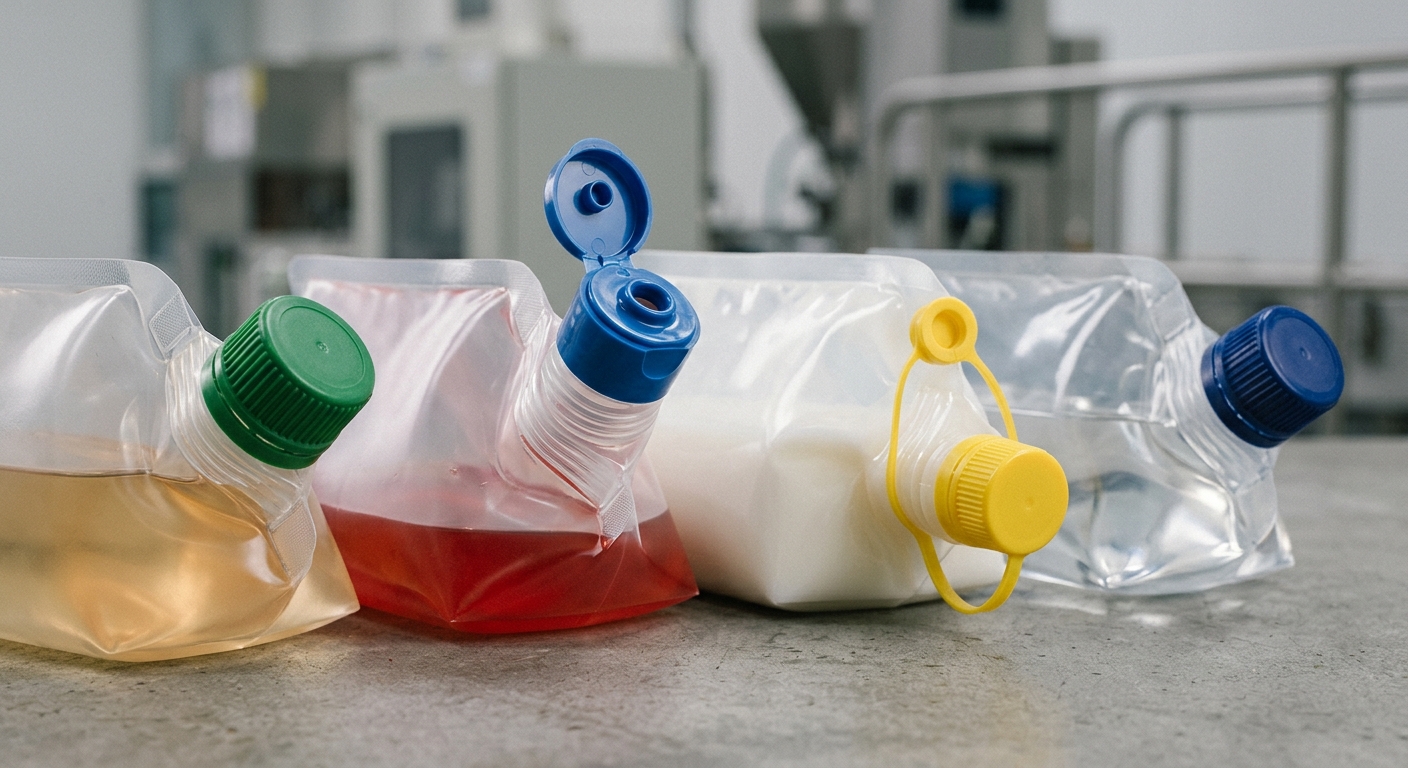
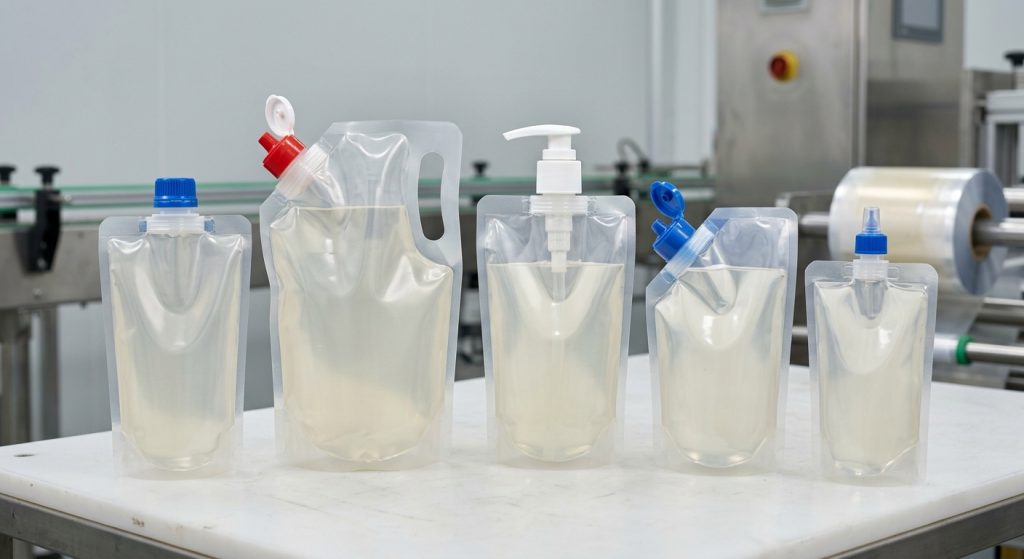
Caps are the most widely used closure for spout pouches. They are suitable when the product needs straightforward opening and closing rather than metered dosing. Common configurations include standard screw caps, tethered caps, flip-top caps, and child-resistant or tamper-evident designs where the application requires them.
Screw caps
Screw caps provide a familiar resealing method and are available in different diameters, thread profiles, and colors. They are often used for beverages, sauces, baby food, cleaning liquids, personal-care products, and refills. The cap must match the spout thread precisely. Buyers should not assume that two caps with a similar outside diameter are interchangeable.
Flip-top caps
Flip-top caps can support one-handed opening and closing. They may be useful for products used in the shower, kitchen, or other situations where the user wants to keep one hand free. The opening geometry should be reviewed against the product’s viscosity and the required flow rate. A small orifice can improve control but may restrict thicker products.
Tamper-evident and child-resistant options
Where market requirements or product risk make visible opening evidence or restricted access necessary, a suitable tamper-evident or child-resistant closure may be considered. These features must be evaluated for the intended market and product category rather than added as a general assumption. The supplier should confirm how the feature is formed, applied, and tested.
Caps are usually the simplest fitment category to fill, close, pack, and use. However, the closure still requires checks for thread engagement, torque, seal contact, cap retention, and leakage after shipping.
Pumps for Spout Pouches
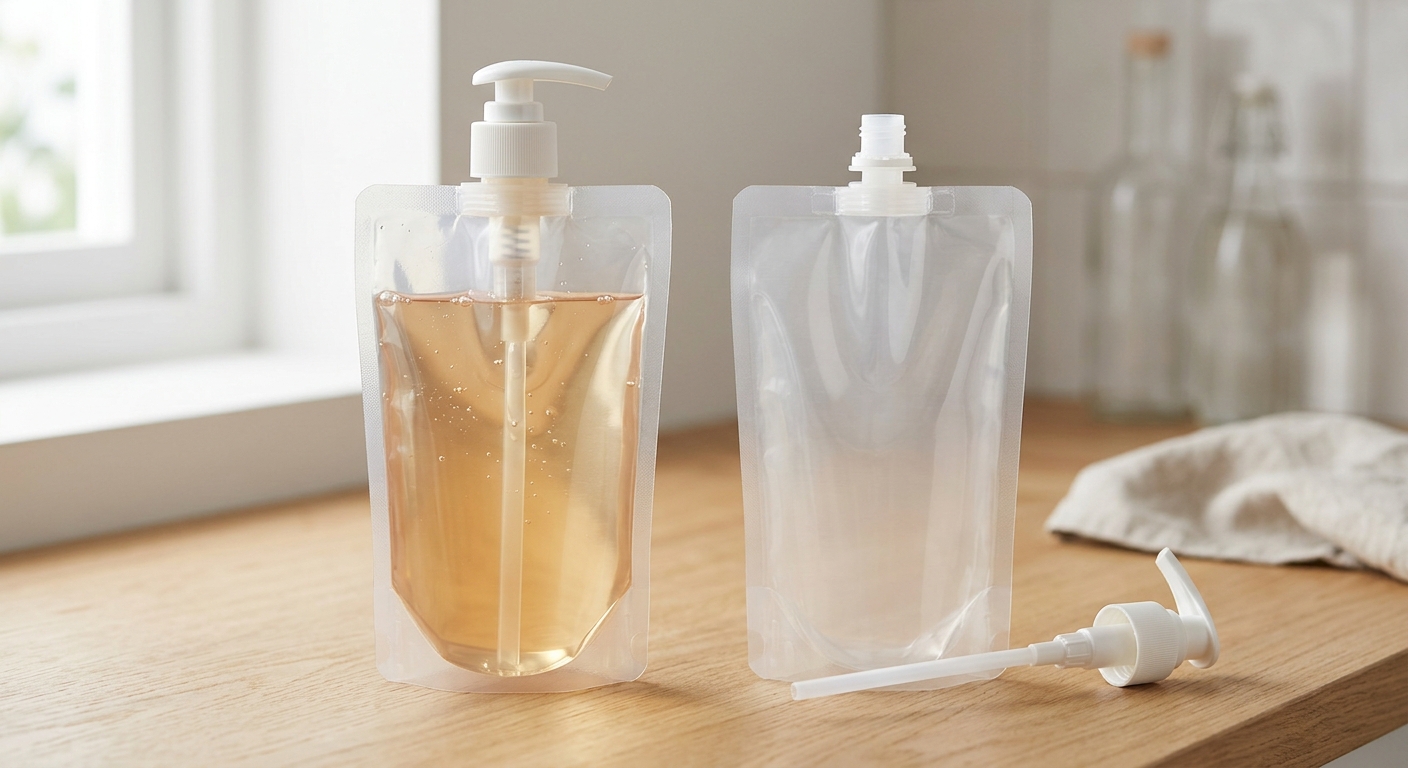
Pumps are designed for products that benefit from controlled, repeatable dispensing. They are commonly considered for liquid soap, hand care products, lotions, creams, gels, and other personal-care or household formulations. A pump can reduce the need to pour the pouch and may help users dispense a product onto a hand, sponge, cloth, or container.
Unlike a basic cap, a pump is a dispensing mechanism. Its performance depends on the product’s viscosity, inclusions, air sensitivity, pouch orientation, and the pump’s internal pathway. A pump intended for a thin liquid may not perform consistently with a thick lotion or particle-containing formulation.
Key pump variables
- Actuation force: The force required to press the pump should be practical for the intended user.
- Dose per stroke: The nominal output per actuation should be checked with the actual product, not only with water or a laboratory substitute.
- Dip-tube or no-dip-tube design: The internal structure must work with the flexible pouch and its ability to collapse as contents are removed.
- Product pathway: Internal passages should be reviewed for viscosity, suspended particles, and cleanability requirements.
- Orientation: A pump may require the pouch to remain upright or use a specific mounting position.
Because the pouch is flexible, pump fitments need particular attention during handling and use. The pouch must remain stable enough for actuation, and the fitment attachment must tolerate the forces generated during repeated pumping.
Dispensers and Controlled-Flow Closures
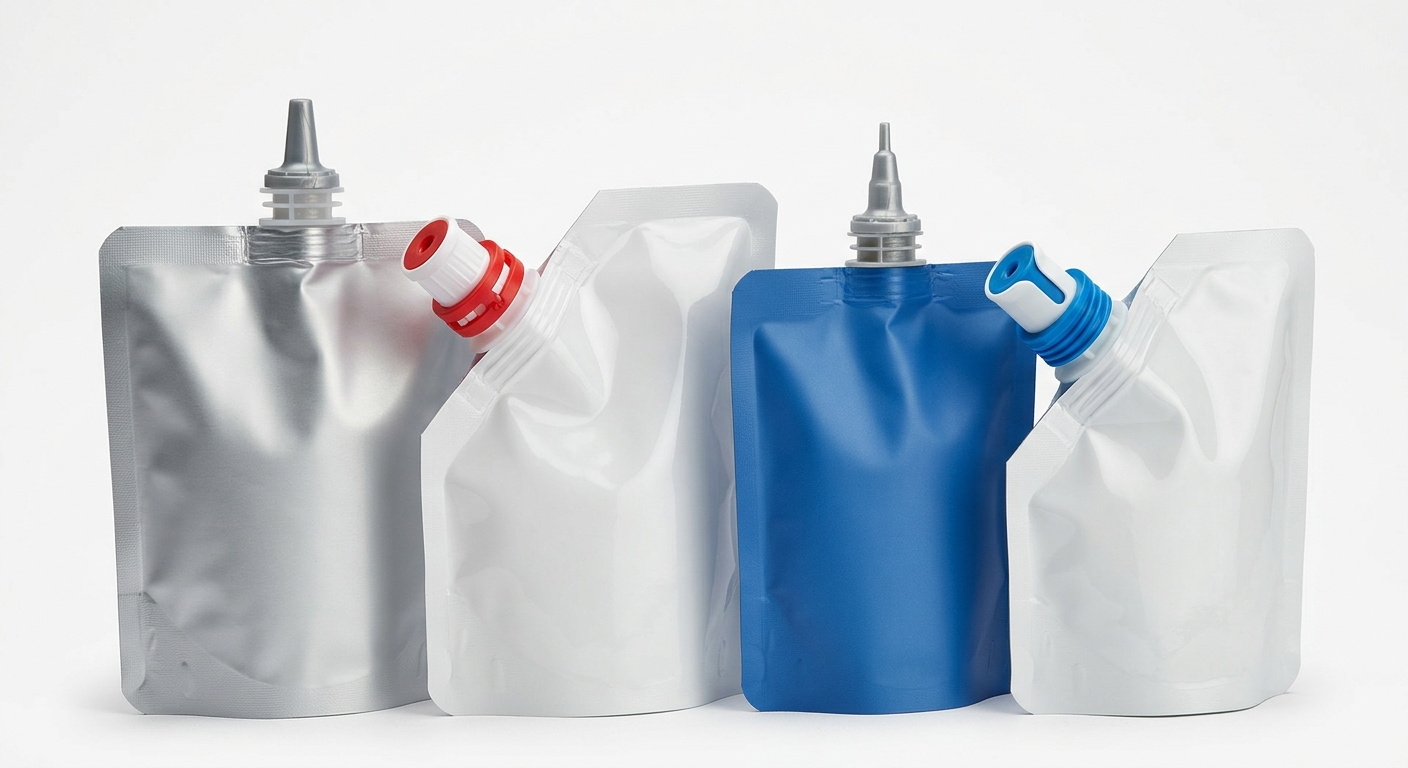
Dispensers cover a broader group of fitments intended to direct or regulate product flow. Examples include dispensing nozzles, push-pull closures, precision orifice fitments, applicator tips, and specialized valves. The best option depends on whether the buyer wants a stream, drop, ribbon, spray-like output, or another controlled delivery pattern.
Dispensing fitments are useful when application accuracy or reduced mess is more important than a wide opening. For example, a narrow nozzle may support targeted application of a gel or sauce, while a push-pull closure may provide quick access for products used frequently during transport or outdoor activities.
Flow control and product compatibility
Orifice size, nozzle length, closure geometry, and venting can change how a product exits the pouch. Thin products may flow too quickly through a large opening, while high-viscosity products may require a wider pathway or a design that reduces resistance. Particles, fibers, seeds, or powders can also obstruct narrow passages.
Dispensers should be evaluated with the actual formulation at expected temperatures. Viscosity can change with temperature, and a product that dispenses easily in a warm test room may behave differently during cold storage or use. The evaluation should also consider whether the pouch is squeezed, hung, placed upright, or used with a secondary holder.
How to Select the Right Fitment

The correct spout pouch fitment is selected by matching the closure system to the product and use case. The following questions help narrow the design before sampling.
- What is the product viscosity? Classify the product as free-flowing, moderately viscous, thick, gel-like, or particulate-containing. This affects the opening diameter, pump pathway, and expected dispensing behavior.
- How should the product be delivered? Decide whether the user will pour, squeeze, pump, spread, apply, or dispense a repeatable dose. A simple cap may be enough for pouring, while a pump or precision nozzle may be better for controlled application.
- Will the pouch be resealed? If the product is used over multiple occasions, confirm cap retention, closure usability, and seal performance after repeated opening and closing.
- What is the pouch orientation? Top-spout, corner-spout, upright, horizontal, hanging, and holder-supported formats can require different fitment positions and closure geometries.
- What is the filling method? The fitment must be compatible with the filling line, insertion method, sealing process, and production speed. Confirm whether the pouch is filled through the spout or through an open top before fitment application.
- What conditions will the package face? Review temperature, pressure, vibration, drops, compression, freezing, hot filling, or other process and distribution conditions that may affect the fitment and pouch seal.
- Who will use the package? Consumer, foodservice, industrial, medical, personal-care, and household applications may have different requirements for accessibility, dosing, tamper evidence, or documentation.
Buyers should also consider the relationship between fitment size and pouch capacity. A large closure may be convenient for thick products but can reduce printable panel area or affect the package’s visual balance. Fitment position can influence filling clearance, shelf presentation, and how much product remains near the opening.
For a structured supplier evaluation, use this spout pouch supplier checklist. A detailed spout pouch RFQ checklist can also help organize fitment, film, artwork, sampling, and commercial requirements.
Technical Specifications Buyers Should Confirm
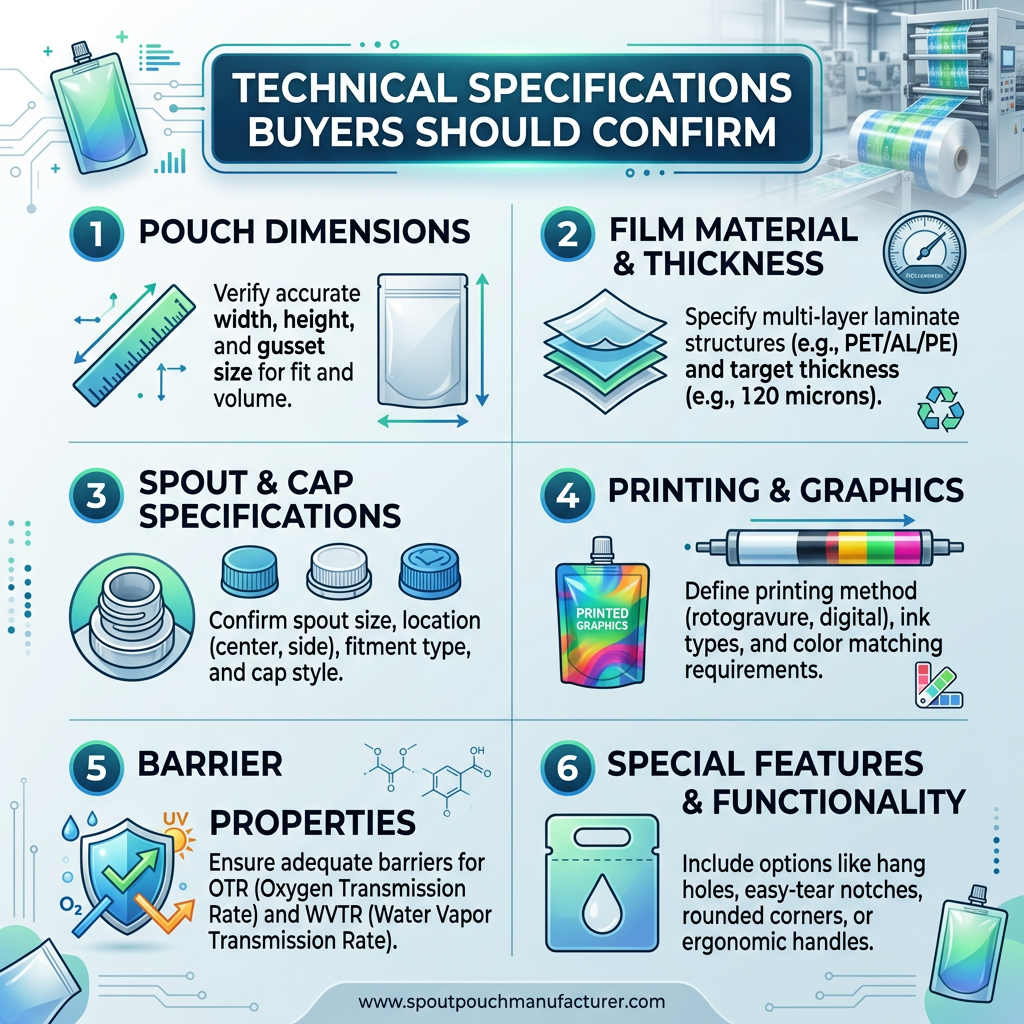
A clear fitment specification reduces sampling delays and helps the converter determine whether the proposed pouch can be manufactured and filled as intended. Include the following information in the project brief:
- Fitment type: Screw cap, flip-top, pump, push-pull, nozzle, valve, or another dispensing design.
- Spout and opening dimensions: Outside diameter, internal diameter, orifice size, neck height, and any relevant thread or connection details.
- Material: Fitment resin or component materials, color requirements, and any product-contact documentation needed for the application.
- Closure requirements: Resealability, tamper evidence, child resistance, tethering, torque range, or seal liner requirements where applicable.
- Pouch interface: Fitment placement, attachment area, seal width, pouch structure, and compatibility with the selected film laminate.
- Product details: Formula type, viscosity range, pH or chemical characteristics where relevant, particles, temperature range, and sensitivity to oxygen or moisture.
- Filling details: Fill volume, fill temperature, filling speed, equipment type, and whether the pouch is filled through the spout.
- Distribution and use: Expected storage, shipping orientation, repeated opening, squeezing, pumping, and end-use environment.
Fitment documentation should be reviewed alongside the pouch material specification. If the product is intended for food contact, buyers should identify the applicable market and request documentation supporting the selected material and package construction. The supplier should not treat a general statement as a substitute for application-specific review.
For products intended for U.S. food applications, buyers can also review the food-contact spout pouch buyer guide.
Fitment Testing and Production Approval

Fitment approval should be based on a representative sample filled with the actual product whenever possible. Testing an empty pouch or substituting water may identify basic assembly issues, but it may not reveal problems caused by viscosity, acidity, particles, temperature, chemical interaction, or repeated use.
Recommended checks
- Confirm the fitment is correctly attached and aligned.
- Check opening and closing effort for the selected cap or closure.
- Evaluate flow rate, dose consistency, and product cut-off during dispensing.
- Inspect for dripping, stringing, clogging, or air ingestion.
- Test the pouch in the intended orientation and with the expected amount of headspace.
- Review leakage around the fitment seal and closure after handling and storage.
- Assess performance after simulated distribution or other relevant handling tests.
- Confirm that the filling line can handle the fitment without jams, deformation, or excessive speed loss.
For pumps, include repeated actuation testing and check whether the pouch remains stable during use. For caps, examine thread engagement, torque, retention, and resealing. For nozzles and dispensers, test the actual dispensing pattern and the ability to prevent unwanted flow after use.
Sample approval should record the exact fitment model, dimensions, color, pouch structure, spout position, fill volume, product used, and agreed test conditions. This record helps prevent accidental substitutions during mass production. Buyers seeking additional validation guidance can review the spout pouch shelf-life testing guide.
HUACANG Packaging, established in 1998 in Guangzhou, China, produces custom flexible packaging for international B2B buyers. Fitment discussions can be coordinated with pouch structure, artwork, sampling, filling requirements, and order planning.