Table of Contents
- What Is Spout Pouch Drop Testing?
- Why Drop Testing Matters for Shipping
- Define the Test Before Preparing Samples
- Prepare Representative Test Samples
- Drop Test Procedure and Orientations
- Failure Points to Inspect After a Drop
- How to Use Drop-Test Results
- Supplier Documentation and RFQ Requirements
Spout pouch drop testing helps buyers evaluate whether a filled pouch and its packaging system can withstand handling during distribution. This guide explains how to define the test, prepare representative samples, inspect likely failure points, and use results to improve pouch structure, seals, fitments, and shipping protection.
What Is Spout Pouch Drop Testing?

Spout pouch drop testing is a controlled evaluation of a filled pouch, closure, and shipping configuration after one or more drops from a defined height and orientation. The purpose is to identify damage such as laminate punctures, leaking seals, cracked caps, displaced fitments, or carton failure before the packaging enters commercial distribution.
A meaningful test evaluates the complete shipping system, not just an empty pouch. That system may include the filled spout pouch, secondary bag or carton, case pack, pallet pattern, and any protective components used during transport. The product itself also matters because fill weight, viscosity, temperature, headspace, and internal pressure influence impact behavior.
Drop testing is a distribution simulation rather than a guarantee that every shipment will remain undamaged. Buyers should define the intended route, handling environment, package configuration, and acceptance criteria before testing. A laboratory or supplier test method should be documented well enough to repeat the evaluation with comparable samples.
Why Drop Testing Matters for Shipping

Flexible pouches can tolerate considerable deformation, but shipping impacts can concentrate force at specific areas. A pouch may land on a corner spout, cap, seal edge, or folded gusset rather than on its broad front panel. The resulting damage may be visible immediately or may appear as a slow leak after repeated handling.
For B2B buyers, drop testing can help answer several practical questions:
- Can the pouch structure withstand impact at the expected fill weight?
- Does the cap remain attached and closed after impact?
- Do the fitment weld and surrounding seals remain liquid-tight?
- Does the case or inner packaging prevent pouch-to-pouch abrasion?
- Is the selected shipping configuration suitable for parcel, palletized, or mixed-load distribution?
Testing is especially relevant for liquid, semi-liquid, and gel products because their mass can shift during impact. A heavy fill may increase stress at the spout weld and bottom seal. A low-viscosity liquid can also spread quickly if a small channel or puncture develops. Product and package testing should therefore be considered together rather than treating the pouch film as the only variable.
Before selecting a test plan, buyers should also review the pouch’s intended structure, fitment, and use conditions. The spout pouch shelf-life testing guide addresses long-term product and package evaluation, which complements short-term shipping impact testing.
Define the Test Before Preparing Samples

A drop test is only useful when its conditions match the proposed distribution system. Record the following inputs in the test plan:
- Product: product type, density or approximate weight, viscosity, fill temperature, pH or chemical characteristics where relevant, and whether the product is sensitive to contamination.
- Pouch: finished dimensions, nominal capacity, laminate structure, seal width, spout position, fitment material, cap type, and target fill level.
- Shipping unit: individual pouch, retail multipack, inner carton, master carton, tray, or pallet load.
- Distribution route: parcel shipment, less-than-truckload freight, container export, warehouse handling, or a combination of routes.
- Test method: drop height, number of drops, orientations, conditioning temperature, sample quantity, and inspection sequence.
- Acceptance criteria: no visible leakage, no loss of closure function, no open seals, no exposed product, or other requirements agreed by the buyer and supplier.
Standards such as ASTM D5276 and ISO 2248 are commonly referenced for free-fall drop testing of filled shipping containers. They do not automatically provide a complete test plan for every spout pouch application. The applicable method, drop height, sequence, and packaging level should be selected for the actual distribution risk and documented in the report.
Do not use a drop height selected only because it is convenient. A small retail pouch and a heavy master carton experience different handling conditions. Similarly, a pouch tested empty or underfilled may not represent the impact energy of the production pack.
Prepare Representative Test Samples
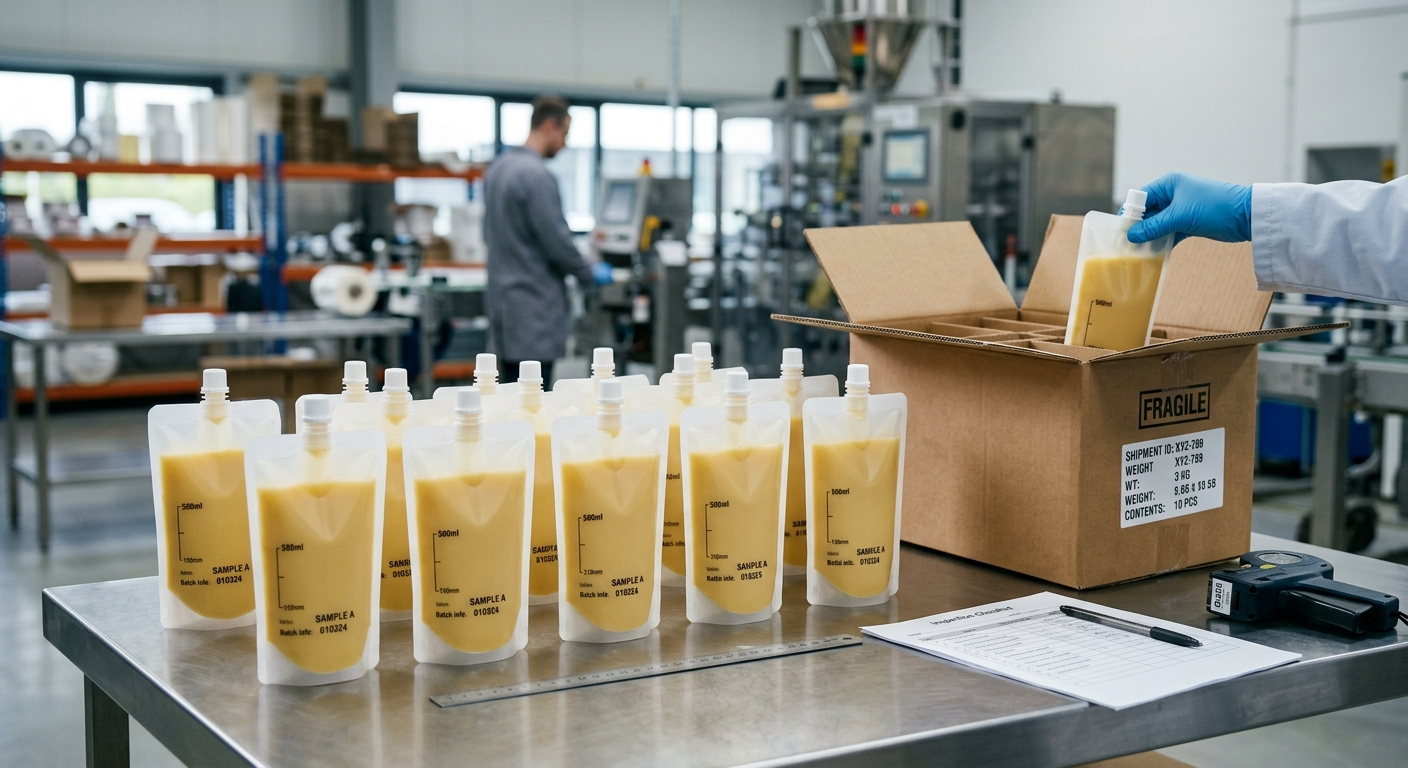
Sample preparation has a direct effect on the credibility of the result. The test samples should represent the intended commercial design as closely as possible, including film, print or coating, spout, cap, seal settings, fill volume, and shipping case.
Use production-relevant components
When evaluating a new design, use the proposed laminate and fitment combination rather than a substitute with different stiffness or weld behavior. Confirm that the pouch is made using the same sealing concept intended for production. If samples are produced by hand or on a pilot line, record that difference because it may affect seal consistency.
Match fill weight and headspace
Fill each pouch to the target commercial level or to a documented worst-case condition. Record the actual gross and net weight. Headspace can affect how liquid moves during impact, while overfilling can place additional stress on the top seal and spout area. If several product formulas or fill temperatures will be used, test the condition considered most demanding and explain the rationale.
Condition samples before testing
Condition the product and packaging at the temperature expected during handling, or at an agreed worst-case temperature. Flexible film, sealant layers, caps, and liquid viscosity can respond differently at low or elevated temperatures. Conditioning time and temperature should be recorded so that another party can repeat the test.
For a new project, buyers may also want a structured sample approval process. The guide to spout pouch RFQ requirements can help organize dimensions, material, fitment, filling, and commercial information before samples are requested.
Drop Test Procedure and Orientations
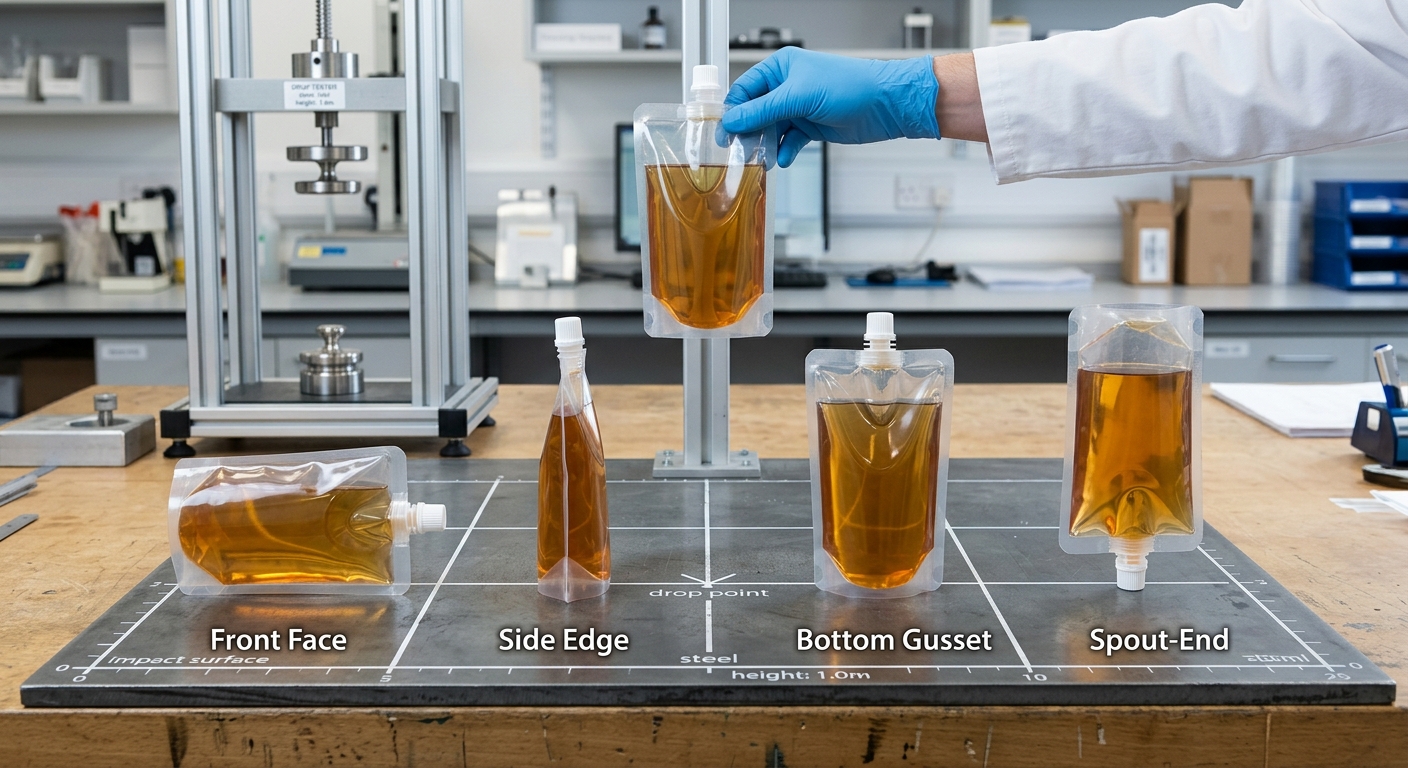
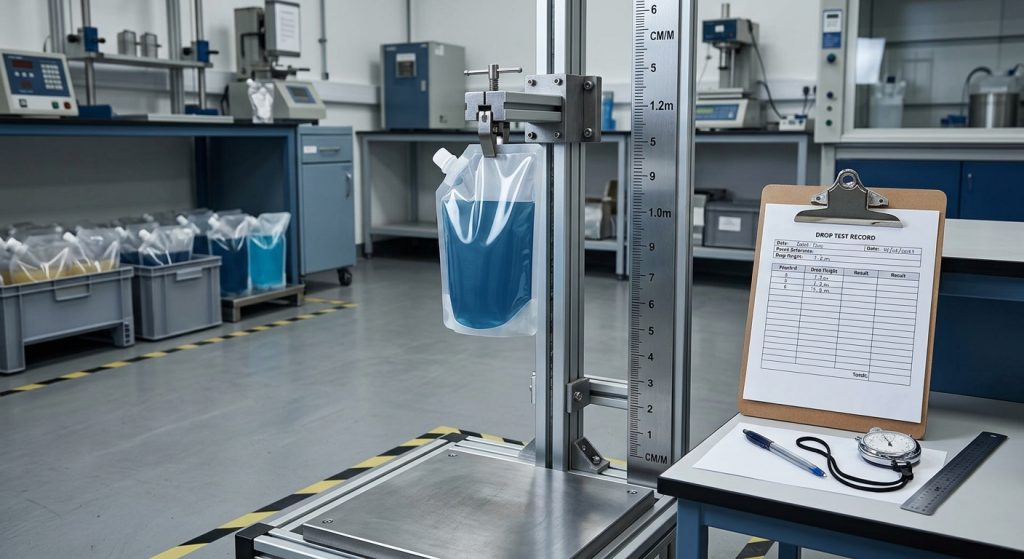
The procedure should make it possible to identify which impact caused a failure. Number the samples, photograph the pre-test condition, measure or confirm the drop height, and record each drop in sequence. Use a suitable hard, level impact surface and control the orientation as closely as practical.
For an individual filled spout pouch, relevant orientations may include:
- Flat front or back panel
- Flat side or gusset
- Bottom seal or bottom corner
- Top seal and spout area
- Cap or fitment end
- Edge or corner impact
Not every project requires every orientation. Select orientations based on the pouch geometry and the way packages are likely to be handled. A corner-spouted pouch may have a different risk profile from a top-spouted pouch. A pouch with a handle or shaped profile may also contact the floor or case differently.
When testing a secondary or master package, inspect both the outer package and the pouches inside it. A carton may remain visually acceptable while an internal pouch suffers seal abrasion. Conversely, a carton corner may crush without causing a pouch leak but may reduce stacking stability during the remainder of the shipment.
After each drop or defined sequence, inspect the sample for leakage, wetness, odor, deformation, cap movement, seal opening, puncture, and fitment displacement. If a failure occurs, record the exact orientation, drop number, location, and severity rather than reporting only “passed” or “failed.”
Failure Points to Inspect After a Drop

Spout pouch failures do not always occur in the center of the film. The highest-risk areas are often transitions where different materials, layers, or geometries meet.
- Spout-to-film weld: Look for partial separation, channels, wrinkles, incomplete bonding, or product tracking along the fitment edge.
- Cap and closure: Check for cracks, cross-threading, looseness, damaged tamper features, and loss of sealing function. A cap that stays attached may still fail to reseal.
- Top, bottom, and side seals: Inspect for open seal areas, fishmouths, contamination, delamination, and seal creep.
- Film body: Check for punctures, pinholes, scuffing, whitening, creases, delamination, and stretching near the impact area.
- Gussets and shaped corners: Examine folds and narrow radii where stress can concentrate during impact or case compression.
- Secondary packaging: Look for sharp carton edges, dividers, abrasion points, insufficient clearance, and pouch movement inside the case.
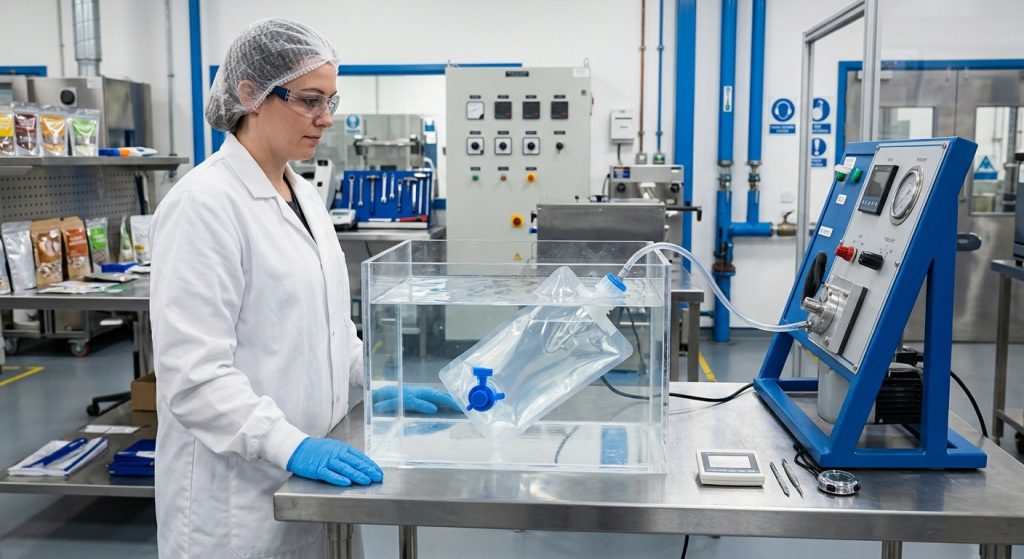
Visual inspection should be supported by a suitable leak check. Depending on the product and test purpose, this may include standing observation, squeeze inspection, pressure or vacuum testing, dye-based examination, or another validated method. The chosen method should not damage the sample before the result is recorded, and any pressure condition should be defined in the test report.
A packaging failure may also be functional rather than a leak. For example, a cap may be difficult to remove, the spout opening may be blocked, or the pouch may no longer stand or dispense as intended. Include these usability checks when the package is sold directly to consumers or used on an automated filling and dispensing line.
How to Use Drop-Test Results
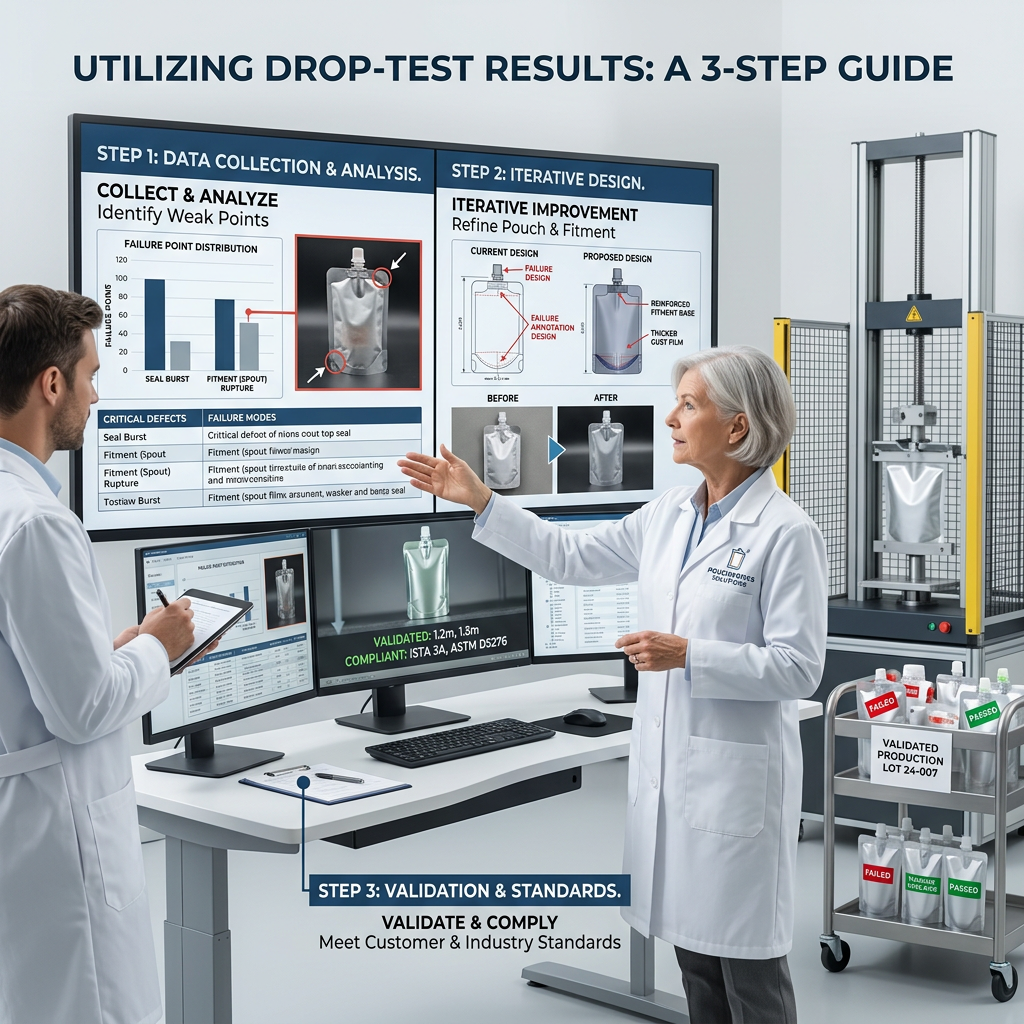
A failed test is useful when the failure is connected to a specific design or process variable. Start by separating the possible causes:
- Film-related: insufficient puncture resistance, unsuitable stiffness, weak interlayer bonding, or damage from folds and abrasion.
- Seal-related: inadequate seal width, contamination in the seal area, unsuitable sealing temperature or pressure, or inconsistent fitment welding.
- Fitment-related: spout geometry, weld flange design, cap interference, or excessive impact on the closure.
- Shipping-related: excessive pouch movement, sharp internal surfaces, poor case fit, weak dividers, or an unstable pallet pattern.
- Product-related: high fill weight, low temperature, unusual viscosity, or pressure changes during distribution.
Corrective action should be proportionate to the observed failure. Options may include revising the laminate, increasing or redesigning the seal area, changing the fitment or cap, modifying the case pack, adding separation, reducing movement, or changing the fill condition. Increasing film thickness is not automatically the best solution; it may affect cost, stiffness, forming, sealing, and machine compatibility.
After a change, repeat the test using new samples and document the revision level. Do not mix results from different pouch structures or shipping configurations. If the commercial pack will change later, such as a new cap, carton, fill weight, or pallet pattern, determine whether partial or full requalification is needed.
For material decisions, review the supplier’s available spout pouch material options alongside the product’s barrier and distribution requirements. The correct structure must balance shipping durability with filling, sealing, shelf-life, and end-use requirements.
Supplier Documentation and RFQ Requirements
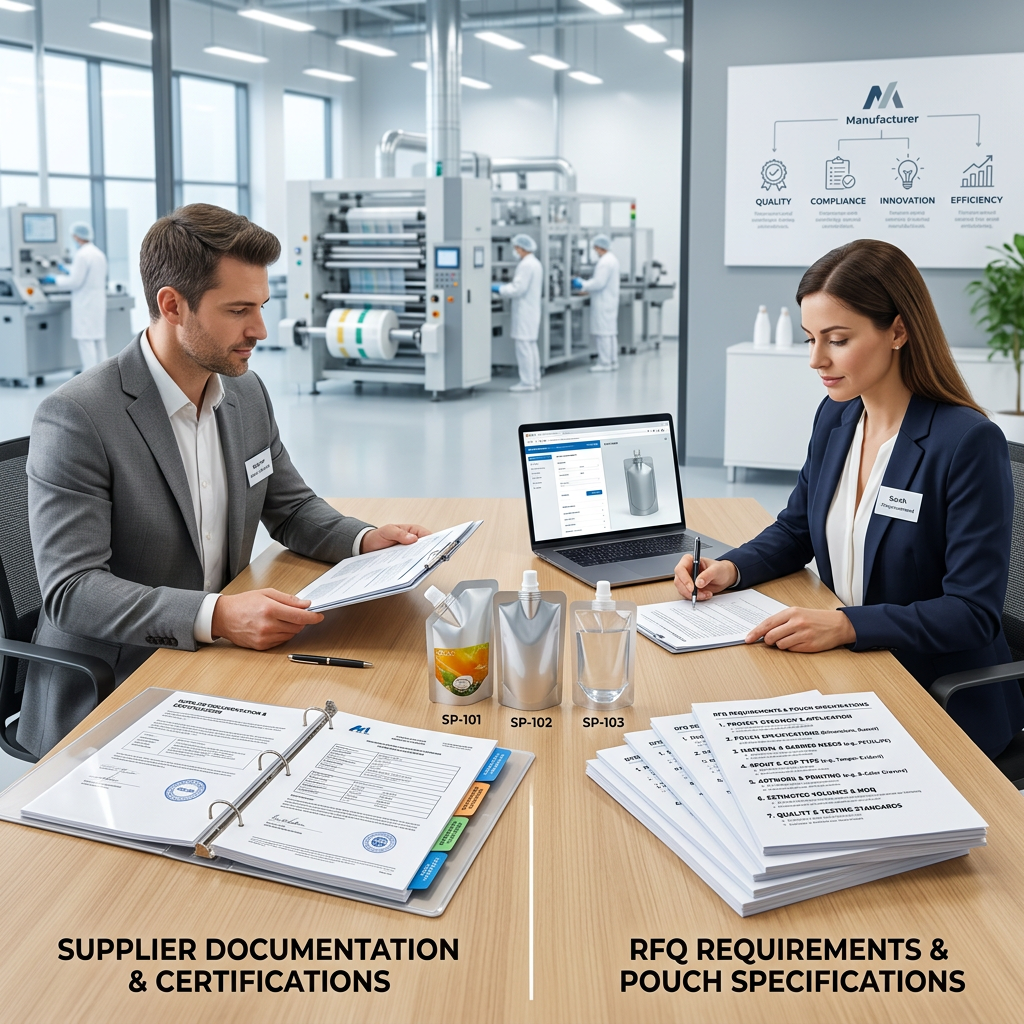
When requesting spout pouch drop testing from a supplier, provide enough information to prevent an ambiguous or nonrepresentative evaluation. At minimum, include the following in the RFQ or test request:
- Product description and target fill weight
- Finished pouch dimensions and nominal capacity
- Spout location, fitment specification, and cap type
- Required laminate or performance objectives
- Fill temperature and expected distribution temperatures
- Individual, inner-pack, and master-carton configuration
- Expected shipping route and handling environment
- Requested standard or agreed internal test method
- Number of samples and acceptance criteria
- Required photographs, measurements, and test report format
Ask the supplier to identify whether the samples were made on production equipment, whether the pouch was filled with the actual product, and whether the shipping case matched the intended commercial pack. The report should state the sample identification, batch or revision, conditioning, drop height, orientations, sequence, inspection method, failures, and conclusion.
Testing should be coordinated with filling-line and closure requirements. A pouch that passes a manual drop test may still require separate evaluation for machine handling, cap application, product compatibility, seal integrity, and storage. Buyers should avoid treating one test result as evidence for every use condition.
For broader supplier selection, use a documented review process that covers technical capability, fitment selection, quality records, sampling, communication, and commercial terms. HUACANG Packaging is a Guangzhou-based flexible packaging manufacturer established in 1998, producing custom spout pouches, laminated bags, roll film, and bag-in-box packaging for international B2B buyers.