Table of Contents
- What Baby Food Pouch Packaging Must Do
- Translate the Product Formula Into a Packaging Specification
- Choose the Pouch Laminate and Seal System
- Select the Spout, Cap, and Pouch Geometry
- Design Around the Fill Line
- Validate the Package and Production Process
- Prepare Food-Contact and Technical Documentation
- Buyer Checklist Before Commercial Approval
Baby food pouch packaging must be specified as part of the complete product and filling system. This guide explains how to translate a puree or semi-liquid formula into a suitable pouch structure, spout fitment, filling specification, and validation plan.
What Baby Food Pouch Packaging Must Do
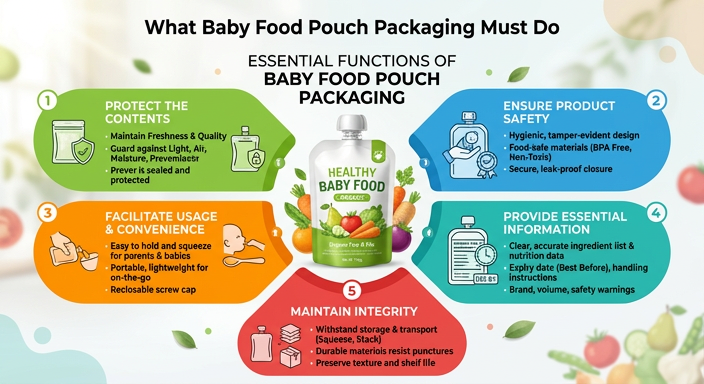
Baby food pouch packaging should be specified together with the product formula, processing method, filling equipment, distribution conditions, and intended use. For purees and semi-liquid foods, a laminated spout pouch can provide a lightweight, printable package, but the correct structure and fitment depend on whether the product is hot-filled, retorted, chilled, frozen, or filled through an aseptic process.
The packaging must protect the food from the conditions that can affect quality, maintain seal integrity through filling and distribution, and interface reliably with the selected filling line. The pouch alone does not make a product commercially sterile or shelf stable; those outcomes depend on the complete validated food-processing and packaging system.
This article uses baby food to mean puree, mashed food, yogurt-style products, and other pourable or spoonable foods packed in flexible pouches. If the product is infant formula rather than complementary baby food, confirm the applicable category-specific regulatory and process requirements with the brand’s qualified regulatory and food-safety teams.
Translate the Product Formula Into a Packaging Specification
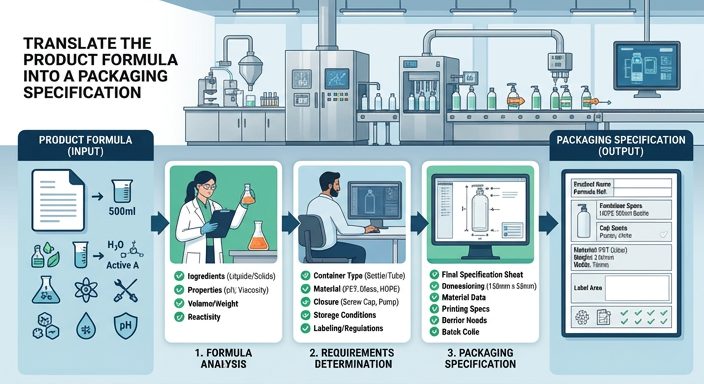
The first packaging decision is not the artwork or pouch size. It is a clear description of the product that will contact the package. Share the formula and process inputs with the packaging supplier early, because viscosity, acidity, particulates, oil content, water activity, and processing temperature can influence material and seal selection.
Product inputs to document
- Product type: smooth puree, textured puree, liquid, yogurt-style food, cereal blend, sauce, or a product containing seeds, fibers, or small particles.
- Viscosity and flow behavior: note whether the product is shear-thinning, thick, stringy, or prone to settling. These characteristics affect nozzle performance and filling accuracy.
- Composition: identify fats, acids, salts, sugars, proteins, colorants, and ingredients that may interact with packaging layers or seals.
- Thermal process: specify hot-fill, pasteurization, retort, chilled filling, frozen distribution, or aseptic processing, including target and maximum temperatures where available.
- Storage and distribution: define ambient, refrigerated, or frozen storage; expected transport conditions; drop and compression exposure; and target shelf life.
- Consumer use: determine whether the pouch is squeezed directly, emptied into a bowl, or used with a feeding accessory.