Table of Contents
- Spout Pouch vs Bottle: The Direct Answer
- What Are Spout Pouches and Rigid Bottles?
- Spout Pouch and Bottle Comparison Table
- Product Protection and Material Structure
- Filling Line and Spout Compatibility
- Packaging, Shipping, and Total Cost
- Packaging Format Selection by Application
- How to Evaluate Bottle Replacement Packaging
- Information to Include in an RFQ
- Key Takeaways
- Conclusion
A practical comparison of spout pouches and rigid bottles for liquid products, covering materials, filling compatibility, dispensing, logistics, testing, and sourcing decisions.
Spout Pouch vs Bottle: The Direct Answer

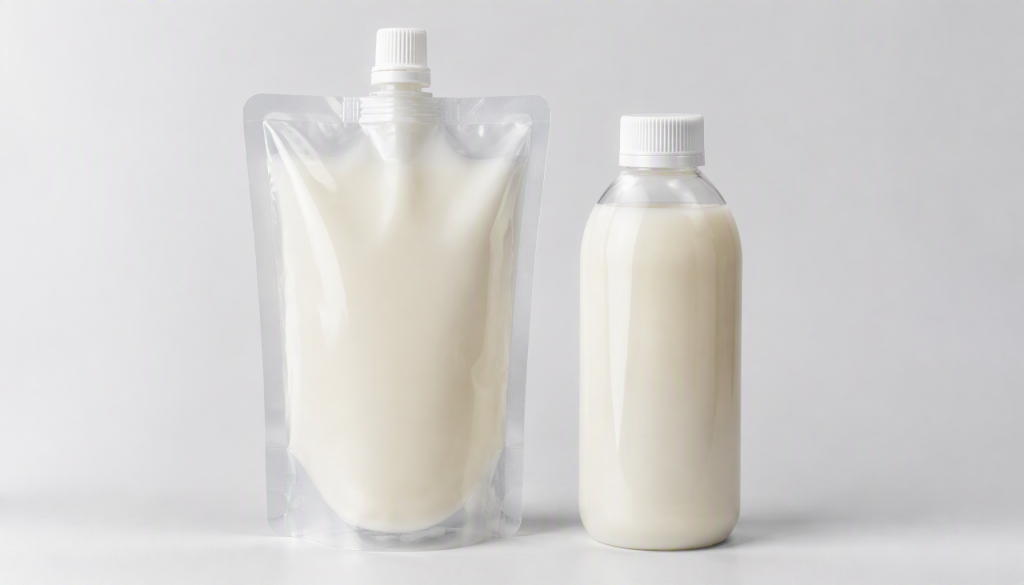
In a spout pouch vs bottle decision, a spout pouch is generally the stronger candidate when a buyer wants a lightweight, collapsible package for refills, concentrates, sauces, beverages, personal care products, or household liquids. A rigid bottle is often more appropriate when the package must stand independently throughout use, tolerate repeated handling, integrate with an established bottle filling line, or provide a familiar dispensing experience.
Neither format is universally better. The correct choice depends on product chemistry, viscosity, required barrier, filling temperature, dispensing behavior, distribution conditions, retail presentation, and local end-of-life infrastructure. Buyers should compare the complete packaging system rather than the empty container alone. For a pouch, that system includes the laminated film, seals, spout, cap, filling process, secondary packaging, and transport configuration. For a bottle, it includes the resin, closure, liner or induction seal where applicable, label or decoration, filling equipment, and case configuration.
This article assumes a noncarbonated liquid product unless otherwise stated. Products involving carbonation, retort processing, aseptic filling, hazardous chemicals, or regulated child-resistant packaging require application-specific engineering and validation.
What Are Spout Pouches and Rigid Bottles?
A spout pouch is a flexible package made from laminated film, with a molded fitment sealed into the top or corner of the pouch. The fitment provides a controlled opening for filling, pouring, or dispensing, and it is normally paired with a screw cap or another compatible closure. The pouch body may use polyethylene, polypropylene, PET, nylon, EVOH, aluminum foil, or other layers selected for sealing, strength, printability, and barrier requirements.
A rigid bottle is a formed container that retains its shape before and after filling. Common bottle materials include HDPE, PET, and PP. Bottles may be extrusion blow molded, injection stretch blow molded, or produced through another molding process depending on the resin and application.
A liquid refill pouch is often designed to refill a durable bottle or dispenser, but spout pouches can also serve as the primary retail package. The intended role matters because a refill pack may prioritize evacuation, compact storage, and pouring control, while a primary package may require stronger shelf presentation, repeated reclosing, and more robust handling performance.
Spout Pouch and Bottle Comparison Table
The following flexible packaging comparison summarizes the main differences buyers should investigate. Actual results depend on the selected design, product, filling operation, and distribution environment.
| Decision factor | Spout pouch | Rigid bottle |
|---|---|---|
| Empty package | Flexible and collapsible; commonly shipped flat before filling | Retains its full shape and volume before filling |
| Material system | Laminated or mono-material-oriented film structure plus fitment and cap | Molded resin body plus closure, label, and optional seal components |
| Barrier options | Can incorporate clear or opaque barrier layers, subject to compatibility and process needs | Barrier depends on bottle resin, wall design, color, coatings, or multilayer construction |
| Filling equipment | Requires equipment and tooling matched to pouch presentation, spout, and filling method | Supported by widely established bottle handling and filling systems |
| Dispensing | Package can collapse as product is removed; spout geometry controls flow | Rigid body supports gripping and repeated dispensing; venting behavior must be considered |
| Storage before filling | Flat pouches can reduce empty-package storage volume | Empty bottles require their full dimensional storage volume |
| Decoration | Rotogravure, flexographic, or digital printing may be available depending on quantity and specification | Pressure-sensitive labels, shrink sleeves, direct print, or in-mold decoration may be used |
| Damage modes | Seal failure, puncture, flex cracking, fitment leakage, or delamination | Panel deformation, cracking, closure leakage, stress cracking, or denting |
| End of life | Depends on film structure, fitment combination, and local collection infrastructure | Depends on resin, color, label, closure, product residue, and local collection infrastructure |
Product Protection and Material Structure

Product protection should be evaluated before appearance or unit price. A pouch film structure must provide the required sealability, puncture resistance, flex durability, chemical compatibility, and oxygen, moisture, aroma, or light barrier. A clear pouch may make the product visible but cannot provide the same light protection as an opaque structure containing foil or another suitable light-barrier layer.
Bottle performance is also material-specific. PET, HDPE, and PP do not provide identical resistance to heat, oxygen transmission, flavor scalping, stress cracking, or chemical interaction. Bottle wall thickness and geometry influence rigidity and top-load performance. Colorants, labels, closure liners, and induction seals can also affect the final system.
For both formats, buyers should provide the packaging supplier with the complete formulation or relevant compatibility information under appropriate confidentiality controls. Important inputs include pH, fat or oil content, solvents, surfactants, alcohol, essential oils, flavor compounds, particle size, and anticipated shelf life. The supplier can use these inputs to propose a candidate structure, but the filled-product owner remains responsible for shelf-life and compatibility validation.
Do not approve bottle replacement packaging from an unfilled sample alone. Conduct filled-package storage at defined temperatures, seal and closure integrity checks, transport simulation, drop testing, and shelf-life evaluation under conditions relevant to the actual supply chain. Food, beverage, cosmetic, and household product projects may also require migration, regulatory, or material documentation appropriate to the destination market.
Filling Line and Spout Compatibility

A spout pouch should not be specified independently of its filling line. Buyers must determine whether the package will be filled through the spout or through an open pouch edge that is sealed afterward. Through-spout filling requires the machine nozzle, pouch-holding method, fitment geometry, cap application, and target output to work together. Open-top filling requires enough clean seal area and controlled product splash so that contamination does not weaken the final seal.
Critical spout data includes the inner opening, outer dimensions, flange geometry, neck finish, cap thread, tamper-evident features if required, resin, cap application method, and expected opening torque. Highly viscous products, particulates, and products that foam may need a larger flow path or slower filling parameters. Low-viscosity liquids may require different anti-drip and handling controls.
Bottles are often easier to introduce when an established line already handles a standard neck finish and closure. However, changing bottle geometry can affect guides, star wheels, conveyors, labelers, cappers, inspection equipment, and case packing. A nominally compatible bottle can still create line instability if its center of gravity, panel strength, or dimensions differ.
Before tooling or a production order, conduct a line trial using representative pouches, fitments, caps, and product whenever possible. Confirm filling accuracy, seal or cap integrity, torque, leakage, pouch handling, coding location, and finished-pack case loading. Laboratory samples help screen a concept, but they do not replace a production-speed trial.
Packaging, Shipping, and Total Cost

Pouch packaging vs plastic bottles should be compared on total delivered cost, not only the quoted price per container. Empty spout pouches are typically shipped flat and may require less incoming warehouse space than formed bottles. The actual freight difference depends on pouch dimensions, fitment projection, carton count, bottle nesting limitations, shipping route, and pallet configuration.
Direct package cost can include film, printing cylinders or plates, pouch conversion, fitments, caps, bottle molds, labels, sleeves, cartons, and setup charges. Operational costs can include filling speed, changeover time, labor, rejects, leak inspection, cleaning, coding, and case packing. A package that costs less per unit can become more expensive if it lowers line output or requires substantial equipment modification.
Distribution testing is particularly important because the two formats load cartons differently. Bottles may rely on their rigid walls and case arrangement for stacking. Pouches redistribute liquid when compressed and may need carefully sized cases, dividers, orientation controls, or limits on headspace. Pallet tests should evaluate carton deformation, vibration, leakage, and load stability under realistic temperatures and stacking durations.
Sustainability comparisons should use measured data for the specific systems. A pouch may use less packaging material by mass and occupy less space before filling, but a multilayer pouch and attached fitment may not be accepted by local recycling programs. A bottle may use more material but have an established collection route in some markets. Avoid broad environmental claims unless they are supported by a defined life-cycle method, geographic scope, and comparable functional unit.
Packaging Format Selection by Application
Package geometry should match how the customer stores, grips, opens, and dispenses the product. The table below provides a starting point rather than a final specification.
| Application need | Format to evaluate | Specification focus |
|---|---|---|
| Compact refill for an existing dispenser | Corner-spout or top-spout pouch | Controlled pour, evacuation, cap security, and refill compatibility |
| Larger family-size or foodservice liquid | Spout pouch with carrying handle | Handle strength, grip clearance, drop performance, and pouring balance |
| Brand-led promotional format | Custom-shaped spout pouch | Dieline feasibility, usable print area, stability, and converting tolerances |
| Repeated one-handed dispensing | Rigid bottle or engineered dispenser pouch | Grip, dosing, closure design, package recovery, and use orientation |
| High-speed line using existing bottle tooling | Compatible rigid bottle | Neck finish, top load, guides, capping, labeling, and line speed |
| Light-sensitive liquid | Opaque bottle or high-barrier opaque pouch | Light transmission, oxygen barrier, seal integrity, and shelf-life testing |
For larger refill and institutional volumes, a spout pouch with a carrying handle can improve lifting and pouring ergonomics when the handle and seals are validated for the filled weight. Where shelf differentiation is central to the project, a custom-shaped spout pouch format can combine a branded silhouette with a resealable fitment, subject to stability and manufacturing constraints.
Capacity alone should not determine the format. Evaluate how the center of gravity changes during pouring, whether the pouch can stand after partial use, how much residual product remains, and whether users can control the flow without spilling. These factors should be assessed with representative users and filled prototypes.
How to Evaluate Bottle Replacement Packaging
A bottle replacement project should use a controlled evaluation process. Changing the container can affect filling, shelf life, distribution, consumer use, labeling, and regulatory documentation.
- Define the package function. Decide whether the pouch will replace the bottle as the primary package or operate as a refill. Record the fill volume, number of expected uses, dispensing method, and storage orientation.
- Document the product and process. Provide formulation characteristics, viscosity range, particles, filling temperature, processing method, target shelf life, and expected storage conditions.
- Set measurable requirements. Establish acceptance criteria for leakage, seal integrity, closure torque, dimensions, print registration, filled-package drop performance, and carton or pallet behavior.
- Check equipment compatibility. Review pouch loading, nozzle dimensions, filling method, capping, coding, inspection, conveying, and case packing. Identify required change parts before commercial approval.
- Produce and test prototypes. Use the intended film structure, fitment, cap, and approximate dimensions. Hand-filled mockups may support early evaluation, but machine trials are needed for line approval.
- Run filled-product validation. Evaluate package compatibility, sensory effects where relevant, barrier performance, leakage, distribution, user handling, and shelf life according to a documented plan.
- Complete a cost comparison. Include package components, tooling, minimum order quantities, setup waste, filling performance, freight, warehousing, secondary packaging, and expected losses.
- Approve controlled specifications. Finalize drawings, tolerances, material structure, artwork, fitment details, test methods, sampling criteria, carton configuration, and change-control expectations.
Information to Include in an RFQ
A detailed RFQ helps a manufacturer evaluate feasibility and reduces assumptions during pricing. Include the following information:
- Product name, intended market, and application category
- Fill volume and maximum filled weight
- Product composition, viscosity, particles, and relevant compatibility risks
- Filling method, filling temperature, and target line speed
- Required pouch style, dimensions, gusset, and top or corner spout position
- Preferred spout opening, cap style, color, and tamper-evident requirement
- Target oxygen, moisture, aroma, or light barrier where known
- Required material and food-contact or market documentation
- Artwork files, print colors, finish, coding area, and registration requirements
- Leak, drop, transport, torque, or other acceptance tests
- Carton and pallet requirements
- Annual forecast, order quantity by SKU, sample needs, and delivery destination
HUACANG Packaging produces custom flexible packaging with in-house printing, lamination, and pouch converting. Buyers comparing a pouch concept with an existing bottle can discuss package specifications with the packaging team before requesting production pricing. Quoted MOQ, lead time, and print setup should be confirmed for the exact structure, dimensions, artwork, and order mix.
Key Takeaways
- A spout pouch can be a practical option for refills, compact storage, controlled pouring, and applications where a collapsible package is useful.
- A rigid bottle can remain preferable for established filling lines, high package rigidity, repeated handling, or familiar one-handed dispensing.
- Material weight, package price, or recyclability labeling should not be considered in isolation.
- Film structure, bottle resin, barrier, fitment geometry, closure torque, filling process, and distribution conditions must be evaluated as one system.
- Filled-product compatibility, shelf-life testing, line trials, and transport validation are necessary before a commercial conversion.
- The most reliable cost comparison includes tooling, operations, secondary packaging, freight, storage, rejects, and equipment changes.
Conclusion
The right result in a spout pouch vs bottle comparison depends on the product and operating system, not on a single generic advantage. Spout pouches are strong candidates for refill strategies, compact empty-package logistics, and flexible dispensing formats. Bottles continue to offer advantages where rigidity, established equipment, or familiar handling is essential.
Start with product compatibility and filling requirements, then compare barrier, usability, distribution, documentation, and total delivered cost. A representative sample and a documented validation plan provide a more reliable basis for selection than appearance or unit price alone.
FAQ
Can a spout pouch replace any plastic bottle?
No. Suitability depends on the product formulation, filling process, temperature, barrier needs, intended use, and distribution environment. Carbonated, hot-fill, retort, aseptic, solvent-containing, or hazardous products require specific materials and validation. Filling equipment must also be able to handle the selected pouch and fitment.
Is a spout pouch cheaper than a bottle?
Not in every project. The pouch body may use less material than a rigid container, but total cost also includes fitments, caps, printing setup, filling speed, tooling, rejects, cartons, freight, and equipment changes. Buyers should compare costs at the same fill volume and performance specification.
What pouch structure is suitable for liquid refill packaging?
The structure depends on the liquid. A supplier needs information about ingredients, pH, oils, alcohol, surfactants, filling temperature, light sensitivity, oxygen sensitivity, and target shelf life. Candidate structures may use PE or PP sealant layers with PET, nylon, EVOH, foil, or other functional layers. The final construction must be verified through compatibility and shelf-life testing.
How should buyers select the spout size?
Select the spout opening according to viscosity, particles, desired pour rate, filling nozzle, cap design, and user handling. Thin liquids may work with a smaller opening, while viscous or particulate products may need a larger flow path. Confirm dimensions with the filling equipment provider and test representative samples before ordering.
Are spout pouches recyclable?
Recyclability depends on the film structure, fitment and cap materials, product residue, local collection rules, and available processing infrastructure. Some projects can evaluate mono-material-oriented structures, but technical suitability and local acceptance must be confirmed. Buyers should avoid unqualified recyclable claims without market-specific evidence.
Need Custom Spout Pouch Packaging?
Share your product, fill volume, packaging requirements, artwork, and estimated order quantity. HUACANG Packaging can review a suitable pouch structure, spout fitment, sample plan, MOQ, and quotation requirements for your project.