Table of Contents
- Rollstock Film Specifications: What Buyers Must Define
- What Is Flexible Packaging Rollstock?
- Start With Packaging Machine Film Requirements
- Specify Film Structure and Functional Requirements
- Define Web Width, Repeat, and Registration
- Confirm Unwind Direction, Core, and Roll Limits
- Set COF and Sealing Requirements
- Compare Rollstock Construction Options
- Connect Film Specifications to the Final Package
- Control Splices, Acceptance, and Trial Approval
- Key Takeaways for a Purchase-Ready Specification
Build a machine-ready rollstock specification covering film construction, dimensions, unwind direction, friction, sealing, registration, splices, and delivery limits.
Rollstock Film Specifications: What Buyers Must Define
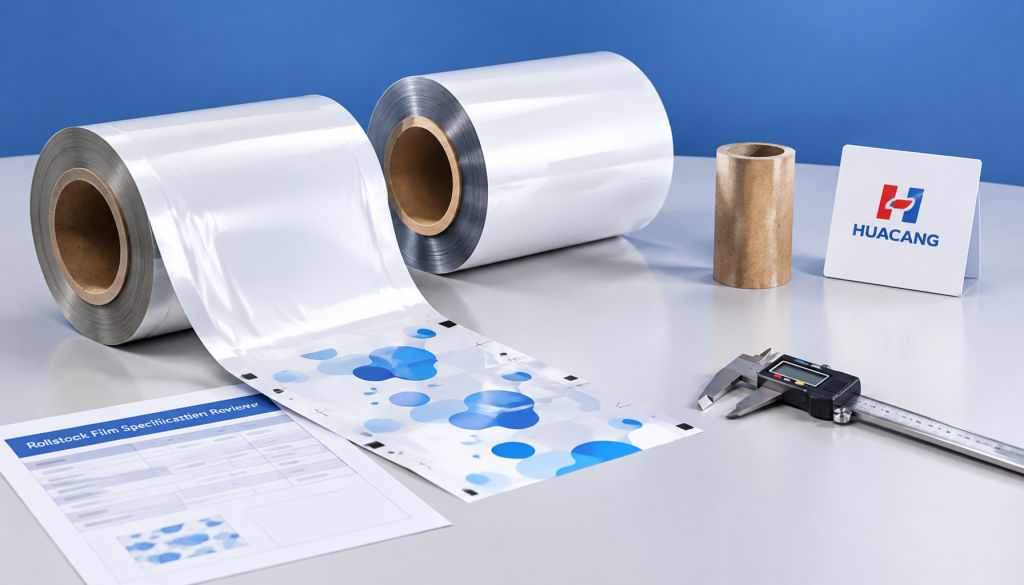
Rollstock film specifications should define the film structure, thickness, web width, print repeat, unwind direction, core dimensions, maximum roll diameter and weight, coefficient of friction, sealing behavior, registration marks, and splice rules. Buyers should agree on these details with the film supplier and packaging machine team before ordering, because a suitable barrier material can still fail to feed, track, register, or seal on the intended line.
This guide assumes you are purchasing printed or unprinted flexible film for automated forming, filling, and sealing or downstream pouch conversion. It focuses on the machine interface and purchase acceptance criteria. Numerical limits must come from your equipment documentation, product requirements, and trials; there is no universal rollstock specification that fits every machine.
- Product requirements: contents, storage conditions, intended shelf life, and filling process.
- Machine requirements: web geometry, winding arrangement, handling limits, and sealing conditions.
- Acceptance requirements: measurement methods, tolerances, traceability, and an approved trial reference.
Collecting these three groups of information makes supplier quotations easier to compare and reduces ambiguity when a production roll performs differently from a sample.
What Is Flexible Packaging Rollstock?
Flexible packaging rollstock is a continuous web of packaging material wound onto a core for processing on packaging or converting equipment. It may be a single film, a coextruded film, or a laminated structure, with printing and functional layers selected for the application.
Unlike a finished pouch, packaging roll film reaches the buyer before the package has been fully formed. The receiving operation controls web transport, forming, cutting, and sealing. Consequently, the purchase specification must describe both the finished package requirements and the roll as delivered.
A useful specification identifies the outer surface, product-contact surface, machine direction, and cross direction. These references prevent confusion when discussing surface treatment, friction, registration, or mechanical properties.
Start With Packaging Machine Film Requirements
The machine manual and a proven production roll are the best starting points for packaging machine film requirements. Identify the machine manufacturer, model, forming arrangement, seal configuration, and intended operating speed before discussing film construction.
- Document the web path: include the unwind stand, rollers, forming collar or forming box, registration sensor, and sealing jaws.
- Confirm the sealing arrangement: fin seals typically join inner surfaces; lap seals require compatibility between the surfaces that overlap.
- Capture operating conditions: record fill temperature, product contamination risk, jaw design, dwell time, pressure settings, and cooling arrangements.
- Provide a reference: share a drawing, approved roll sample, and photographs showing how the web enters the machine.
For an equipment change, involve the machine supplier early. An existing film may behave differently with a new forming collar, drive system, or seal jaw. State the target speed as a trial objective rather than an unverified performance guarantee.
Specify Film Structure and Functional Requirements
Specify the layer sequence from outside to product-contact side, each layer’s material and nominal thickness where relevant, and the total thickness with an agreed tolerance. A material abbreviation alone does not fully describe film behavior: resin grade, orientation, coatings, adhesives, and sealant formulation can affect performance.
Separate measurable requirements from descriptive preferences. Oxygen and moisture barrier values need test temperature, humidity, units, and method. Mechanical requirements may include puncture resistance, stiffness, tear behavior, or dimensional stability, depending on the package and machine.
Also identify the product composition, filling temperature, distribution environment, and required destination-market documentation. Food-contact suitability must be assessed for the actual structure and intended use. Neither an aluminum layer nor a high-barrier description establishes shelf life by itself.
Request relevant test reports and agree on change control. A supplier should obtain approval before changing materials or processing details that could affect the agreed specification.
Define Web Width, Repeat, and Registration
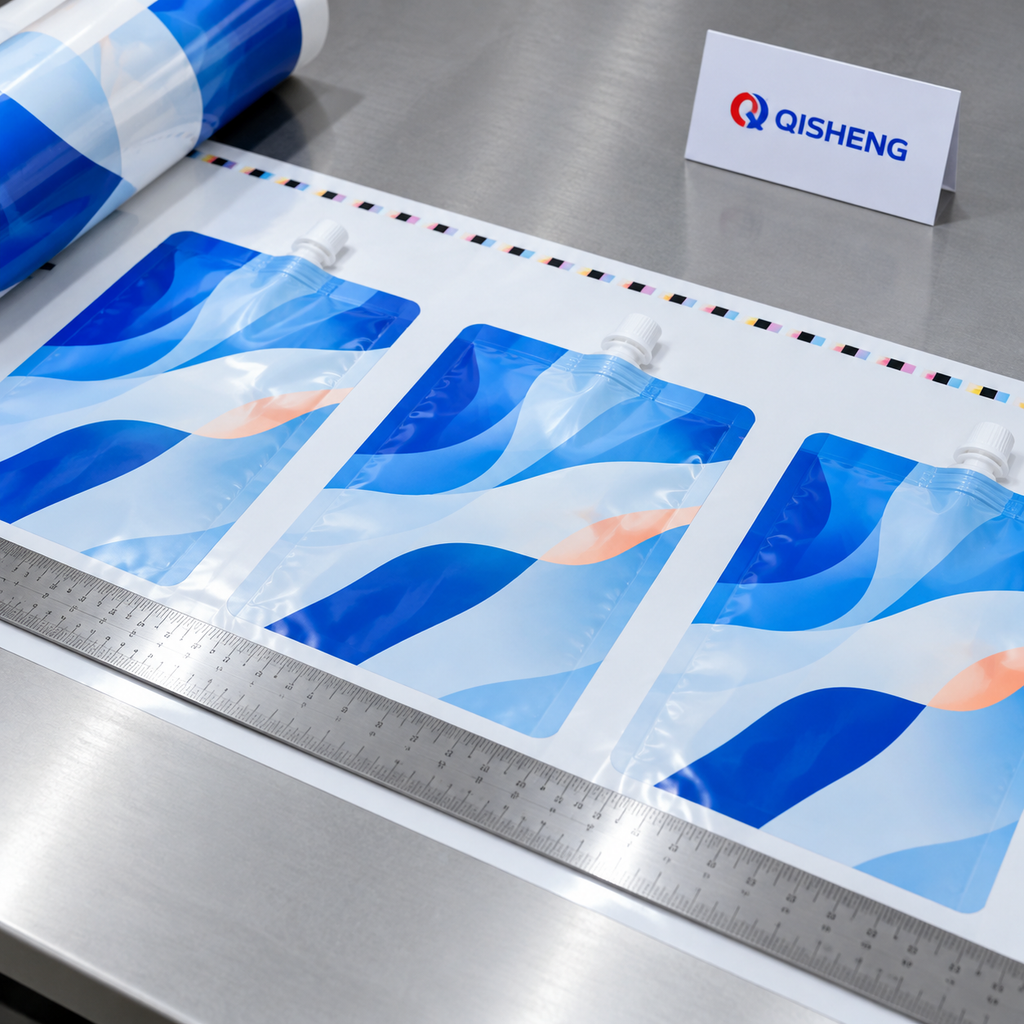
Web width and repeat length must match the forming and cutting geometry. Specify finished slit width and tolerance, the repeat measured along the machine direction, and the position of artwork and registration marks relative to an identified web edge.
For multilane production, include lane count, lane pitch, slit positions, and whether individual lanes require registration marks. Distinguish the artwork repeat from any additional allowance used by the equipment; do not assume the printed design height equals the machine’s cut length.
Registration marks need agreed dimensions, location, spacing, contrast, and a clear surrounding area. Confirm compatibility with the actual sensor and its settings, especially when using transparent or reflective webs. Decorative graphics near the detection zone can cause false triggering.
Define print-to-cut and print-to-seal acceptance limits on the finished package. A correctly printed roll may still produce misplaced cuts if web tension or registration settings differ from the approved trial.
Confirm Unwind Direction, Core, and Roll Limits
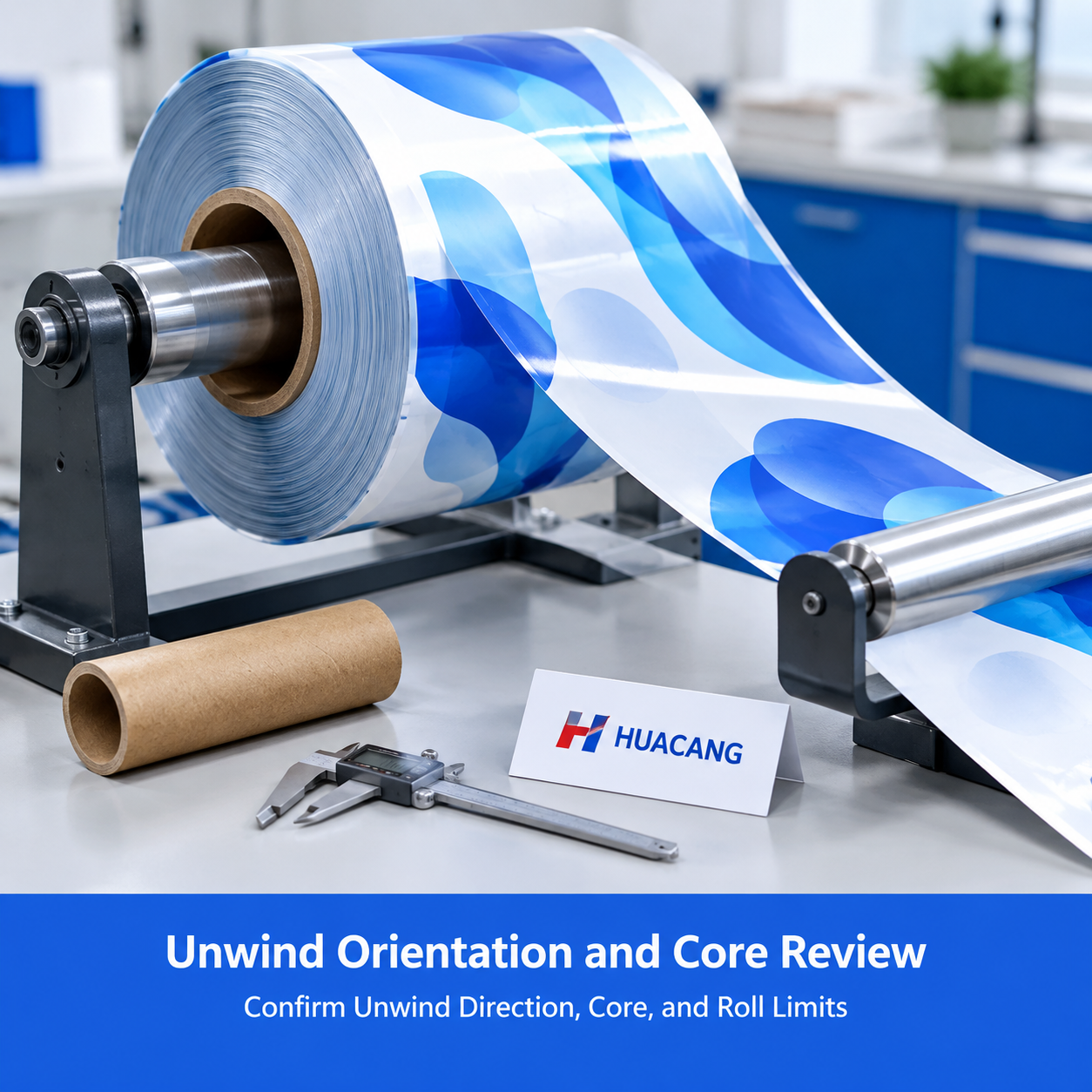
Rollstock unwind direction should be approved with a drawing that shows the viewing position, web travel, printed surface, and which artwork edge exits first. A winding number alone is insufficient unless both parties use the same chart.
Specify whether printing faces inward or outward on the wound roll, which side contains the sealant, and how the artwork faces the operator at the machine entry. Include a photograph of an approved roll when possible.
Core and roll limits should cover:
- Core inside diameter, material, length, and permitted protrusion beyond the web.
- Maximum outside diameter and gross roll weight, including the core.
- Target film length or net film weight, with delivery tolerance.
- Winding quality, including agreed limits for telescoping, loose wraps, blocking, and edge damage.
Common core inside diameters include 3 inches and 6 inches, but the machine shaft or chuck determines the required size. Specify the actual dimension and tolerance. Roll diameter, weight, and handling constraints all apply; meeting one limit does not establish compliance with the others.
Set COF and Sealing Requirements

Film coefficient of friction, or COF, describes resistance to sliding between specified surfaces. Static COF concerns the start of movement; kinetic COF concerns continued sliding. Report both when relevant, and identify the contact pair, such as outside-to-outside or inside-to-inside.
A COF value needs a test method and conditioning details to be comparable. ASTM D1894 is a commonly used method for plastic film and sheeting. Film age, storage temperature, surface additives, and conditioning can change results. A film-to-film result does not directly establish friction against every machine surface.
Agree on a range validated by the line: excessive friction can impede feeding, while very low friction may reduce traction or package stacking stability.
For sealing, request an operating window supported by tests at stated temperature, dwell time, and pressure. Distinguish cooled seal strength from hot tack, which describes seal strength shortly after formation. A package that carries product weight immediately after sealing may need adequate hot tack before the seal cools.
Verify seal appearance, strength, and leakage under actual filling conditions. Laboratory results guide selection; line trials establish whether the proposed film works with the intended process.
Compare Rollstock Construction Options
Compare structures by their required function and machine behavior. The examples below are starting points for evaluation, not confirmed specifications for any particular product.
| Construction option | Potential application | Buyer verification priorities |
|---|---|---|
| PET/PE laminate | General printed packs where the measured barrier is sufficient | Stiffness, sealant formulation, COF, and product compatibility |
| PET/metallized PET/PE laminate | Light-sensitive or barrier-sensitive products | Finished laminate barrier, flex durability, and sensor response |
| PET/aluminum foil/PE laminate | Applications requiring substantial light and gas protection | Foil integrity, flex cracking, seal performance, and inspection compatibility |
| PA-containing laminate | Packages with demanding puncture or handling conditions | Mechanical performance, moisture effects, and dimensional stability |
| PE-based or PP-based structure | Projects evaluating a predominantly single-polymer construction | Heat resistance, web stability, barrier, and sealing window |
PET means polyethylene terephthalate, PE means polyethylene, PA means polyamide, and PP means polypropylene. Final performance depends on grades, thicknesses, and processing. Material composition alone does not establish recyclability in the destination market.
Connect Film Specifications to the Final Package
The final package format adds requirements beyond the roll itself. If the web will be converted into spout pouches, the converter must also validate fitment sealing, pouch geometry, and stresses around cutouts or handles.
| Package format | Application consideration | Additional specification focus |
|---|---|---|
| Transparent spout pouches | Displaying product color and fill level | Clarity, haze where relevant, light exposure, barrier, and fitment compatibility |
| Spout pouches with carry handles | Larger liquid packs that need carrying and pouring | Handle geometry, load distribution, puncture resistance, and filled-pack trials |
| Custom-shaped spout pouches | Packages with a distinctive die-cut outline | Cut-to-print registration, seal clearance, corner geometry, and usable fill volume |
These are finished package examples, not interchangeable rollstock grades. Confirm whether the purchase covers film only, converted pouches, or a development project involving both.
Control Splices, Acceptance, and Trial Approval
Splice and inspection rules should be part of the purchase specification. Define the maximum splice count per roll, permitted joint construction, tape suitability, splice marking, and whether packs containing a splice must be automatically rejected. Confirm tape placement and any restrictions related to product contact or heated jaws.
Agree on sampling, measurement methods, defect classifications, and the response to nonconforming rolls. Roll labels should identify the order, item, artwork revision, production lot, roll number, quantity basis, and splice count. Packaging should protect roll edges and cores during shipment.
- Approve the drawing and specification revision.
- Review material documentation and laboratory measurements.
- Run a representative trial roll through the intended line.
- Record settings, feed stability, registration, seal results, and filled-pack checks.
- Approve the commercial specification and retain a reference sample.
For quotations, state kilograms or meters, rolls per shipment, SKU count, and quantity tolerances. Film length per kilogram changes with width, thickness, and material density. A finished-pouch MOQ should not be assumed to apply to rollstock.
Key Takeaways for a Purchase-Ready Specification
- Use a controlled specification with dimensions, tolerances, test conditions, and approval references.
- Confirm unwind orientation with a shared drawing.
- Validate COF and sealing on the intended machine.
- Define splice, roll labeling, and delivery acceptance rules.
Complete rollstock film specifications connect product protection with reliable machine operation. Before placing a commercial order, align the film supplier, production team, and machine provider around the same approved requirements and trial results.
FAQ
What information should I send when requesting a rollstock quotation?
Send the product application, proposed structure, thickness, web width, repeat, artwork, unwind drawing, core size, maximum roll diameter and weight, machine details, order quantity, and delivery destination. Include barrier, sealing, COF, splice, and documentation requirements. Mark unresolved items for review rather than treating assumptions as approved specifications.
Is there a standard rollstock unwind direction?
There is no single unwind direction suitable for all packaging lines. Numbered winding charts are useful only when buyer and supplier share the same reference. Approve a drawing showing the viewing position, web travel, printed side, sealant side, and artwork edge that exits first.
What film coefficient of friction should I specify?
Specify a range supported by your equipment guidance and production trials. Identify static or kinetic COF, the contacting surfaces, test method, conditioning, and film age. A value from a different surface pairing or test condition may not predict your machine’s feeding behavior.
Can two films with the same thickness run differently?
Yes. Films with equal total thickness can differ in stiffness, friction, seal initiation behavior, hot tack, and dimensional stability. Layer composition, material grades, surface additives, and processing all matter. Approve the structure and functional requirements alongside thickness.
Should rollstock orders be specified in kilograms or meters?
Either basis can work if the order defines how quantities are measured and reconciled. Meters help production planning, while kilograms are often used for film quotations. Specify net film weight separately from gross roll weight and agree on length or weight tolerances. Conversion requires the actual width, thickness, and material density.
Need Custom Spout Pouch Packaging?
Share your product, fill volume, machine requirements, artwork, and estimated order quantity with HUACANG Packaging. Discuss film or pouch structure, spout fitment where applicable, MOQ, samples, and quotation requirements with our packaging team.