Table of Contents
- Clear vs Foil Spout Pouches: The Direct Answer
- What Clear and Foil Spout Pouches Mean
- Key Takeaways for Packaging Buyers
- Barrier and Performance Comparison
- How to Evaluate a Clear Pouch Barrier
- How an Aluminum Foil Spout Pouch Protects Products
- Printing, Product Visibility, and Inspection
- Structure Selection by Product and Application
- Spout, Filling, and Pouch Format Factors
- Recycling and Sustainability Claims
- Testing and RFQ Specifications
- Conclusion
Compare transparent and aluminum foil spout pouch structures by oxygen, moisture, light, and aroma barrier, as well as printing, inspection, filling, recycling claims, and shelf-life validation.
Clear vs Foil Spout Pouches: The Direct Answer
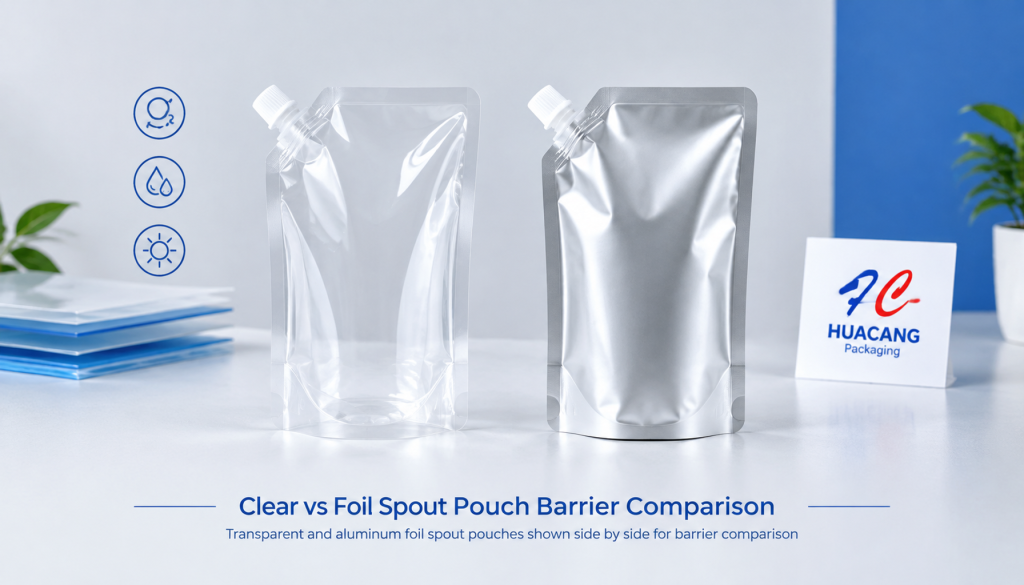
When comparing clear vs foil spout pouches, choose clear packaging when product visibility, fill-level inspection, or a transparent retail presentation is important. Choose an aluminum foil structure when the product needs stronger protection from light and potentially very low oxygen, moisture, or aroma transmission. The correct choice depends on the complete laminate, not its appearance alone.
A transparent spout pouch can use a basic laminate or a high-barrier structure containing nylon, EVOH, or a transparent barrier coating. A foil pouch normally combines an aluminum layer with printable outer film and a product-compatible inner sealant. Neither option guarantees a particular shelf life without test data for the specified structure, pouch format, spout, filling conditions, and product.
Packaging teams should therefore begin with the product’s sensitivity to oxygen, light, moisture, and aroma. They should then consider retail presentation, filling-line inspection, transport conditions, sealing requirements, and the evidence needed to support recycling or shelf-life claims.
What Clear and Foil Spout Pouches Mean
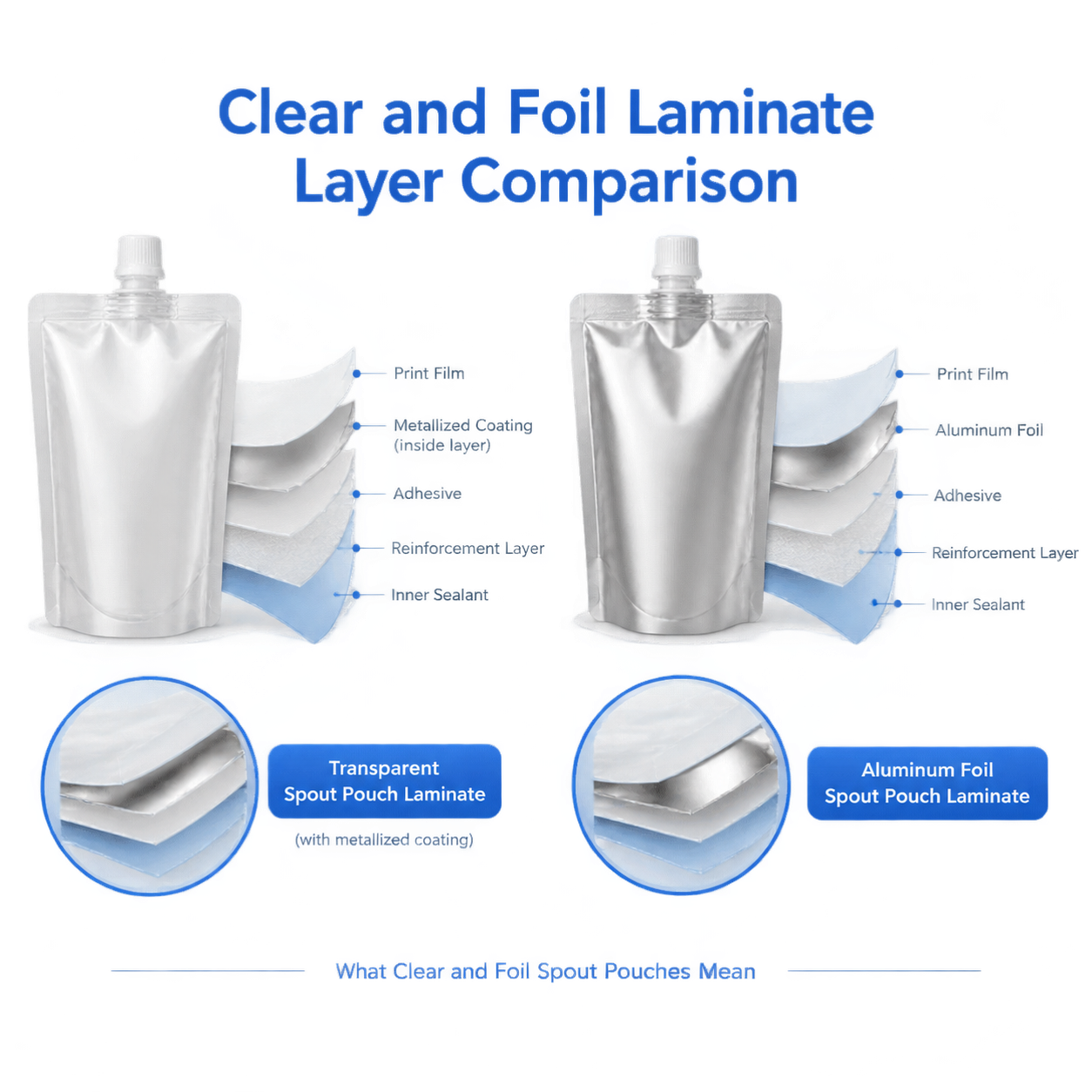
Transparent spout pouch: A pouch made with clear flexible films through which the packed product can be seen. Typical structure families include PET/PE, PET/PA/PE, and clear high-barrier laminates incorporating EVOH or transparent oxide-coated film. The exact layer sequence must be selected for the product and filling process.
Aluminum foil spout pouch: A multilayer pouch containing a thin aluminum foil layer. The foil is normally positioned between other films rather than touching the product. An outer film provides printing and surface protection, while the inner sealant layer creates the pouch seals and bonds to a compatible spout fitment.
Important distinction: Metallized film is not the same as aluminum foil. Metallized film carries a very thin deposited metal coating and may provide useful barrier and opacity, but its performance and resistance to flexing can differ substantially from a foil laminate. Buyers should request the actual layer composition instead of relying on descriptions such as “silver,” “metallic,” or “foil look.”
Key Takeaways for Packaging Buyers
- Visibility favors clear film: Transparent pouches show product color, texture, separation, and fill level without opening the pack.
- Light protection favors foil: An intact foil laminate is opaque and is commonly used for light-sensitive formulations.
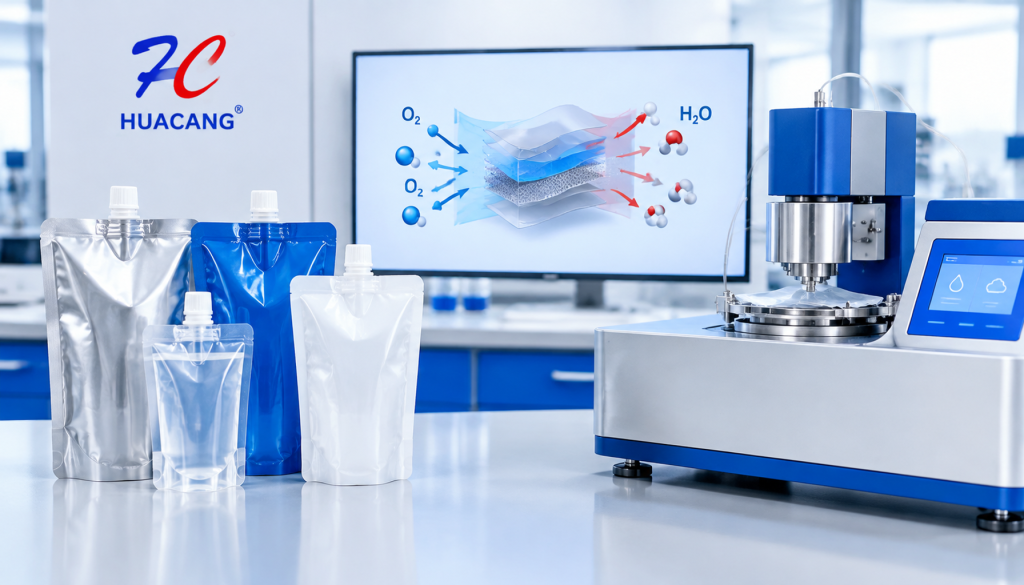
- Oxygen and moisture performance must be quantified: Compare OTR and WVTR data at stated temperature and humidity conditions rather than choosing by appearance.
- The weakest area may not be the flat film: Seals, spout interfaces, closure systems, and flex damage can influence whole-package performance.
- Shelf life requires validation: Laboratory barrier data helps screen materials, but filled-product stability and distribution testing confirm whether the finished package is suitable.
Barrier and Performance Comparison
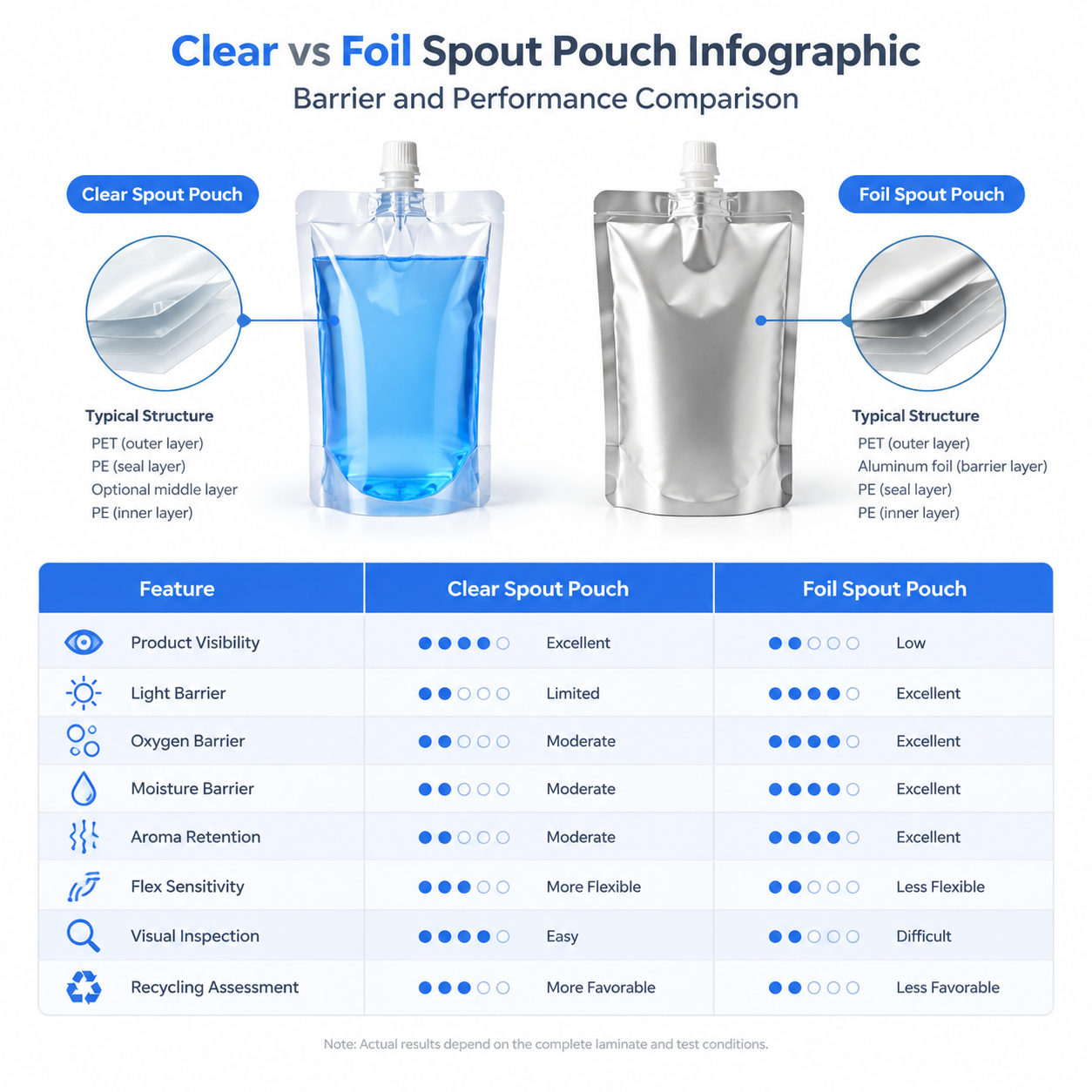
The table summarizes typical decision factors. It is directional rather than a substitute for a supplier specification, because both clear and foil structures are available in multiple gauges and layer combinations.
| Decision factor | Transparent spout pouch | Aluminum foil spout pouch |
|---|---|---|
| Product visibility | Full or partial visibility is possible | Opaque; product is not visible through the laminate |
| Light barrier | Limited unless tinted or engineered with a light-control layer | Strong light exclusion when the foil layer remains intact |
| Oxygen barrier | Ranges from modest to high depending on EVOH, coatings, thickness, and humidity | Typically very high in an intact foil laminate; flex cracking and package interfaces must be controlled |
| Moisture barrier | Depends on the polymers, coatings, and total structure | Typically very high through intact foil |
| Aroma retention | Can be engineered for aroma-sensitive products | Often selected for demanding aroma and flavor retention |
| Flex behavior | Polymeric films may tolerate repeated flexing well when correctly specified | Foil can develop pinholes or cracks under severe flexing, folding, or impact |
| Visual inspection | Supports fill-level and product inspection | Requires weight, sensors, sampling, or another inspection method |
| Printing | Can use reverse printing, white ink, and clear windows | Supports opaque graphics; white ink or surface treatment depends on design and construction |
| Recycling assessment | Depends on whether the complete pouch and fitment qualify for a collection and processing stream | Multimaterial foil laminates are generally difficult to place in common flexible-plastic recycling streams |
How to Evaluate a Clear Pouch Barrier
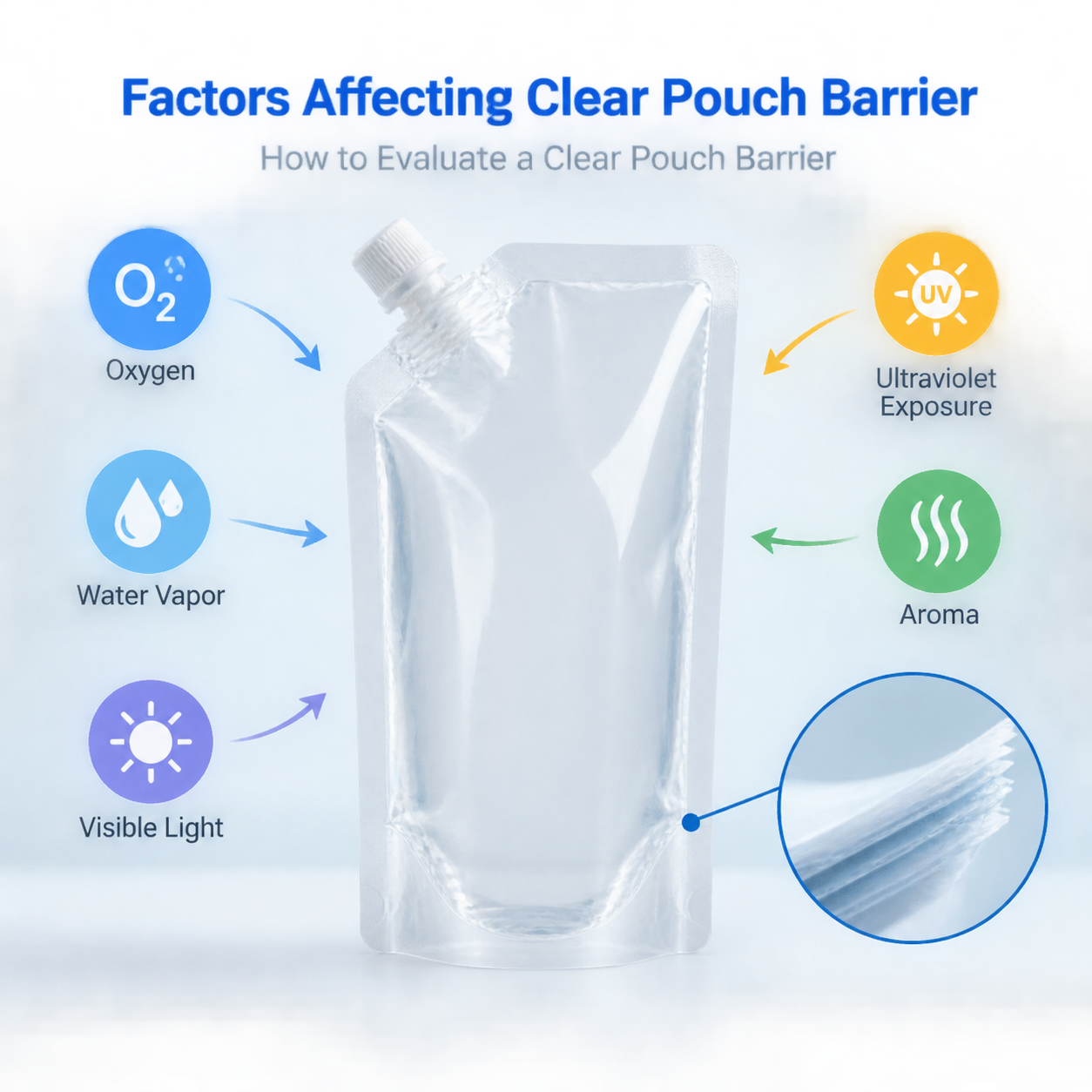
A clear pouch barrier cannot be judged from transparency or total thickness alone. A basic PET/PE laminate may be suitable for products with limited barrier requirements, but oxygen-sensitive foods, beverages, or cosmetics may require nylon, EVOH, or a coated transparent film. Each added layer has a specific job, such as print support, puncture resistance, gas barrier, moisture resistance, or heat sealing.
Ask the supplier for oxygen transmission rate (OTR) and water vapor transmission rate (WVTR) data for the proposed construction. The specification should state the test method, units, temperature, relative humidity, and whether the result applies to flat film or a finished package. This context matters because EVOH performance, for example, can change with humidity.
Transparency also leaves the product exposed to visible and ultraviolet light unless another light-control feature is used. If a formulation contains light-sensitive colors, vitamins, oils, fragrances, or active ingredients, perform light-exposure testing under realistic storage and retail conditions. A clear window can also be combined with printed or opaque areas when limited visibility is sufficient.
How an Aluminum Foil Spout Pouch Protects Products
An aluminum foil spout pouch is commonly considered when light exclusion and demanding oxygen, moisture, or aroma protection are priorities. A representative structure may combine PET for printing, foil for barrier, and PE or another sealant for product contact and fitment welding. Some designs add nylon or another reinforcing layer where puncture or handling resistance requires it.
Foil performance depends on maintaining the continuity of the barrier layer. Sharp folds, repeated flexing, rough handling, or unsuitable conversion conditions can create pinholes or cracks. The pouch design should therefore account for fill weight, headspace, carton packing, shipping vibration, drop exposure, and how consumers squeeze or fold the package.
Foil also does not correct an unsuitable sealant or spout interface. The inner layer must be chemically compatible with the product and capable of sealing consistently to the selected fitment. Seal width, contamination in the seal area, filling temperature, and cap application all remain critical. Buyers should evaluate the finished pouch rather than assuming that a high-barrier film automatically creates a high-barrier, leak-resistant package.
Printing, Product Visibility, and Inspection
Clear film can make the product part of the package design. Reverse-printed graphics and selective white ink can create opaque branded areas while leaving a viewing window. Artwork approval should identify which areas are transparent, white-backed, or affected by the product color behind the film. Buyers should review a printed sample with a representative fill because an empty pouch may not predict the final appearance.
Visibility also supports manual checks for fill level, separation, sediment, color variation, or trapped contamination. However, a window is not a substitute for controlled filling and inspection equipment. Foil pouches require alternative controls such as fill-weight verification, flow monitoring, vision inspection before closure, or sampling.
If shelf presence depends on an unusual silhouette, a custom-shaped spout pouch can be evaluated in either clear or opaque material families. The shape must still leave enough seal area and avoid corners that create stress during filling and transport.
Structure Selection by Product and Application
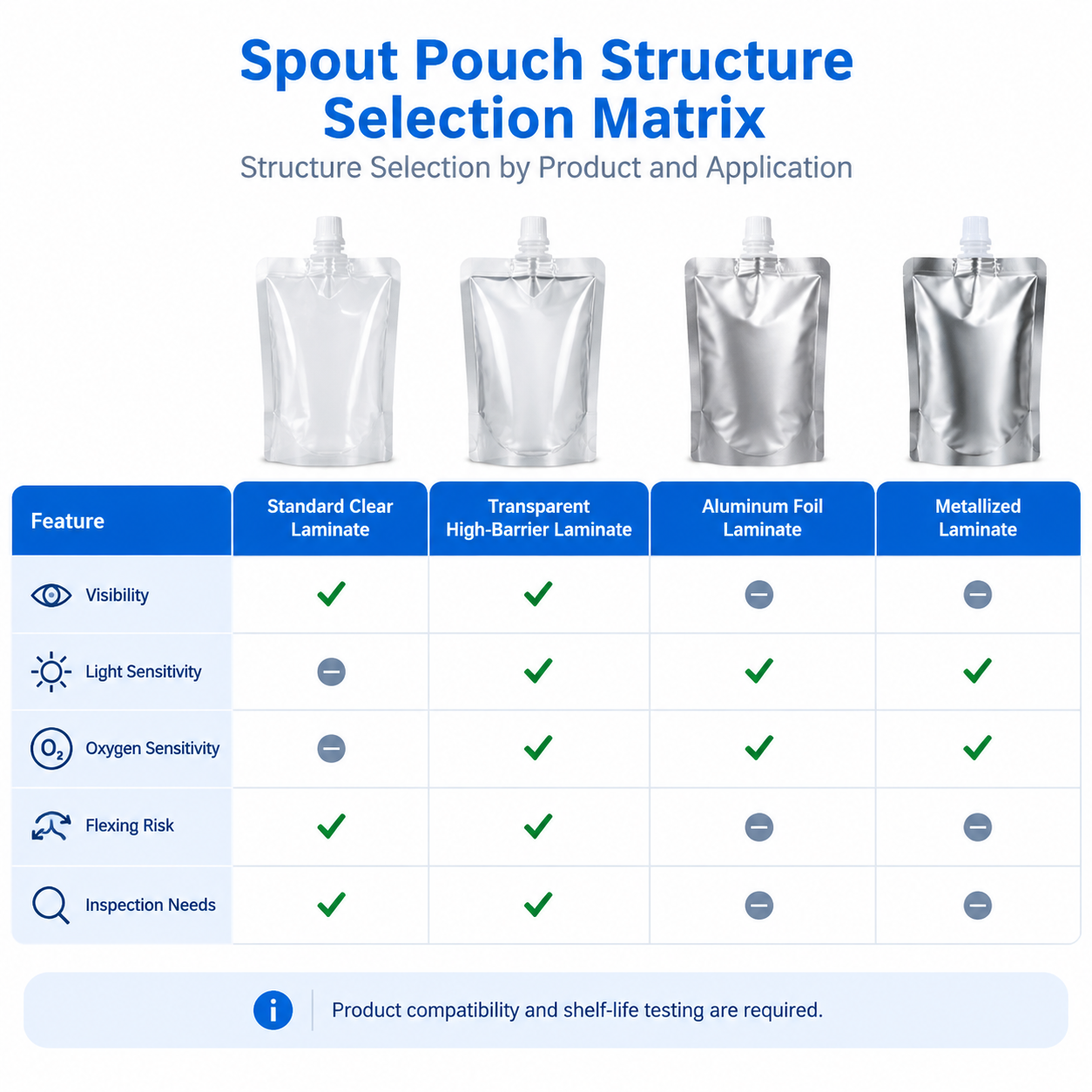
This product table provides a starting point for technical discussions. It does not replace compatibility and shelf-life testing.
| Product or requirement | Structure family to evaluate | Main validation questions |
|---|---|---|
| Short-distribution-cycle liquid with strong visual appeal | Standard transparent laminate | Is the product stable under expected light, oxygen, moisture, and temperature exposure? |
| Oxygen-sensitive product requiring visibility | Transparent high-barrier laminate with EVOH or a transparent coating | Does barrier remain adequate at the intended humidity, and can the structure survive distribution? |
| Light-sensitive beverage, sauce, puree, or ingredient | Foil laminate or another validated opaque high-barrier structure | Will light exclusion improve stability, and can the foil tolerate flexing and handling? |
| Aroma-sensitive concentrate or formulation | High-barrier clear or foil laminate | What aroma compounds can migrate or scalp, and is the product compatible with the sealant? |
| Personal care or household refill | Clear or opaque structure selected by chemical compatibility | Do surfactants, fragrances, solvents, or oils affect film, seals, fitment, or print? |
| Large or heavy liquid format | Reinforced transparent or foil laminate | Can the pouch withstand lifting, drops, stacking pressure, and repeated dispensing? |
When visibility and maximum light protection conflict, buyers can also consider a limited clear window, secondary carton, tinted film, sleeve, or another validated design. These approaches add variables and should be assessed as complete packaging systems.
Spout, Filling, and Pouch Format Factors
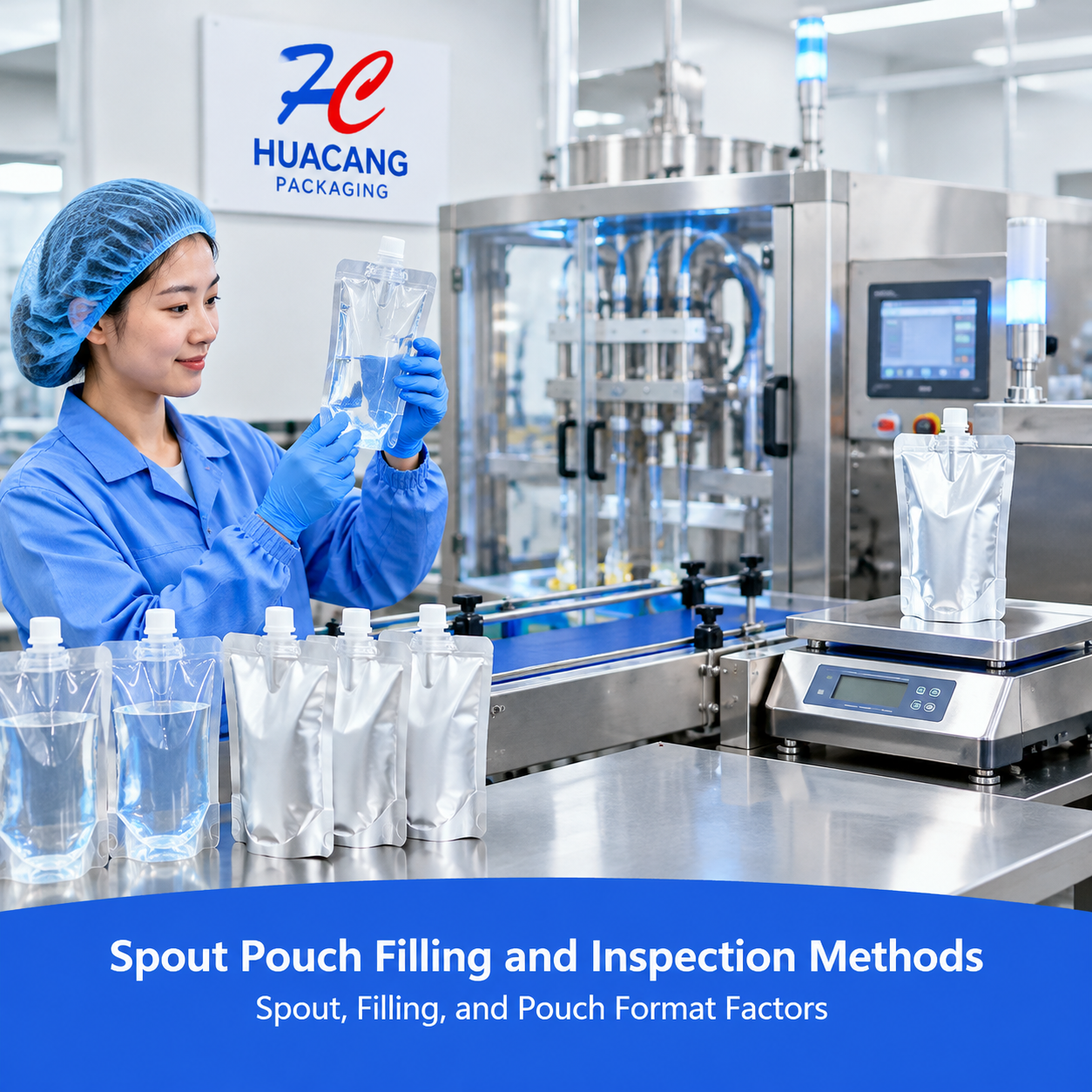
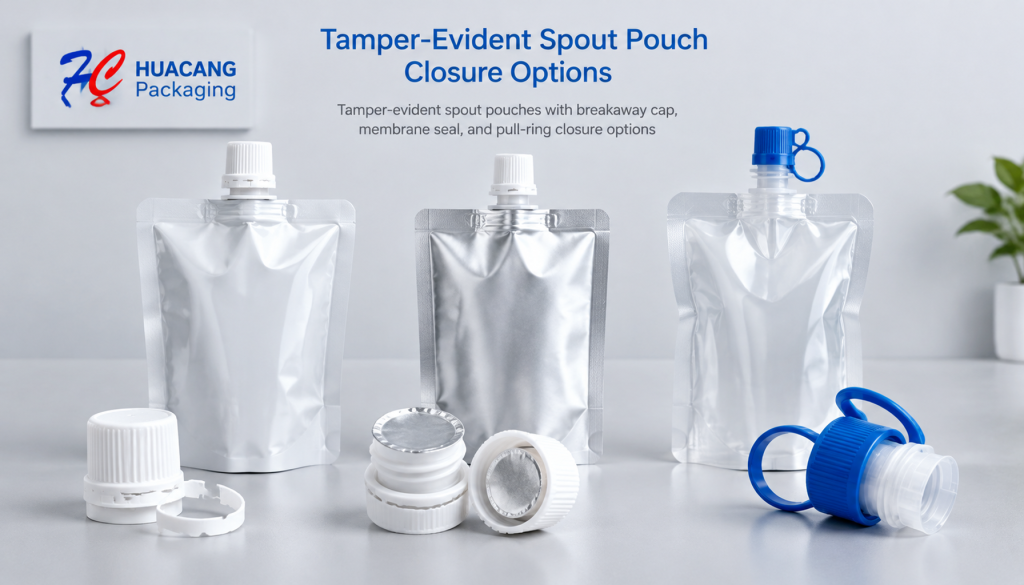
Material selection must be coordinated with the spout and filling process. The sealant layer and fitment resin need a compatible welding window. Spout diameter must suit product viscosity, particulates, dispensing rate, and filling equipment. Cap design, tamper evidence, application torque, and reclosing behavior should be specified separately from the film barrier.
Through-spout filling places different demands on the fitment and equipment than open-top filling followed by final pouch sealing. Hot-fill, cold-fill, aseptic, frozen, or retort processes each require structures and fitments engineered for their temperatures and mechanical loads. A clear film that performs well at ambient conditions may not suit thermal processing, and a foil laminate still requires process-specific validation.
For family-size or institutional liquids, a spout pouch with a carry handle may improve lifting and controlled pouring. The handle area, spout weld, bottom gusset, and shipping carton should be tested with the intended fill volume because greater mass increases stress throughout the package.
Recycling and Sustainability Claims
A clear pouch should not automatically be described as recyclable, and a foil pouch should not be judged solely by its thin material use. Recycling eligibility depends on the complete package: film layers, adhesives, inks, fitment, closure, labels, residue, local collection, sorting technology, and end-market acceptance.
Many traditional clear laminates combine PET, nylon, EVOH, and PE. Many foil pouches combine plastic films with aluminum. Both may be difficult to process in common single-material recycling systems. A predominantly polyethylene transparent structure may offer a different pathway, but any claim must be supported for the intended market and package configuration.
Buyers selling in the United States should review the Federal Trade Commission Green Guides before making environmental marketing claims. Requirements and access differ by country and municipality, so artwork should not use an unqualified recycling claim based only on a material name or supplier statement.
Testing and RFQ Specifications
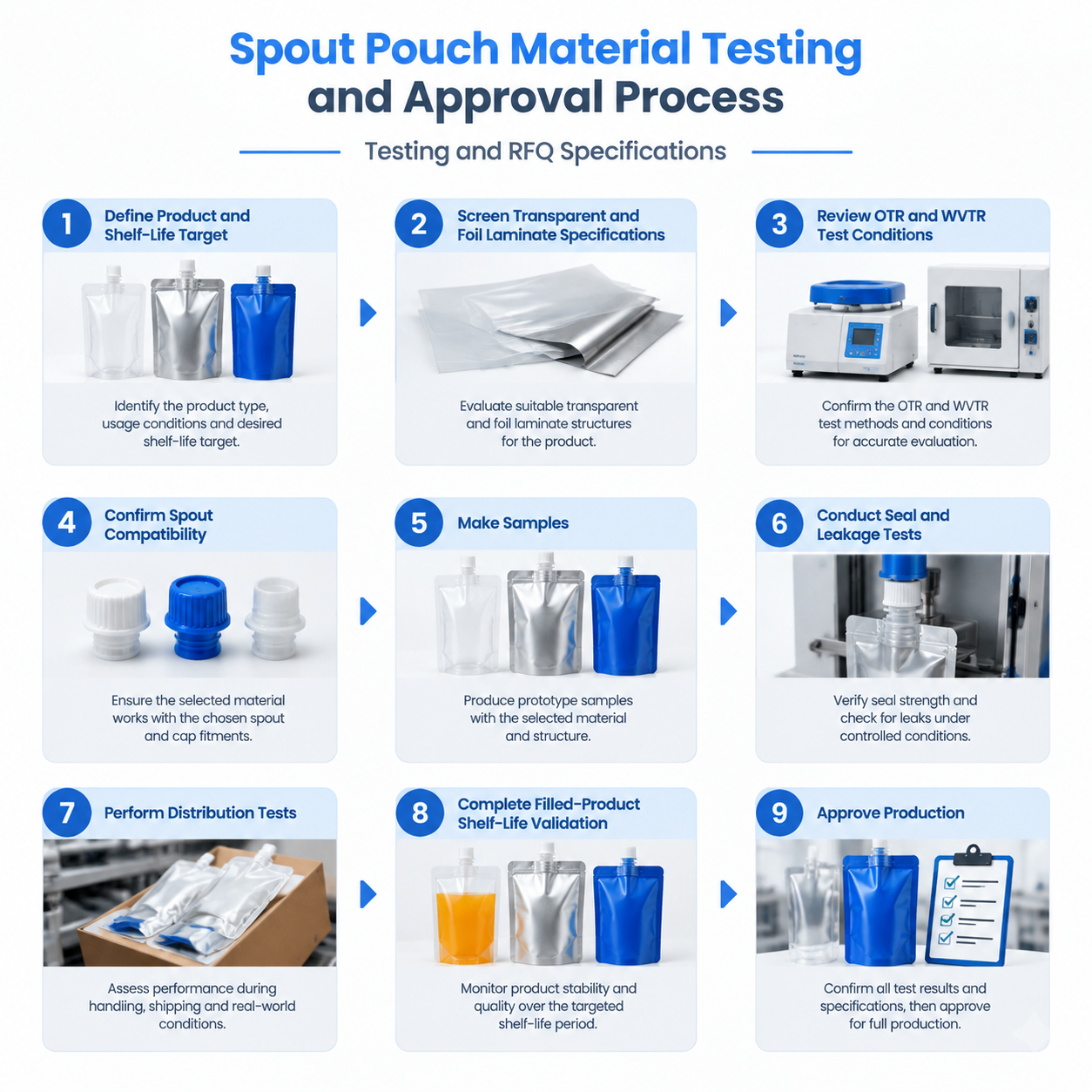
Request comparable data for both candidate structures before approving commercial production. Barrier values should identify the test conditions because a value without temperature, humidity, units, and method cannot support a reliable comparison.
| RFQ or approval item | Information to provide or request |
|---|---|
| Product profile | Ingredients, pH where relevant, oils, alcohol, surfactants, aromas, particulates, and known sensitivities |
| Target shelf life | Required duration plus storage, retail, and distribution conditions |
| Laminate | Layer sequence, thickness by layer where available, total thickness, sealant, and foil or coating identification |
| Barrier | OTR and WVTR with method, units, temperature, relative humidity, and specimen type |
| Light exposure | Need for opacity, UV control, or a viewing window |
| Spout system | Position, bore size, fitment resin, cap style, tamper evidence, torque targets, and filling interface |
| Process | Fill temperature, through-spout or open-top filling, sanitation method, line speed, and downstream handling |
| Mechanical tests | Seal strength, burst or pressure resistance, leak test, drop test, compression, vibration, and flex durability as applicable |
| Commercial details | Pouch dimensions, fill volume, artwork, colors, order quantity, delivery market, samples, and documentation requirements |
Use accelerated studies for screening, but confirm the final decision with real-time or otherwise scientifically justified shelf-life work using the actual product and finished pouch. Food-contact buyers should also review applicable documentation for every product-contact component. The US Food and Drug Administration provides background on food-contact substances and packaging.
Before tooling or mass production, buyers can discuss custom pouch specifications with HUACANG Packaging, including candidate structures, spout samples, artwork, filling conditions, order quantity, and test expectations.
Conclusion
The choice between clear vs foil spout pouches is a balance between visibility and protection. Clear structures support product display and visual inspection, while foil structures are generally better suited to products requiring opacity and demanding oxygen, moisture, or aroma barrier. Compare complete laminate specifications, include the spout and seals in the assessment, and validate the chosen package under actual filling, storage, and distribution conditions.
FAQ
Can a transparent spout pouch provide a high oxygen barrier?
Yes. A transparent laminate can incorporate EVOH, nylon, or a transparent oxide coating to improve oxygen barrier. Performance varies with the layer construction, thickness, humidity, manufacturing process, and package design. Request OTR data with stated test conditions and validate the finished pouch with the actual product.
Is metallized film the same as aluminum foil?
No. Metallized film has a very thin metal coating deposited on a polymer film, while an aluminum foil laminate contains a separate foil layer. Both can look silver and opaque, but their oxygen and moisture barrier, flex resistance, thickness, and cost may differ. Ask for the complete material specification.
How can fill level be checked in an opaque foil pouch?
Manufacturers can use checkweighers, controlled dosing, flow monitoring, inspection before the pouch is closed, sensors, or production sampling. The appropriate method depends on the filling process, product behavior, line speed, and required inspection level.
Are clear spout pouches cheaper than foil pouches?
Not necessarily. Price depends on resin and foil inputs, number of layers, thickness, barrier coatings, printing coverage, pouch dimensions, spout and cap configuration, order quantity, and testing requirements. Compare quotations using the same pouch size, structure specification, fitment, print design, and quantity.
What tests should be completed before choosing clear or foil packaging?
Relevant tests may include OTR, WVTR, light exposure, chemical compatibility, seal strength, leakage, internal pressure or burst resistance, drops, compression, vibration, flex durability, cap torque, and filled-product shelf life. Select tests according to the product, filling process, distribution route, and applicable market requirements.
Need Custom Spout Pouch Packaging?
Share your product, fill volume, pouch structure requirements, spout fitment, artwork, estimated order quantity, and sample needs. Our packaging team can recommend a suitable structure, spout option, and quotation.