Table of Contents
- What Buyers Need to Specify
- What Is Printed Rollstock Film?
- Printed Rollstock Film Specification Table
- Match Film Geometry to the Packaging Machine
- Compare Material Structure Options
- Printing, Artwork, and Registration Requirements
- Sealing and Machine-Handling Specifications
- Roll Quality, Splices, and Packing
- Step-by-Step Approval Process
- Rollstock Film vs. Premade Pouches
- RFQ Checklist for Buyers
- Conclusion
- Frequently Asked Questions
A practical guide to specifying printed packaging rollstock, including dimensions, winding, print registration, material structure, barrier, sealing, roll quality, and form-fill-seal machine compatibility.
What Buyers Need to Specify
Printed rollstock film should be specified as a complete machine-ready system, not only by material and thickness. A usable purchase specification identifies the web width, print repeat, unwind direction, core dimensions, maximum roll diameter and weight, registration requirements, material structure, barrier targets, seal behavior, coefficient of friction, splice rules, and packing method.
The final values must match the forming set, sealing jaws, sensors, product, filling temperature, line speed, and distribution conditions. This guide assumes the film will run on vertical or horizontal form-fill-seal equipment. Lidding film, labels, and thermoforming webs require different specifications.
Key takeaways
- Obtain a machine film drawing before requesting production.
- State dimensions and tolerances numerically rather than using terms such as “standard roll.”
- Define barrier values with test methods and environmental conditions.
- Approve artwork together with unwind orientation and eye-mark position.
- Use a production-representative roll trial before committing to a large order.
What Is Printed Rollstock Film?
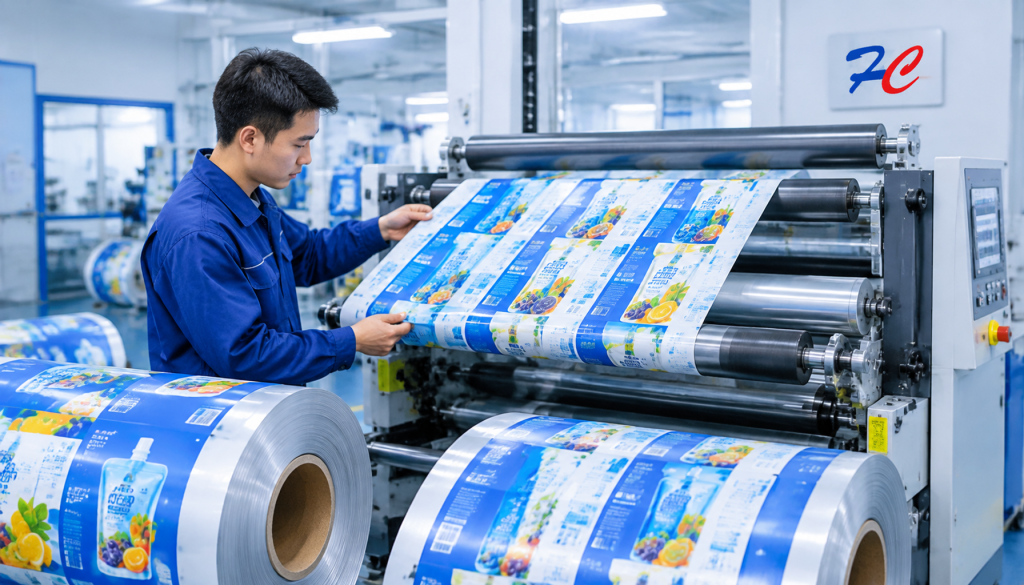
Printed rollstock film is a flexible packaging web supplied on a core for conversion into packages on automated equipment. The machine unwinds the web, forms it around or over the product, seals the package, and cuts it at a controlled repeat.
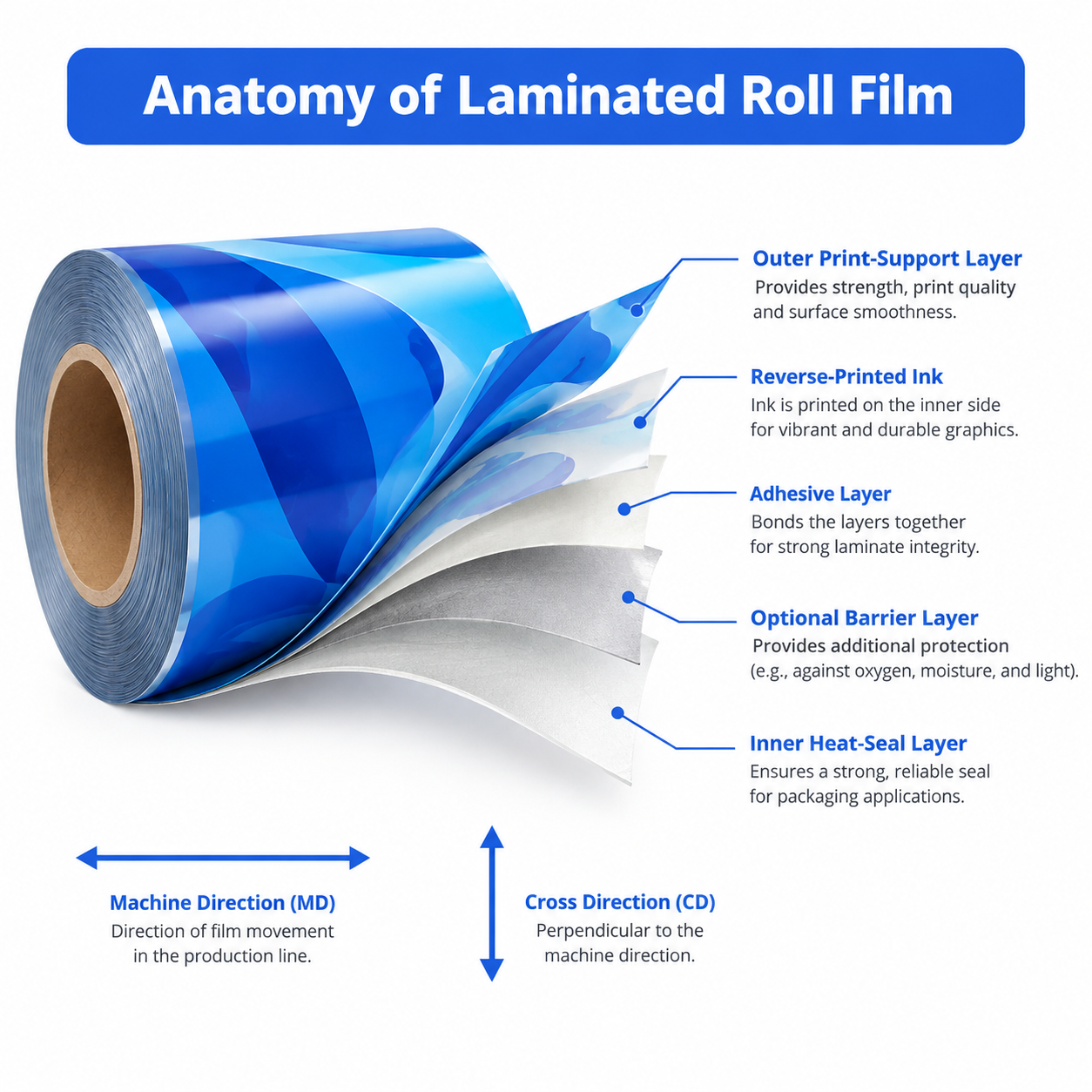
The web may be a single-layer film, but many applications use laminated roll film made by bonding two or more layers. Each layer has a specific function, such as print protection, stiffness, gas or moisture barrier, puncture resistance, or heat sealing. Reverse printing is commonly enclosed between layers of a laminate, while surface printing remains exposed and therefore requires suitable ink and rub resistance.
Printed Rollstock Film Specification Table
The following worksheet covers the principal rollstock film specifications a converter needs. Values should come from the packaging machine supplier, a qualified line trial, the product requirements, and the approved package drawing.
| Specification field | What the buyer should provide | Why it matters |
|---|---|---|
| Package and process | Package style, fill weight, product type, filling temperature, and expected line speed | Establishes forming, barrier, and sealing demands |
| Material structure | Each layer, nominal layer thickness, total thickness, and applicable tolerance | Controls stiffness, protection, machinability, and sealing |
| Web width | Finished width and tolerance in millimeters | Must fit the former, guides, and sealing configuration |
| Print repeat | Machine-direction repeat or cutoff length and tolerance | Controls graphics placement and package length |
| Unwind direction | Winding diagram showing print orientation, leading edge, and sealant side | Prevents inverted graphics or an incorrectly facing seal layer |
| Core | Inside diameter, core length, material, and permitted protrusion | Must fit the unwind shaft or chucks |
| Finished roll | Maximum outside diameter, roll weight, and web length | Prevents conflict with unwind capacity and lifting limits |
| Print system | Number of colors, spot or process colors, surface or reverse print, and color references | Defines production setup and artwork controls |
| Registration | Print-to-print and print-to-cut requirements | Controls alignment of graphics, seals, and cutting |
| Eye mark | Size, color, contrast, location, and sensor-readable area | Allows the machine to control package cutoff |
| Barrier | OTR, WVTR, or light-barrier target with test method and conditions | Makes barrier requirements measurable |
| Sealing | Seal initiation, operating window, hot tack, and seal-strength criteria where relevant | Supports reliable sealing at the intended settings |
| COF | Static and dynamic coefficient of friction, tested on identified surfaces | Affects tracking, forming, and product flow |
| Splices | Maximum number, tape type, marking, and permitted locations | Reduces unexpected line stops or sensor errors |
| Packing | Roll orientation, end protection, bagging, carton or pallet pattern, and labels | Protects roll edges and supports traceability |
Match Film Geometry to the Packaging Machine
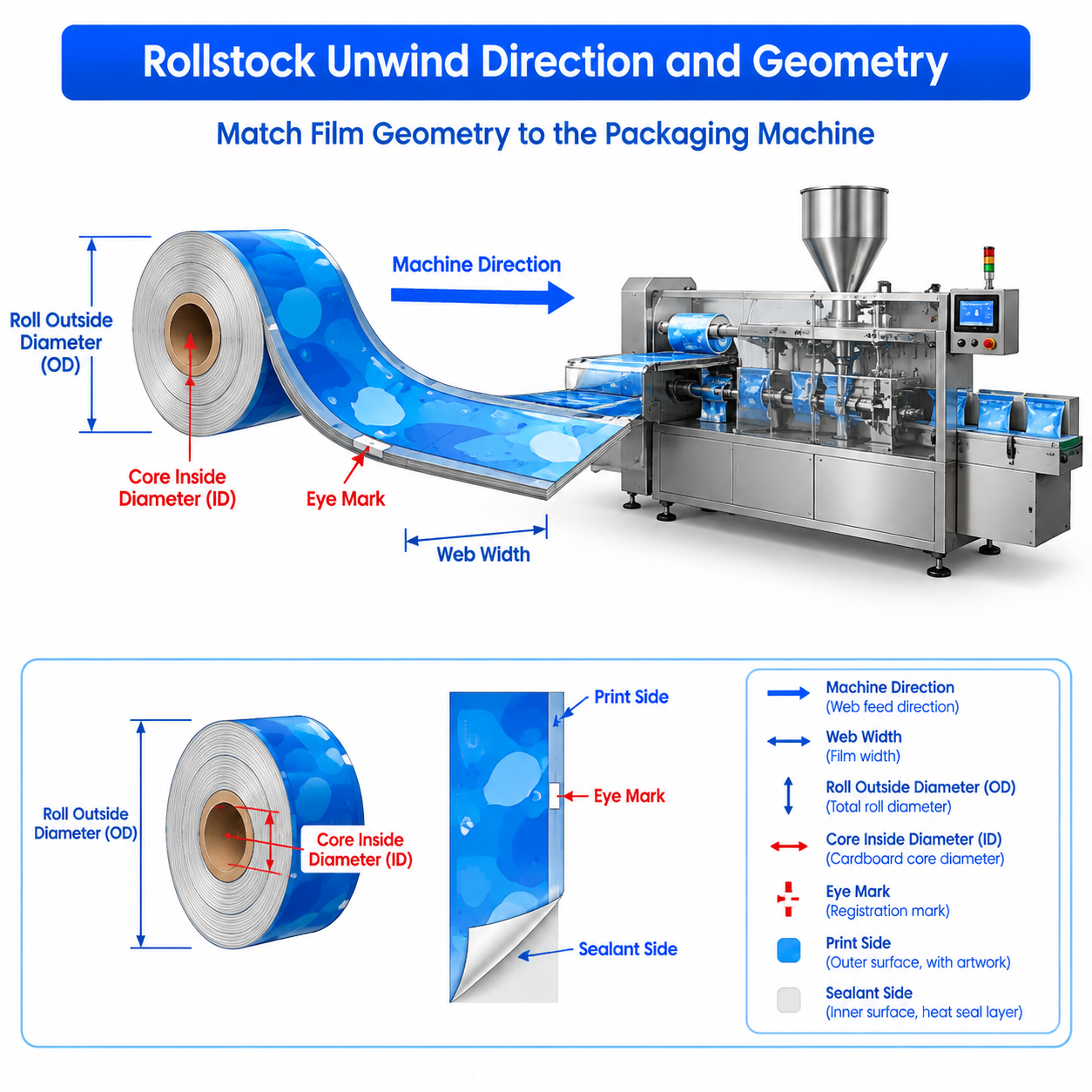
Web width and repeat cannot be selected from the desired package dimensions alone. Their calculation depends on the machine type, forming collar or plow, lane count, fin-seal or lap-seal allowance, gussets, cross-seal width, cutoff position, and tracking system.
Ask the machine manufacturer for a dimensioned film layout. It should show the machine direction, cross direction, sealing areas, package panel dimensions, eye-mark position, and cutting line. For multi-lane equipment, it should also show lane pitch and any trim or slit allowance.
Unwind direction must be confirmed with a drawing rather than a supplier-specific winding number. Numbering conventions are not universal. The drawing should identify:
- Whether the printed face is wound inward or outward.
- Which artwork edge enters the machine first.
- Whether the sealant layer faces the product side.
- The side of the web carrying the eye mark.
- The operator-side orientation when relevant.
Core inside diameter, maximum roll diameter, roll weight, and core length also come from the unwind unit. A roll that fits dimensionally may still exceed the line’s lifting, braking, or tension-control capability.
Compare Material Structure Options
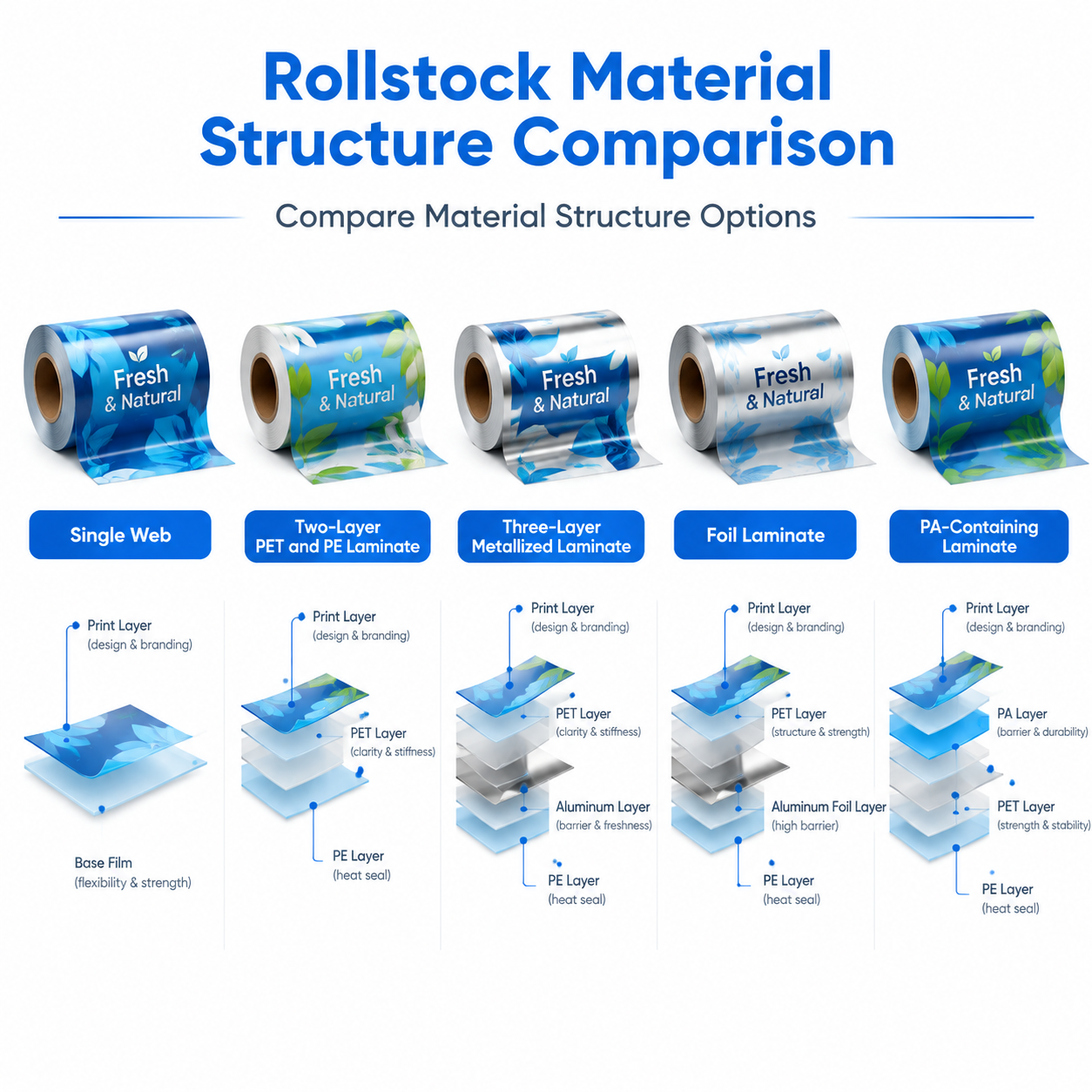
A material structure should be selected from the packed product, shelf-life target, filling process, seal requirements, and distribution environment. The examples below are screening options rather than universal recommendations. Final structures require product compatibility and line testing.
| Structure approach | Potential use | Selection considerations |
|---|---|---|
| PE-based single web | Selected products with modest graphics and barrier requirements | Confirm stiffness, printing surface, seal range, COF, and machine tracking |
| BOPP/CPP laminate | Snacks, confectionery, and selected dry products | Review moisture barrier, stiffness, heat resistance, and seal behavior |
| PET/PE laminate | Dry foods, powders, personal care, and household products | PET supports print and dimensional stability; the PE grade controls sealing and product contact |
| PET/metallized film/PE | Products needing increased light, oxygen, or moisture protection | Define measurable barrier targets and check metal-layer continuity after converting |
| PET/foil/PE | High-barrier applications where aluminum foil is technically justified | Evaluate flex-crack risk, opacity, stiffness, sealing, and package handling |
| PA/PE or PA-containing laminate | Applications needing additional toughness or puncture resistance | Assess moisture sensitivity, forming behavior, product compatibility, and required barrier |
| Engineered high-temperature laminate | Hot-fill, pasteurization, or retort processes | Process temperature alone is insufficient; time, pressure, product chemistry, seals, inks, and adhesives must be validated together |
Total thickness should not replace a full layer description. Two laminates with the same total gauge can behave differently because layer materials, individual gauges, adhesives, and sealant formulations differ. If oxygen transmission rate or water vapor transmission rate is important, state the maximum acceptable value together with the test standard, temperature, relative humidity, sample conditioning, and whether the requirement applies before or after processing.
Printing, Artwork, and Registration Requirements
Custom printed packaging film requires artwork controls that connect the graphic file to the forming and cutting process. Start with an approved dieline or web layout supplied at actual size. Keep critical text, barcodes, and regulatory information outside seal, fold, trim, and registration-risk areas.
The print specification should identify process colors, spot colors, color references, white ink, varnish, and any areas intentionally left unprinted. HUACANG Packaging can produce jobs with up to nine colors, subject to artwork review, print method, and technical feasibility. Buyers should approve a digital proof for content and layout, while understanding that screens do not establish a final physical color standard.
Registration requirements should cover print-to-print alignment and print-to-cut positioning. The acceptable numerical tolerance must be agreed for the artwork, equipment, and package design rather than assumed. Very fine borders placed close to seals or cut lines may make normal process movement more visible.
For automatic packaging rollstock, specify the eye mark’s dimensions, color, location, repeat, and contrast against the surrounding graphics. Confirm compatibility with the machine’s photoelectric sensor. A mark that is visually obvious to a person may not provide the required response for a particular sensor.
Sealing and Machine-Handling Specifications
The innermost layer must seal within the available time, temperature, and pressure on the intended equipment. A film described only as “heat sealable” does not define whether it will run reliably at the target speed or tolerate product contamination in the seal area.
Where the application requires them, discuss these properties with the converter:
- Seal initiation temperature: the point at which a defined seal strength begins under stated laboratory conditions.
- Operating seal window: the usable temperature range on the production line.
- Hot tack: seal resistance while the seal remains hot, which may matter when product weight loads a fresh seal.
- Final seal strength: measured using an agreed specimen width, dwell time, pressure, conditioning, and test speed.
- Seal-through-contamination behavior: evaluated using the actual powder, liquid, oil, or particles likely to enter the seal area.
Coefficient of friction also affects machinability. Specify whether the result applies film-to-film or film-to-metal, which surfaces are tested, and whether a static or dynamic value is required. Excessively high friction can interfere with feeding, while excessively low friction may affect web control or package stacking. The acceptable range should be established by trials on the actual line.
Roll Quality, Splices, and Packing
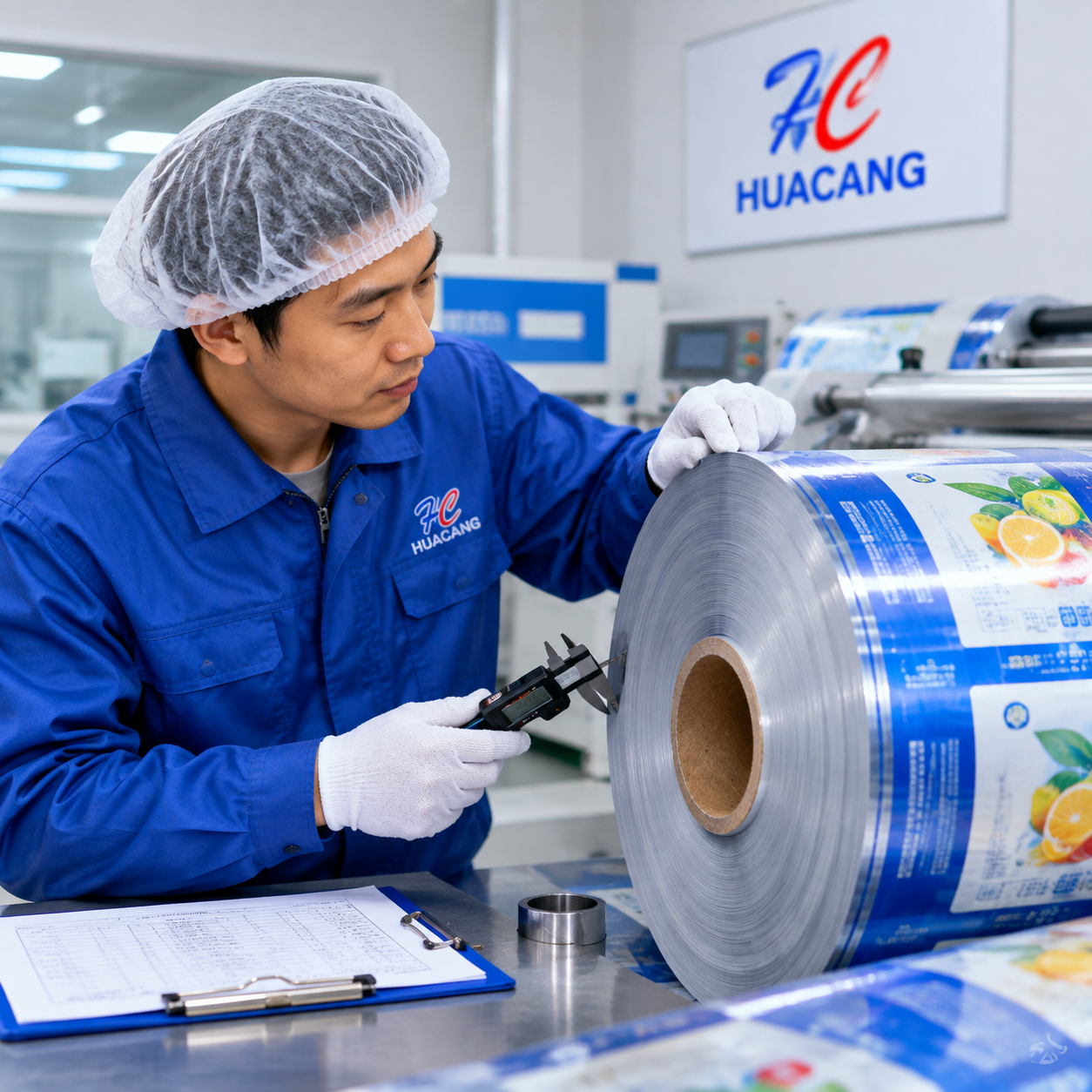
Converting quality affects line efficiency even when the material and print are correct. Purchase specifications should address roll edges, telescoping, wrinkles, blocking, winding tension, core alignment, and visible contamination or damage. Acceptance limits should be measurable and agreed before production.
Splice rules should state the maximum permitted number per roll, approved tape type, flagging or label method, minimum distance from the roll end, and whether printed or barrier-sensitive areas have special restrictions. Confirm whether the machine can pass a splice automatically or requires an operator stop.
Roll labels should normally identify the order, item or SKU, roll number, dimensions, net or gross weight as required, and manufacturing traceability code. Protective end boards, moisture-resistant wrapping, cartons, or palletization can then be selected according to roll size and shipping conditions. Rolls should be restrained without crushing cores or damaging edges.
Step-by-Step Approval Process
- Document the packed product. Provide ingredients or chemical type, particle content, oil or solvent exposure, fill temperature, target shelf life, package size, and distribution conditions. Sensitive formulations may require compatibility testing.
- Collect machine data. Request the web layout, forming method, sealing-jaw information, sensor requirements, core size, maximum roll diameter, maximum roll weight, and target operating speed.
- Select a candidate structure. Translate product and process needs into layer functions, barrier targets, thickness, sealant choice, and surface properties.
- Approve the dieline and winding diagram. Confirm width, repeat, artwork orientation, eye mark, seals, folds, cuts, and unwind direction in one controlled document.
- Review artwork and print standards. Check copy, colors, barcodes, legal marks supplied by the buyer, image resolution, trapping, bleed, and safe zones.
- Test representative material. A laboratory seal test can screen a structure, but a production-scale line trial is more useful for tracking, forming, sensor response, sealing, cutting, and finished-package appearance.
- Approve a controlled production standard. Record the final structure, dimensions, tolerances, color references, test criteria, and retained approval sample where applicable.
- Inspect incoming rolls. Verify labels, count, dimensions, roll condition, winding direction, and agreed quality records before releasing film to production.
Changes to the machine, product formula, filling temperature, artwork layout, or material structure should trigger a documented review. A previous approval may not remain valid after a significant change.
Rollstock Film vs. Premade Pouches
Rollstock is suitable when the buyer has compatible forming and sealing equipment and wants the package to be created during filling. Premade pouches arrive already converted and may be more appropriate when the design requires a fitment, handle, unusual shape, or construction that the buyer’s form-fill-seal line cannot produce.
| Decision factor | Printed rollstock film | Premade pouch |
|---|---|---|
| Package formation | Formed and sealed on the filling line | Converted by the packaging manufacturer before filling |
| Required equipment | Compatible form-fill-seal machine | Pouch loading, opening, filling, and sealing equipment or a suitable manual process |
| Design complexity | Controlled by the line’s forming and sealing capabilities | Can incorporate certain fitments, handles, and die-cut profiles before delivery |
| Critical specifications | Web geometry, repeat, winding, tension, COF, eye mark, and seals | Pouch dimensions, fitment, opening, seals, and filling method |
| Trial focus | Web handling and continuous package formation | Pouch feeding, opening, filling, closure, and finished-package integrity |
For products where visibility is important but a dispensing fitment is also required, a transparent spout pouch for visible liquid products may be more suitable than forming the package from a plain roll on site. Larger refill formats can be evaluated as spout pouches with an integrated carry handle. Brand-led projects requiring a nonstandard outline can instead consider a custom-shaped spout pouch with a dispensing fitment. These alternatives still require compatibility, filling, seal, transport, and product testing.
RFQ Checklist for Buyers
A complete RFQ reduces assumptions and makes supplier quotations easier to compare. Include the following information:
- Product name, type, and relevant compatibility concerns.
- Package style, net fill, filling temperature, and target line speed.
- Machine manufacturer, model, and dimensioned web drawing.
- Requested structure or required functional performance.
- Web width, print repeat, core size, maximum roll diameter, and maximum roll weight.
- Unwind diagram, eye-mark details, and sensor type where known.
- Artwork files, number of colors, print references, and finish.
- Barrier, seal, COF, and mechanical test requirements with test methods.
- Splice limit, roll labeling, packing, and pallet requirements.
- Destination market and documentation requested for the intended product use.
- Number of SKUs, forecast quantity per SKU, order frequency, and delivery destination.
- Sample-roll or production-trial requirements and approval criteria.
Do not rely on a previous supplier’s product code as the complete specification. Request a layer description, dimensional drawing, and measurable acceptance criteria that can be reviewed by both parties.
Conclusion
Successful printed rollstock film sourcing depends on connecting the film construction and artwork to the exact packaging machine and product. Define geometry, winding, roll limits, registration, barrier, sealing, COF, splices, and inspection criteria before production. A controlled drawing and representative machine trial provide a stronger purchasing basis than relying on material name or total thickness alone.
FAQ
What information is essential when ordering printed rollstock film?
At minimum, provide the material structure, thickness, web width, print repeat, unwind drawing, core inside diameter and length, maximum roll diameter and weight, eye-mark details, artwork, print requirements, splice rules, and order quantity. Product, filling, sealing, barrier, and machine information are also necessary when the supplier is expected to recommend a structure.
How is the correct unwind direction determined?
Use a drawing showing the web entering the machine, the artwork’s leading edge, whether print faces inward or outward, the sealant side, and the eye-mark position. Do not rely only on a winding number because numbering conventions can differ between suppliers and machine manufacturers.
Are web width and package width the same?
Not necessarily. Web width can include front and back panels, fin- or lap-seal allowance, gussets, multiple lanes, trim, and other machine-specific features. The value should be taken from a qualified machine drawing rather than calculated from the visible package width alone.
Should a buyer specify total film thickness or every layer?
Specify both when possible. Total thickness supports incoming inspection, while the layer-by-layer structure explains the intended print, barrier, mechanical, and sealing functions. Films with equal total thickness can perform differently when their materials, layer gauges, adhesives, or sealants differ.
Is a sample roll necessary before a production order?
A representative trial roll is advisable for a new machine, structure, artwork layout, or product. It allows the buyer to assess unwind behavior, tracking, sensor response, forming, seals, cutting, graphics position, and the finished package. The required roll length should be agreed according to threading waste, startup time, and the planned trial protocol.
Need Custom Spout Pouch Packaging?
Share your product, fill volume, packaging requirements, artwork, and estimated order quantity. Our packaging team can discuss pouch structure, spout fitment, MOQ, samples, and the information needed for a quotation.