Table of Contents
- Flexible Packaging OTR and WVTR: What Buyers Need to Know
- OTR and WVTR Definitions and Units
- Why Test Conditions Change Barrier Results
- Translate Product Sensitivity into Barrier Requirements
- Barrier Film and Laminate Structure Comparison
- Film Data Versus Finished-Package Performance
- What to Include in Barrier Film Specifications
- How to Compare Supplier Barrier Data
- Application and Pouch Format Factors
- Common OTR and WVTR Specification Mistakes
- Conclusion
A practical guide to interpreting OTR and WVTR data, comparing barrier films under equivalent test conditions, and writing usable pouch specifications.
Flexible Packaging OTR and WVTR: What Buyers Need to Know
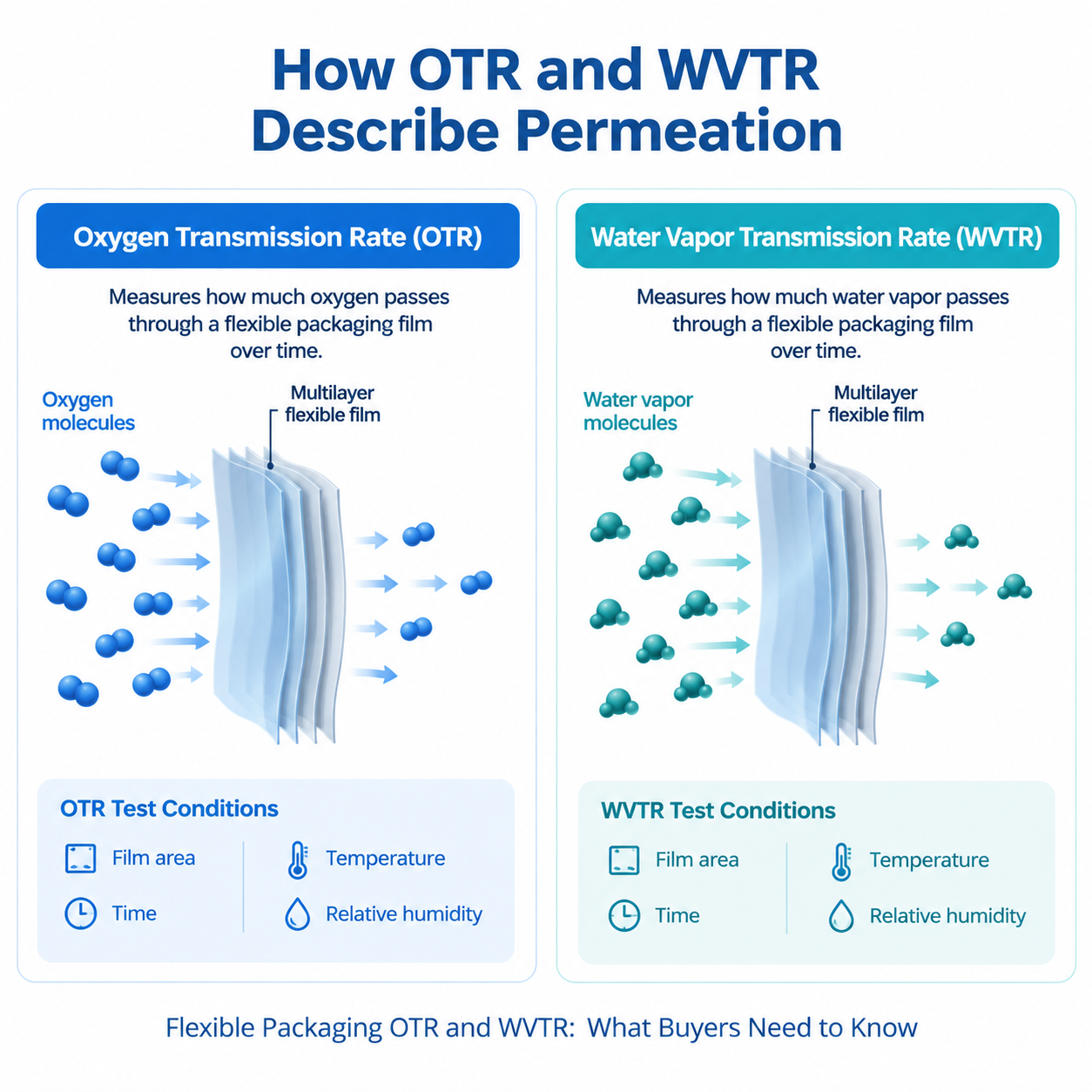
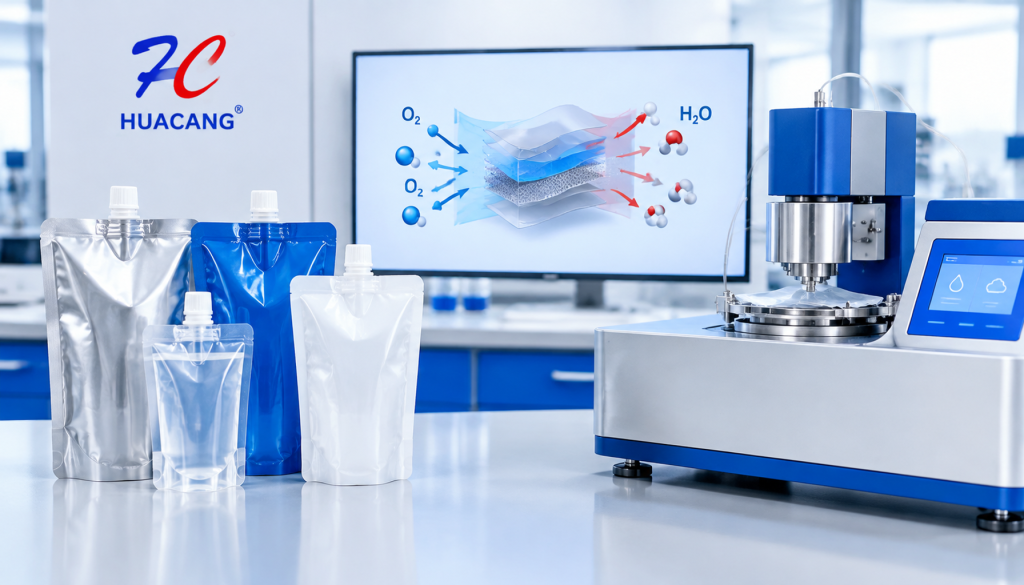
Flexible packaging OTR and WVTR values describe how quickly oxygen and water vapor pass through a film or laminate under stated test conditions. Lower values indicate a stronger barrier to the measured gas or vapor. Buyers should use these values to compare candidate structures, but a number without its units, temperature, relative humidity, test method, sample construction, and test orientation is not a complete specification.
OTR and WVTR are shelf-life inputs rather than shelf-life guarantees. Actual product life also depends on package area, headspace, initial oxygen or moisture, seal quality, spout and closure performance, distribution conditions, light exposure, and the sensitivity of the formulation.
Key takeaways:
- Compare results only when units and test conditions are equivalent.
- Specify a maximum acceptable value, not merely a target laminate name.
- Distinguish flat-film data from results for a converted pouch or complete package.
- Validate the final printed, laminated, converted, and filled package before commercial release.
OTR and WVTR Definitions and Units
Oxygen transmission rate (OTR) is the quantity of oxygen that passes through a defined area of material during a defined time. A common metric unit is cm³/(m²·day), although some reports include pressure in the denominator. US laboratories may report cc/(100 in²·day). The report must state the basis used.
Water vapor transmission rate (WVTR) is the mass of water vapor passing through a defined area during a defined time. It is commonly reported as g/(m²·day) or g/(100 in²·day). It is also called moisture vapor transmission rate, or MVTR.
Both values normally apply to a specific material gauge and construction. For example, “PET/PE” does not provide enough information to predict barrier performance because resin grade, layer thickness, coatings, adhesives, and manufacturing variation can change the result. A complete data record identifies the exact tested laminate.
Why Test Conditions Change Barrier Results
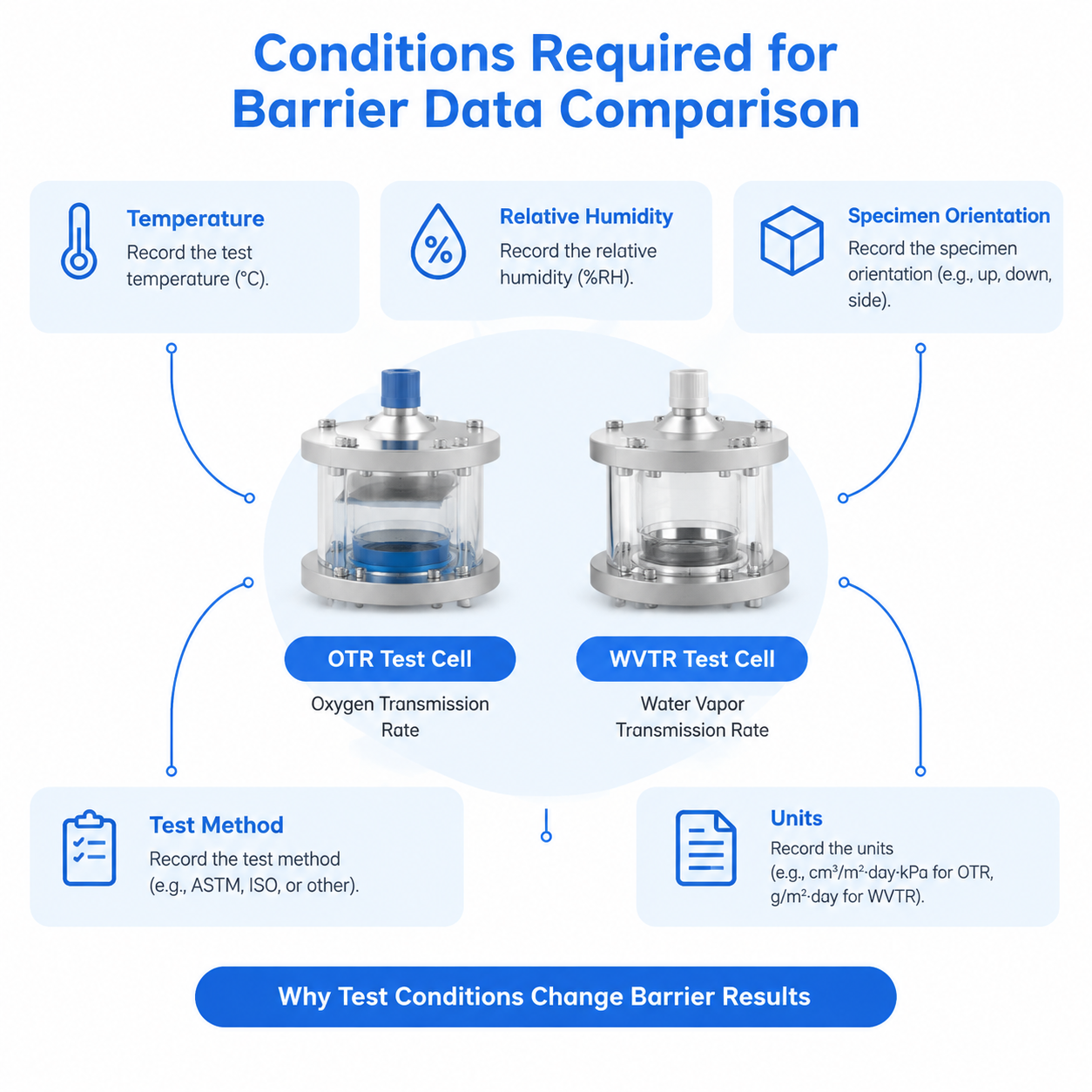
Temperature and relative humidity affect permeation, so values generated under different conditions may not be directly comparable. Higher temperature generally increases molecular movement and transmission. Humidity can also alter the behavior of hygroscopic barrier layers such as EVOH and some polyamides. The effect depends on where each material sits in the laminate and whether protective layers limit moisture exposure.
An OTR report should identify the test temperature, relative humidity on each side of the specimen when applicable, oxygen concentration or pressure basis, test standard, equipment approach, and sample orientation. Common instrumental methods include ASTM D3985 and ISO 15105-2. WVTR reports should likewise state temperature, relative-humidity gradient, method, and orientation; commonly referenced methods include ASTM F1249 and ISO 15106-2. A gravimetric method may produce data on a different basis from an instrumental method.
Do not convert a result measured at one temperature or humidity into another condition with a simple universal factor. The relationship is material-specific. If the use environment differs materially from the available data, request testing at a representative condition.
Translate Product Sensitivity into Barrier Requirements
Begin with the product failure mode rather than selecting the material first. Oxidation can affect flavors, colors, oils, vitamins, fragrances, and other oxygen-sensitive ingredients. Moisture gain can soften dry products, cause clumping, or change chemical stability. Moisture loss can alter product weight, viscosity, or texture. Some products require both barriers, while others are limited primarily by seals, light, temperature, or microbial control.
- Define the intended shelf life. State whether the period begins at packing, manufacture, or shipment.
- Identify distribution conditions. Include expected temperatures, humidity, transport time, warehouse exposure, and retail environment.
- Set the allowable product change. Use product testing to define acceptable oxygen uptake, moisture gain or loss, flavor change, viscosity change, or other relevant endpoint.
- Account for package geometry. A transmission rate stated per square meter must be scaled to the actual permeating area.
- Include initial conditions. Consider dissolved oxygen, headspace oxygen, product moisture, nitrogen flushing, and residual air after filling.
For a simplified screening estimate, permeation through the pouch body can be approximated as transmission rate × effective area × time. This calculation assumes the reported test conditions represent distribution and does not automatically account for seals, folds, pinholes, spouts, closures, or changing concentration gradients. It is useful for comparing options, but it should not replace product shelf-life validation.
Barrier Film and Laminate Structure Comparison
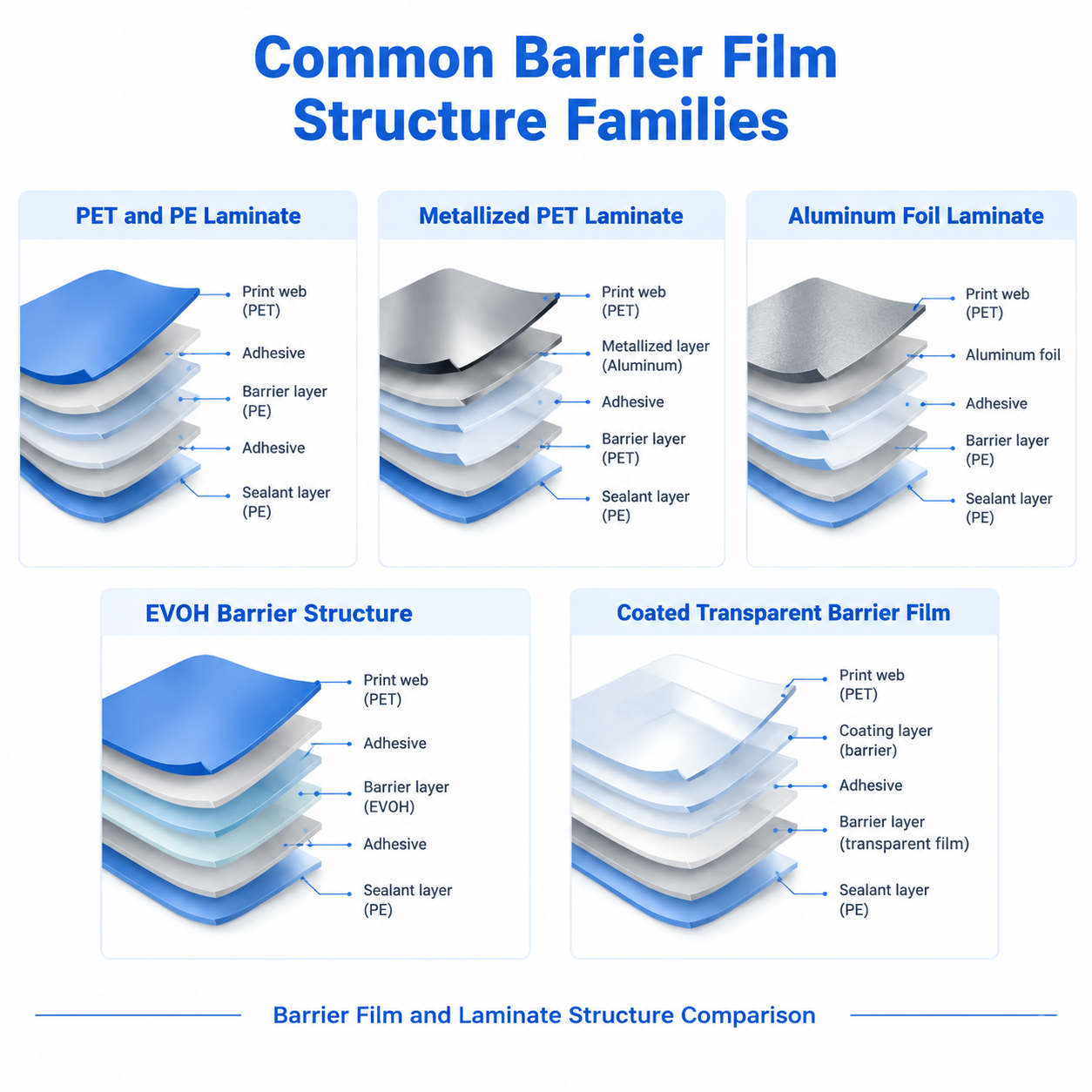
The following product-oriented comparison shows how common material families contribute to flexible packaging barrier properties. It intentionally avoids universal OTR or WVTR numbers because performance varies with grade, thickness, coating weight, lamination quality, flexing, and test conditions.
| Structure or barrier layer | Primary contribution | Common uses | Buyer considerations |
|---|---|---|---|
| PET/PE laminate | Print surface, stiffness, sealing, and moderate moisture protection depending on gauge | Household liquids, personal care products, and less barrier-sensitive foods | Standard PET is not normally selected as a high oxygen barrier by itself. Confirm whether the product needs an added coating or barrier layer. |
| Metallized PET laminate | Improved oxygen, moisture, and light barrier compared with an equivalent clear base film | Coffee, powders, snacks, concentrates, and selected refill products | Barrier depends on metal deposition quality and can decline after severe flexing or converting damage. |
| Aluminum foil laminate | Very high light, oxygen, and moisture barrier when the foil remains intact | Highly sensitive foods, concentrates, and long-distribution applications | Evaluate foil gauge, flex-crack risk, pinholes, pouch geometry, and recycling constraints in the target market. |
| EVOH coextrusion or laminate | Strong oxygen barrier under suitable humidity conditions | Sauces, beverages, and other oxygen-sensitive products | Performance is sensitive to moisture exposure. Layer placement and protective polyolefin layers matter. |
| Coated transparent barrier film | Enhanced oxygen and sometimes moisture barrier while retaining product visibility | Products requiring a clear window or full transparent presentation | Confirm coating type, flex durability, seal-area design, and the exact OTR and WVTR conditions. |
| PE-rich or mono-material-oriented structure | Sealing and moisture resistance with a design intended around one main polymer family | Selected refill, food, and household-liquid formats | Required oxygen barrier may need a compatible barrier technology. Recyclability claims require market-specific evaluation. |
Use this table to form a shortlist, then compare actual supplier data for the exact proposed construction. Nominal material names are not substitutes for tested barrier film specifications.
Film Data Versus Finished-Package Performance
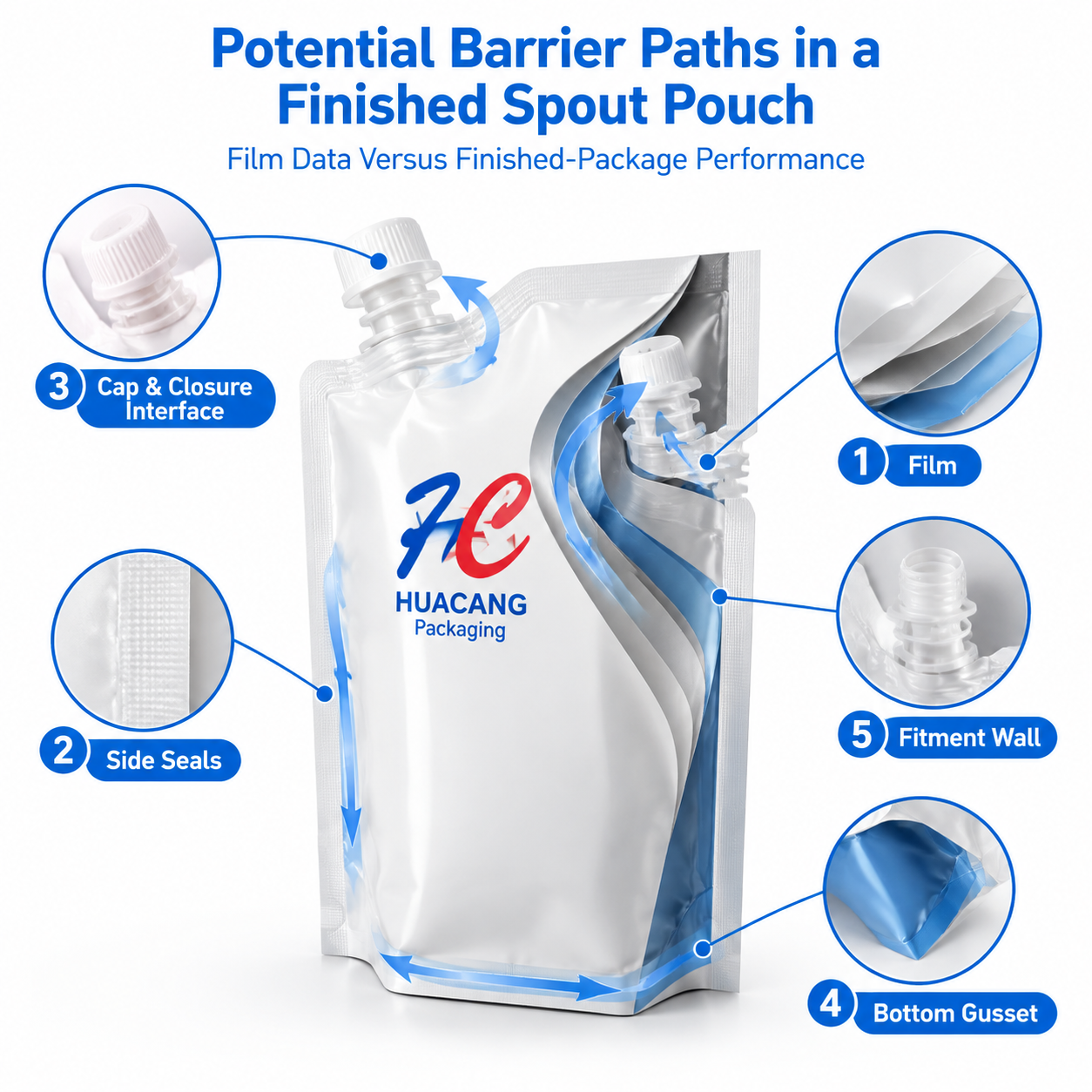
A flat-film result characterizes the specimen placed in the test cell. It does not automatically represent the entire pouch. Printing, lamination, curing, slitting, forming, gusset folding, heat sealing, fitment insertion, and handling can change the effective package barrier.
For a spout pouch, permeation can occur through the pouch panels, seals, polymer fitment, cap, closure interface, or any damaged area. The importance of each path depends on package size, film barrier, fitment resin and wall thickness, closure design, and shelf-life requirement. As the body film becomes more protective, non-film paths may represent a larger share of total ingress.
Buyers should therefore distinguish among three evidence levels: supplier technical data for a material family, a test report for the exact finished laminate, and whole-package or filled-product validation. The last level provides the closest evidence for commercial use, provided that production materials and processes match the tested package.
What to Include in Barrier Film Specifications
A purchasing specification should make the acceptance requirement reproducible. Include the following information in the RFQ, approved specification, or quality agreement:
- Exact layer sequence, material family, and nominal total thickness.
- Individual layer gauges when they are critical to function.
- Maximum acceptable OTR with units, temperature, humidity, pressure basis, test method, and test orientation.
- Maximum acceptable WVTR with units, temperature, humidity gradient, test method, and orientation.
- Whether results apply to unprinted film, printed laminate, converted pouch, or finished package.
- Sample conditioning, number of specimens, reporting precision, and acceptance approach.
- Package dimensions, fill volume, surface area, and spout or closure specification.
- Filling method, fill temperature, post-fill treatment, and expected distribution conditions.
- Requirements for supporting test reports, certificates, retained samples, and change notification.
Use “maximum” for transmission-rate acceptance because lower OTR or WVTR represents greater resistance to transmission. Avoid specifying an exact value unless a justified tolerance is provided; normal material and measurement variation makes an exact single-number requirement impractical.
Also state whether the supplier may substitute a resin, adhesive, coating, gauge, or layer arrangement. A seemingly minor construction change can affect barrier, seal behavior, product compatibility, and filling performance, so changes should be reviewed before production.
How to Compare Supplier Barrier Data
Use a controlled comparison instead of ranking films by the smallest number shown on separate data sheets.
- Normalize the units. Convert area and volume units carefully, and check whether pressure is included in the OTR basis.
- Match the conditions. Compare temperature and relative humidity on both sides of the specimen. Treat unmatched conditions as separate data sets.
- Check the specimen. Confirm the full laminate structure, thickness, print status, curing status, and orientation.
- Review the method. Determine whether the same standard and test principle were used. Record detection limits when very low rates are reported.
- Assess data quality. Request the test date, laboratory identity, specimen count, individual or average results, and any deviations from the named method.
- Relate the value to the package. Calculate the approximate permeation contribution for the actual pouch area and intended shelf-life period.
- Verify the converted format. Test representative samples after printing, lamination, pouch making, fitment sealing, and any required thermal process.
If data cannot be normalized confidently, ask suppliers to test candidate structures under the same protocol. This creates a more useful technical and commercial comparison than relying on unrelated nominal values.
Application and Pouch Format Factors
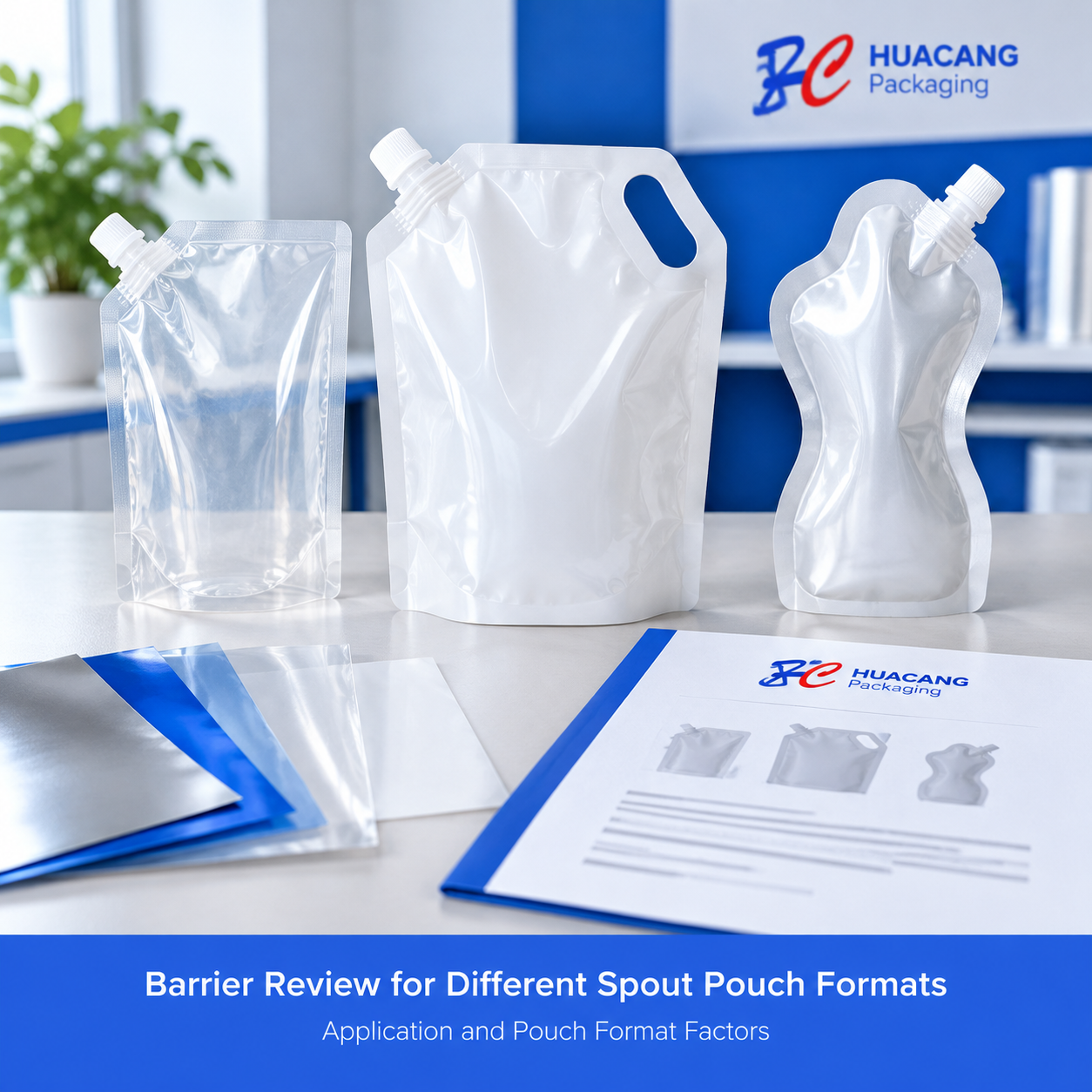
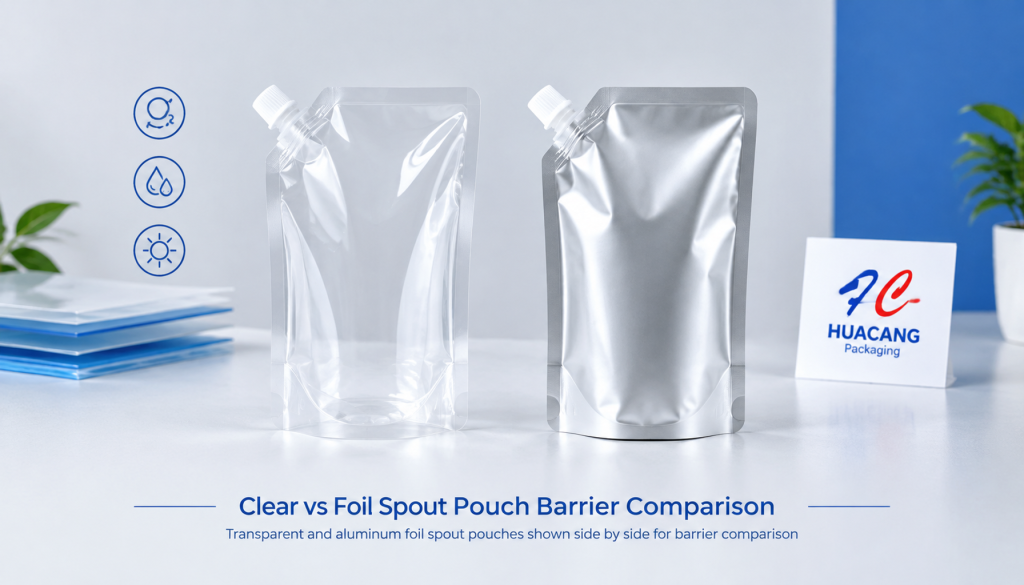
Barrier selection must fit the product, pouch format, filling process, and merchandising requirement. A clear package may need a transparent coating or EVOH-based construction when product visibility is important. Buyers evaluating this format can review transparent spout pouch options, then define the required OTR, WVTR, light exposure, and seal performance for the actual contents.
Larger packs have more film area and may contain more headspace, while carrying and pouring create additional mechanical demands. For handle spout pouches for larger liquid packs, barrier selection should be reviewed together with film toughness, handle reinforcement, filled weight, drop performance, and fitment sealing.
Unusual contours can introduce tight radii, stress concentration, or additional seal geometry. When specifying custom-shaped spout pouch formats, assess whether forming and distribution could flex or damage a metallized or foil barrier layer.
Hot filling, retort processing, freezing, and chemical exposure require separate material and package validation. A film with favorable room-temperature barrier data is not automatically suitable for elevated-temperature processing, repeated flexing, aggressive ingredients, or direct food contact. Product compatibility and regulatory documentation should be reviewed independently from OTR and WVTR.
Common OTR and WVTR Specification Mistakes
- Comparing unlike conditions: A lower published value is not necessarily better if it was measured at a less demanding temperature or humidity.
- Leaving out units: Metric and US customary area bases can produce numbers that look similar while representing different rates.
- Specifying only a laminate abbreviation: Layer names without grades, thicknesses, and test values do not define performance.
- Using flat-film data as a package guarantee: Seals, folds, spouts, closures, and converting damage can affect the finished result.
- Ignoring variability: Specifications need an acceptance limit, sampling plan, and agreed test method.
- Assuming barrier alone establishes shelf life: Product chemistry, processing, initial headspace, seal integrity, light, and distribution also matter.
- Selecting excessive barrier without analysis: A more complex laminate may add cost or affect processing without extending useful shelf life if another failure mode controls the product.
Conclusion
Effective flexible packaging OTR and WVTR specifications connect product sensitivity with measurable package requirements. Begin with the intended shelf life and distribution environment, compare exact structures under equivalent conditions, and express acceptance limits with complete units and test details. Then verify that the printed laminate, seals, spout, closure, and converted pouch perform together.
This process helps buyers avoid both insufficient protection and unnecessary material complexity. Final approval should be based on representative production samples and filled-product testing under conditions relevant to the intended market.
FAQ
Is a lower OTR or WVTR always better?
A lower value means less oxygen or water vapor passed through the tested material under the stated conditions. However, the lowest available value is not automatically the best commercial choice. The requirement should be based on product sensitivity, package area, intended shelf life, distribution conditions, processing needs, and cost. Values are comparable only when units, test methods, temperature, humidity, and specimen construction are aligned.
What is a good OTR for flexible packaging?
There is no universal good OTR. An acceptable value depends on how much oxygen the product can tolerate, the pouch area, initial headspace and dissolved oxygen, target shelf life, temperature, humidity, and the contribution of seals and closures. Buyers should establish a maximum OTR from product stability work and package modeling, then validate the finished package.
What is a good WVTR for packaging film?
A suitable WVTR is application-specific. A dry, moisture-sensitive powder may require a much stronger moisture barrier than a stable household liquid. Determine the permitted moisture gain or loss over the required shelf life, account for package area and distribution humidity, and specify a maximum WVTR under defined test conditions.
Can OTR and WVTR values predict exact product shelf life?
Not by themselves. They can support screening and shelf-life models, but exact shelf life also depends on product composition, processing, headspace, package geometry, seal integrity, spout and closure transmission, light, temperature, humidity, and transport stresses. Filled-package stability testing remains necessary for final validation.
Should buyers test film or the complete pouch?
Both can be useful at different stages. Flat-film testing supports material screening and incoming specification control. Testing the converted pouch reveals effects from printing, lamination, folding, sealing, and fitment insertion. Filled-product studies under representative storage conditions provide the strongest evidence for commercial approval.
Need Custom Spout Pouch Packaging?
Share your product, fill volume, pouch structure, spout fitment, barrier requirements, artwork, MOQ, sample needs, and quote requirements. Our packaging team can recommend a suitable pouch structure and spout option for evaluation.