Table of Contents
- What Tamper-Evident Means for a Spout Pouch
- How a Tamper-Evident Closure System Works
- Comparison of Tamper-Evident Closure Options
- Closure Specification Table for Buyer RFQs
- Match the Closure to the Filling Process
- How to Select a Tamper-Evident Pouch Closure
- Tamper-Evident Is Not the Same as Child-Resistant
- Inspection and Validation Checks
- Application Examples
- Key Takeaways for Packaging Buyers
- Conclusion
Compare breakaway caps, foil liners, sealed membranes, pull-ring fitments, and shrink bands for tamper-evident spout pouches. Learn how to match visible opening evidence to the product, filling process, inspection method, and consumer-use requirements.
What Tamper-Evident Means for a Spout Pouch
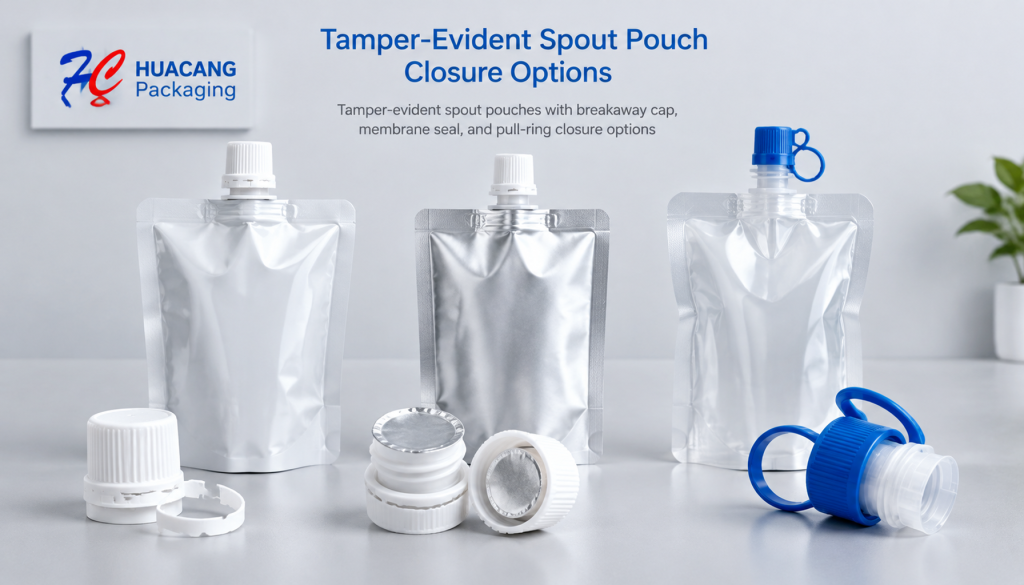
Tamper-evident spout pouches use a closure feature that changes visibly when the package is opened for the first time. Common choices include a breakaway cap, a foil liner, a sealed membrane, an integral pull-ring diaphragm, or an external shrink band. The right option depends on how the pouch is filled, how obvious the evidence must be, whether the product needs an additional barrier at the spout, and how the consumer will open and reclose the package.
For procurement purposes, the closure should be treated as a system consisting of the cap, spout neck, threads or snap features, sealing land, optional membrane or liner, fitment-to-film seal, and application process. Selecting only a cap style without reviewing the mating spout and filling line can result in premature band breakage, poor liner sealing, excessive opening force, or unclear visual evidence.
How a Tamper-Evident Closure System Works
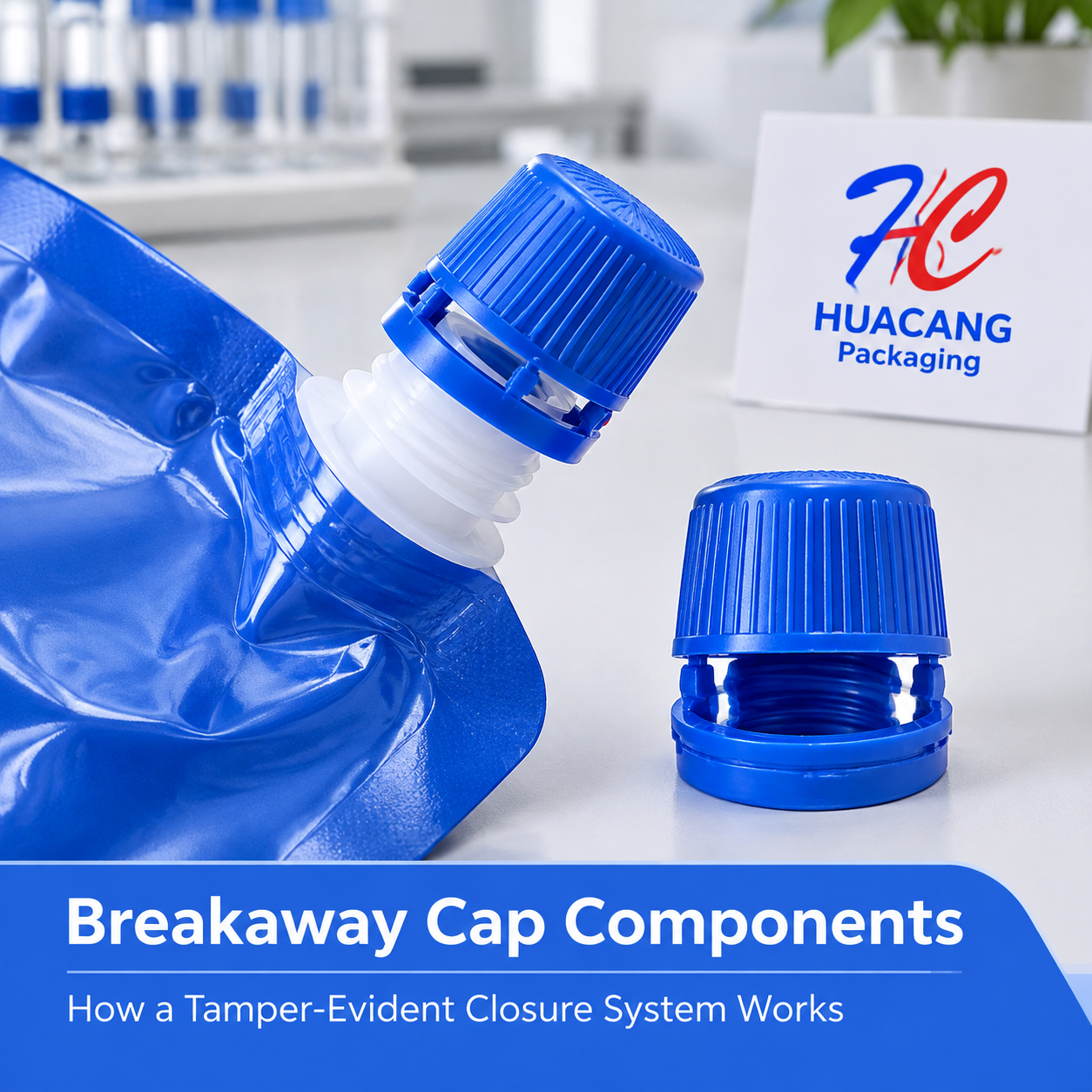
A tamper evident pouch cap normally creates evidence through one of three mechanisms: a component breaks, a seal must be removed, or an external band changes permanently. With a threaded breakaway cap, small bridges connect the cap shell to a lower ring. Correct first opening breaks those bridges, leaving the ring separated or retained below the spout’s locking feature.
A liner or membrane works differently. It closes the spout opening beneath the cap and must be peeled, punctured, or torn before dispensing. This can provide both visible opening evidence and an additional closure surface, but only when the liner material, spout resin, sealing land, and application process are compatible. An integral pull-ring fitment uses a molded diaphragm that is removed by pulling a ring or tab.
The fitment-to-pouch joint is another critical spout pouch seal, but it is not usually the consumer-facing tamper indicator. It must remain leak-resistant throughout filling, distribution, and use while the selected closure provides the intended first-opening evidence.
Comparison of Tamper-Evident Closure Options
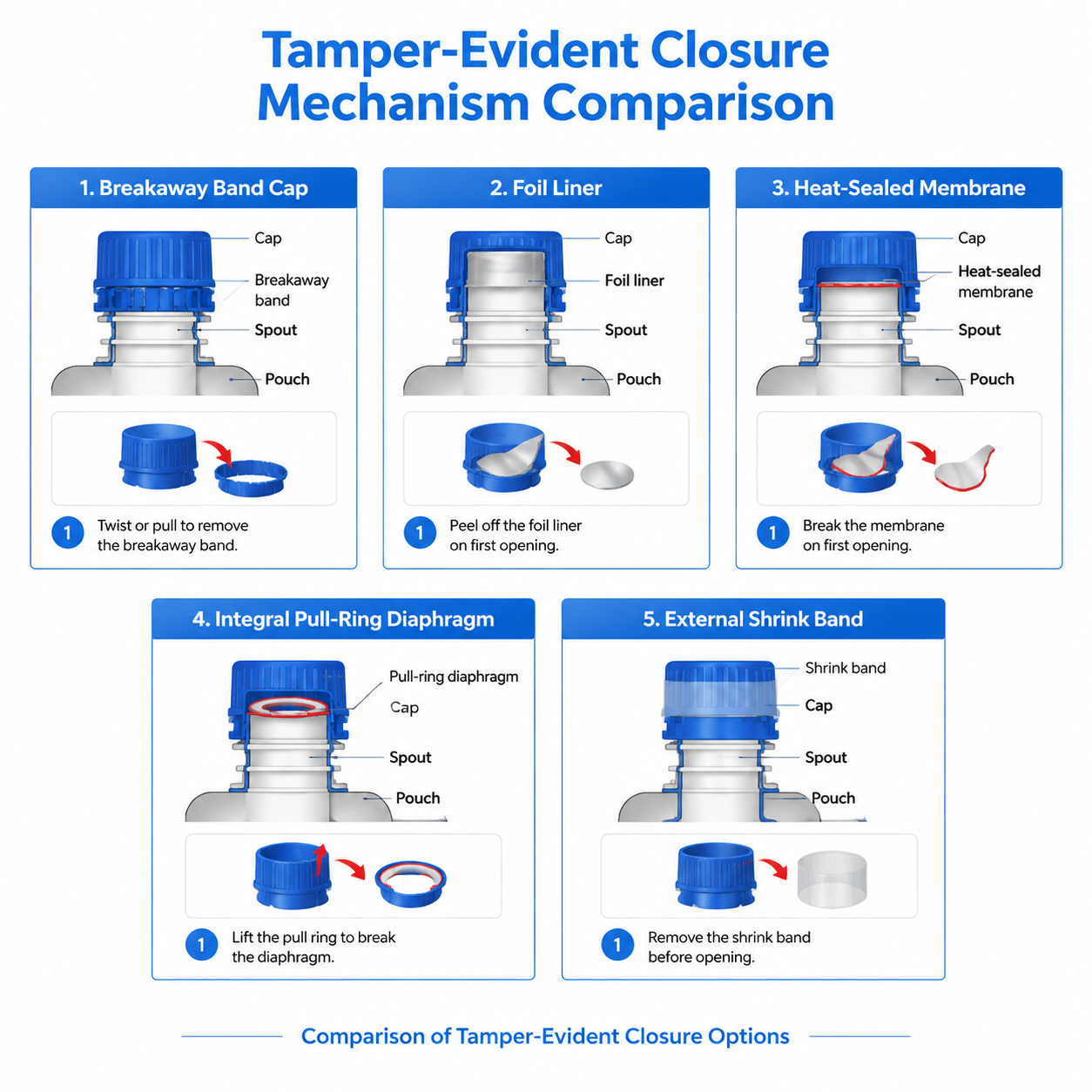
No single closure is appropriate for every project. The table compares the principal pouch closure options at a sourcing level; final suitability must be confirmed using production-representative components and filled-package testing.
| Closure option | How opening is shown | Advantages | Points to verify | Typical fit |
|---|---|---|---|---|
| Breakaway band cap | Frangible bridges break and the lower ring separates | Evidence is external and usually easy to inspect; cap remains reclosable | Cap-spout geometry, application torque, bridge strength, ring retention, and line handling | Beverages, sauces, refills, and other multi-use liquids |
| Foil or induction liner | Liner must be peeled or punctured | Evidence is directly over the dispensing opening; may add a barrier surface | Induction compatibility, spout resin, sealing land, liner construction, seal window, and peel behavior | Products needing under-cap evidence where compatible sealing equipment is available |
| Heat-sealed membrane | Film or foil membrane is removed or pierced | Can provide clear evidence at the opening | Membrane application sequence, seal strength, contamination at the sealing land, and opening force | Purpose-designed filling and membrane-sealing systems |
| Integral pull-ring diaphragm | Molded diaphragm tears away when the ring is pulled | Tamper feature is integrated into the fitment | Pull force, tear path, loose-part risk, molding consistency, and consumer accessibility | Projects able to use a dedicated fitment design |
| External shrink band | Band tears, splits, or is removed from the cap and neck | Highly visible before opening and adaptable to some existing closures | Secondary application equipment, perforation quality, heat exposure, band retention, and material disposal | Products needing conspicuous external evidence |
Closure Specification Table for Buyer RFQs
A useful RFQ identifies the entire closure interface instead of requesting a generic tamper-proof cap. “Tamper-proof” should be avoided because these features provide evidence rather than an absolute guarantee against interference.
| Specification item | Information to provide or request | Why it matters |
|---|---|---|
| Product and fill conditions | Ingredients, pH where relevant, viscosity, particles, oils or solvents, fill temperature, and storage conditions | Supports material compatibility and opening-size review |
| Spout | Nominal opening, neck finish, flange shape, resin, top or corner position, and drawing | Defines cap fit, flow, pouch sealing, and line handling |
| Cap | Threaded or snap-on design, tamper-band type, resin, dimensions, color, and required opening behavior | Establishes mechanical compatibility and visible evidence |
| Liner or membrane | Material, sealing method, peel or puncture requirement, and contact compatibility | Determines whether under-cap evidence can be applied consistently |
| Filling method | Through-spout or open-top filling, cap application sequence, line speed range, and available sealing equipment | Prevents the tamper feature from being activated during filling |
| Verification | Torque limits, visual criteria, leak testing, opening-force checks, transport tests, and sampling plan | Turns the design intent into measurable acceptance criteria |
Match the Closure to the Filling Process
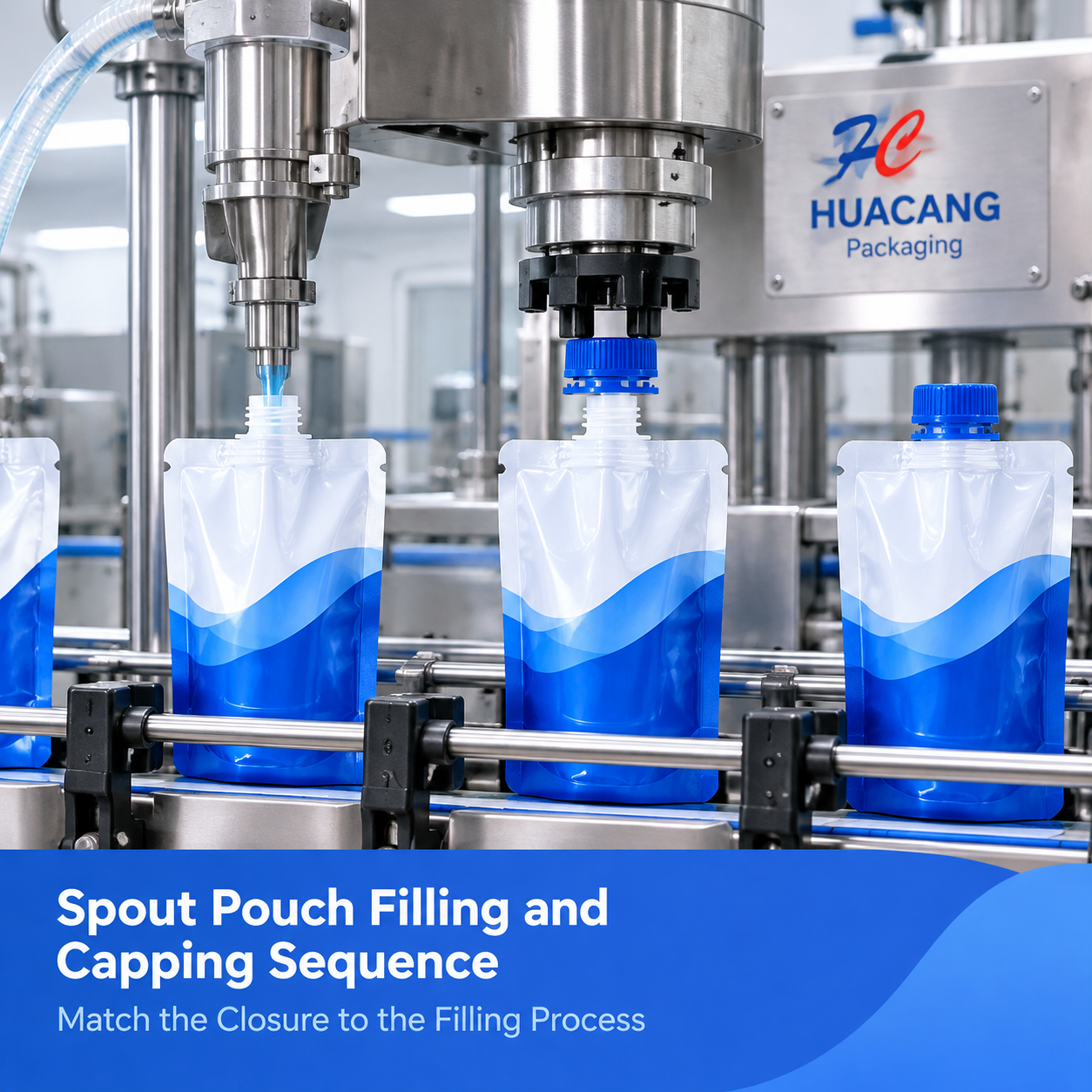
The filling sequence often determines whether a tamper-evident design is practical. For through-spout filling, the pouch generally reaches the filling station with the dispensing opening accessible. The cap is then applied after filling. A breakaway band must pass over the spout’s retaining feature without breaking prematurely, while application torque must be sufficient for closure engagement without deforming the fitment.
For open-top filling, a pre-applied cap may remain untouched while the product enters through the unsealed pouch top. The top is sealed after filling. This can simplify cap handling, but the process still requires protection against product contamination around the fitment and stable pouch presentation during filling.
Foil liners and membranes add another operation. Buyers should confirm whether the seal is pre-applied to the closure, activated after cap application, or applied directly to the spout. Conventional induction equipment cannot be assumed to work with every flexible pouch fitment. The pouch must remain stable in the equipment, and the spout neck, liner, and cap must form a validated system.
How to Select a Tamper-Evident Pouch Closure
Use a step-by-step selection process so that visible evidence, sealing performance, and production requirements are evaluated together.
- Define the required evidence. Decide whether inspectors and consumers must see evidence outside the cap, beneath the cap, or at both locations. Consider whether evidence remains visible after the cap is reinstalled.
- Map the filling and capping sequence. Record when the spout is accessible, when the cap is fitted, and whether membrane or induction equipment is available.
- Check product compatibility. Review the product against the pouch film, spout, cap, liner, inks, adhesives, and any direct-contact membrane. Actual formulation information is more useful than a broad description such as “food” or “cleaner.”
- Set opening and dispensing requirements. Consider hand strength, cap diameter, grip texture, pull-tab access, viscosity, particles, desired flow rate, and whether the package will be reclosed repeatedly.
- Evaluate distribution conditions. Filled weight, headspace, temperature, altitude changes, carton orientation, vibration, and drops can affect the cap, spout joint, and pouch body.
- Approve production-representative samples. Test the final film structure, fitment, cap, printing, fill conditions, and capping settings together. Appearance samples alone cannot establish line compatibility or filled-package performance.
Tamper-Evident Is Not the Same as Child-Resistant
Tamper-evident packaging is designed to leave visible evidence of opening or interference. Child-resistant packaging is designed to make access difficult for children while remaining usable by adults under defined test protocols. A standard breakaway cap may be tamper-evident without being child-resistant, and a child-resistant closure may still require a separate tamper-evident feature.
Do not substitute one claim for the other in specifications, artwork, or compliance files. Requirements depend on the product category and destination market. In the United States, the tamper-evident packaging requirements in 21 CFR 211.132 concern specified over-the-counter human drug products; they should not be applied automatically to every pouch category. Child-resistant requirements are addressed separately, including guidance provided by the U.S. Consumer Product Safety Commission. Buyers should identify the rules and test methods applicable to their exact formulation, claim, use, and sales market.
Inspection and Validation Checks
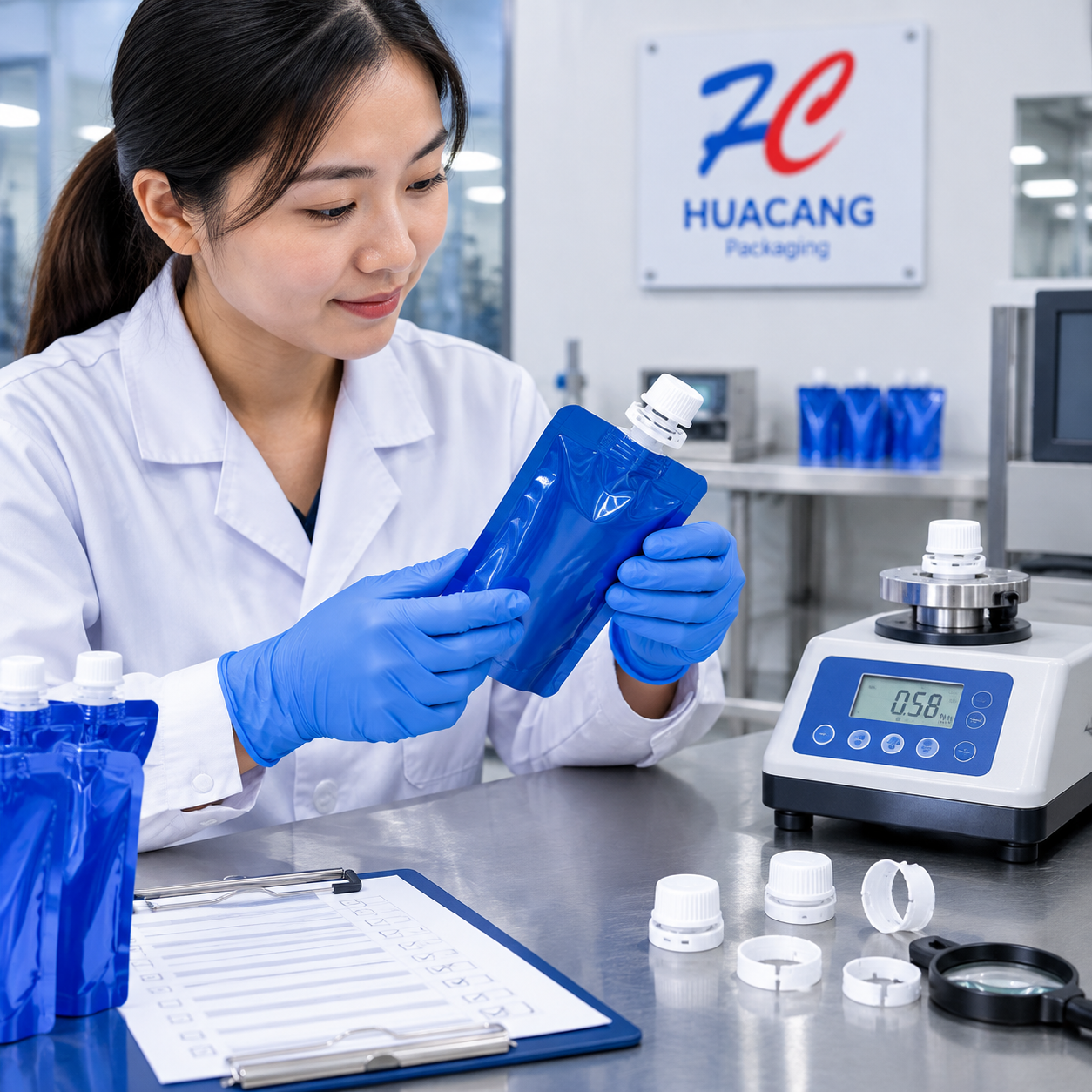
Validation should confirm that intact packs are recognizable, first opening creates consistent evidence, and the pouch continues to meet its leakage and dispensing requirements. Establish acceptance criteria before the production trial.
- Incoming component inspection: Check cap and spout dimensions, threads, locking features, frangible bridges, sealing lands, resin identification, and contamination.
- Application checks: Record capper settings and applied torque where relevant. Inspect for cocked caps, damaged bands, incomplete ring engagement, wrinkled liners, or displaced membranes.
- First-opening checks: Confirm where bridges break, whether the ring remains visible, and whether the liner or diaphragm removes as intended. Measure opening torque or pull force when the specification requires it.
- Leak and distribution checks: Test filled, sealed packages under agreed orientations and conditions. Include the pouch body, fitment-to-film seal, cap interface, and membrane rather than testing the cap alone.
- Post-aging review: Recheck closure operation after relevant storage because product contact, temperature, and time can change torque, peel behavior, or material dimensions.
For US food projects, the FDA’s food ingredients and packaging resources provide a starting point for understanding the regulatory framework. Compliance documentation and migration or compatibility review must still be matched to the actual materials, food type, conditions of use, and supply chain.
Application Examples
Application context can narrow the closure choice. A sauce or beverage in a transparent spout pouch may use an external breakaway band when clear first-opening evidence and repeated reclosure are priorities. The clear pouch still requires a film structure selected for the product’s barrier and processing needs.
Family-size or refill products packaged in spout pouches with carry handles place more filled weight on the package. Closure selection should therefore be reviewed together with handle strength, pouch seals, pouring control, cap grip, and transport testing.
For a custom-shaped spout pouch, the cap and tamper feature must remain accessible despite the silhouette, graphics, and display orientation. A decorative shape should not hide the tamper band, restrict capping equipment, or make the first-opening feature difficult to inspect.
Key Takeaways for Packaging Buyers
Conclusion
Tamper-evident spout pouches should be specified around the required visual evidence, product contact conditions, filling sequence, opening experience, and inspection method. Breakaway caps are practical when external evidence and reclosure are needed, while liners, membranes, pull-ring diaphragms, and shrink bands address different evidence and processing priorities. Final approval should be based on production-representative components and filled-package testing.
FAQ
What is the most common tamper-evident closure for a spout pouch?
A threaded breakaway band cap is a common choice because first opening breaks visible bridges between the cap and lower ring. Suitability still depends on the spout neck, filling sequence, application torque, product, and market requirements.
Can a spout pouch use both a breakaway cap and a foil seal?
Yes. A design may combine external evidence from a breakaway band with under-cap evidence from a foil liner or membrane. The spout, liner, cap, and sealing equipment must be compatible, and the combined opening experience should be tested.
Is a tamper-evident cap child-resistant?
Not automatically. Tamper evidence indicates prior opening or interference, while child resistance is evaluated under separate requirements and test protocols. Specify and validate the two functions independently.
Can a tamper-evident cap be applied before filling?
It can remain pre-applied when the pouch is filled through an open top that is sealed afterward. For through-spout filling, the cap is generally applied after filling because removing it beforehand could activate the tamper feature.
What should buyers test before approving a tamper-evident pouch?
Test cap application, first-opening evidence, torque or pull force where relevant, leakage, dispensing, reclosure, storage, and distribution using production-representative pouches filled with the actual product or an approved test medium.
Need Custom Spout Pouch Packaging?
Share your product, fill volume, pouch structure requirements, preferred spout and tamper-evident closure, filling method, artwork, estimated order quantity, sample needs, and quote requirements. Our packaging team can review the fitment and recommend a suitable configuration for testing.