Table of Contents
- Why Spout Pouch Prices Vary
- Main Cost Drivers
- Configuration and Cost Impact
- Materials, Barrier, and Thickness
- Fitments and Pouch Converting
- Printing, Tooling, and Order Quantity
- Information Needed for an Accurate Quote
- How to Compare Supplier Quotes
A practical guide to the specifications, production decisions, and commercial terms that affect a custom spout pouch quotation.
Why Spout Pouch Prices Vary

Custom spout pouch cost is determined by the complete packaging specification, not capacity alone. Film structure, pouch dimensions, barrier requirements, spout and cap design, printing method, order quantity, testing, packing, and commercial terms all affect the quotation. Two pouches with the same nominal volume can therefore have different unit costs.
This guide assumes a custom-printed B2B order manufactured to an approved specification. Freight, import duties, filling, product testing, and destination-specific certification are excluded unless a supplier explicitly includes them. Buyers should confirm the quotation currency, Incoterm, validity period, and whether prices include cylinders, plates, molds, samples, cartons, or inspection.
A useful quote separates one-time charges from recurring production costs. One-time items may include printing cylinders, plates, cutting dies, or a new fitment mold. Recurring costs normally include laminated film, printing, pouch conversion, spout insertion, caps, inspection, and export packing. The exact breakdown depends on the production process and supplier quotation format.
Main Cost Drivers in a Spout Pouch Quote
The following variables usually have the greatest influence on price. Their importance changes by application, run size, and manufacturing route.
| Cost driver | What the supplier evaluates | Why it affects the quote |
|---|---|---|
| Film structure | Resins, barrier layers, foil, adhesives, and total thickness | Changes material consumption, lamination steps, and processing requirements |
| Pouch dimensions | Width, height, gusset, seal area, and film yield | Determines material usage and the number of pouches produced across the web |
| Spout and cap | Neck size, flange, cap style, color, tamper evidence, and dispensing function | Affects component price, tooling compatibility, insertion, and sealing |
| Printing | Method, number of colors, artwork coverage, finish, and SKU count | Influences setup, cylinders or plates, ink use, and changeovers |
| Order quantity | Quantity per size, artwork, structure, and fitment combination | Fixed setup costs are distributed across the accepted production quantity |
| Pouch geometry | Standard rectangular, handle, contour, or custom shape | May require additional converting steps, dies, registration control, or waste allowance |
| Quality requirements | Inspection plan, leak testing, dimensions, torque checks, and documentation | Adds sampling, labor, test time, records, or third-party fees |
| Packing terms | Count per carton, liners, labels, pallets, and export requirements | Changes packaging materials, labor, volume, and logistics preparation |
How Pouch Configuration Changes Cost
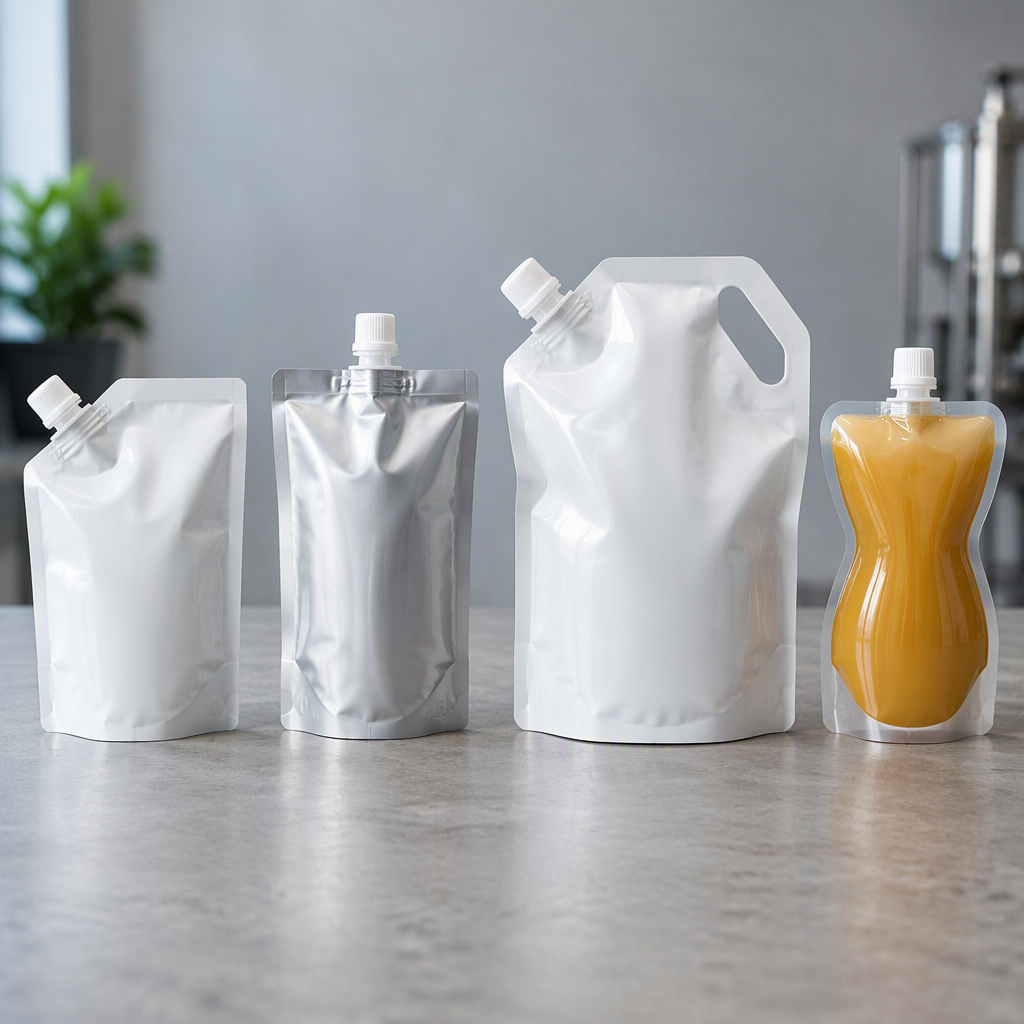
Configuration should be selected for product protection, filling, dispensing, handling, and retail presentation. A lower component price does not create savings if the pouch is incompatible with the filling line or distribution conditions.
| Configuration | Typical cost considerations | Common applications |
|---|---|---|
| Standard corner-spout pouch | Conventional pouch profile and established fitment options can simplify converting | Sauces, concentrates, personal care refills, and household liquids |
| Center-spout pouch | Placement must align with filling and dispensing requirements | Beverages, purees, and products displayed or used upright |
| Handled spout pouch | Additional material, handle geometry, and load performance must be considered | Larger refill packs, family-size liquids, and products requiring controlled carrying |
| Custom-shaped pouch | May require a dedicated cutting die, tighter registration, and a different waste allowance | Promotional packaging and brand-specific retail formats |
| Retort or hot-process pouch | Requires a structure, fitment, seal system, and validation appropriate to the process | Products subjected to defined thermal processing conditions |
For larger packs, review the construction of a spout pouch with a carry handle before requesting a price. For nonrectangular retail formats, a custom-shaped spout pouch may involve different tooling and converting assumptions.
Materials, Barrier, and Thickness

The laminate is often a major recurring cost component. A supplier needs to know what the package must resist, including oxygen, moisture, light, aroma loss, oils, chemicals, elevated filling temperatures, freezing, or thermal processing. The answer should be based on the product and distribution conditions rather than a generic request for a high-barrier pouch.
Common structures may use PET, PE, PA, PP, EVOH, metallized film, or aluminum foil in different combinations. Each layer has a function, such as printability, stiffness, puncture resistance, barrier, or heat-seal performance. Material names alone are insufficient: buyers should specify total thickness, individual layer thicknesses where relevant, adhesive system, sealant requirements, and any required test method.
Increasing thickness generally increases material consumption, but the lowest gauge is not automatically the lowest total-cost choice. Pouch size, filled weight, drop exposure, product viscosity, spout flange geometry, and carton packing all influence the required construction. Request samples for filling and distribution trials before approving a production structure. Shelf-life suitability should be established through testing with the actual product under intended storage conditions.
Fitments, Caps, and Pouch Converting

The spout assembly is both a purchased component and a critical sealing interface. Quote requests should identify the spout inner diameter, neck finish, flange dimensions, cap style, cap color, opening method, tamper-evident feature, and any liner or dispensing insert. Product viscosity and target pour rate help determine the practical opening size.
A standard fitment already compatible with the converter’s equipment will usually require fewer development steps than a new proprietary design. A custom fitment can introduce mold charges, component trials, longer development work, and a separate MOQ. Any custom color may also have a minimum production requirement or color-matching charge.
Spout position affects both pouch conversion and filling-line handling. Specify corner or center placement, spout orientation, and dimensional tolerances. Buyers should also state whether pouches will be supplied open at the top for filling and final sealing or filled through the spout. The supplier needs this information to define the pouch opening, seal area, fitment installation, and inspection plan.
Handled formats require particular attention to filled weight, carrying conditions, handle placement, and pouch dimensions. The relevant variables can be reviewed on the handled spout pouch product page.
Printing, Tooling, and Order Quantity
Printed pouch cost depends on the selected process, color count, artwork coverage, finish, registration requirements, and production volume. Rotogravure commonly involves engraved cylinders, while flexographic printing uses plates. Digital printing may use a different setup and pricing model. Availability and commercial suitability depend on the converter, structure, dimensions, and order size.
Ask whether printing setup is charged once, charged again after artwork changes, or amortized into the unit price. Confirm cylinder or plate ownership, storage terms, usable life, and replacement policy in writing. A design change involving dimensions, color separations, or print repeats can require new tooling even when the brand remains unchanged.
MOQ should be confirmed per SKU, not only for the combined purchase order. Pouches with different artwork, dimensions, laminates, spouts, or cap colors may require separate setups and production runs. Combining forecasts does not necessarily reduce setup time if every SKU requires an independent changeover.
Buyers should request both the estimated production quantity and the permitted quantity tolerance. Flexible packaging production can result in an agreed overrun or underrun, so the purchase order should define how the final delivered quantity and invoice will be handled.
Information Needed for an Accurate Quote

A complete request for quotation reduces assumptions and makes supplier responses easier to compare. Include:
- Product name, ingredients or chemical characteristics, and intended market
- Nominal fill volume, filled weight, viscosity, and any particulates
- Pouch width, height, gusset, seal area, and preferred spout position
- Requested laminate or required barrier and mechanical performance
- Filling temperature, filling method, sealing process, and line speed requirements
- Spout bore, flange, cap style, tamper evidence, color, and torque requirements
- Artwork files, number of print colors, finish, and number of SKUs
- Order quantity per SKU and estimated annual demand
- Sample, test, inspection, documentation, and approval requirements
- Individual packing, carton count, carton marks, pallet requirements, and destination
- Requested Incoterm, currency, delivery location, and target schedule
If the structure is not yet finalized, provide the product and process data and ask the manufacturer to identify its assumptions. Do not compare a provisional structure directly with a fully validated specification without accounting for the technical differences.
How to Compare Supplier Quotes
Compare quotations line by line against one controlled specification. A lower unit price may reflect a different film thickness, barrier layer, fitment, inspection level, carton quantity, or trade term. Normalize these variables before deciding which proposal has the lower commercial cost.
- Confirm specification equivalence. Check dimensions, laminate layers, total thickness, spout model, cap, print process, and tolerances.
- Separate recurring and one-time charges. Identify unit price, tooling, samples, testing, cartons, pallets, and other fees.
- Compare quantity bases. Verify the MOQ, quoted quantity, production tolerance, and quantity per SKU.
- Align trade terms. An EXW price cannot be directly compared with a quote that includes inland transport, export handling, or ocean freight.
- Review approval requirements. Confirm what samples, artwork proofs, test reports, and signed specifications are provided before mass production.
- Evaluate change scenarios. Ask what happens to cost when volume, artwork, dimensions, or the fitment changes.
The most useful quote is not merely a unit price. It is a documented offer with enough technical detail to show what will be manufactured, how quantity will be measured, and which costs remain outside the supplier’s scope.
FAQ
What is the biggest factor in custom spout pouch cost?
There is no single factor for every project. The laminate, dimensions, fitment, print setup, and order quantity commonly have substantial effects. The dominant factor depends on whether the pouch uses a specialized barrier structure, custom tooling, complex printing, or a relatively small production run.
Does a larger order always reduce the unit price?
A larger run can distribute fixed setup costs across more pouches and may improve manufacturing efficiency. However, the result depends on material purchasing, production capacity, SKU count, packing, and the quantity tier quoted. Buyers should request prices at realistic annual order quantities rather than assuming unlimited volume reductions.
Are printing cylinders or plates included in the pouch price?
That depends on the quotation. Some suppliers list cylinders or plates as a separate one-time charge, while others may include or amortize setup costs. Confirm the charge, ownership, storage period, replacement policy, and cost of future artwork revisions before ordering.
Does a custom-shaped spout pouch cost more than a rectangular pouch?
It may. A custom silhouette can require a dedicated die, additional setup, tighter print-to-cut registration, or a different material waste allowance. The actual difference depends on the shape, pouch dimensions, print design, and available converting equipment.
How does the spout size affect the quote?
Spout size changes the component specification and may affect insertion, flange sealing, pouch dimensions, cap options, and filling-line compatibility. A larger opening is not automatically better; it should match product viscosity, particulates, pour rate, filling method, and closure requirements.
What costs are commonly excluded from a factory quote?
Depending on the Incoterm and quotation scope, excluded costs may include freight, insurance, import duties, destination charges, third-party inspection, laboratory testing, filling-line trials, and custom molds. Buyers should request a written list of inclusions and exclusions.
Can a supplier quote before the film structure is finalized?
A supplier can provide a budgetary estimate based on stated assumptions, but it should not be treated as a final production price. Product compatibility, barrier needs, processing conditions, thickness, and validation requirements must be resolved before the specification and firm quotation are approved.
Request a Specification-Based Spout Pouch Quote
Discuss your pouch structure, spout fitment, artwork, MOQ, sample needs, and quote requirements with HUACANG Packaging. Include product, filling, dimensions, quantity, and delivery details so the proposal can state clear technical and commercial assumptions.