Table of Contents
- What Are Recyclable Spout Pouches?
- How Mono-Material Spout Pouches Work
- What PCR Means for Spout Pouches
- Understanding the Spout Pouch Recycling Stream
- Performance and Design Tradeoffs
- Choosing an Option by Application
- Buyer Specification Checklist
- How to Validate Recyclability Claims
Recyclable spout pouches can be designed around mono-material PE or PP structures, PCR content, or a combination of both. This guide explains how recyclability differs from recycled content, what affects the pouch recycling stream, and which specifications B2B packaging buyers should confirm before ordering.
What Are Recyclable Spout Pouches?
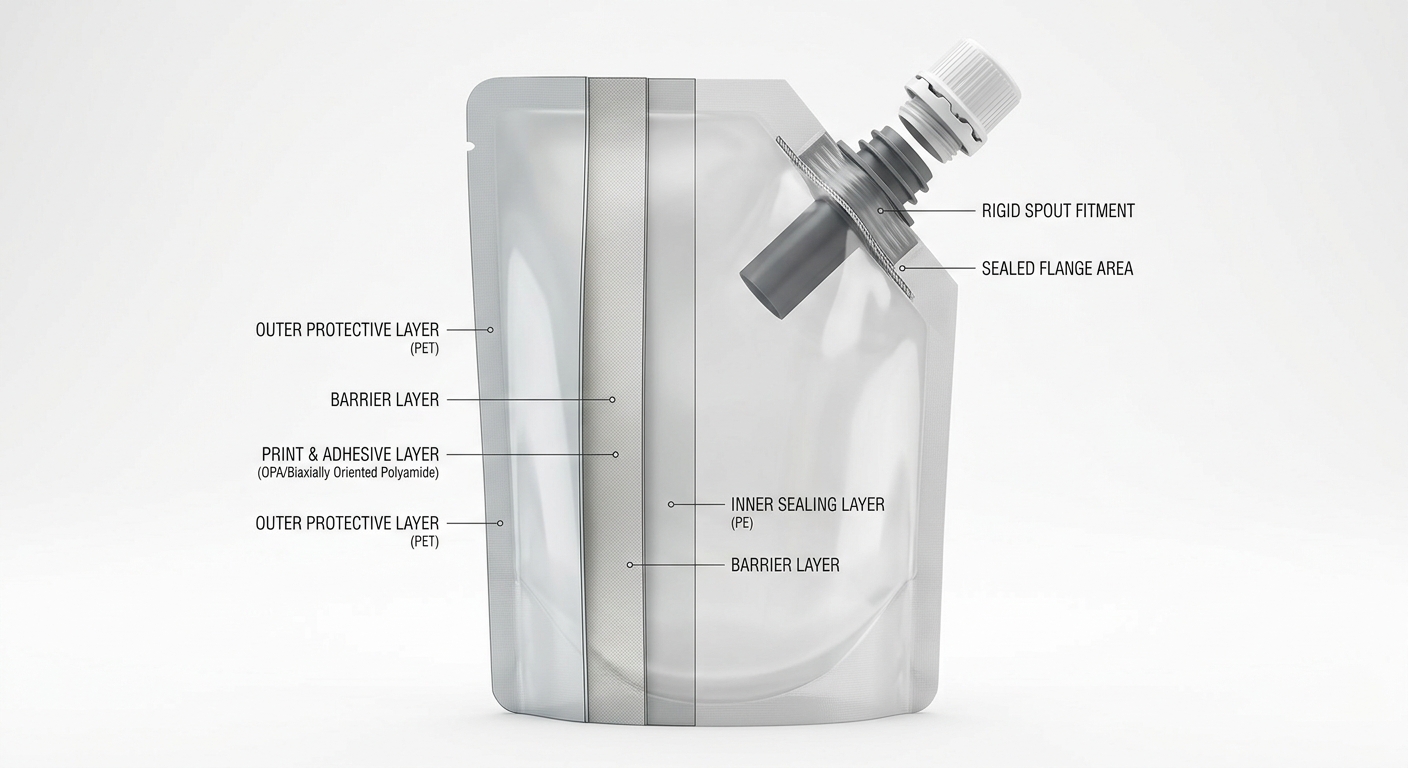
Recyclable spout pouches are flexible packages designed with a material structure and fitment combination that may be compatible with a defined recycling system. In practice, recyclability depends on more than the pouch film. The polymer family, barrier layer, inks, adhesives, spout, cap, package dimensions, local collection, sorting, and available end market must all be considered.
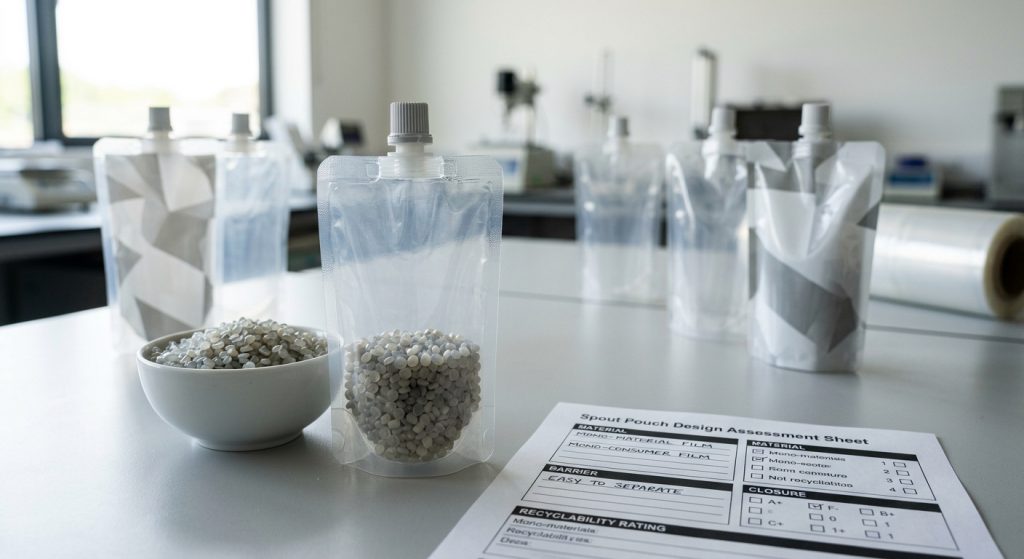
For B2B buyers, the most common routes are a mono-material pouch, usually based on PE or PP, and a pouch that incorporates post-consumer recycled resin. These approaches address different goals. Mono-material construction is primarily a design strategy for improving compatibility with a particular recycling stream. PCR is a recycled-content strategy that reduces reliance on virgin resin, subject to quality, regulatory, and application requirements. A PCR pouch is not automatically recyclable, and a mono-material pouch is not automatically accepted everywhere.
A practical specification should therefore state the intended sales market and recycling pathway before the film structure is finalized. A pouch intended for one country or collection program may require a different structure from a pouch sold internationally.
- Mono-material: Film layers and, where practical, fitments are designed around one compatible polymer family.
- PCR: A defined percentage of post-consumer recycled resin is incorporated into the package or a specified layer.
- Recyclable flexible packaging: Packaging designed for recovery through a specific collection, sorting, and reprocessing system.
How Mono-Material Spout Pouches Work
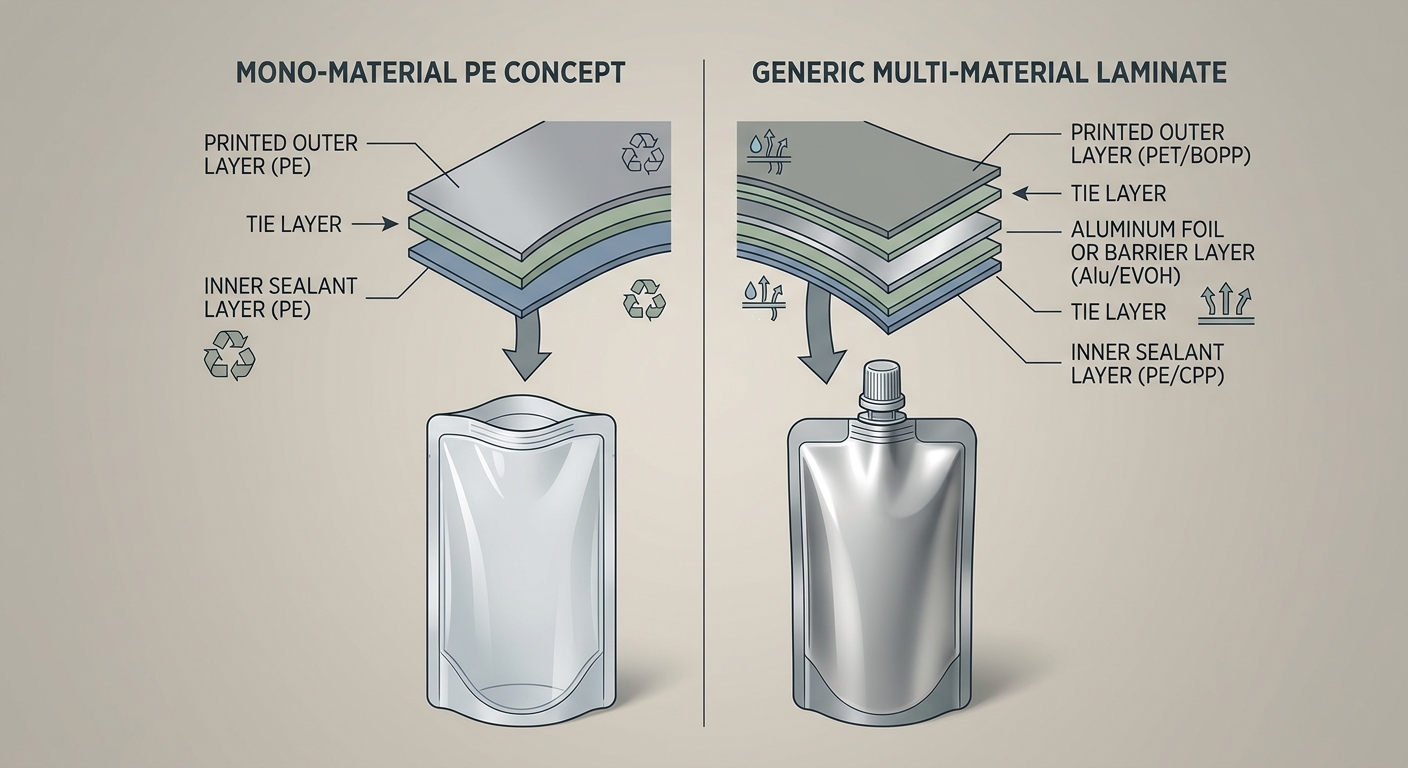
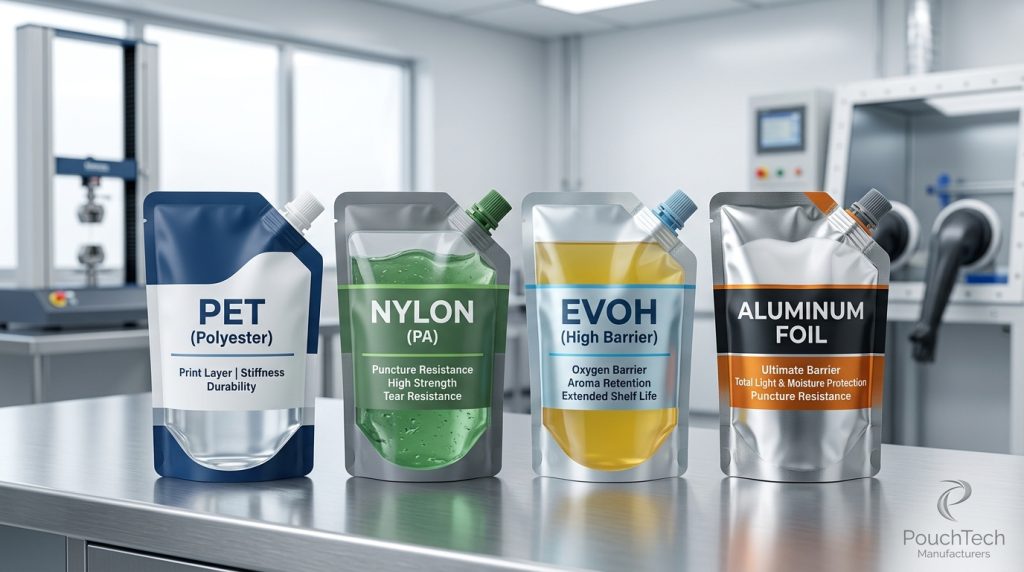
A mono-material spout pouch uses films and components selected around one primary polymer family rather than combining unrelated materials such as polyester, nylon, aluminum foil, and polyethylene in a conventional laminate. PE-based and PP-based designs are the principal options considered for flexible packaging, but the exact construction must be evaluated against the requirements of the target recycling system.
Mono-material does not mean that every molecule, additive, ink, or component is identical. A pouch may still contain different grades within the same polymer family, printing ink, adhesive, coatings, and a separate cap or spout. The important question is whether these elements remain compatible with the intended recycling process and published design requirements.
Removing aluminum foil or a difficult-to-separate polymer layer can simplify the material design, but it can also reduce barrier performance. Oxygen, moisture, aroma, light, chemical resistance, seal strength, puncture resistance, and filling temperature must be reviewed together. A structure that is suitable for an ambient detergent may not be suitable for an oxygen-sensitive food product or a high-temperature process.
Film thickness should be specified as a complete structure, including the sealant and any barrier layers. Buyers can use the spout pouch material thickness guide when comparing micron or mil specifications and requesting quotations.
- Identify the primary polymer family and each layer within the proposed structure.
- Confirm whether the spout and cap use a compatible polymer and whether they remain attached during disposal.
- Review barrier performance instead of assuming that a mono-material film provides the same protection as a foil laminate.
- Check whether the intended recycling program accepts the complete pouch format, not only the base film.
What PCR Means for Spout Pouches
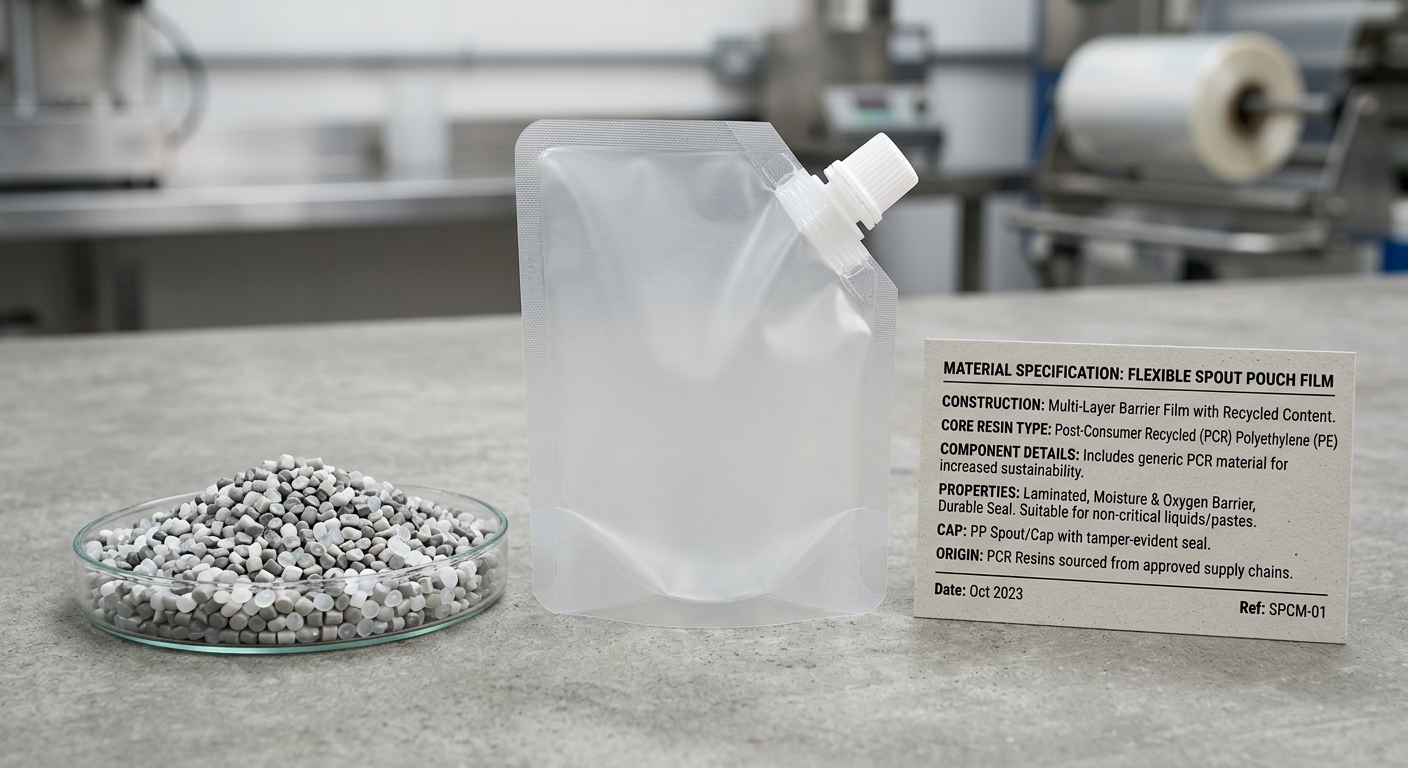
PCR stands for post-consumer recycled resin. It is material recovered from products that have been used by consumers, processed, and converted into resin for a new packaging application. PCR is different from post-industrial recycled material, which generally comes from manufacturing scrap or industrial waste generated before consumer use.
A PCR spout pouch can use recycled resin in a selected film layer, provided the resin quality, appearance, odor, mechanical properties, seal performance, and regulatory status are appropriate for the application. In some designs, PCR is placed in a non-contact layer while the product-contact layer uses a separately specified resin. This arrangement is not universal; food, personal care, pharmaceutical, and chemical applications each require a review of the applicable requirements.
PCR content may affect color consistency, stiffness, tensile properties, puncture resistance, odor, and processing stability. These effects depend on the resin source, sorting quality, purification, blend ratio, and film manufacturing process. The percentage should be stated clearly as a target or minimum and linked to an agreed test or documentation method.
Recycled content and recyclability should be recorded as separate specification items. A pouch can contain PCR but still be difficult to recover if it uses a multi-material laminate that is not accepted by the relevant recycling stream. Conversely, a mono-material pouch may be recyclable by design while containing no PCR.
- Define whether PCR is required, optional, or limited to a specific layer.
- Specify the target percentage and acceptable variation.
- Confirm the resin source, batch documentation, color tolerance, and odor requirements.
- Review product-contact and market-specific compliance requirements before approval.
Understanding the Spout Pouch Recycling Stream
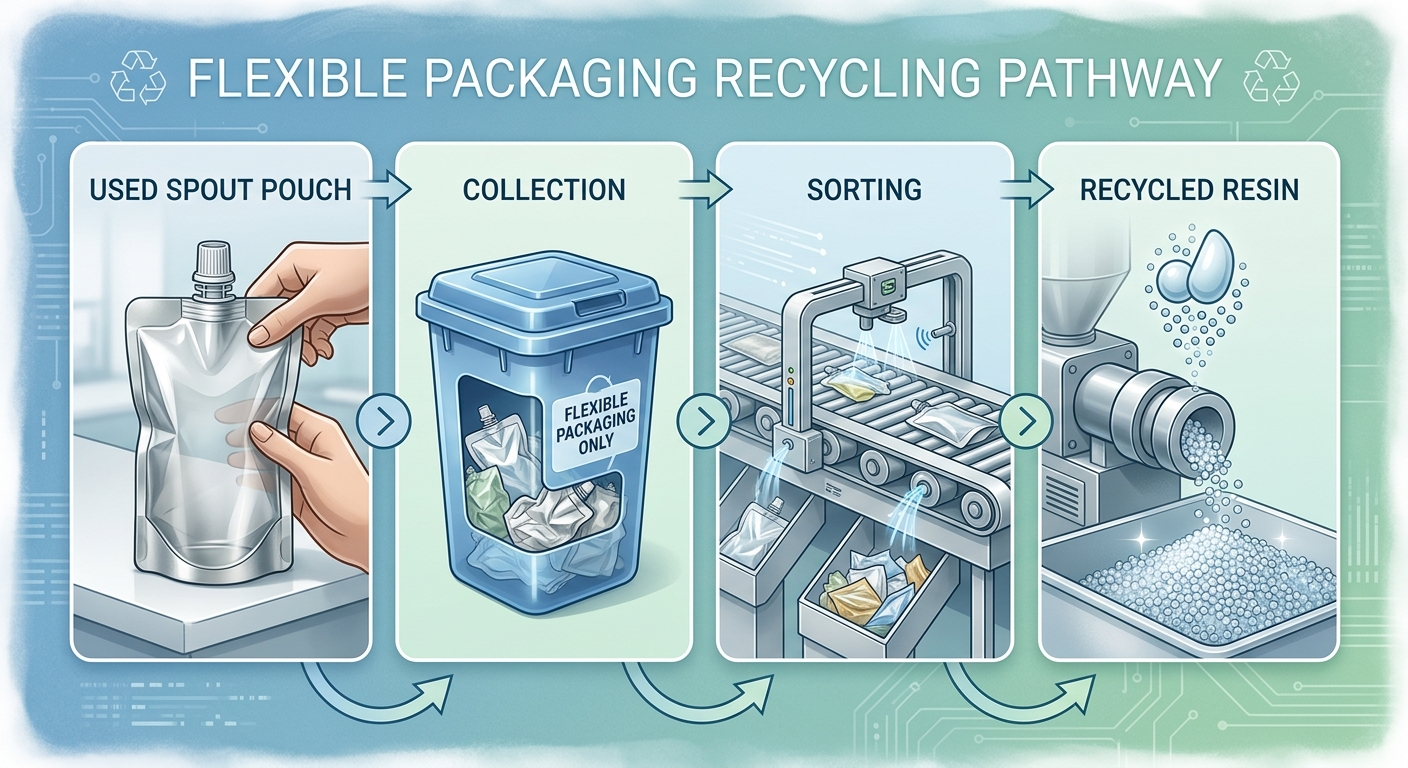
The phrase spout pouch recycling stream refers to the collection, sorting, processing, and remanufacturing route available for a used pouch in a defined market. Flexible packaging is not handled identically in every region. Some areas have a dedicated flexible-film collection route, while others do not accept pouches in household recycling. A package should not be labeled recyclable without identifying the market and pathway supporting the claim.
Spout pouches also present format-specific considerations. A pouch may be too small for some sorting equipment, and the fitment can influence how the package is identified or processed. Residual product, moisture, labels, closures, and attached components can further affect recovery. These conditions do not mean that recyclable spout pouches are impossible; they mean the complete package must be evaluated rather than the film viewed in isolation.
Before approving a structure, buyers should ask the supplier and the relevant recycling program:
- Which polymer family and pouch format are accepted?
- Are the spout and cap compatible with the same route, and should they remain attached?
- Are printed, laminated, or coated surfaces covered by the design guidance?
- Does the package size meet the collection and sorting requirements?
- What end market is available for the recovered material?
For international brands, recyclability language may need to vary by country. Packaging artwork, product pages, and technical documents should use precise wording such as designed for compatibility with a named or defined system, when that statement can be substantiated.
Performance and Design Tradeoffs
Sustainability goals cannot be separated from package performance. A recyclable structure must still protect the product, run on the filling line, survive distribution, and provide a reliable dispensing experience. The most important design tradeoffs usually involve barrier, heat resistance, seal integrity, puncture resistance, fitment compatibility, and visual requirements.
Barrier: A PE or PP mono-material structure may require a compatible barrier layer or coating for products sensitive to oxygen, moisture, light, or aroma loss. The barrier solution should be reviewed as part of the complete recycling design.
Seals: Recycled resin can introduce variation that affects seal initiation, hot tack, seal strength, or the appearance of the seal area. The final film should be tested at the actual filling conditions rather than approved only from a flat film sample.
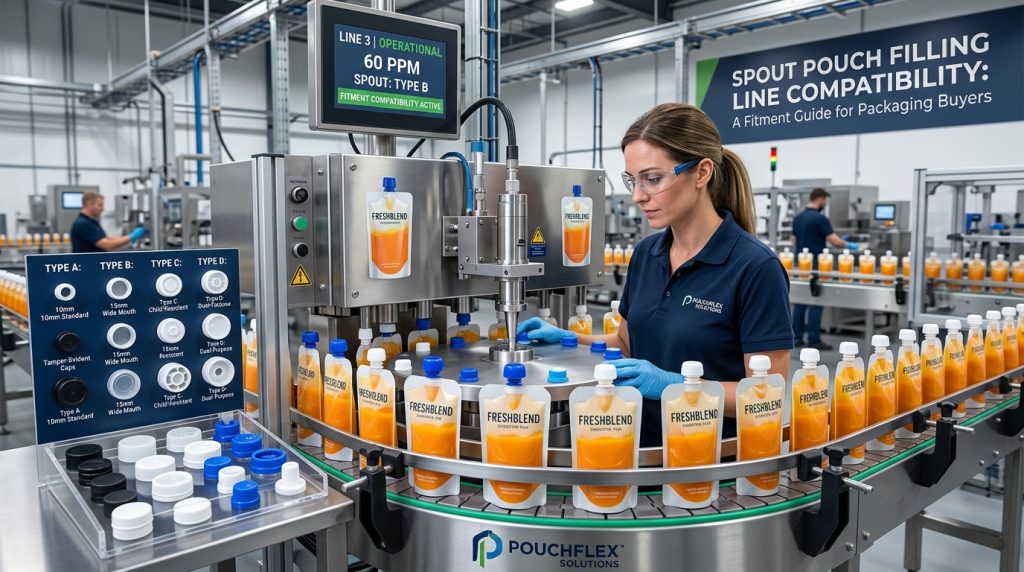
Fitments: The spout, cap, pump, or dispenser must match the product viscosity, opening size, torque requirements, filling equipment, and recycling objective. The spout pouch fitment selection guide can help buyers define these requirements.
Distribution: Filled pouches should be assessed for drops, compression, vibration, leakage, and handling. Testing should include the pouch-to-spout seal and the cap, not only the flat film. A supplier’s spout pouch leak testing methods should be aligned with the product and shipping conditions.
Choosing an Option by Application
The right recyclable spout pouch depends on the product and process, not only on the desired environmental claim. Use the following as an initial screening framework rather than a universal material recommendation.
- Shampoo and personal care refills: A PE-based mono-material design may be considered where the required barrier, fragrance retention, seal performance, and local flexible-film route are compatible. Product residue and dispensing behavior should be included in testing. Buyers can review the guide to shampoo refill pouch film and spout selection for related specification questions.
- Liquid detergents and household chemicals: Chemical compatibility, stress cracking, odor, drop resistance, and closure security are central. The intended recycling stream should be checked separately from chemical resistance.
- Sauces, beverages, and other food liquids: Product-contact requirements, oxygen and aroma barriers, filling temperature, seal contamination, and shelf-life targets may narrow the available mono-material or PCR options.
- Hot-fill products: The film, sealant, spout, cap, filling temperature, cooling cycle, and headspace must be validated as one system. A hot-fill spout pouch engineering guide provides a useful framework for these checks.
- Products requiring high barrier or retort processing: The performance requirement may conflict with a simple mono-material concept. Any alternative structure should be assessed for its actual recycling pathway and not described as broadly recyclable without substantiation.
Buyer Specification Checklist

A clear RFQ helps a packaging manufacturer recommend a structure without treating recyclability as an isolated film feature. Include the following information in the initial specification:
- Product details: Product type, viscosity, pH, oil or solvent content, fragrance, solids, filling temperature, and sensitivity to oxygen, moisture, light, or aroma loss.
- Capacity and dimensions: Nominal fill volume, target pouch dimensions, gusset or shape requirements, headspace, and acceptable dimensional tolerance.
- Material objective: Preferred polymer family, mono-material target, required barrier, PCR target, and whether PCR is allowed in the product-contact layer.
- Fitment: Spout position, opening diameter, cap or dispenser style, tamper evidence, torque range, and compatibility with the filling and capping equipment.
- Printing and finish: Artwork process, number of colors, matte or gloss finish, coating requirements, and any limitations associated with the proposed recycling design.
- Performance: Seal strength, hot tack, puncture resistance, drop performance, leak resistance, shelf-life target, and distribution conditions.
- Recycling market: Countries of sale, intended collection route, accepted polymer family, fitment expectations, and the evidence required to support the recycling statement.
- Quality and documentation: Resin identification, PCR percentage, certificate or declaration requirements, retained samples, test reports, and batch-to-batch appearance tolerances.
Ask for a trial structure and filled samples before approving mass production. Film-only testing cannot fully predict the performance of the finished pouch because spout insertion, heat sealing, filling, capping, and distribution introduce additional variables.
How to Validate Recyclability Claims
Recyclability claims should be specific, documented, and limited to the market and package configuration that have been evaluated. Start by separating three questions:
- Is the pouch designed for a compatible material pathway? Review the film layers, adhesives, inks, coatings, spout, cap, and any barrier technology.
- Is the pouch collected and sorted in the target market? Confirm the actual local or regional program, including format and size requirements.
- Can the recovered material be processed into an accepted output? Consider the requirements of the recycler and available end market.
For PCR, validate the recycled-content percentage, resin source, chain-of-custody documentation if required, product-contact status, appearance, odor, mechanical properties, and production consistency. For the finished pouch, validate seal strength, leak resistance, drop performance, fitment integrity, filling-line behavior, and shelf-life under the intended conditions.
Do not use recyclable and recycled-content as interchangeable terms. A more accurate technical document can state the proposed structure, the PCR percentage, the target market, the applicable qualification status, and any disposal instructions. If market acceptance has not been confirmed, use qualified language such as designed with a mono-material structure for evaluation rather than an unqualified universal claim.
HUACANG Packaging works with international B2B buyers on custom spout pouch structures, fitments, artwork, and production specifications. The final recommendation should be based on the product, filling process, distribution conditions, target market, and evidence required for the buyer’s claim.