Table of Contents
- Spout Pouch Material Selection Starts with the Laminate
- How a Spout Pouch Laminate Is Built
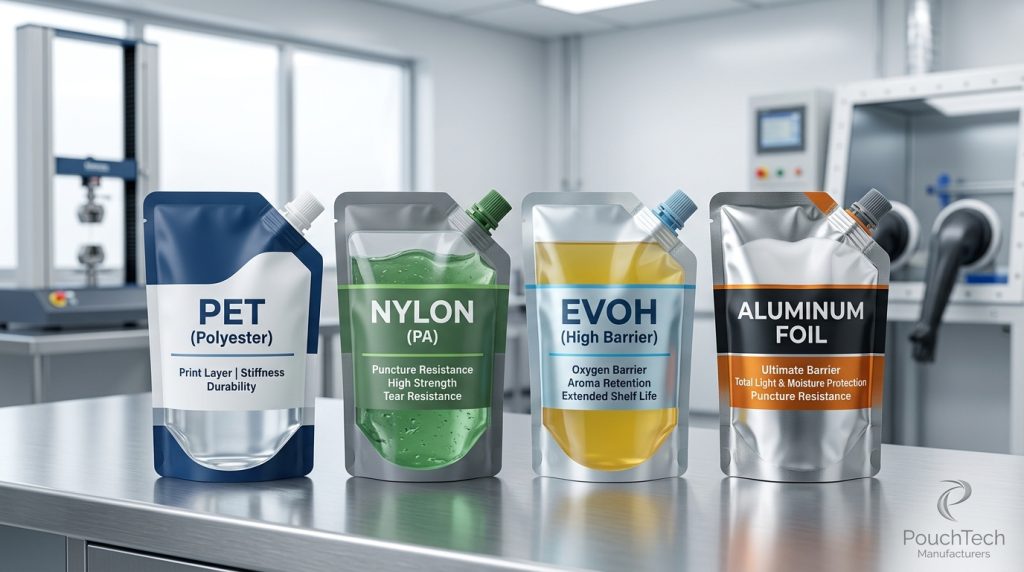
- PET in Spout Pouches: Printability and Stiffness
- Nylon (BOPA) in Spout Pouches: Toughness and Flex Resistance
- EVOH Barrier Film: Oxygen Protection with Limits
- Aluminum Foil Spout Pouches: Maximum Barrier and Light Protection
- Selecting the Right Material Combination
- Filling and Processing Conditions
- Cost and Performance Trade-offs
- Testing and Validation
Spout pouch material selection involves combining PET for stiffness, nylon for puncture resistance, EVOH for oxygen barrier, and aluminum foil for absolute protection. This guide explains how to specify the right laminate for your product and filling process.
Spout Pouch Material Selection Starts with the Laminate
Spout pouch material selection is not about choosing a single film but about engineering a multilayer laminate that balances stiffness, puncture resistance, barrier performance, seal integrity, and cost. For most liquid products, the laminate combines an outer layer of PET or nylon for strength and printability, a core barrier layer of EVOH or aluminum foil when oxygen or moisture protection is critical, and an inner sealant layer of polyethylene (PE) or polypropylene (PP) that bonds to the spout fitment. The right combination depends on your product’s sensitivity, required shelf life, filling temperature, and distribution conditions.
This guide breaks down the four most important spout pouch barrier materials—PET, nylon, EVOH, and aluminum foil—and explains how to specify a structure that meets your technical and commercial targets.
How a Spout Pouch Laminate Is Built
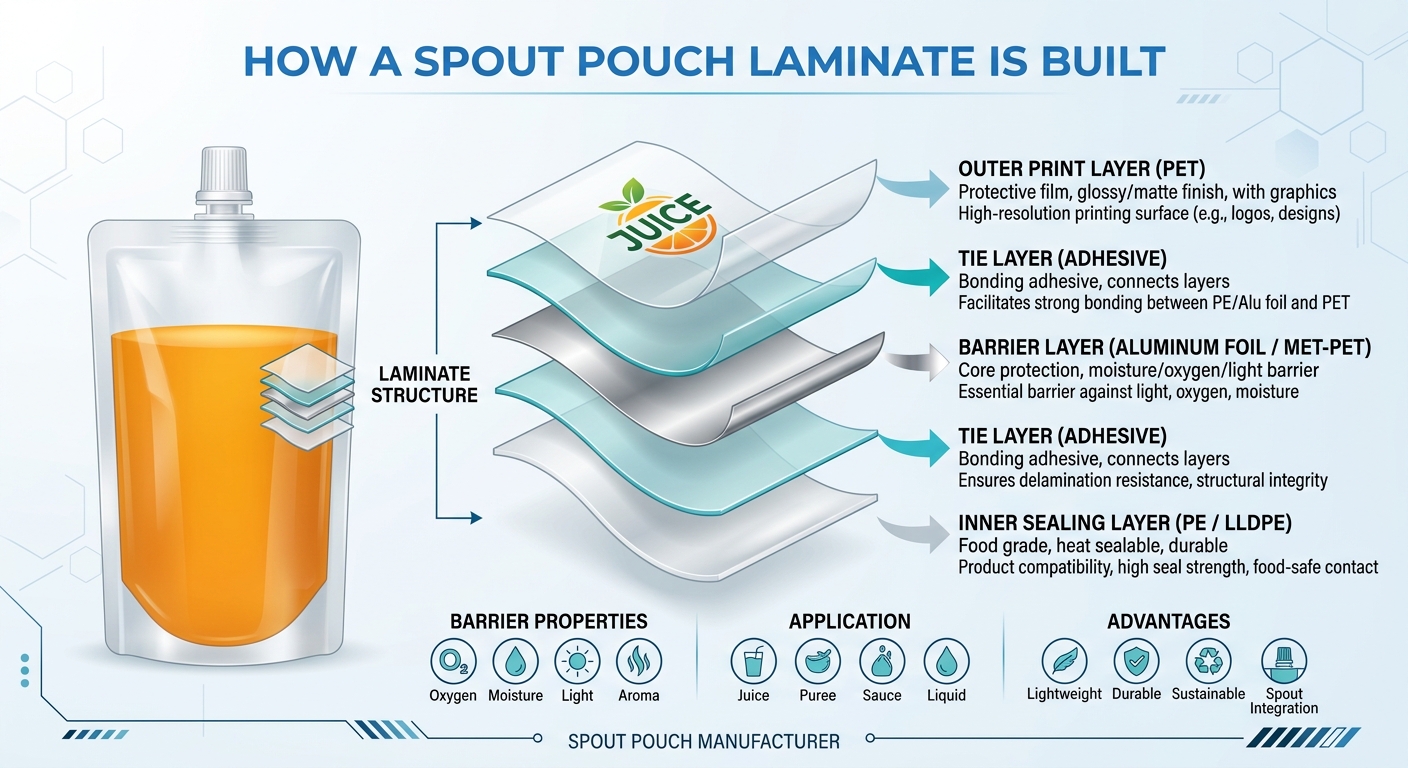
A spout pouch laminate is a sandwich of three or more functional layers bonded with adhesives or extrusion lamination. Each layer has a specific job:
- Outer layer (print web): Typically PET or nylon. It provides stiffness, puncture resistance, and a surface for reverse printing or surface printing. PET is common for its clarity and cost; nylon adds toughness.
- Core barrier layer: EVOH, aluminum foil, metallized PET, or a coating. This layer controls oxygen, moisture, and light transmission. Its placement between outer and inner layers protects it from abrasion and moisture.
- Inner sealant layer: PE or PP. This layer melts during heat sealing to form pouch seals and bonds to the spout fitment. The sealant must be compatible with the spout material (typically PE or PP) and the product’s filling temperature.
Total laminate thickness typically ranges from 80 to 160 microns (0.08–0.16 mm), but the exact gauge depends on pouch size, product weight, and required drop resistance. For guidance on specifying thickness correctly, see spout pouch material thickness specification.
PET in Spout Pouches: Printability and Stiffness
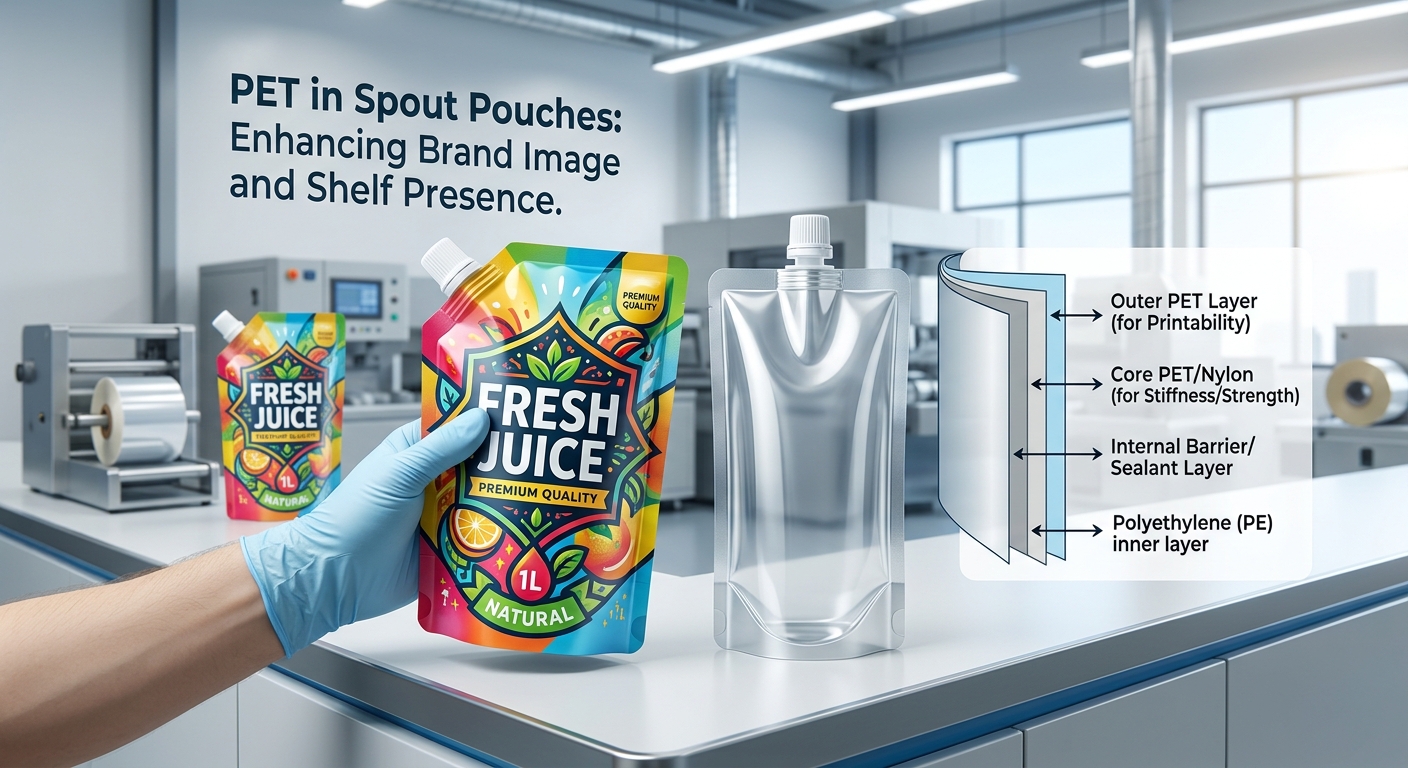
Polyethylene terephthalate (PET) is the most common outer layer in spout pouch laminates. It offers excellent clarity, high stiffness, and good dimensional stability, which helps the pouch stand upright on retail shelves. PET is also the preferred print web because it accepts high-quality rotogravure or flexographic printing and protects the ink when reverse printed.
However, PET has limitations. Its oxygen barrier is modest compared to EVOH or aluminum foil, and it provides only moderate puncture resistance. It also softens at temperatures above approximately 70°C, so it cannot be used alone as the outer layer for retort applications unless combined with a heat-resistant layer. In many standard structures for non-sensitive liquids such as shampoo or household cleaners, PET is paired directly with a PE sealant, forming a two-layer laminate (PET/PE) that is economical and sufficiently protective.
Nylon (BOPA) in Spout Pouches: Toughness and Flex Resistance
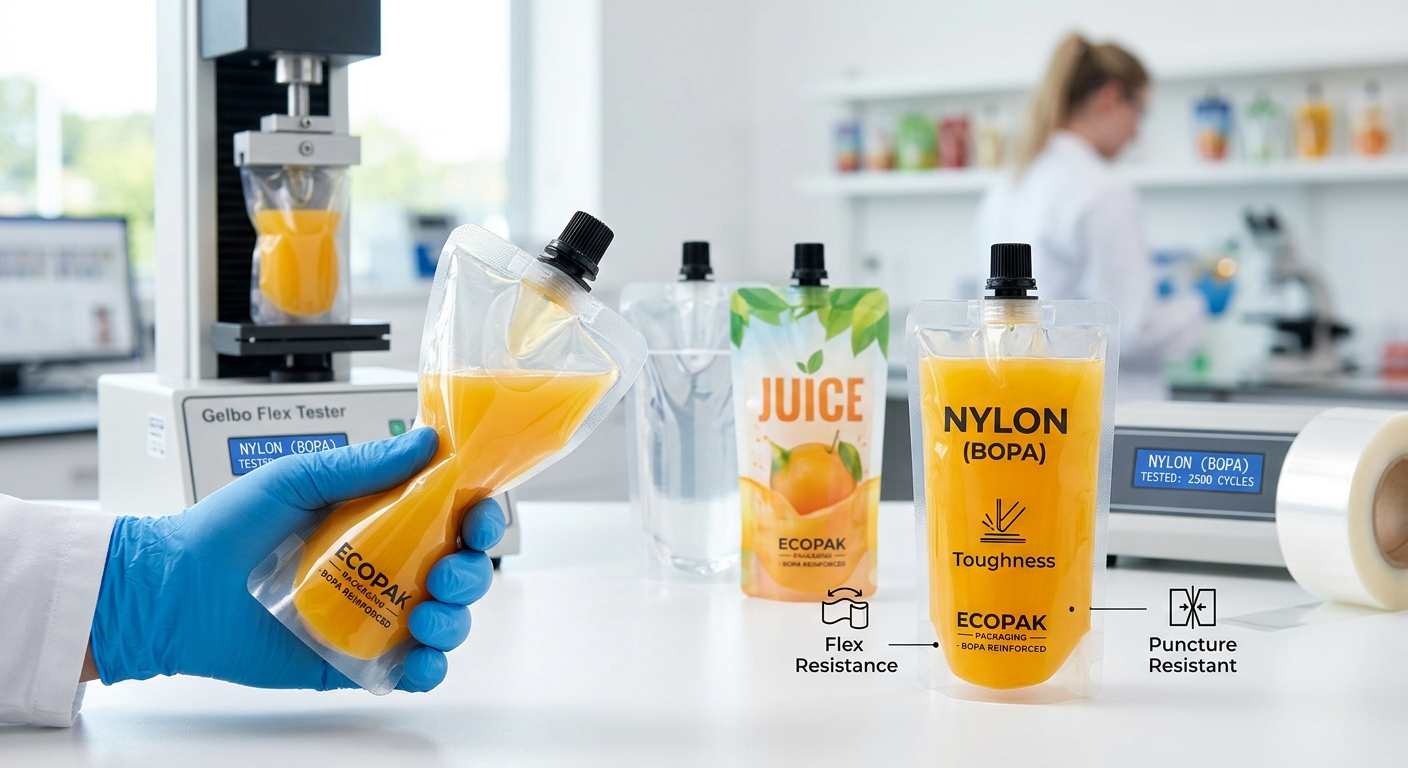
Biaxially oriented polyamide (BOPA), commonly called nylon, is added to spout pouch laminates when the package must withstand puncture, flex cracking, or rough handling. Nylon has high tensile strength, excellent puncture resistance, and good oxygen barrier properties—better than PET under dry conditions. It also remains ductile at low temperatures, which makes it suitable for frozen or refrigerated products.
The trade-off is cost and moisture sensitivity. Nylon absorbs moisture from the environment, which can reduce its oxygen barrier and cause slight dimensional changes. In most laminates, nylon is sandwiched between PET and the sealant layer to minimize direct moisture exposure. Comparing PET vs nylon as an outer layer: PET provides better stiffness and print quality at lower cost, while nylon offers superior toughness and flex crack resistance. For products like pet food with high fat content or abrasive particulates, a structure such as PET/NY/PE is common. You can read more about puncture-resistant structures in the pet food spout pouch specification guide.
EVOH Barrier Film: Oxygen Protection with Limits
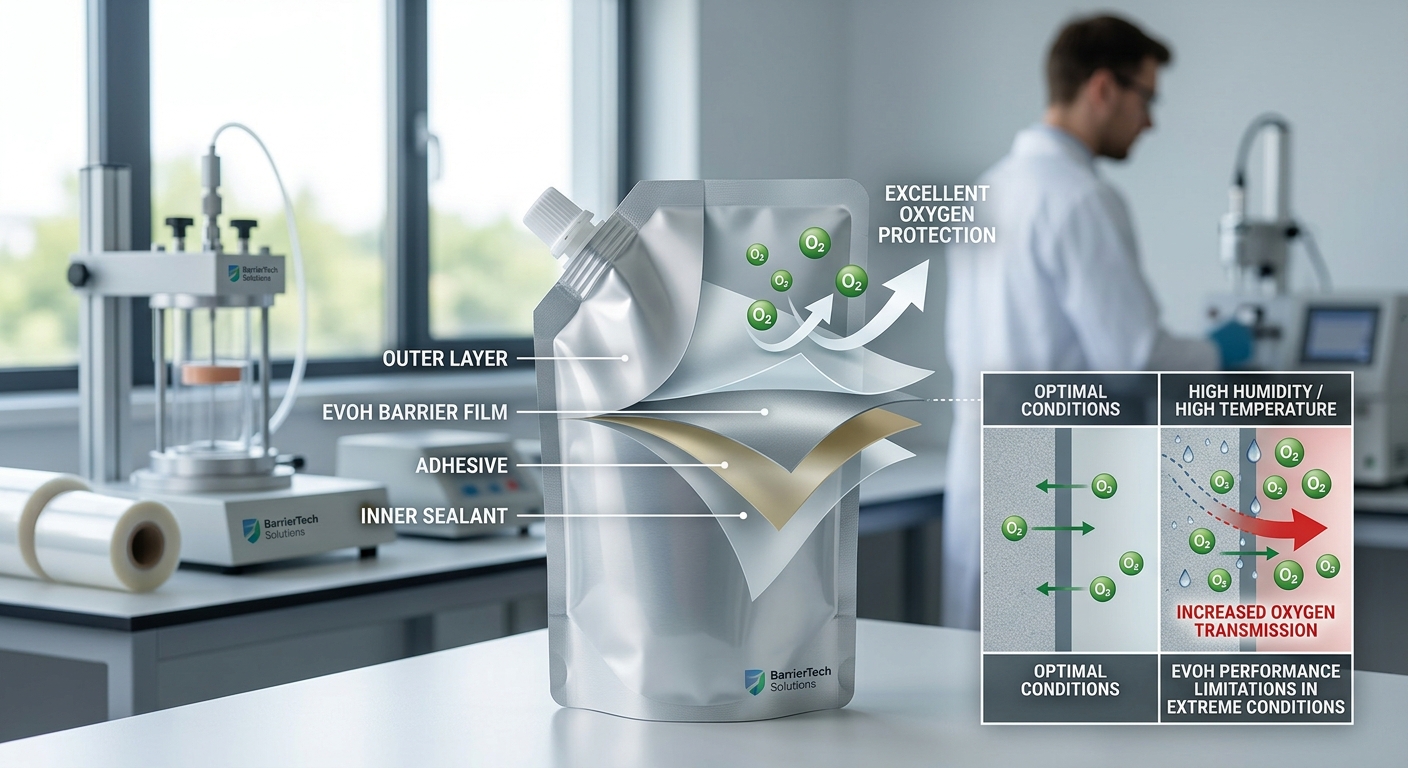
Ethylene vinyl alcohol (EVOH) is a transparent copolymer that provides excellent oxygen barrier at low relative humidity. It is the material of choice when brands need a clear spout pouch that still protects oxygen-sensitive products such as ketchup, mayonnaise, or certain sauces. EVOH is always placed in the middle of the laminate because it loses barrier performance when exposed to high humidity or direct moisture.
EVOH grades vary by ethylene content (typically 27%, 32%, or 38% ethylene). Higher ethylene content improves moisture resistance but reduces oxygen barrier. The grade is selected based on the product’s water activity and expected shelf life. For high-moisture products, EVOH must be buried between layers of polyolefin to stay dry. If the pouch will undergo hot fill or retort, a retort-grade EVOH with higher ethylene content is required. For more on heat-resistant structures, see hot fill spout pouch film and seal guide.
Aluminum Foil Spout Pouches: Maximum Barrier and Light Protection
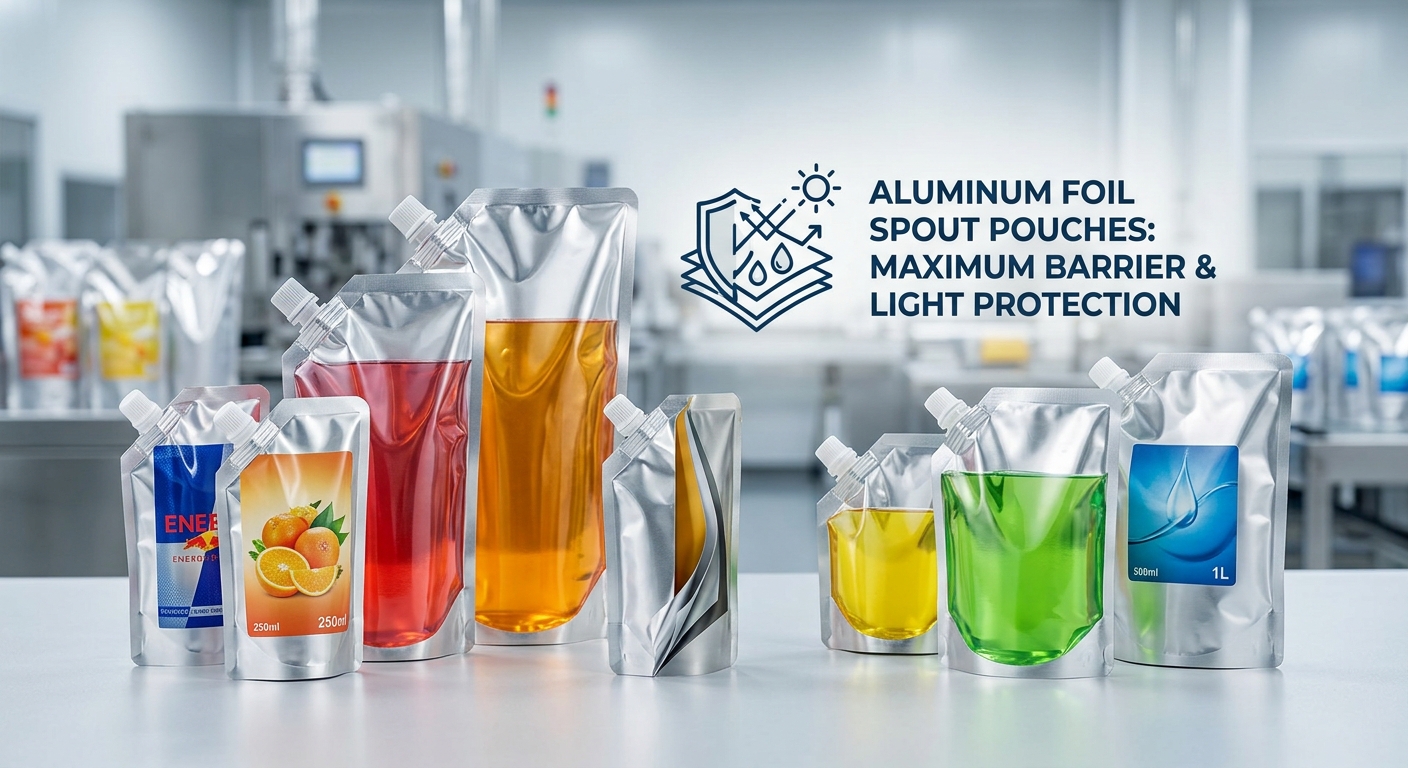
Aluminum foil is the definitive barrier material for spout pouches. An aluminum foil layer—typically 7 to 9 microns thick—provides virtually absolute protection against oxygen, moisture vapor, and light. It is required for products with very long shelf life, high sensitivity to oxidation, or strict regulatory requirements, such as retort baby food, pharmaceutical liquids, and certain chemicals.
The main drawbacks are cost, opacity, and handling. Aluminum foil increases laminate cost compared to transparent barriers, prevents consumers from seeing the product, and can develop pinholes if flexed excessively or if the foil is too thin. To mitigate pinholes, foil is always laminated with a tough outer layer like PET or nylon. For retort applications, a typical structure is PET/Al/NY/CPP, where CPP (cast polypropylene) serves as the heat-resistant sealant. Learn more in the retort spout pouch materials and processing guide.
Selecting the Right Material Combination
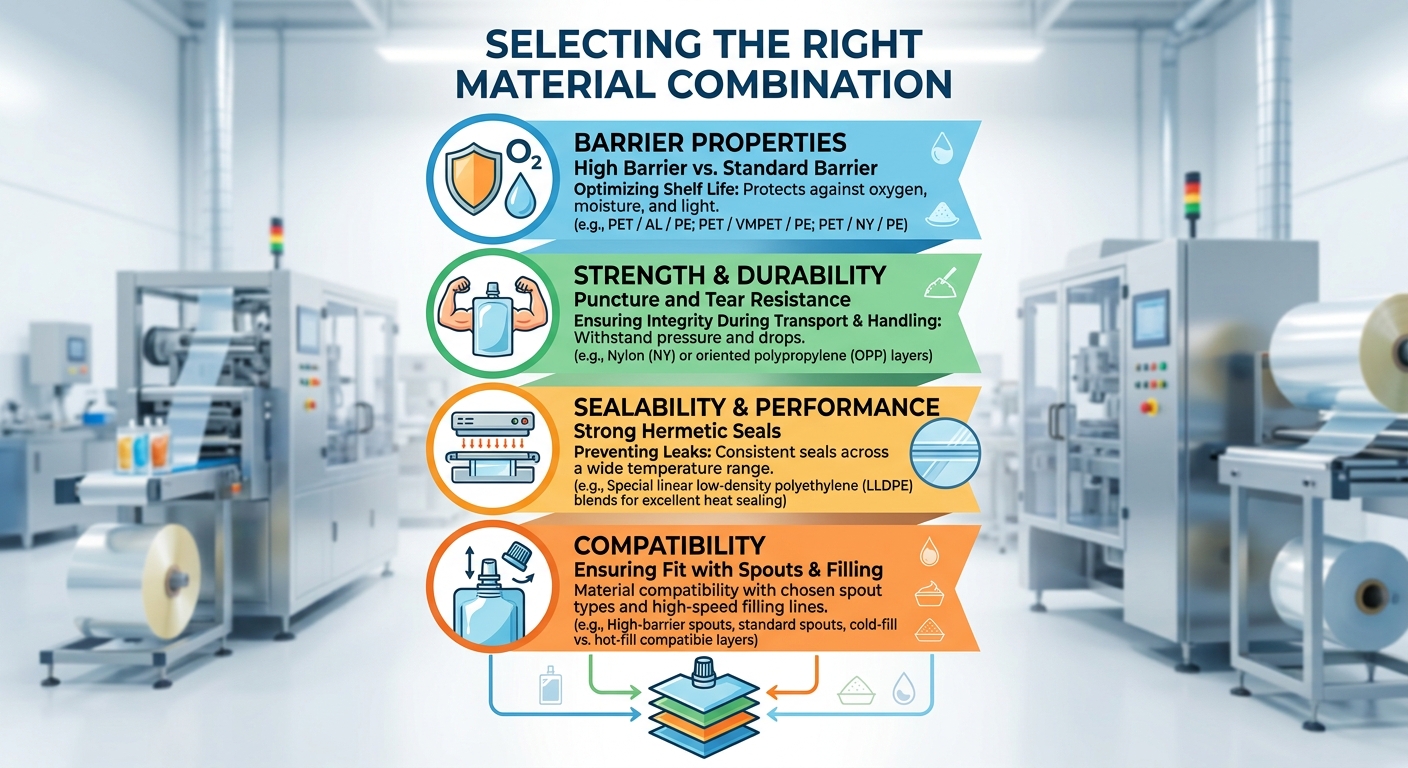
Material selection begins with the product’s sensitivity and the desired shelf life. The following examples illustrate common spout pouch structures:
- Standard liquids (shampoo, liquid soap): PET/PE. Simple, economical, adequate for products that are not oxygen sensitive.
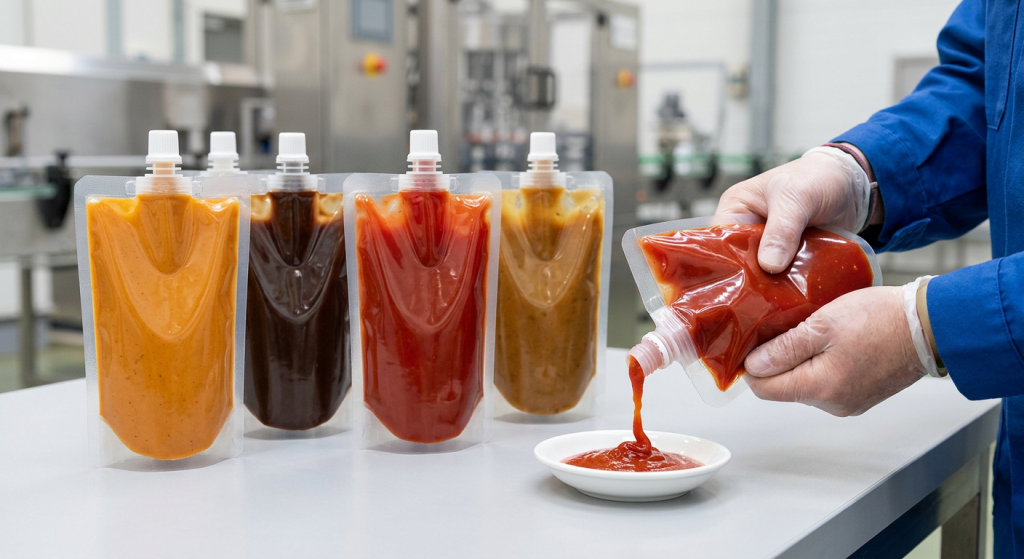
- Oxygen-sensitive foods (ketchup, sauces): PET/EVOH/PE or PET/NY/EVOH/PE. Provides oxygen barrier while maintaining transparency.
- High-fat or abrasive products (pet food supplements, some condiments): PET/NY/PE. Adds puncture resistance and flex crack resistance.
- Long shelf life or retort products (baby food, ready meals): PET/Al/NY/CPP or PET/Al/PA/CPP. Combines foil barrier with heat resistance.
- Hot fill beverages or sauces: PET/NY/PE with a heat-resistant sealant or retort-grade structure if temperatures exceed 85°C.
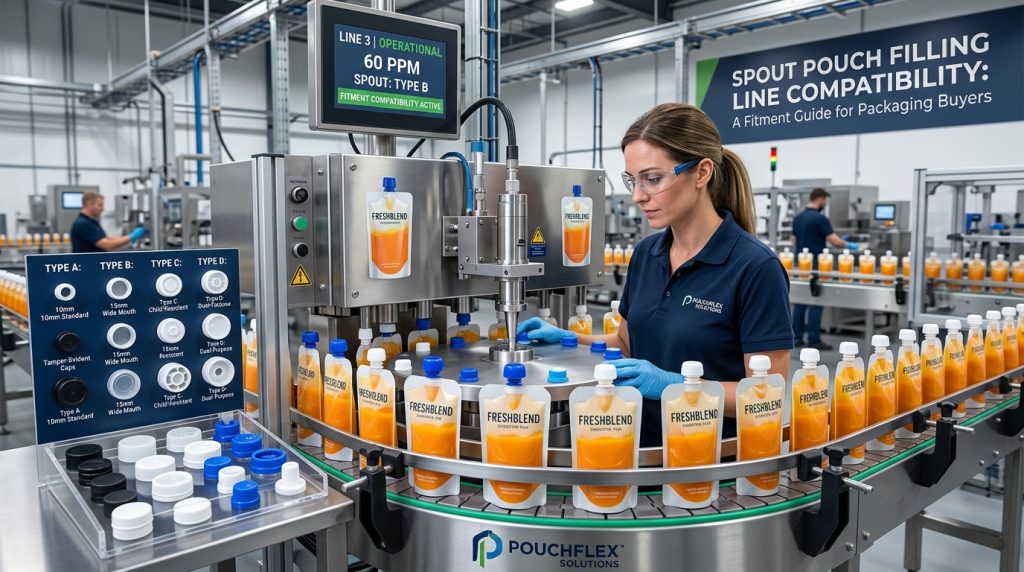
Always confirm total laminate thickness and individual layer gauges with your supplier. Mis-specifying thickness can lead to filling line failures or excessive cost. See the material thickness guide for conversion and measurement details.