Table of Contents
- What Determines Spout Pouch Shipping Cost?
- The Main Cost Components
- How to Plan Spout Pouch Carton Packing
- Carton and Case-Pack Calculations
- Flexible Packaging Palletization Options
- Freight Variables and Packaging Landed Cost
- Specification Decisions That Affect Logistics
- How to Validate the Shipping Plan
Spout pouch shipping cost depends on more than the pouch unit price. Carton dimensions, case pack, gross weight, pallet layout, shipment volume, and delivery terms all affect freight and packaging landed cost. This guide explains how B2B buyers can plan carton packing and palletization before requesting a quotation.
What Determines Spout Pouch Shipping Cost?
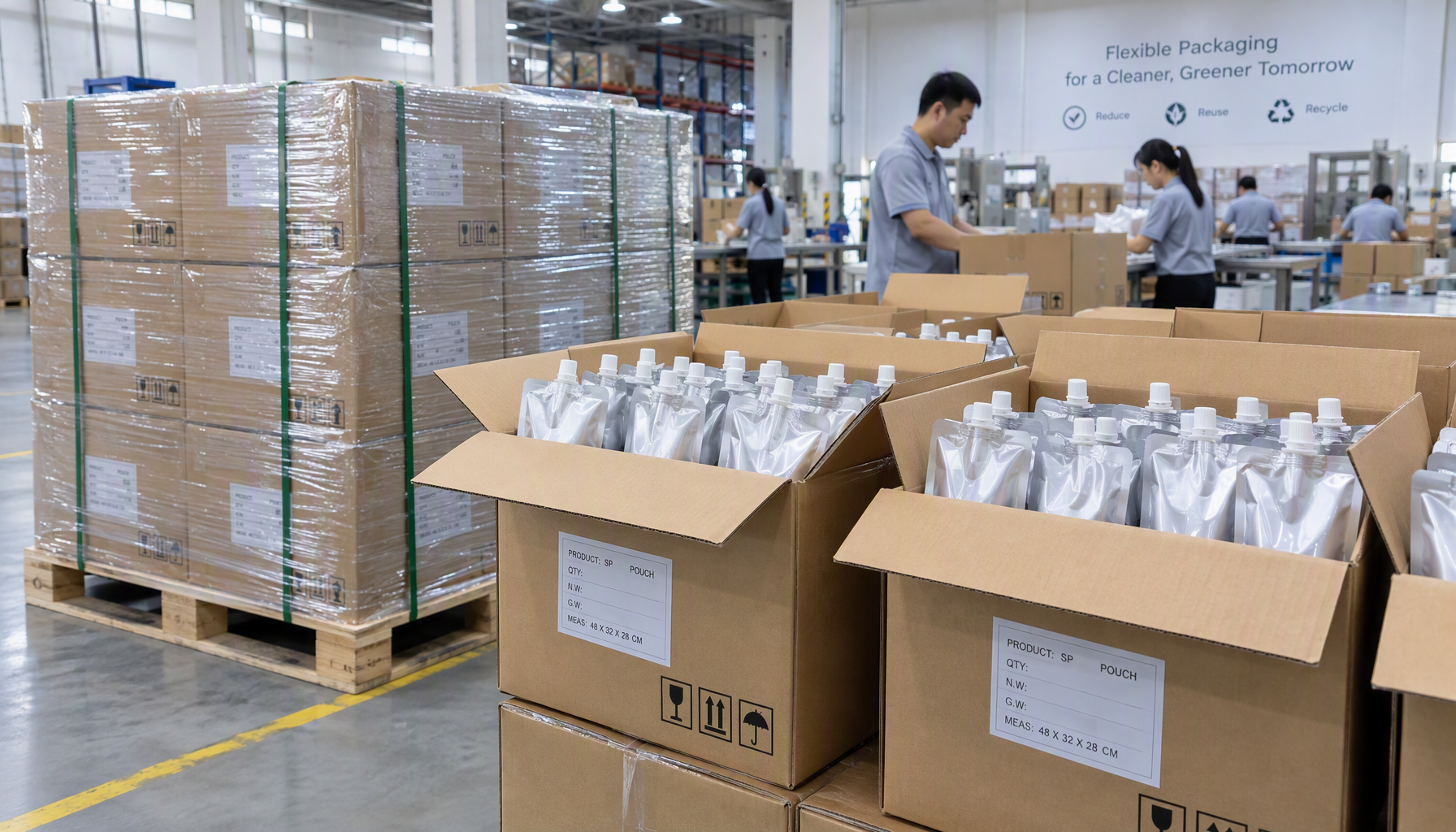
Spout pouch shipping cost is determined by the complete shipment configuration: pouch dimensions, filled or empty shipping condition, carton dimensions, pouch case pack, gross weight, total cubic volume, pallet arrangement, origin, destination, and delivery terms. For empty custom pouches, carton volume often becomes a major planning variable because flexible packaging is light but can occupy significant space when packed with protective separation and cartons.
A reliable estimate should therefore calculate three related figures: cost per pouch, cost per carton, and cost per shipment or pallet. The final packaging landed cost may include the pouch, carton materials, pallet and wrapping, inland transport, export handling, ocean or air freight, destination charges, duties, and delivery to the buyer’s facility. Exact freight cannot be confirmed without shipment details and a carrier or forwarder quotation.
This article assumes that the pouches are shipped empty from a manufacturing site to a B2B buyer. Filled-product distribution requires additional analysis because liquid or semi-liquid contents change the shipment weight, stacking behavior, leakage risk, and regulatory requirements.
The Main Spout Pouch Shipping Cost Components

Before comparing freight quotes, separate the cost elements that are controlled by the packaging specification from those controlled by the shipment route.
- Pouch production cost: This includes film structure, total thickness, printing, pouch dimensions, spout, cap, seals, and order quantity. A heavier laminate or larger fitment can increase both unit cost and shipment weight.
- Secondary packaging: Export cartons, inner bags, dividers, labels, corner protection, pallets, and stretch wrap add material cost and tare weight.
- Carton volume: Freight may be influenced by dimensional weight or chargeable volume, especially for air freight and less-than-container-load shipments. A low-density carton arrangement can reduce the number of cartons loaded into a container.
- Handling and origin charges: These can include factory loading, drayage, documentation, terminal handling, and other origin services depending on the agreed Incoterm and route.
- Main freight: Ocean, air, rail, or courier charges depend on route, service level, chargeable weight or volume, season, and carrier conditions.
- Destination costs: Import clearance, duties or taxes, terminal charges, local delivery, and unloading may be payable by the buyer under the selected commercial terms.
Ask the supplier to identify whether a quoted price is ex works, FOB, CIF, DAP, or another basis. The same pouch can have very different apparent prices when freight and destination charges are allocated differently.
How to Plan Spout Pouch Carton Packing
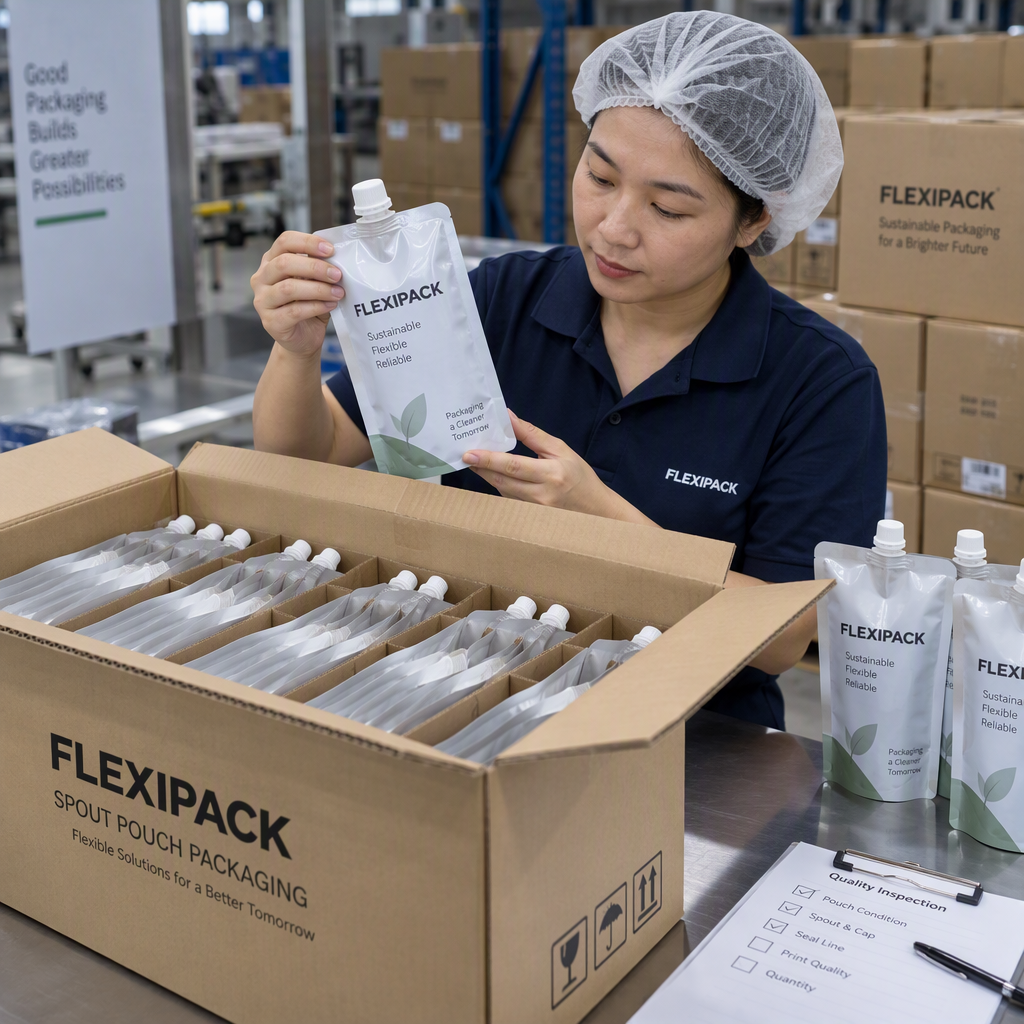
Spout pouch carton packing should protect the fitment and seals while using the carton interior efficiently. The correct arrangement depends on whether the pouches are flat, folded, nested, or separated by an inner bag or divider. A supplier should confirm the actual packed dimensions with a physical sample or production-equivalent packing trial.
Common planning inputs include:
- Pouch orientation: Keep spouts aligned where possible to prevent concentrated pressure on the opposite pouch or carton wall.
- Fitment protection: Caps and spouts may require a defined orientation, protective layer, divider, or controlled compression.
- Seal protection: Avoid carton arrangements that bend, crease, or abrade the seal area.
- Inner packaging: Determine whether pouches are bundled, bagged, counted by hand, or packed in a liner.
- Carton construction: Specify carton board grade, flute or wall construction, closure method, labels, and maximum gross weight with the supplier.
- Counting method: Use a repeatable pouch case pack so warehouse receiving and inventory counting remain accurate.
Do not select the largest possible case pack automatically. A very full carton may lower carton count but increase gross weight, manual handling difficulty, compression risk, and the consequences of a carton failure. The practical target is a stable case pack that protects the product and fits the buyer’s handling process.
Carton and Case-Pack Calculations
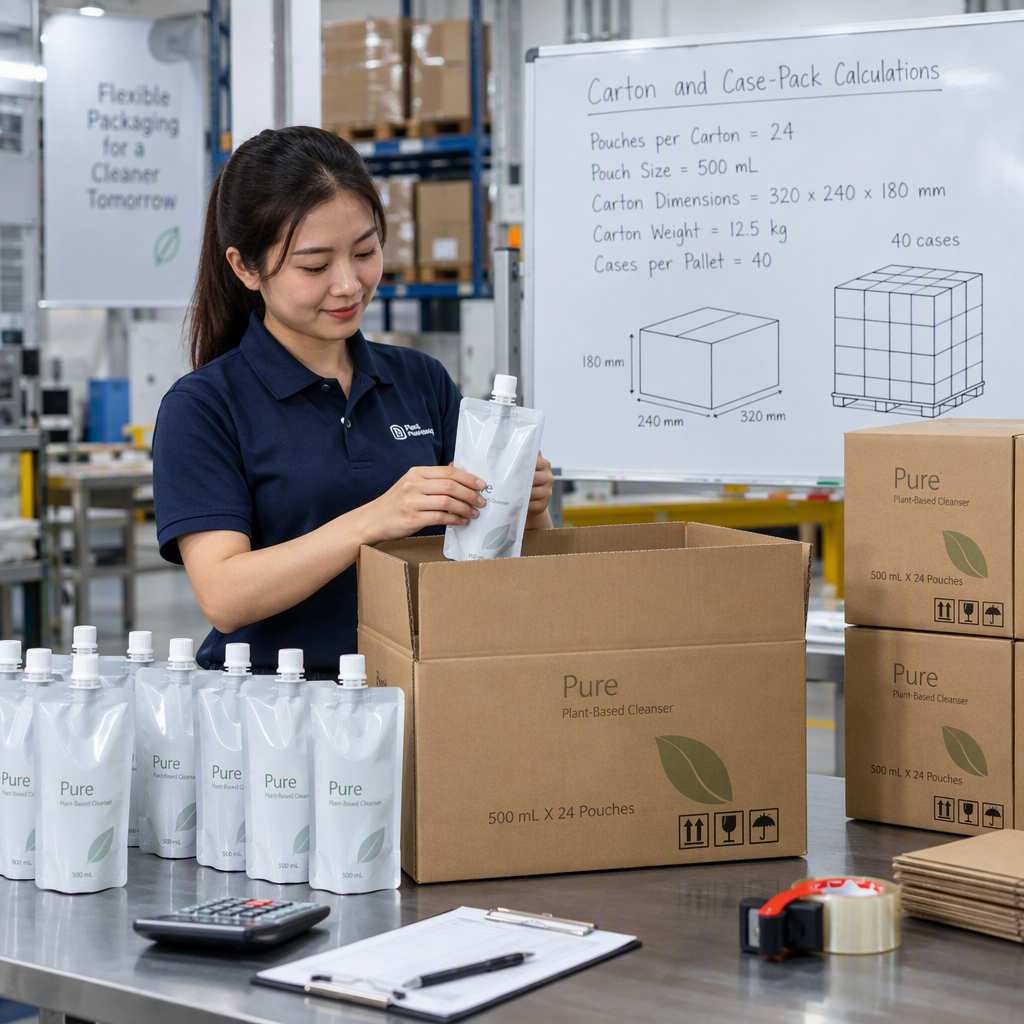
Use the following basic calculations to create a first logistics estimate. Replace the variables with supplier-confirmed values before placing an order.
| Calculation | Formula | Purpose |
|---|---|---|
| Number of cartons | Total pouches divided by pouches per carton, rounded up | Estimates carton quantity for the order |
| Pouch quantity | Cartons multiplied by pouch case pack | Shows planned quantity and any overage |
| Carton volume | Carton length multiplied by width multiplied by height | Calculates cubic volume per carton |
| Total shipment volume | Carton volume multiplied by carton quantity | Supports container, LCL, or air-freight planning |
| Gross shipment weight | Gross carton weight multiplied by carton quantity, plus pallet and securing materials | Supports weight-based freight and handling review |
| Cost per pouch | Total logistics cost divided by total pouches shipped | Allocates freight and logistics cost to each pouch |
For example, an order of 100,000 pouches packed at 1,000 pouches per carton requires 100 cartons before considering production overage. If the confirmed carton size is 600 x 400 x 500 mm, one carton occupies 0.12 cubic meters, and the cartons occupy approximately 12 cubic meters before pallet allowances. This is a planning example only; actual loading efficiency depends on carton orientation, pallet dimensions, stacking limits, and carrier requirements.
Keep units consistent. Convert millimeters to meters before calculating cubic meters, and distinguish net pouch weight from gross carton weight. Request the supplier’s packing list with carton count, dimensions, net weight, gross weight, and pallet quantity.
Flexible Packaging Palletization Options
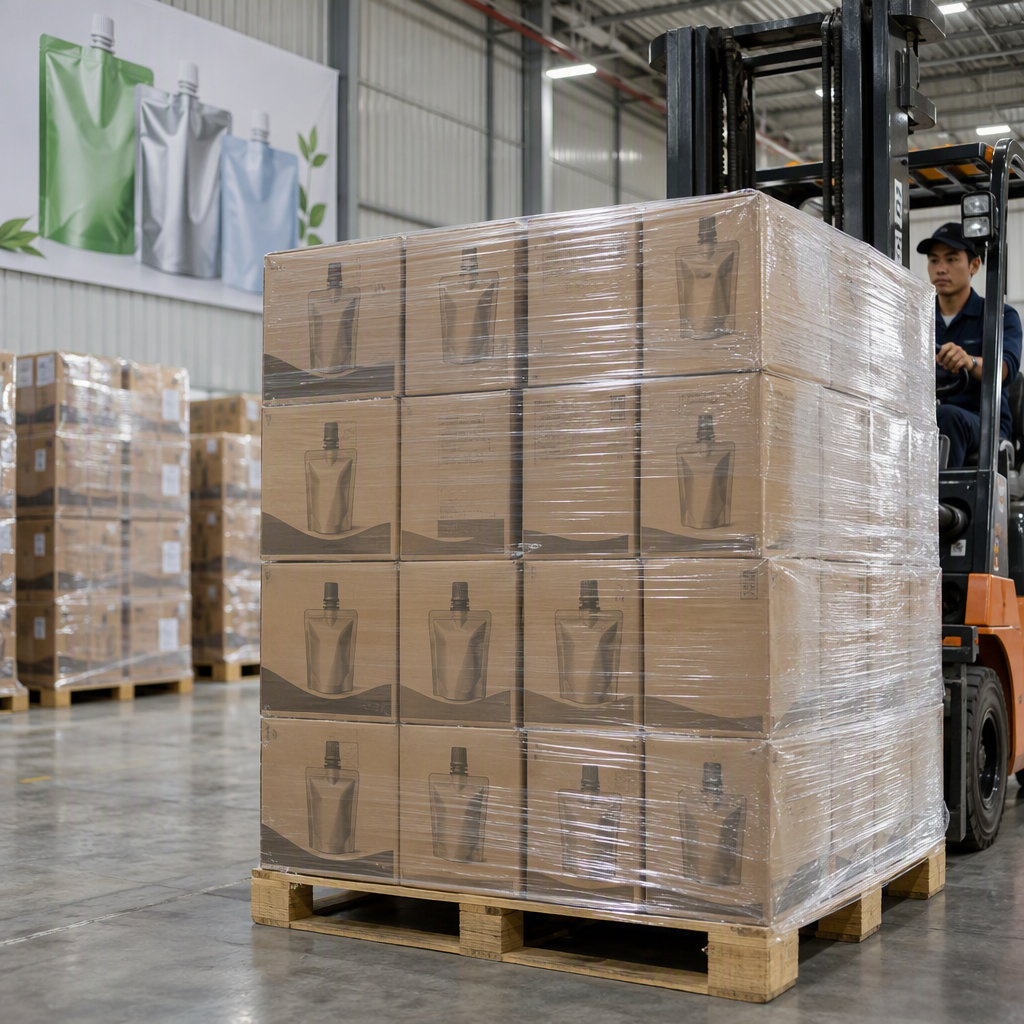
Flexible packaging palletization should balance cube utilization, stack stability, carton compression, and the receiving equipment available at the destination. The best pattern is not determined by carton count alone. Pallet dimensions, maximum height, gross weight, stacking restrictions, and the transportation mode must be considered together.
| Shipping configuration | Best suited for | Advantages | Planning considerations |
|---|---|---|---|
| Floor-loaded cartons | High-volume ocean containers with suitable unloading labor | May use container space efficiently and avoid pallet tare | Unloading is more labor-intensive; cartons need clear count and protection |
| Standard palletized cartons | Warehouse receiving, LTL, and mixed distribution | Easier handling, counting, storage, and forklift movement | Pallet footprint and height can reduce usable cube |
| Mixed-SKU pallets | Smaller orders or several pouch sizes | Can consolidate different items in one shipment | Requires clear layer plans, labels, and weight control |
| Dedicated SKU pallets | Large repeat orders with consistent case packs | Simplifies receiving and inventory control | May leave unused pallet positions if the order quantity is not aligned |
Before approval, request a pallet pattern showing cartons per layer, layers per pallet, total cartons, total pouches, pallet dimensions, and gross pallet weight. Confirm whether the pallet is included in the quoted shipping figures and whether the destination has pallet-size or material requirements.
Freight Variables and Packaging Landed Cost

Spout pouch freight cost cannot be calculated from the pouch quantity alone. A freight provider may price the shipment by actual weight, dimensional weight, chargeable volume, container utilization, or a combination of these factors. The relevant method depends on the transport mode and service contract.
For ocean freight, ask whether the shipment is planned as a full container load or less-than-container load, and confirm the container type and estimated loading volume. For air freight, compare actual weight with the carrier’s dimensional-weight rule. For domestic truck or parcel delivery, pallet count, pallet footprint, linear space, and delivery appointment requirements may affect the quote.
Packaging landed cost can be reviewed with this formula:
Landed packaging cost = product cost + export packaging + origin charges + freight + insurance, if applicable + destination charges + duties and taxes, if applicable + inland delivery.
State the assumptions behind each estimate. A quote based on FOB Guangzhou is not directly comparable with a delivered quote unless the same destination charges, duty assumptions, currency, and shipment quantity are included. Buyers should also distinguish one-time costs, such as tooling or plate charges, from recurring carton and freight costs.
Specification Decisions That Affect Logistics
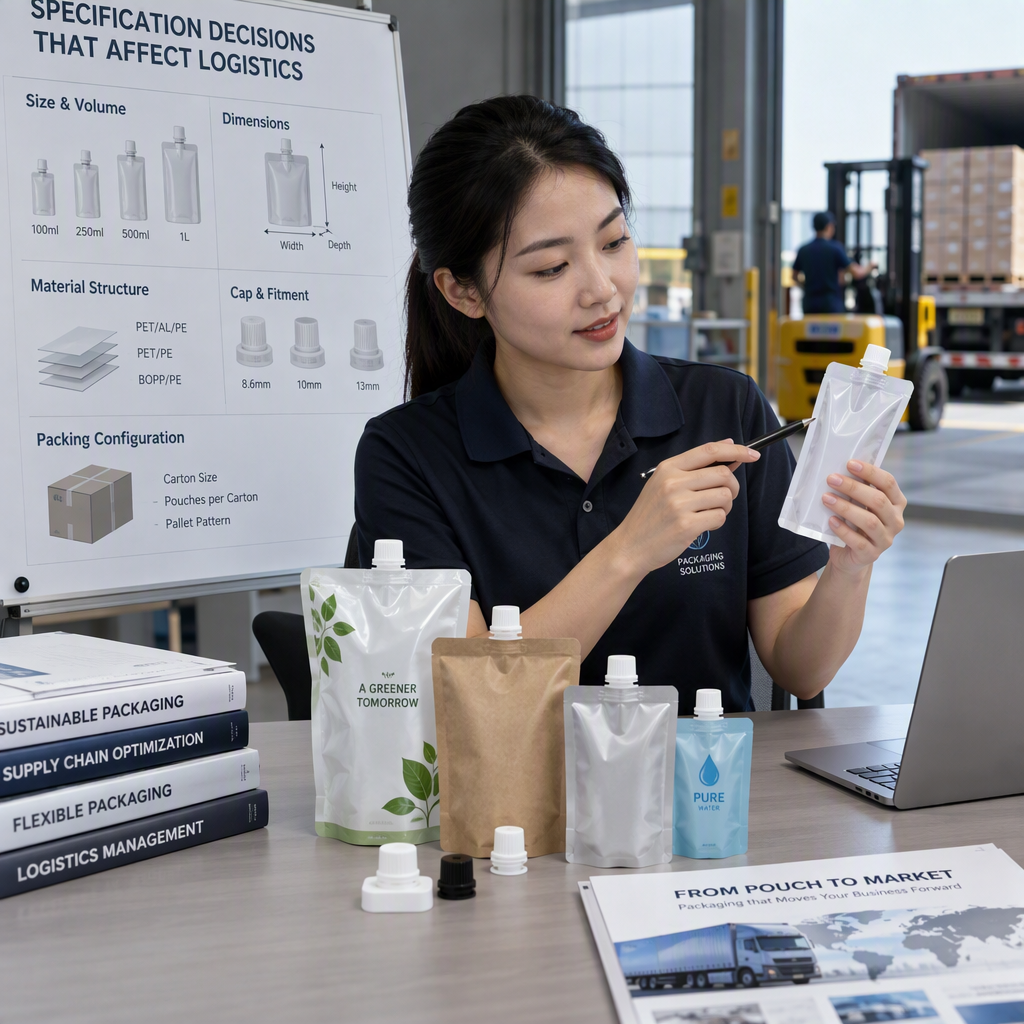
Several technical decisions can change the shipment profile without changing the nominal pouch capacity.
- Finished dimensions: A wider or taller pouch may change how many units can be nested or aligned in a carton.
- Material structure and thickness: Additional layers or higher total thickness may increase weight and reduce the number of pouches that can be packed within a handling limit.
- Spout and cap: Larger or heavier fitments can affect nesting, carton height, and protective packaging requirements.
- Features: Handles, zippers, shaped profiles, rounded corners, and special seal designs may require different packing orientations or lower case packs.
- Product use: Hot-fill, retort, chemical, or food applications may require structures and validation steps that influence packaging weight and handling requirements.
- Order quantity: Quantity should be reviewed against full-carton and full-pallet multiples. A small remainder can require a partial carton or inefficient pallet position.
Do not reduce material thickness solely to lower freight. The structure must remain suitable for the product, filling process, seal design, and distribution conditions. Review any proposed change against the approved specification and shipping test results.
How to Validate the Shipping Plan

Validate the shipping plan before mass production, especially when the pouch has a large fitment, unusual shape, high barrier structure, or a demanding distribution route. Start with an approved sample packed in the proposed inner packaging and carton. Measure the packed carton rather than relying only on theoretical pouch dimensions.
- Confirm pouch count, orientation, inner bag or divider, and carton closure.
- Record carton length, width, height, net weight, and gross weight.
- Build the proposed pallet pattern and record cartons per layer, layers per pallet, pallet height, and gross pallet weight.
- Check whether the configuration meets the buyer’s warehouse, forklift, rack, and carrier requirements.
- Use an appropriate distribution or drop test plan when the shipment may experience repeated handling or stacking.
- Request a commercial freight quote using the confirmed packing list and exact origin, destination, mode, and Incoterm.
After the first production shipment, compare estimated and actual carton counts, weights, dimensions, and freight invoices. This creates a useful logistics baseline for repeat orders and can identify whether the improvement opportunity is case pack, pallet layout, carton strength, or the transport route.
FAQ
Are spout pouches cheaper to ship than rigid containers?
Empty spout pouches are often lightweight and can be nested, but shipping cost still depends on their packed volume, carton arrangement, fitment, and shipment mode. A direct comparison should use the same product capacity, protection level, quantity, origin, destination, and Incoterm.
What information is needed to quote spout pouch shipping cost?
Provide pouch dimensions, material structure and thickness, spout and cap details, quantity, pouches per carton, confirmed or target carton dimensions, gross weight, pallet preference, origin, destination, transport mode, and Incoterm. If some information is not finalized, label it as an estimate.
How many spout pouches should be packed in one carton?
There is no universal pouch case pack. The supplier should select a quantity that protects the pouch and fitment, keeps the carton within a practical handling weight, supports stable stacking, and matches the buyer’s receiving process. A packing trial is more reliable than a theoretical count.
Does palletization always reduce spout pouch freight cost?
No. Pallets can improve handling and stability but add tare weight, materials, and sometimes unused space. Floor loading may provide better cube utilization for some ocean shipments, while palletization may be preferable for warehouse receiving or domestic distribution. Compare both options against the full handling and delivery requirements.
What is the difference between freight cost and packaging landed cost?
Freight cost is the charge for transporting the shipment and may include related origin or carrier services depending on the quote. Packaging landed cost is broader: it allocates the pouch and secondary packaging cost together with freight, applicable duties or taxes, insurance, destination charges, and final delivery.
Can changing pouch thickness reduce shipping cost?
It may reduce shipment weight in some cases, but the change must be technically validated. Thickness affects barrier, seal behavior, stiffness, puncture resistance, filling performance, and product compatibility. Any logistics-driven material change should be reviewed against the approved specification and distribution requirements.
Plan Your Spout Pouch Shipment
Discuss your pouch structure, spout fitment, artwork, MOQ, samples, destination, and quote requirements with HUACANG Packaging. We can use the proposed case pack and pallet plan to prepare a more complete packaging and shipping estimate.