Table of Contents
- What Is a Customized Shaped Spout Pouch?
- Start With the Product and Filling Conditions
- Choose the Pouch Shape and Format
- Select the Laminate and Barrier Structure
- Specify the Spout, Cap, and Location
- Prepare Artwork for a Shaped Pouch
- Validate the Design Before Production
- Request a Complete Supplier Quote
A practical B2B guide to designing and buying customized shaped spout pouches for liquid, semi-liquid, and refill products.
What Is a Customized Shaped Spout Pouch?
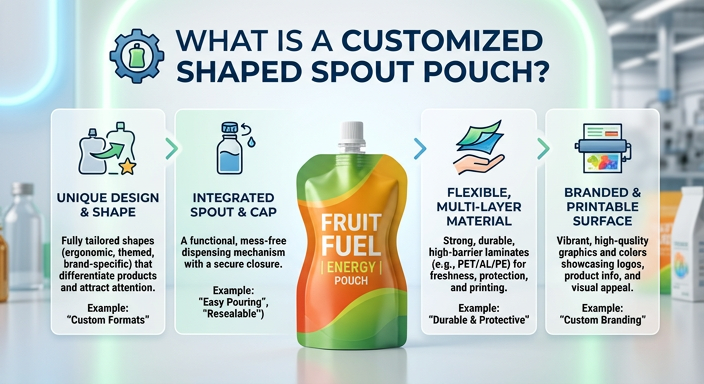
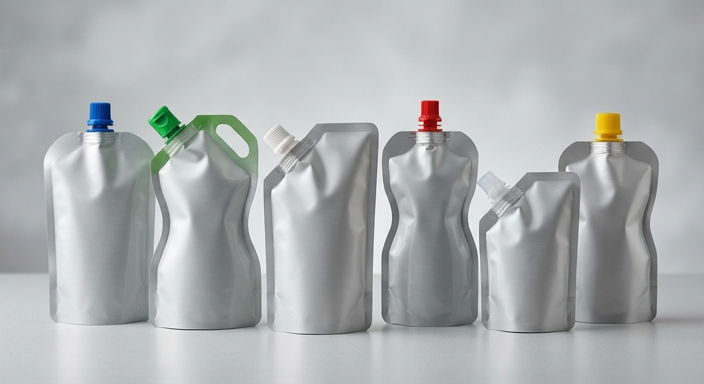
A customized shaped spout pouch is a flexible package with a dispensing fitment and an exterior profile that differs from a standard rectangle, stand-up pouch, or flat pouch. The profile may follow a brand silhouette, create an easy-grip area, form a rounded shoulder, or improve shelf recognition. It is commonly used for beverages, fruit purees, sauces, edible oils, liquid soap, household refills, and similar flowable products.
The important buying decision is not only the outline. A viable shaped pouch must balance visual design with fill volume, headspace, laminate stiffness, seal width, spout welding area, cap function, and the filling line. A complex die-cut contour can affect material yield, registration, pouch stability, and production efficiency. Buyers should therefore define the product and process before approving a shape.
For this guide, the assumption is a custom-printed multilayer pouch with a pre-applied spout and cap, supplied to a brand owner, importer, or co-packer. Food-contact applications should be evaluated against the destination market and the intended conditions of use; see this practical guide to food-contact packaging requirements for U.S. imports when the pouch will contact food.
Start With the Product and Filling Conditions
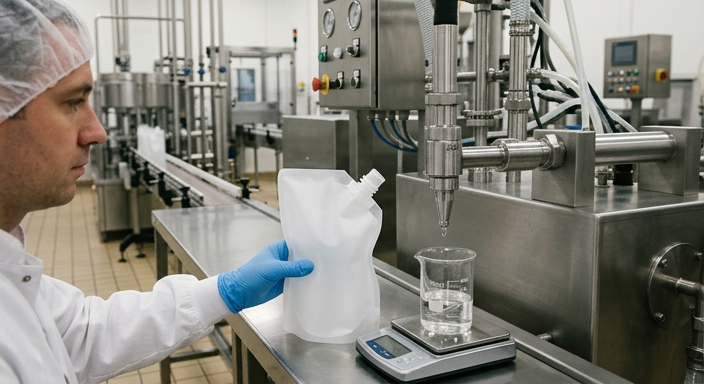
Product characteristics determine the pouch structure before design preferences do. Provide the supplier with the formula category, viscosity, acidity or alkalinity where relevant, oil content, particulates, fragrance or solvent content, target fill weight or volume, and intended storage conditions. These factors influence film compatibility, barrier needs, sealant selection, spout bore size, and whether the product can dispense reliably.
Also identify the filling method. A pouch filled through the spout has different handling requirements from one that is filled through an open top and then sealed. State the fill temperature, expected filling speed, product temperature at packing, post-fill cooling, distribution environment, and any process such as hot fill, retort, freezing, or aseptic filling. A pouch should not be described as suitable for any of these processes without structure-specific and process-specific validation.
Viscous products such as honey, condiments, gels, and concentrated detergents may require a larger outlet than low-viscosity drinks. Products with particulates need particular attention because particle size can affect dispensing and fill equipment. For concentrates, product viscosity and reclosure expectations are central to the specification; this spout pouch guide for beverage concentrates gives related selection considerations.
- Product: formula category, viscosity, pH if known, oil or solvent content, and particulate size.
- Pack: nominal fill volume, allowable headspace, target finished dimensions, and orientation on shelf.
- Process: filling method, fill temperature, line speed, and sealing or capping sequence.
- Distribution: ambient, refrigerated, frozen, or other expected storage and handling conditions.
Choose the Pouch Shape and Format
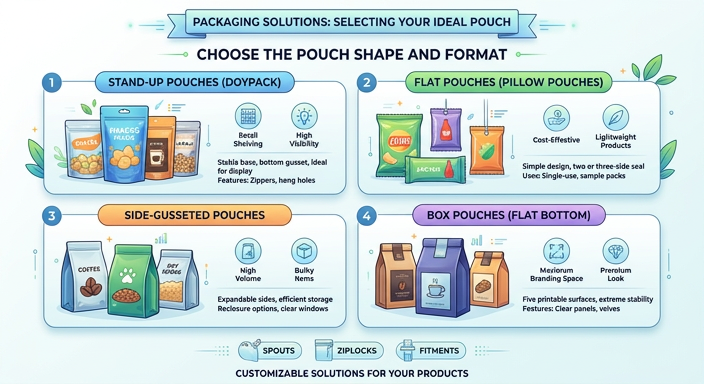
Choose the pouch format and the shaped area separately. A customized outline can be applied to a three-side-seal pouch, a stand-up pouch with a bottom gusset, or a shaped pouch with a dedicated handle or shoulder area. The best format depends on the required volume, how the pouch will be displayed, and whether it must stand independently after filling.
Keep functional areas clear of decorative contours. The spout base needs sufficient flat material for secure application. Side seals and bottom seals need consistent width, and the pouch needs enough space above the fill level to manage headspace and handling. Very narrow necks, deeply concave curves, sharp inside corners, and small projections can make conversion and filling more difficult. They can also create areas that wrinkle or are hard to register accurately in printing.
Ask for a dieline that clearly identifies the trim contour, finished pouch outline, safe artwork area, seal zones, gusset area, spout location, and fill direction. The dieline should be approved before artwork is finalized. A physical blank sample is useful for checking grip, shelf fit, carton packing, and line handling before committing to printed production.
For liquid products, shape should not be the only format decision. A larger dispensing format may be better suited to bag-in-box in some uses, while a pouch may be preferable for smaller retail or refill packs. Review how to choose between bag-in-box and a spout pouch for liquid products when evaluating both options.
Select the Laminate and Barrier Structure
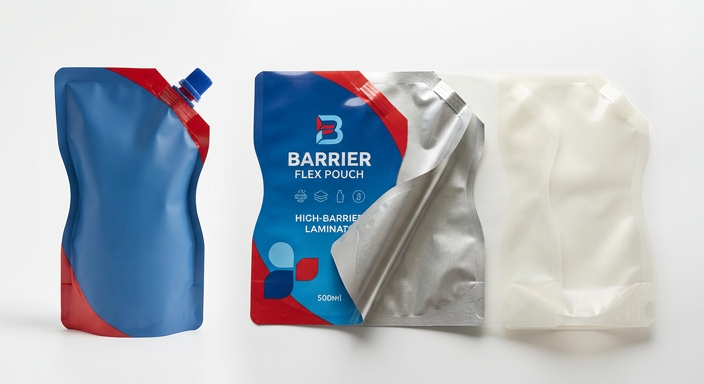
A shaped pouch is normally made from a laminated film structure. Each layer has a role: an outer web provides print surface and abrasion resistance, intermediate layers may contribute barrier or stiffness, and the inner sealant layer contacts the product and forms seals. The appropriate construction depends on the actual product, process, and shelf-life objective, not on pouch shape alone.
Common structures may combine polyester, nylon, polyethylene, polypropylene, metallized films, aluminum foil, or specialty barrier layers. Material names alone are not a complete specification. Film gauges, adhesive system, sealant type, barrier requirement, and process conditions all matter. For example, an oxygen- or light-sensitive product may call for a barrier approach that differs from a dry powder or a short-turnover household refill.
Discuss the following with the pouch manufacturer:
- Required protection from oxygen, moisture, light, aroma loss, or external odors.
- Resistance to product ingredients, including oils, surfactants, acids, fragrances, and alcohols where applicable.
- Required stiffness for shape retention, shelf presentation, and filling-line handling.
- Seal performance at the planned filling conditions and expected distribution environment.
- Whether the final construction must support frozen storage, thermal processing, or other special use conditions.
For frozen applications, material flexibility and seal behavior at low temperature deserve separate evaluation. See material and seal selection for frozen food pouches for a focused discussion of those conditions.
Specify the Spout, Cap, and Location
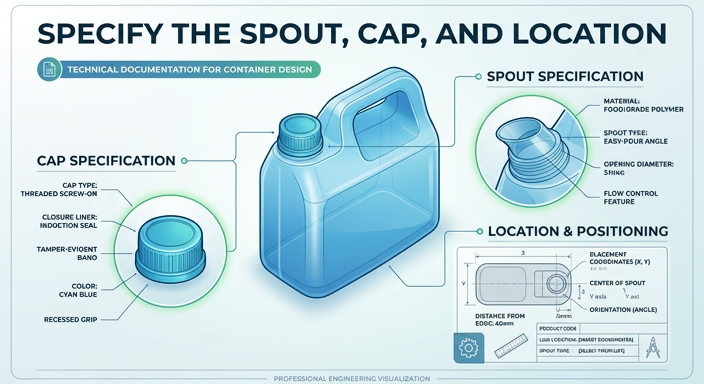
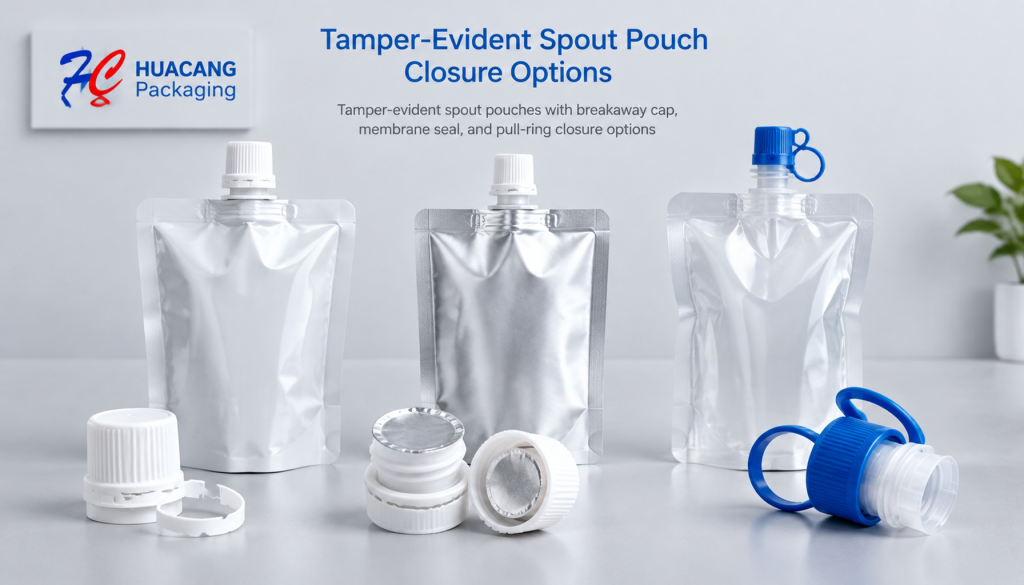
The fitment is a functional component, not a decorative add-on. Specify its diameter, bore, thread or closure style, cap type, tamper-evident feature if required, resin expectation where relevant, orientation, and application location. The cap must be practical for the user to open and reclose, while the spout must match the product flow and filling equipment.
Top-center spouts are common for upright packs and controlled pouring. Corner spouts can be useful where a pouring angle or layout calls for them. Center spouts on a shaped shoulder may create a balanced appearance, but the shoulder must still provide enough weld area and resist distortion. The choice affects how the pouch empties, stacks, stands, and is presented to the consumer.
Do not assume a standard fitment will work on every line. Confirm the capper or filler can handle the selected spout dimensions, orientation, pouch profile, and expected tolerances. Request samples for line trials when the design, product, or equipment is new. Household and personal-care formulas in particular should be reviewed for compatibility with both the laminate and fitment; see how to specify liquid soap spout pouches for related product inputs.
Prepare Artwork for a Shaped Pouch

Artwork for a shaped pouch needs to follow the approved dieline precisely. Keep mandatory copy, barcodes, logos, and critical graphics inside the designated safe area. Do not place small text, barcode quiet zones, or important imagery across seals, gussets, curved trim areas, spout weld zones, or locations likely to distort when the pouch is filled.
Provide editable vector artwork where possible, identify spot colors or process-color requirements, and state any finish such as gloss, matte, or a selective finish. The production method and color management approach should be confirmed with the supplier. Proofing should address spelling, graphics, color targets, dieline version, print registration, and the correct orientation of the spout and pouch front.
A shaped outline can make front-panel alignment more visually sensitive than on a rectangular pouch. Design elements that intentionally follow the contour should allow for normal manufacturing tolerances. For a detailed prepress checklist, consult this custom spout pouch printing guide covering artwork, colors, and finishes.
Validate the Design Before Production

Production approval should follow a validation plan that reflects the product and supply chain. A sample can confirm basic dimensions and appearance, but it does not by itself demonstrate full-scale line performance or product compatibility. Buyers should agree with their supplier and filling partner on the checks needed before a commercial run.
Typical evaluation points include finished pouch dimensions, fill-volume fit, seal appearance, fitment placement, cap application, leak testing method, drop or handling assessment where relevant, print registration, carton packing, and filling-line compatibility. Product-filled trials may also reveal whether the pouch dispenses, empties, or stands as expected. The exact test method, acceptance criteria, and sample quantity should be documented by the parties involved.
For food products, request appropriate material and compliance documentation for the destination market and intended use. For special processes such as hot fill, retort, or aseptic filling, define the process parameters first and confirm that the proposed structure and fitment are intended for evaluation under those conditions. Claims about shelf life, sterilization performance, or regulatory suitability should be supported by the relevant product-specific evidence rather than assumed from a generic pouch construction.
Request a Complete Supplier Quote

A clear request for quotation reduces revisions and helps the manufacturer assess whether the custom shape is practical. Include the intended application, annual or per-order quantity, pouch format, estimated dimensions, fill volume, product details, filling method, storage conditions, laminate expectations, spout and cap preferences, artwork status, destination, and requested delivery timing.
Where dimensions are not final, provide a target volume and a reference package or sketch. The supplier can then advise on a workable dieline and approximate dimensions. Ask which tooling, printing setup, sample, and production steps apply to the proposed shape. Custom outlines may involve dedicated cutting or forming elements, so the first order can have different setup considerations from a repeat order.
MOQ is influenced by print method, number of colors, material structure, pouch dimensions, fitment type, and production planning. It is better to request an MOQ against a defined specification than to ask for a universal minimum. Review the spout pouch MOQ planning guide before setting first-order volume and artwork variants.
Before placing the order, make sure the approved specification identifies the revision-controlled artwork, dieline, material construction, pouch dimensions, tolerances where agreed, fitment and cap, packaging method, inspection expectations, and commercial terms. This gives both buyer and manufacturer a common production reference.