Table of Contents
- The Right Material and Seal System for Frozen Food
- Define the Packaging Service Profile First
- Choose Laminate Layers by Product Risk
- Select the Sealant Layer and Seal Design
- Select Pouch Format and Features
- Validate Frozen Pouch Performance
- Prepare a Clear Frozen Pouch RFQ
Frozen food pouches need a laminate and seal system matched to the food, filling process, freezer temperature, and distribution handling. This buyer guide explains how to select barrier layers, puncture-resistant films, low-temperature sealants, and practical validation tests.
The Right Material and Seal System for Frozen Food
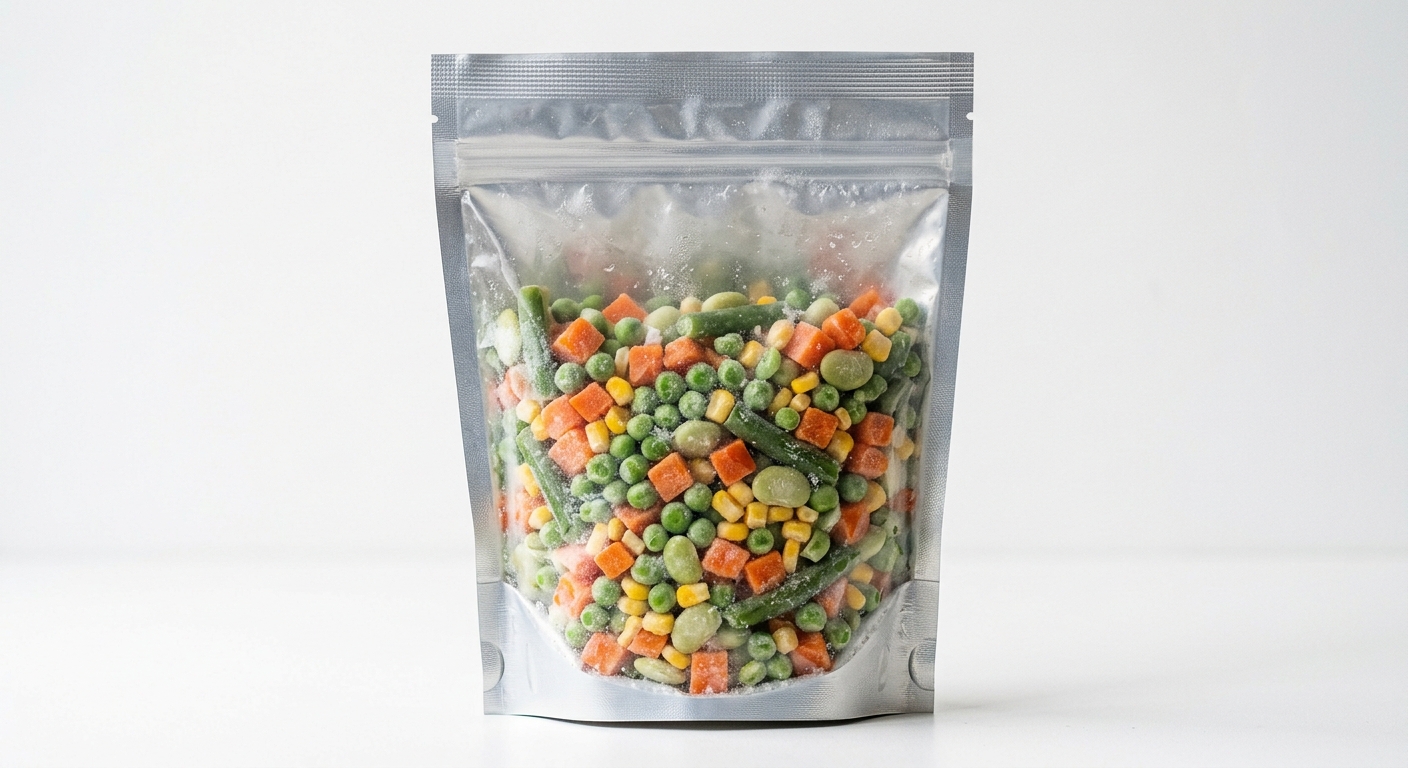
Frozen food pouches should use a laminate that remains resistant to puncture and flex damage at the intended frozen-storage temperature, combined with a heat-seal layer that maintains seal integrity after freezing and handling. For many frozen vegetables, fruit, seafood, meat portions, and prepared foods, buyers start with a printed outer web, a functional middle layer for barrier or toughness, and a polyethylene-based inner sealant. The final construction must be selected against the actual product shape, fat or moisture level, fill method, barrier requirement, and distribution conditions.
Material selection is not only about whether a pouch can enter a freezer. Sharp or irregular pieces can challenge the film; frost, product residue, and seal-area contamination can affect sealing; and drops, stacking, and case packing can load a pouch differently once its contents are frozen. A seal that looks acceptable immediately after packing should therefore be evaluated after the intended freeze-and-thaw or frozen-handling cycle.
As a practical starting point, use a sealant designed for the product and packing line, add mechanical protection when the food has sharp edges or hard particles, and add oxygen, moisture, light, or aroma barrier only when product shelf-life requirements call for it. This is an engineering selection, not a one-material choice.
Define the Packaging Service Profile First
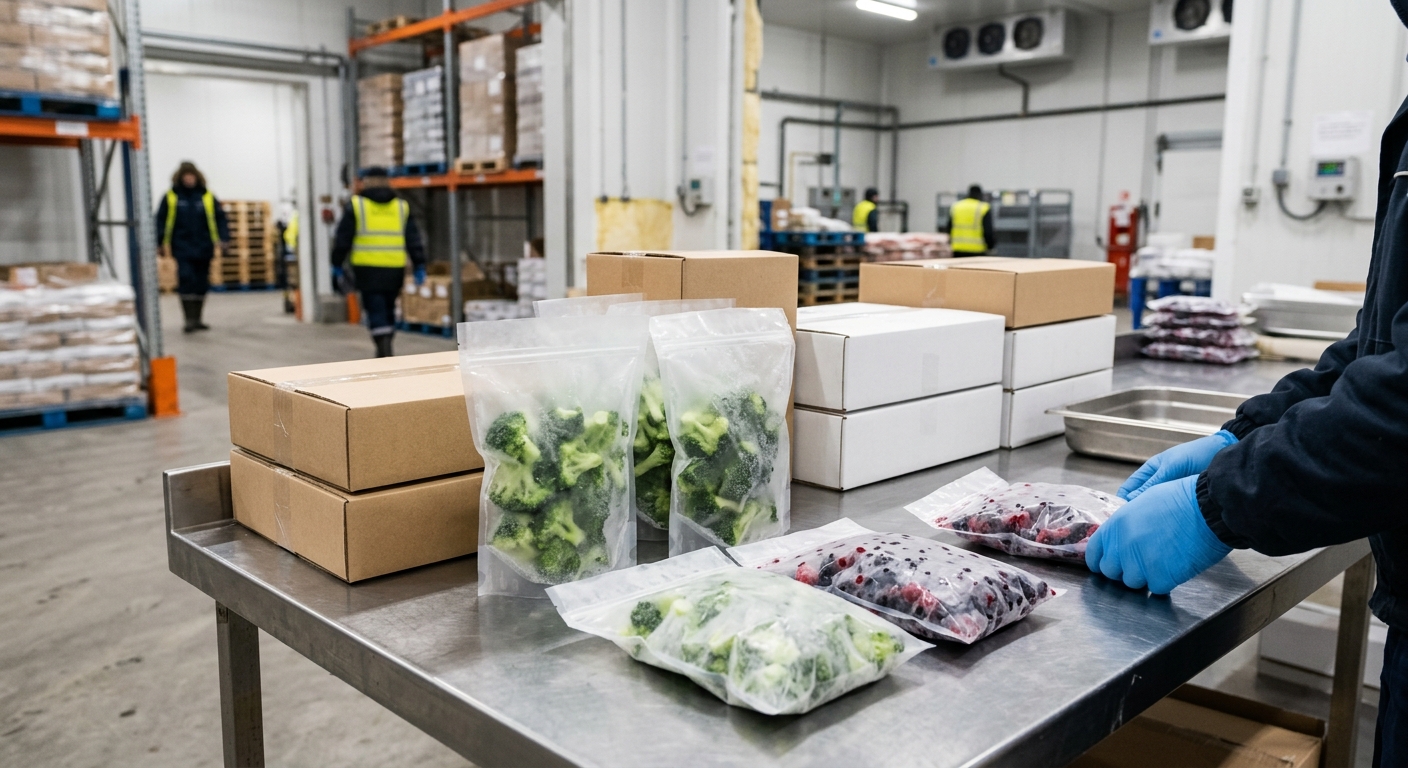
Before choosing films, define how the pouch will be filled, frozen, shipped, displayed, and used. “Frozen” is a storage condition, but it does not describe all the forces the packaging must tolerate. A pouch for individually quick frozen (IQF) berries has different risks from a pouch for marinated chicken, frozen fish fillets, or a ready-to-cook sauce.
Key inputs to provide to a packaging supplier
- Food type and physical form: powder, sauce, diced pieces, bone-in portions, frozen vegetables, breaded items, or sharp seafood shells.
- Product characteristics: moisture, oil or fat content, salt, acidity, particulates, and any ingredients that may transfer to the seal area.
- Filling conditions: product temperature at filling, fill weight, headspace, fill method, and whether the pack is vacuum packed, gas flushed, or conventionally filled.
- Freezing and storage conditions: target storage temperature, freezing method, expected storage period, and likely temperature excursions during distribution.
- Handling risks: product drop height, case configuration, pallet stacking, e-commerce shipment exposure, and consumer handling.
- Product protection objective: moisture retention, oxygen control, light protection, aroma retention, or a combination of these needs.
These inputs help distinguish a basic freezer pouch from a higher-demand structure requiring more puncture resistance, barrier performance, or specialized sealing behavior. If the pack must be opened and reclosed at home, closure requirements should be considered separately from the permanent perimeter seal.
Choose Laminate Layers by Product Risk

A laminated frozen food pouch assigns different jobs to different layers. The exact film gauges, resin grades, adhesive system, and barrier technology should be confirmed with the converter based on the approved specification and production trials.
- Outer layer: commonly a printable polyester or oriented polypropylene film. It provides print support, surface appearance, and a portion of the laminate’s mechanical stability.
- Middle functional layer: may provide added puncture resistance, stiffness, barrier, or light protection. Nylon-based films can be considered where toughness is important. Metallized films or aluminum foil may be considered when light or barrier needs are high, subject to the required flex performance and product application.
- Inner sealant layer: typically a polyethylene family film or coextruded sealant web selected for sealability, product contact suitability, and low-temperature toughness.
For soft, low-risk frozen foods, a simpler clear laminate may be appropriate when the required barrier can be achieved without extra layers. For hard, angular, or abrasive products, mechanical robustness deserves greater weight. Examples include frozen broccoli florets, diced vegetables, shell-on seafood, bone-in proteins, and products with hard inclusions. In these applications, a puncture-resistant functional layer and suitable total structure can reduce the chance that corners or edges damage the pouch during packing and distribution.
Barrier selection should follow the food’s quality target rather than a generic preference for the highest-barrier material. Moisture barrier can matter for products prone to freezer dehydration; oxygen barrier may be relevant for oxidation-sensitive foods; and light barrier may be relevant for products affected by light exposure. Barrier performance is influenced by the completed laminate, package geometry, seals, storage environment, and test conditions. For a broader explanation of layer roles and trade-offs, review this guide to choosing the right flexible pouch laminate.
When specifying transparent packaging, be clear about whether product visibility is essential. A clear window can support merchandising, but it may not offer the same light-blocking behavior as an opaque construction. Conversely, an opaque printed pouch may be more appropriate when light protection is a product requirement.
Select the Sealant Layer and Seal Design
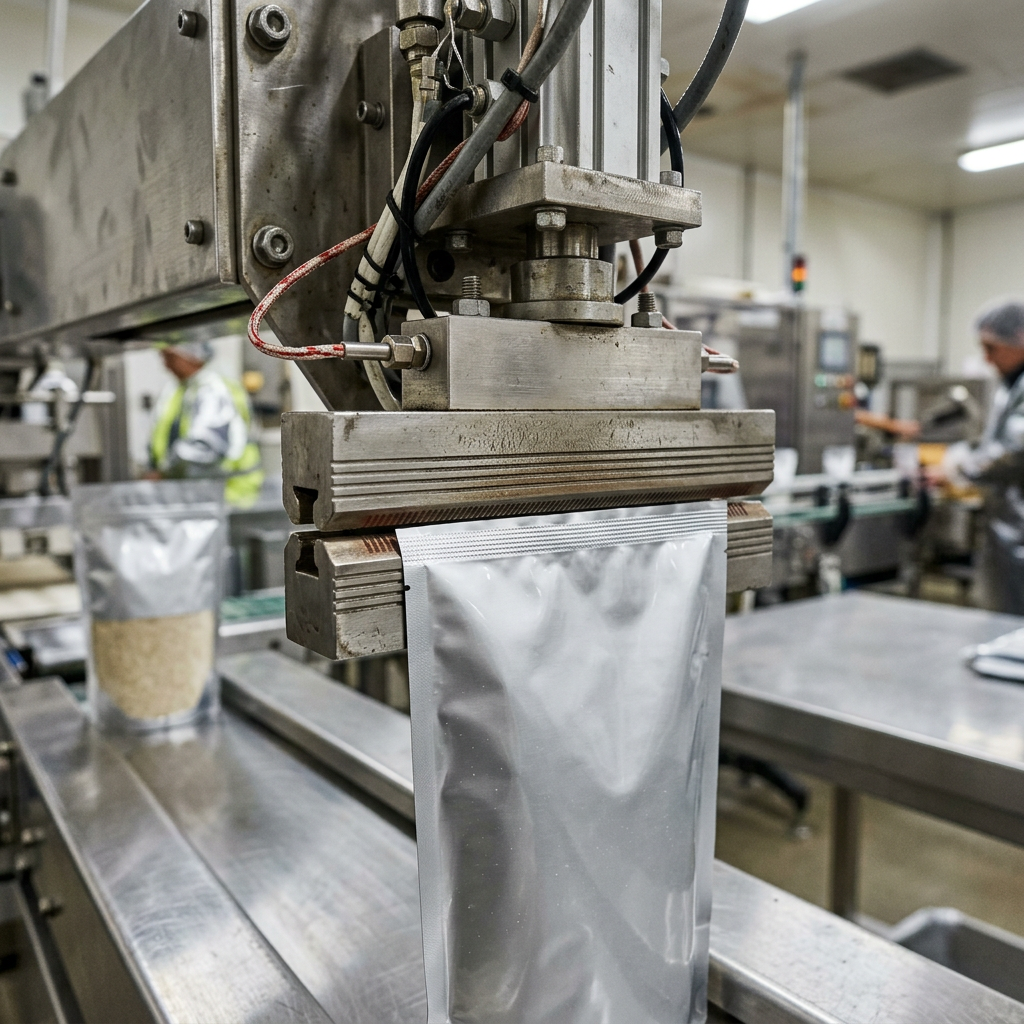
The sealant layer is the inside film surface that forms the permanent package seal under heat, pressure, and dwell time on the packing machine. For frozen food pouches, it must be compatible with the laminate, product-contact requirements, sealing equipment, and the expected frozen handling environment.
Polyethylene-based sealant systems are widely used because they can provide practical heat-seal performance and toughness. However, “PE” alone is not a complete specification. Resin selection, sealant-web construction, thickness, sealing temperature range, and the product condition at the seal interface all affect results. A supplier may recommend an LLDPE-, LDPE-, metallocene PE-, or coextruded PE-based sealant approach depending on the application. The appropriate choice should be confirmed through line trials and finished-pack testing.
Seal factors to review
- Seal-through contamination tolerance: Frozen food fills can leave water, oil, seasoning, or small particulates near the seal area. Do not assume a sealant will seal through contamination; test representative conditions.
- Heat-seal window: The sealant should operate consistently within the temperature, pressure, and dwell-time range available on the actual equipment. A narrow process window can increase reject risk when operating conditions vary.
- Seal strength and failure mode: Evaluate the required opening or burst resistance and determine whether failure occurs in the seal, film, or another area. The required result depends on pack size, headspace, filling process, and distribution loads.
- Low-temperature behavior: Assess seals after the intended frozen-storage exposure and handling sequence, not only at room temperature.
- Seal geometry: Seal width, corner shape, fin-seal or lap-seal design, and pouch construction affect the effective sealed area and stress distribution.
Wider seals are not automatically the best answer. They can consume material and change pouch geometry, while a poor seal interface or unsuitable sealing condition may still cause failure. The goal is a controlled seal process using a compatible material structure and a seal design suited to the product and machine.
For products requiring a reclosable consumer feature, a zipper is usually supplementary to the permanent package seal. The zipper must be matched to product particle size, expected use, and filling process. This food packaging zipper pouch buying guide explains the specification questions buyers should review when adding a zipper feature.
Select Pouch Format and Features
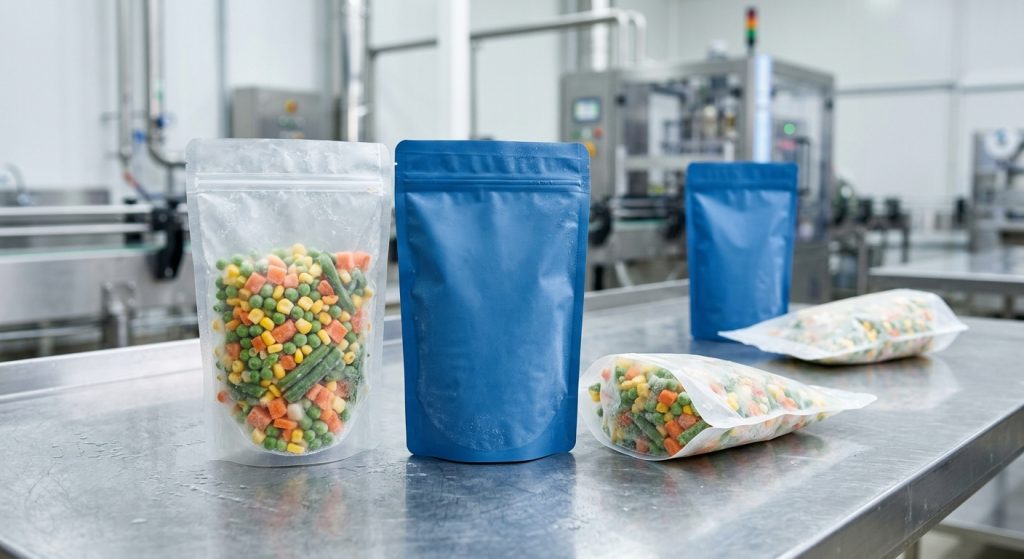
The pouch format should support the product’s filling behavior, pack weight, shelf presentation, and consumer use. Flat pouches are commonly used for portions and products that pack efficiently in cases. Stand-up pouches can improve retail display for suitable products, but the bottom gusset, fill level, and frozen product shape should be assessed so the pack performs as intended after freezing.
- Three-side-seal pouch: a practical format for flat frozen portions, samples, sachets, and products where shelf-standing is not required.
- Four-side-seal pouch: can provide a flat, symmetrical pack profile for selected portions and foodservice applications.
- Stand-up pouch: suitable when upright presentation and a larger front panel are important. Confirm that the gusset design suits product settling and case packing.
- Resealable zipper pouch: useful for multi-serve frozen fruit, vegetables, snacks, and ingredients when consumers are expected to use only part of the pack at a time.
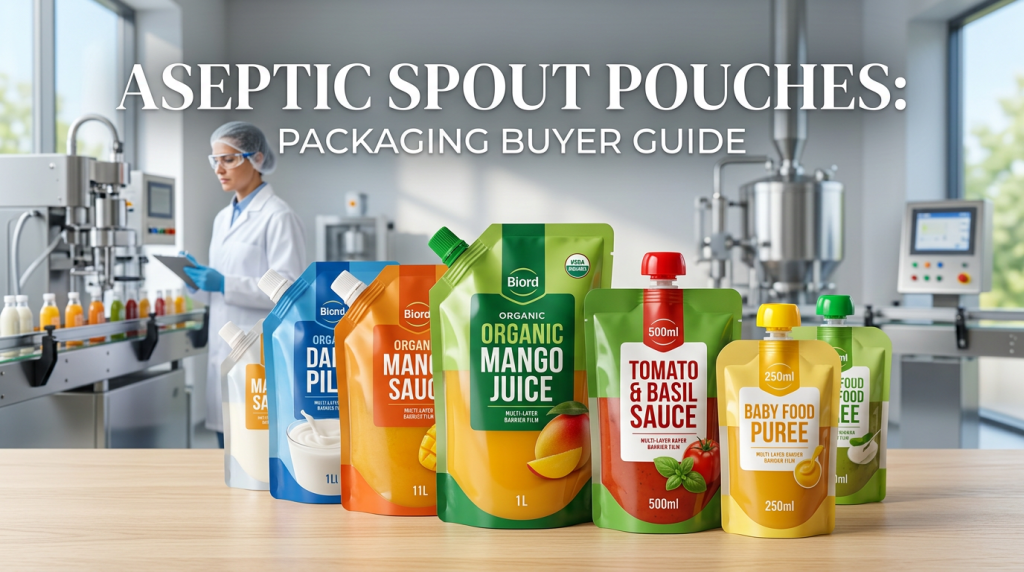
- Spouted pouch: may suit frozen sauces, purees, concentrates, or semi-liquid products that need controlled dispensing after thawing or during use. Spout fitment selection requires separate review of application conditions.
Features such as tear notches, laser scoring, hang holes, and rounded corners should be specified according to the real use case. For example, easy-open features must be assessed with the laminate and expected opening direction; a tear feature that works well before freezing may need verification after frozen storage. If a spout is being considered for a thawed or pourable food application, this guide to spout pouch specifications for purees and semi-liquid foods provides relevant fitment and filling considerations.
Validate Frozen Pouch Performance Before Full Production
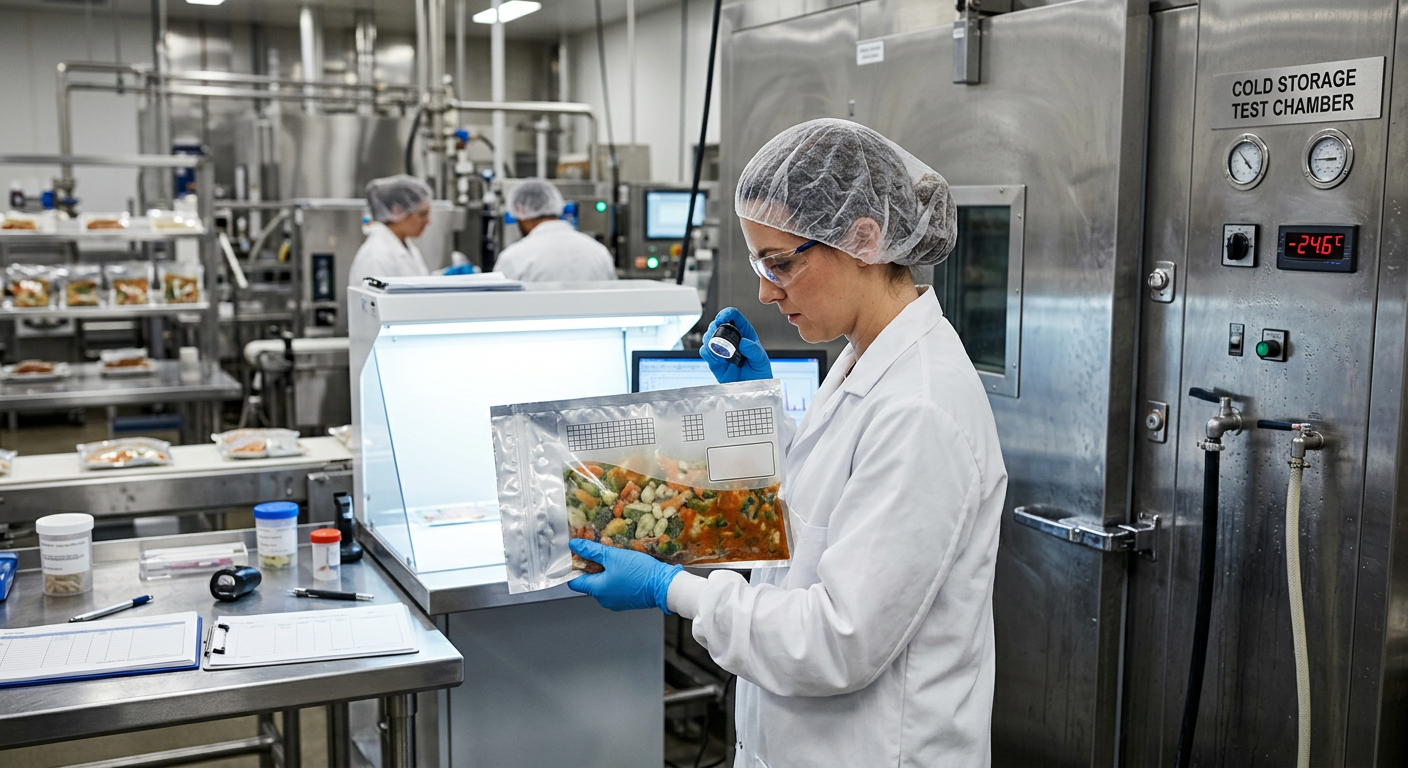
Finished frozen food pouches should be validated as a package system. Film samples and laboratory seal data are useful, but they cannot fully represent every combination of product, packing equipment, freezer exposure, and distribution handling. Agree on a validation plan before commercial production, especially for products with sharp pieces, oily marinades, vacuum packing, or demanding distribution routes.
Practical validation activities
- Run filling trials using the actual food or a representative product simulant when appropriate.
- Confirm sealing parameters on the intended equipment, including temperature, pressure, dwell time, and line speed.
- Inspect seal areas for trapped particles, channels, wrinkles, or incomplete fusion.
- Condition filled packs at the planned frozen-storage temperature for an agreed period.
- Perform handling assessments relevant to the route, such as case packing, stacking, vibration, and controlled drop evaluation where applicable.
- Inspect the pouch body, seals, gussets, zipper, and easy-open feature after frozen exposure and after thawing if the product is thawed before use.
- Use agreed test methods and acceptance criteria for seal integrity, leak detection, seal strength, and package appearance.
Testing conditions and acceptance criteria should be documented between the buyer, co-packer, and packaging supplier. Requirements may also be influenced by the destination market, food-contact obligations, brand quality systems, and retailer requirements. Those requirements should be identified by the responsible buyer rather than inferred from a generic pouch specification.
Artwork and print also deserve review during trials. Condensation, abrasion, and cold-chain handling can affect the appearance expectations for a finished pack. For artwork preparation and finish choices, see the guidance on custom pouch artwork, colors, and finish selection.
Prepare a Clear Frozen Pouch RFQ
A detailed request for quotation helps a packaging manufacturer recommend a more relevant structure and reduces revision cycles. Provide a pouch drawing or target dimensions where available, but also provide the operating information that explains why the pouch is needed.
- Pouch format, dimensions, target fill weight, and required pack volume
- Food description, product photos if available, and known sharp-edge or abrasion risks
- Fill temperature, filling equipment, approximate line speed, and sealing method
- Freezing method, storage-temperature range, and expected distribution conditions
- Barrier objective and required shelf-life validation approach
- Closure, zipper, tear-open, hang-hole, or spout requirements
- Artwork files, number of SKUs, print colors, finish preference, and coding area
- Target order quantity, delivery destination, sample requirement, and commercial timeline
For custom pouch orders, quantities are affected by pouch size, material structure, printing requirements, fitments, and production setup. Buyers planning an initial project can use this custom pouch minimum order quantity planning guide to prepare for the discussion. The same planning principle applies to frozen food pouches: state the full specification early, then confirm the final structure through samples and production-representative testing.