Table of Contents
- What to Evaluate in a Spout Pouch Supplier
- Start With the Product and Filling Process
- Review Pouch Converting and Fitment Capability
- Assess Material Structure and Barrier Selection
- Verify Quality Controls and Documentation
- Evaluate Samples and Production Validation
- Compare MOQ, Lead Time, and Quote Scope
- Assess Communication and Project Management
- Use a Practical Supplier Scorecard
A practical B2B checklist for selecting a spout pouch supplier based on product compatibility, converting capability, fitment selection, quality documentation, sampling, commercial terms, and communication.
What to Evaluate in a Spout Pouch Supplier

To evaluate a spout pouch supplier, confirm that the supplier can match the pouch laminate, seal system, spout fitment, printing process, and quality checks to your actual product and filling operation. A supplier should be able to turn a clear technical brief into a documented pouch specification, explain material and fitment tradeoffs, provide representative samples, and define what will be inspected before shipment.
Price matters, but a low unit price does not establish suitability. A pouch that leaks at the spout weld, delaminates in distribution, or does not run reliably on a filling line can create costs far beyond the packaging purchase. The practical sourcing objective is to select a manufacturer whose capabilities, controls, and commercial terms fit the intended application.
This guide assumes a buyer is sourcing custom flexible packaging for a liquid, semi-liquid, powder, or refill product. Requirements vary by product formulation, fill temperature, storage condition, market, and packaging format. Confirm application-specific requirements with the supplier and relevant technical or regulatory advisors before approving production.
Start With the Product and Filling Process

A capable supplier needs enough information to recommend or quote a pouch responsibly. Begin with the packaged product rather than pouch appearance. Product viscosity, oil content, acidity, particulates, fragrance, alcohol content, and chemical ingredients can affect film compatibility, barrier needs, sealant selection, and fitment choice.
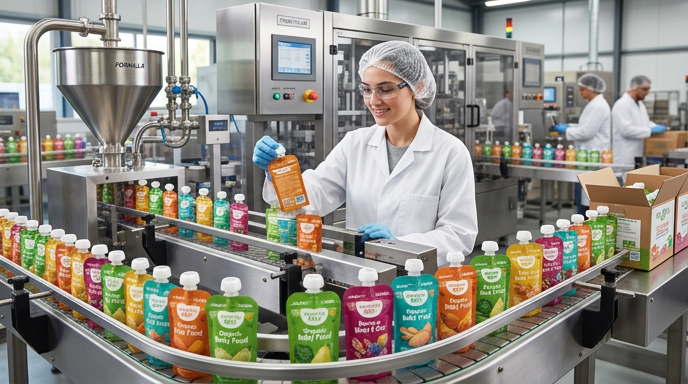
Describe the filling process in practical terms: manual or automated filling, filling temperature, target fill weight or volume, headspace, spout orientation, cap application method, and expected line speed. Also identify distribution conditions such as ambient warehousing, freezing, refrigeration, stacking, and e-commerce shipment. These details help a supplier identify questions that should be resolved before manufacturing.
For food or beverage applications intended for the United States, ask how the supplier will support the relevant food-contact packaging documentation. Review the requirements in this practical guide to food-contact packaging requirements for U.S. imports alongside your own product and market obligations. A supplier should not make broad compliance statements without identifying the materials, intended use conditions, and supporting documentation.
Information to provide in an initial inquiry
- Product type and ingredients relevant to packaging compatibility
- Target pouch volume, dimensions, and desired format
- Filling conditions and packaging line details
- Storage, transport, and end-use conditions
- Preferred spout location, diameter, cap type, and tamper-evidence needs
- Artwork status, print colors, finish, and expected order quantity
Review Pouch Converting and Fitment Capability

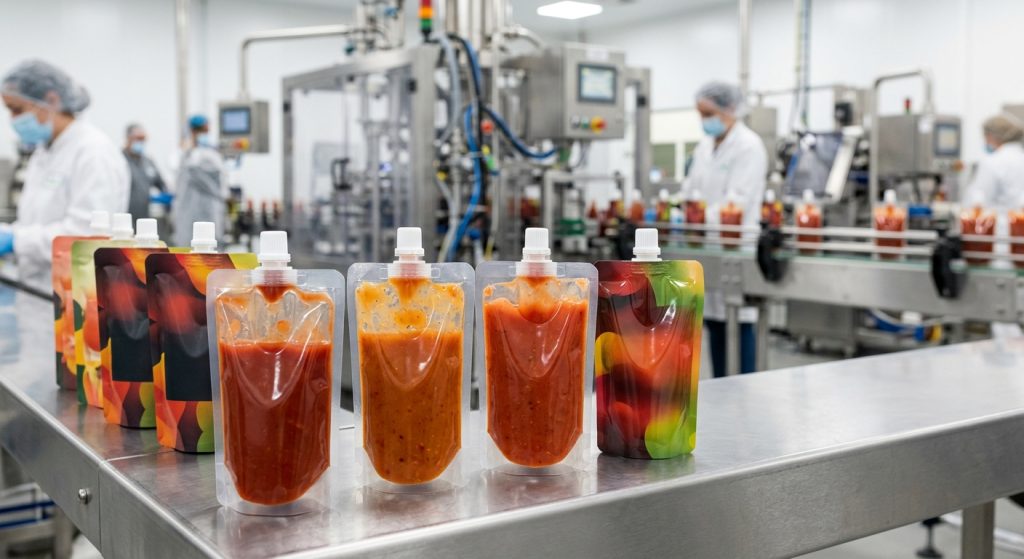
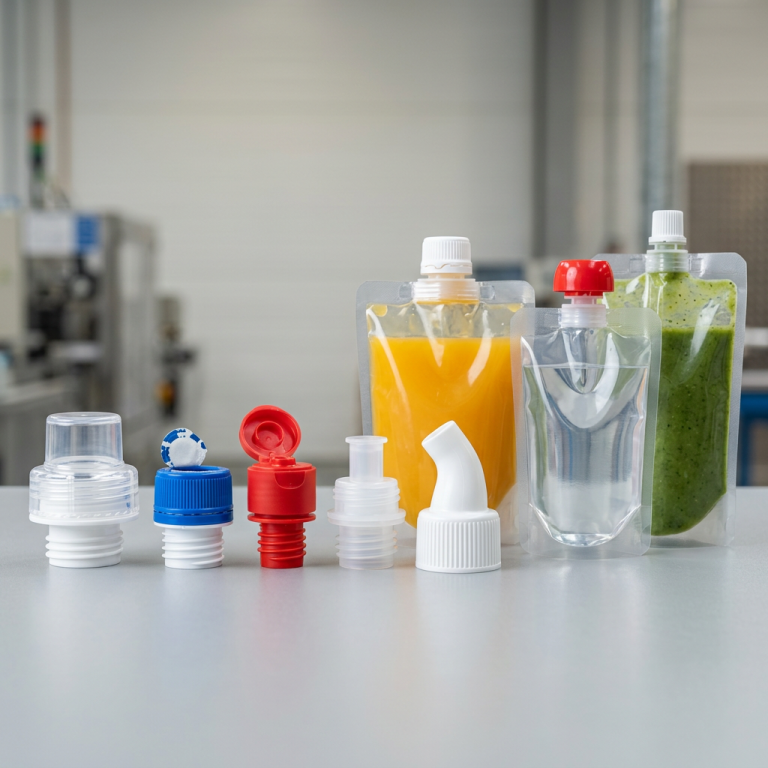
Spout pouches combine flexible-film conversion with spout and cap application. Ask the supplier to explain the proposed pouch format and how the fitment is integrated into the pouch. Common configurations include top-spout stand-up pouches, corner-spout pouches, flat pouches, and shaped formats. The location and size of the spout influence pouring, dispensing, filling access, shelf presentation, and stress at the pouch shoulder.
Fitments are not interchangeable by appearance alone. Confirm the nominal spout diameter, thread or cap configuration, material, tamper-evident feature where applicable, and the interface with the filling and capping equipment. If a buyer plans to use a dispensing accessory or a particular cap torque range, that requirement should be shared early.
Ask whether the supplier can produce the proposed dimensions and gusset design at the desired fill volume. A pouch may have the same stated capacity as another format but differ in headspace, stability, pour performance, and usable fill range. Request a dimensioned drawing or approved specification that identifies tolerances and the location of key features.
For applications that involve validated aseptic processing, packaging selection requires additional process-specific review. The aseptic spout pouch buyer guide explains the questions to align among the packaging supplier, filler, and process owner.
Assess Material Structure and Barrier Selection

The laminate structure should be selected for the product and use condition, not selected from a generic material list. Flexible pouches often combine layers that contribute print surface, stiffness, puncture resistance, oxygen or moisture barrier, light protection, and heat-seal performance. The best structure depends on the product, required shelf life, filling process, package geometry, and distribution environment.
Ask the spout pouch supplier to identify the proposed layers and the functional reason for each layer. The response should distinguish between a material description and a validated claim about finished-package performance. For example, an aluminum-containing structure may provide a light barrier, but it does not by itself establish the shelf life of a specific product. Shelf-life suitability requires consideration of the formulation, fill process, seal integrity, storage, and appropriate validation.
Sealant selection deserves specific attention because pouch seals and the spout-weld area are critical package interfaces. Discuss contamination risk at the seal area, fill temperature, flexibility at low temperature, and any post-fill treatment. For frozen applications, material and seal behavior must be considered under freezer storage and handling; see this guide to frozen food pouch material and seal selection for a more focused review.
Questions to ask about the proposed structure
- What is the full laminate construction and nominal thickness?
- What function does each layer serve in this application?
- What sealant layer is proposed, and why?
- Which conditions could affect compatibility or seal performance?
- What product-specific testing does the supplier recommend before approval?
Verify Quality Controls and Documentation

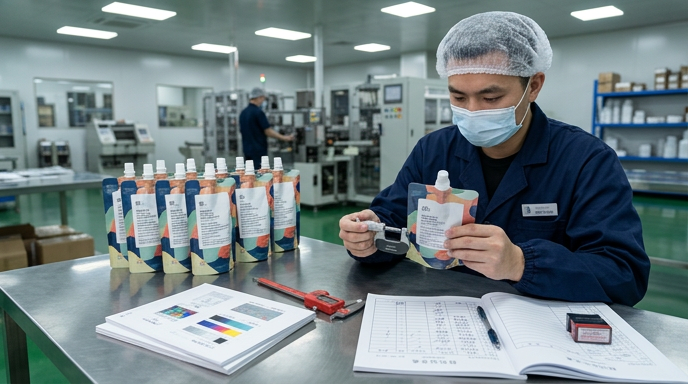
Ask how the supplier controls the characteristics that matter to your pouch: artwork, dimensions, film structure, seal appearance, spout position, cap fit, and pack-out. The right inspection plan depends on the product and purchase agreement, but the supplier should be able to describe its incoming material checks, in-process controls, finished-goods inspection, traceability approach, and handling of nonconforming output.
Request documents that are relevant to the project rather than a generic document package. Depending on the application, useful records may include an approved artwork proof, pouch specification, material declaration, certificate of analysis when applicable, inspection report, and lot identification. Clarify which documents are available with samples, before production, and with shipment.
For packaging intended to contact food, review the scope of any documentation carefully. Material declarations, supplier statements, and test reports each serve different purposes. They should identify the material or product, intended use, issuing party, and any applicable limitations. The supplier should be willing to clarify document scope without representing that a document covers conditions it does not address.
A useful question is: “What attributes will be checked for my order, how are acceptance criteria set, and what shipment records can you provide?” Specific answers are more informative than broad statements about quality.
Evaluate Samples and Production Validation

Samples are a decision tool, not only a presentation item. Ask what the sample represents: a stock pouch, a prior production format, a digital proof, a pilot run, or a production-equivalent sample. A stock sample can help evaluate dimensions and basic fitment handling, but it may not represent the final laminate, artwork, cap, or seal conditions.
Plan validation around the actual use case. Where relevant, buyers may conduct filling trials, cap application checks, leak evaluation, drop or compression assessment, storage observation, and product compatibility review. The appropriate method, duration, and acceptance criteria should be determined by the buyer’s product, process, and risk profile. A supplier can provide input, but the product owner remains responsible for confirming suitability for its intended use.
Artwork approval should be controlled as carefully as structural approval. Confirm dieline dimensions, readable text, barcodes if used, color references, finishing areas, and the treatment of variable information. For a detailed prepress workflow, review the custom spout pouch printing guide for artwork, colors, and finish.
Before releasing a first production order, document the approved pouch version, fitment, artwork revision, material structure, sample status, and any agreed inspection requirements. This record reduces ambiguity if a later order is placed by a different buyer, co-packer, or internal team.
Compare MOQ, Lead Time, and Quote Scope
Compare quotations on a like-for-like specification. A meaningful quote identifies the pouch format, dimensions, material structure, spout and cap configuration, printing assumptions, quantity, packaging method, delivery terms, and currency. If one supplier’s quote omits material details or fitment specifications, it may not be comparable with a more complete proposal.
Minimum order quantity is often influenced by film purchasing, printing setup, pouch dimensions, number of designs, and fitment procurement. It can differ between an initial custom order and a repeat order. Ask whether the MOQ applies per design, per size, per structure, or across a combined order. Also clarify overrun or underrun policy, payment terms, production lead time after artwork approval, and the point at which specifications become locked.
For first-time buyers, the spout pouch MOQ planning guide outlines the inputs that affect order quantity and helps structure a more complete quotation request.
Freight should be evaluated separately from manufacturing price. Confirm export packaging, carton and pallet assumptions, shipment readiness date, Incoterms, destination port or address, and whether the supplier is quoting freight or only product supply. International buyers should also identify which party manages import clearance, duties, and destination charges.
Assess Communication and Project Management
Supplier communication is part of technical risk management. During the inquiry stage, assess whether the supplier asks relevant questions, identifies missing specifications, distinguishes assumptions from confirmed requirements, and provides written follow-up. A supplier that immediately quotes an undefined pouch may be leaving important decisions unresolved.
Establish one controlled source for drawings, artwork files, specifications, approvals, and revisions. Confirm the commercial contact, technical contact, and escalation route. For multi-party projects involving a brand owner, co-packer, distributor, and packaging supplier, define who has authority to approve structural changes and artwork changes.
Good project management does not mean every issue can be predicted. It means the supplier communicates changes before production, records decisions, and provides information in a form the buyer can review. This is especially important for repeat orders, where a seemingly minor change in film, fitment, artwork, or packing configuration can affect the finished product.
Use a Practical Supplier Scorecard
A scorecard helps a buying team compare suppliers consistently. Weight the categories according to application risk. For example, a food or chemical product may place greater emphasis on material documentation and compatibility review, while a promotional retail pack may place greater emphasis on print execution and order flexibility.
Suggested evaluation categories
- Application understanding: Does the supplier understand the product, fill process, and distribution conditions?
- Technical proposal: Is the pouch structure, dimension, and fitment recommendation specific and explained?
- Manufacturing capability: Can the supplier produce the selected format and provide appropriate drawings or specifications?
- Quality system: Are inspection points, traceability, and shipment documents clearly described?
- Sample and validation support: Can the supplier provide representative samples and respond to trial findings?
- Commercial clarity: Are MOQ, lead time, price basis, delivery terms, and exclusions clear?
- Communication: Are questions answered accurately and revisions controlled?
Use the scorecard after receiving the same brief from each candidate. The result should support, rather than replace, product testing and a documented approval process. The strongest spout pouch supplier for one product is not necessarily the best choice for every format, fill method, or market.