Table of Contents
- What Are Spout Pouch Closure Types?
- Common Spout Pouch Cap Types
- How Spout Fitments Work
- How to Select the Right Closure
- Closure, Seal, and Filling Considerations
- What to Include in a Buyer Specification
Spout pouch closure types affect leak resistance, dispensing, filling compatibility, consumer convenience, and product protection. This guide explains how B2B buyers can select the right cap, fitment, and seal design for liquid, gel, and semi-liquid products.
What Are Spout Pouch Closure Types?
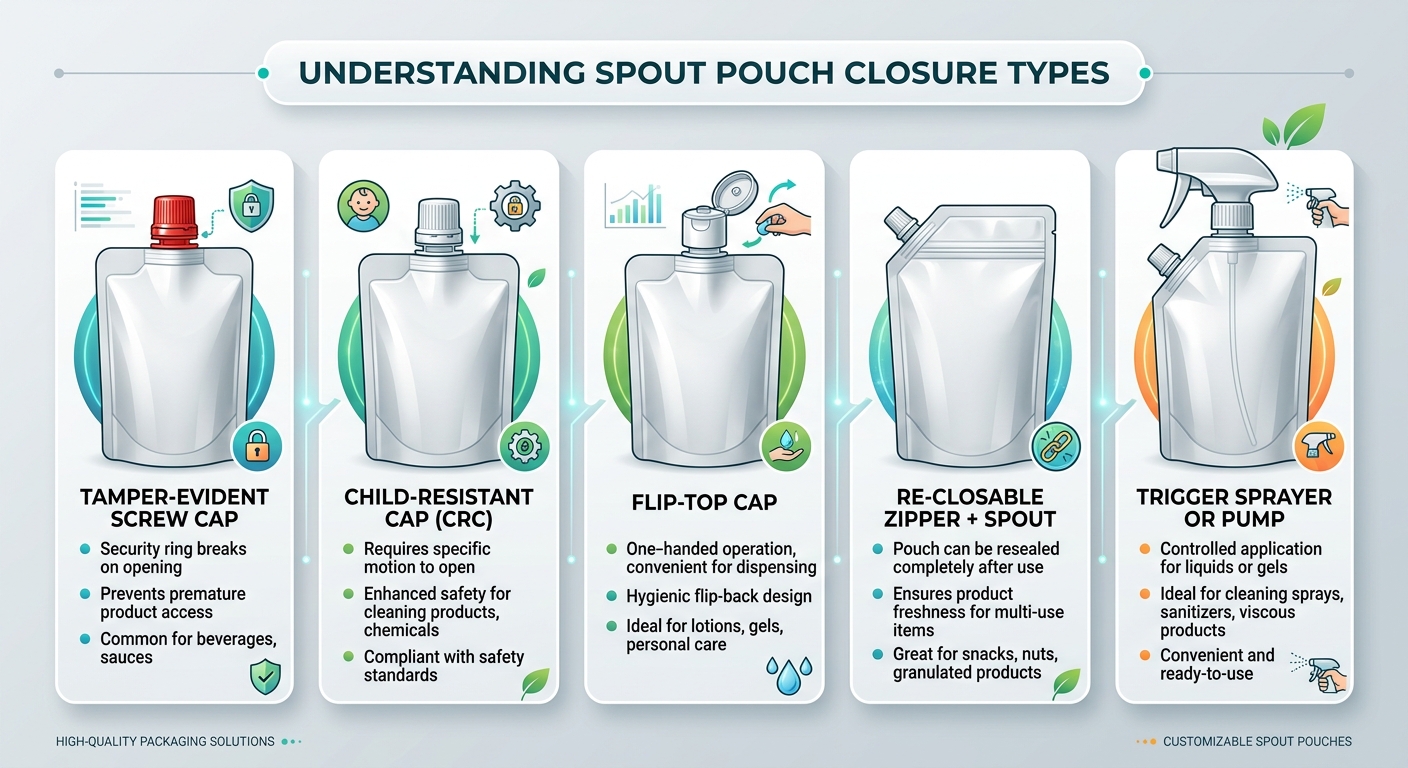
Spout pouch closure types describe the cap and fitment system used to close, dispense, and reseal a flexible pouch. The closure normally includes a molded plastic spout or fitment attached to the pouch and a separate cap that covers the opening. The correct choice depends on the product, filling process, dispensing method, expected opening frequency, and required tamper evidence.
For most commercial liquid and semi-liquid products, buyers evaluate three connected components:
- Fitment: The rigid spout attached to the pouch. It determines the opening diameter, cap interface, filling connection, and dispensing path.
- Cap: The removable or hinged component that closes the fitment after filling and during distribution.
- Seal system: The pouch-to-fitment seal and, where applicable, an inner membrane or closure feature that provides product protection before first opening.
A cap should not be selected independently from the fitment. Thread profile, neck dimensions, opening diameter, cap torque, liner or seal requirements, and filling equipment must be evaluated as one packaging system. Buyers should also confirm that the closure is compatible with the selected laminate and the product’s processing conditions.
For broader information about dimensions, capacity, spout placement, and fitment selection, review this guide to spout pouch sizes, capacity, and fitments.
Common Spout Pouch Cap Types
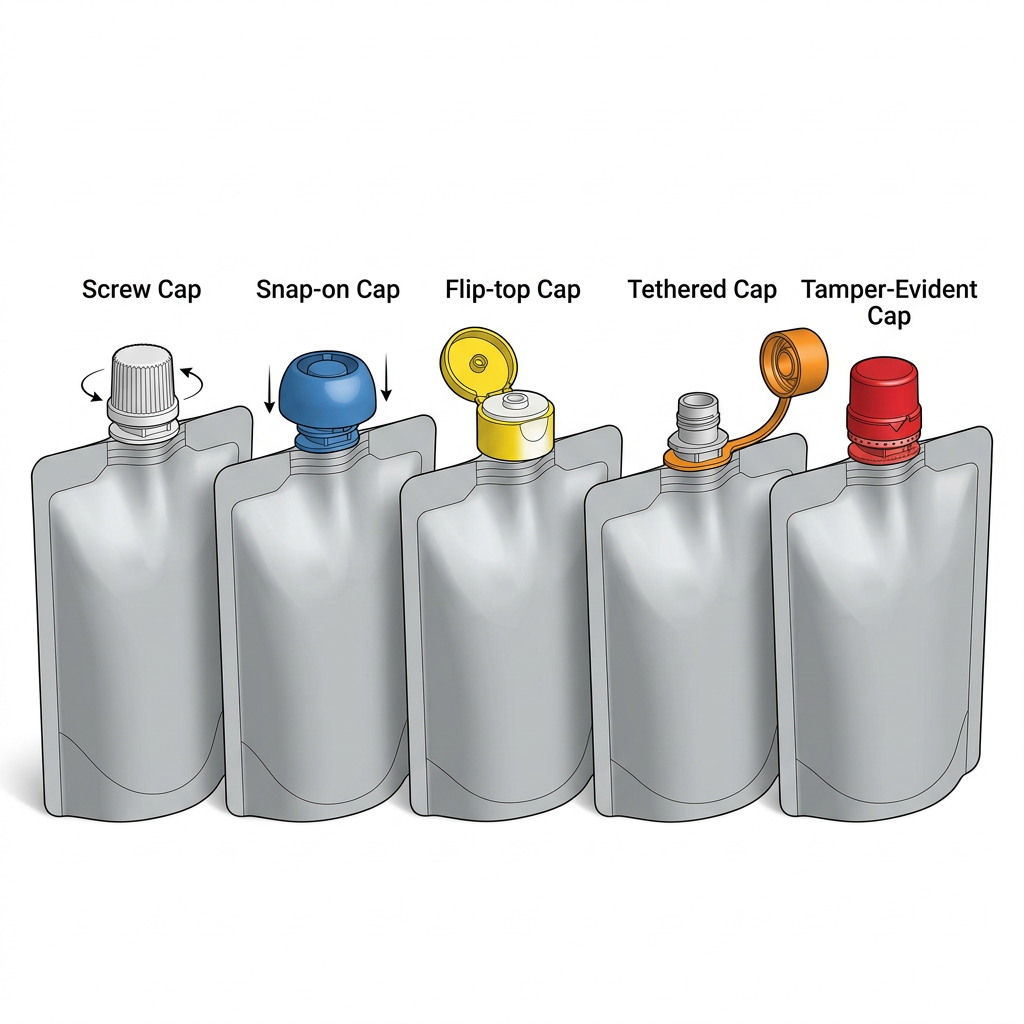
Several cap formats are used for spout pouches. The best option depends on whether the package is intended for single use, repeated dispensing, controlled pouring, or use by children or other specific consumers. Availability can vary by supplier, fitment size, and tooling requirements, so buyers should approve physical samples rather than specifying a cap by name alone.
Screw caps
Screw caps use matching threads on the cap and fitment. They are widely used because they support resealing and can be supplied in different diameters, profiles, colors, and closure geometries. A screw cap is often suitable for products that are opened and closed multiple times, such as sauces, concentrates, cleaning liquids, personal care products, and refill products.
Important variables include thread design, cap height, neck finish, opening diameter, and application torque. The supplier should confirm that the cap can be applied consistently without damaging the fitment or creating an incomplete closure.
Snap-on caps
Snap-on caps attach through a molded bead, lug, or similar retaining feature rather than a conventional threaded connection. They can support quick consumer opening and may be useful when the product concept prioritizes simple dispensing. However, the cap and fitment must be matched precisely to maintain retention and resealing performance.
Flip-top caps
Flip-top caps use a hinged lid that remains attached to the main cap body. They can make repeated opening convenient and reduce the chance of a loose cap being misplaced after use. The hinge design, lid retention, dispensing opening, and pouch orientation should be reviewed during sample approval.
Tethered and tamper-evident closures
Tethered closures keep the cap connected to the fitment or pouch after opening. Tamper-evident designs may use a breakaway ring, band, membrane, or other visible indication that the package has been opened. The exact feature should be specified according to the product category, distribution requirements, and applicable regulations. A tamper-evident feature does not replace leak testing or proper closure validation.
Child-resistant or specialty closures
Some applications may require a closure with a more controlled opening method. Child-resistant packaging should only be specified when the complete package and product category require it, and performance must be assessed using the relevant test method. Buyers should not assume that a particular cap is child-resistant without documented evidence for the finished package.
How Spout Fitments Work
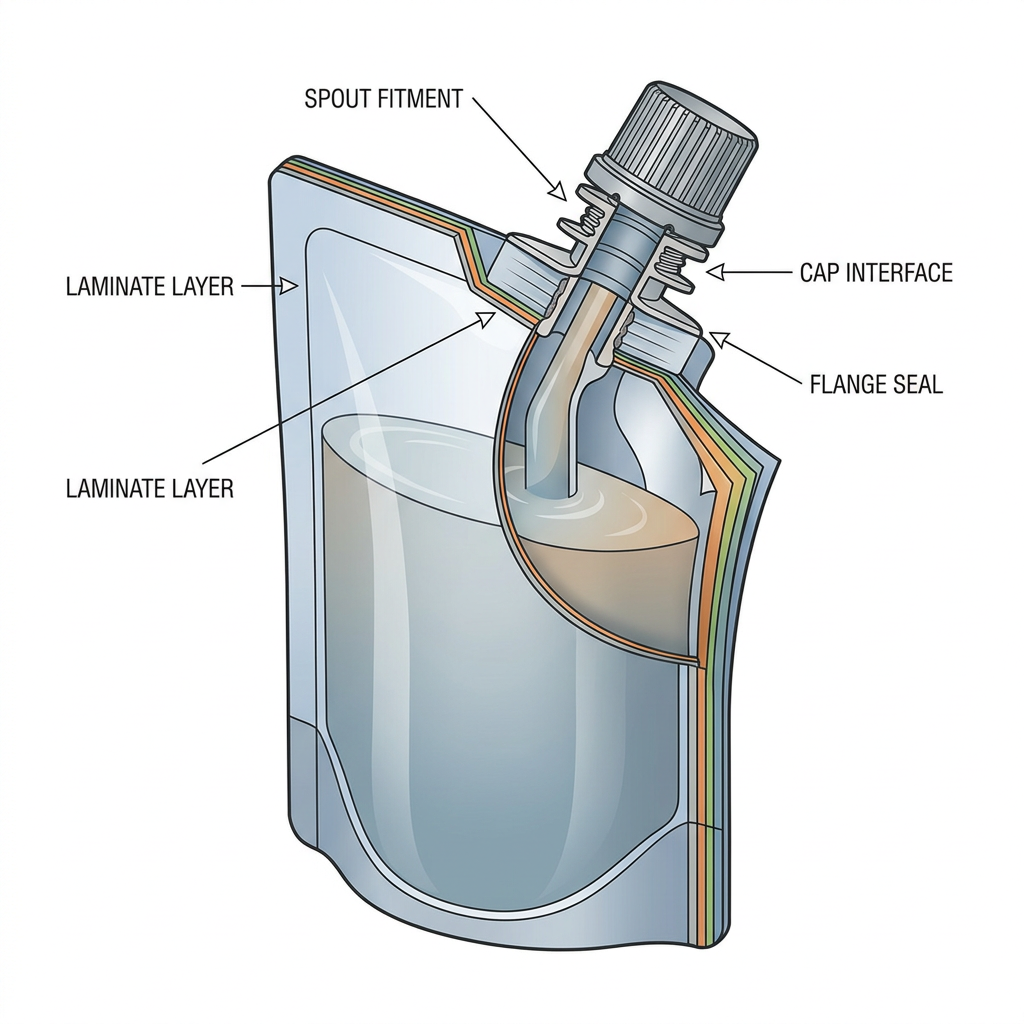
The fitment is the rigid interface between the flexible pouch and the closure. It provides a stable opening for filling and dispensing, while the surrounding laminate forms the product reservoir. Fitments are commonly made from molded plastic, but the exact material, geometry, and construction should be confirmed with the packaging supplier.
Fitment selection starts with the required opening and flow behavior. A narrow opening may provide more controlled dispensing for thin liquids or small portions, while a larger opening can help thicker products flow more easily. A larger opening does not automatically solve every dispensing problem: product viscosity, particulates, pouch orientation, headspace, and air entry also affect performance.
Key fitment dimensions include:
- Neck outside diameter and cap interface
- Internal opening diameter
- Fitment height and flange dimensions
- Spout angle and position on the pouch
- Area available for pouch-to-fitment sealing
- Compatibility with the filling nozzle or adapter
Fitment placement also affects handling. A top spout may support upright dispensing and retail display, while a corner spout can influence pouring angle and how the pouch empties. Placement should be coordinated with the pouch dimensions, artwork orientation, filling line, and intended user experience. See the guide to corner spout and top spout pouch designs for a more detailed placement comparison.
For products requiring heat processing, the fitment, laminate, seals, cap, and process conditions must be evaluated together. A standard closure should not be assumed suitable for hot fill, retort, or other elevated-temperature processing without supplier review and package validation.
How to Select the Right Closure

Closure selection should begin with the product and use case, not with a preferred cap color or catalog image. A practical B2B evaluation covers the following factors.
Product viscosity and solids
Thin liquids, gels, pastes, sauces, and products containing particles may require different opening sizes and flow paths. Ask the supplier to review the actual product or a representative formulation. Testing with water alone may not represent the behavior of a viscous or particulate product.
Opening frequency
Single-use products may need a simple closure with reliable initial sealing. Products used over several occasions generally need a resealable cap, suitable thread engagement or retention, and a dispensing opening that helps limit mess during repeated use.
Filling method
Some pouches are filled through the open pouch before fitment attachment, while others use a fitment or spout as part of the filling process. Confirm the filling sequence, nozzle dimensions, required clearance, cap application step, and whether the supplier’s sample matches the production filling method.
Processing conditions
Hot fill, pasteurization, retort, freezing, and ambient filling can impose different demands on the laminate, fitment, cap, and seals. Provide the supplier with process temperature, time, pressure, cooling conditions, and any handling information before a structure or closure is finalized. Buyers specifying retort packaging can consult this retort spout pouch specification guide.
Product protection and tamper evidence
Determine whether the package needs a visible first-opening indication, an inner seal, or another protection feature. The required solution depends on the product, market, distribution chain, and applicable regulatory expectations. Packaging documentation should identify the closure components and any relevant contact or testing basis.
Consumer handling
Consider grip, pouring angle, cap removal force, resealing, cap retention, and the likelihood of product residue around the opening. A closure that works well on a laboratory sample may need further assessment on the final pouch size and filled weight.
Material and appearance
Cap and fitment color can support brand identification, but color should be finalized only after confirming the available resin, molding, and decoration options. The pouch laminate must also be selected for the product’s barrier and processing needs. Learn more about choosing the right spout pouch laminate.
Closure, Seal, and Filling Considerations
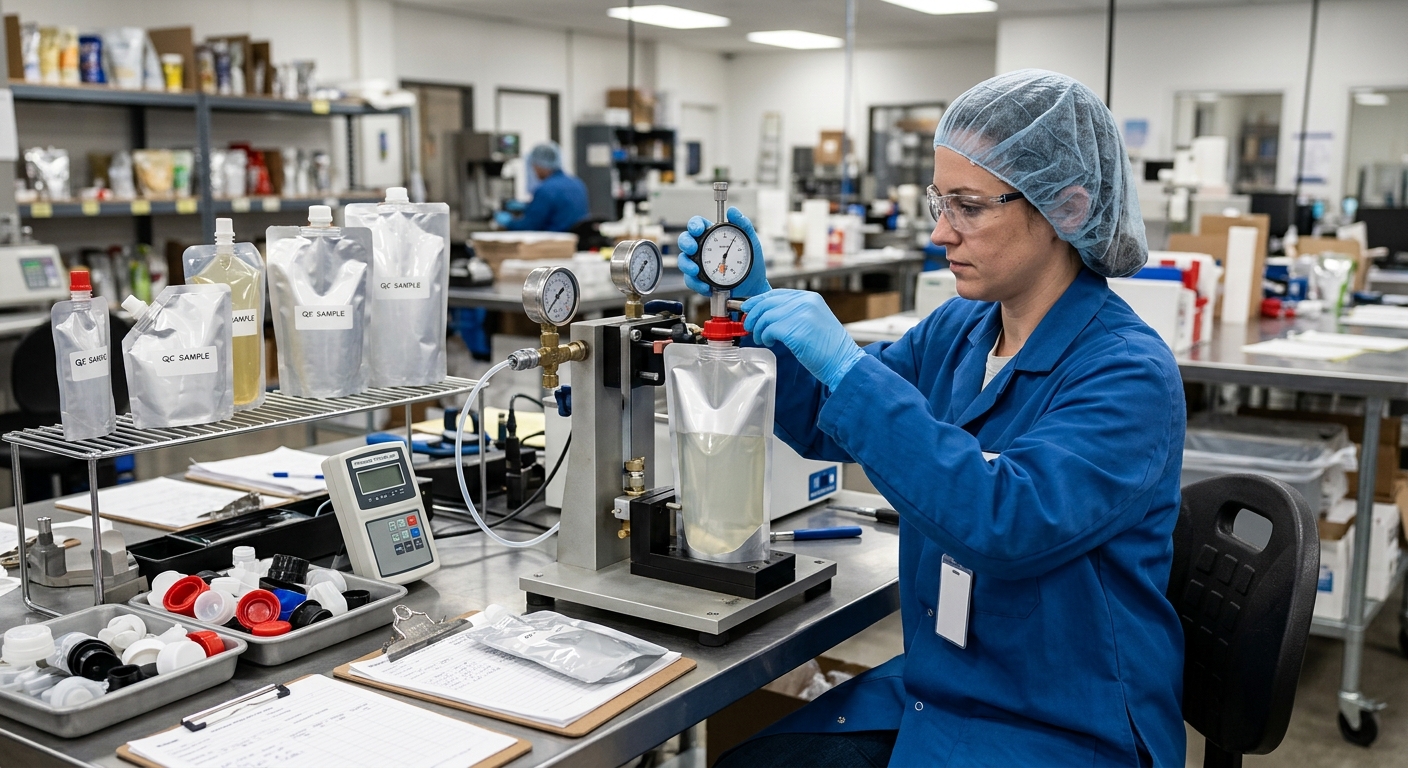
A cap is only one part of the package’s containment system. The pouch-to-fitment seal, pouch edge seals, cap engagement, and any inner seal must work together. During development, suppliers and buyers should define which tests will be performed and under what conditions.
Useful validation checks may include visual inspection, dimensional checks, cap engagement, opening and resealing assessment, leak testing, seal-strength evaluation, drop or handling tests, and compatibility testing with the actual product. The test plan should reflect the intended fill volume, product temperature, storage conditions, transport method, and expected use.
Filling equipment can affect closure performance. Excessive cap torque may damage threads or fitments, while insufficient torque may result in incomplete closure. Product trapped around the fitment seal area can also interfere with sealing. The production line should therefore be reviewed for filling accuracy, cap application, torque control where applicable, and inspection points.
For food, beverage, and other regulated applications, request documentation appropriate to the intended market and product contact conditions. A supplier’s general statement about food use is not a substitute for reviewing the material basis and finished-package requirements. Buyers can use this guide to food-contact packaging requirements for U.S. imports when preparing technical documentation.
What to Include in a Buyer Specification
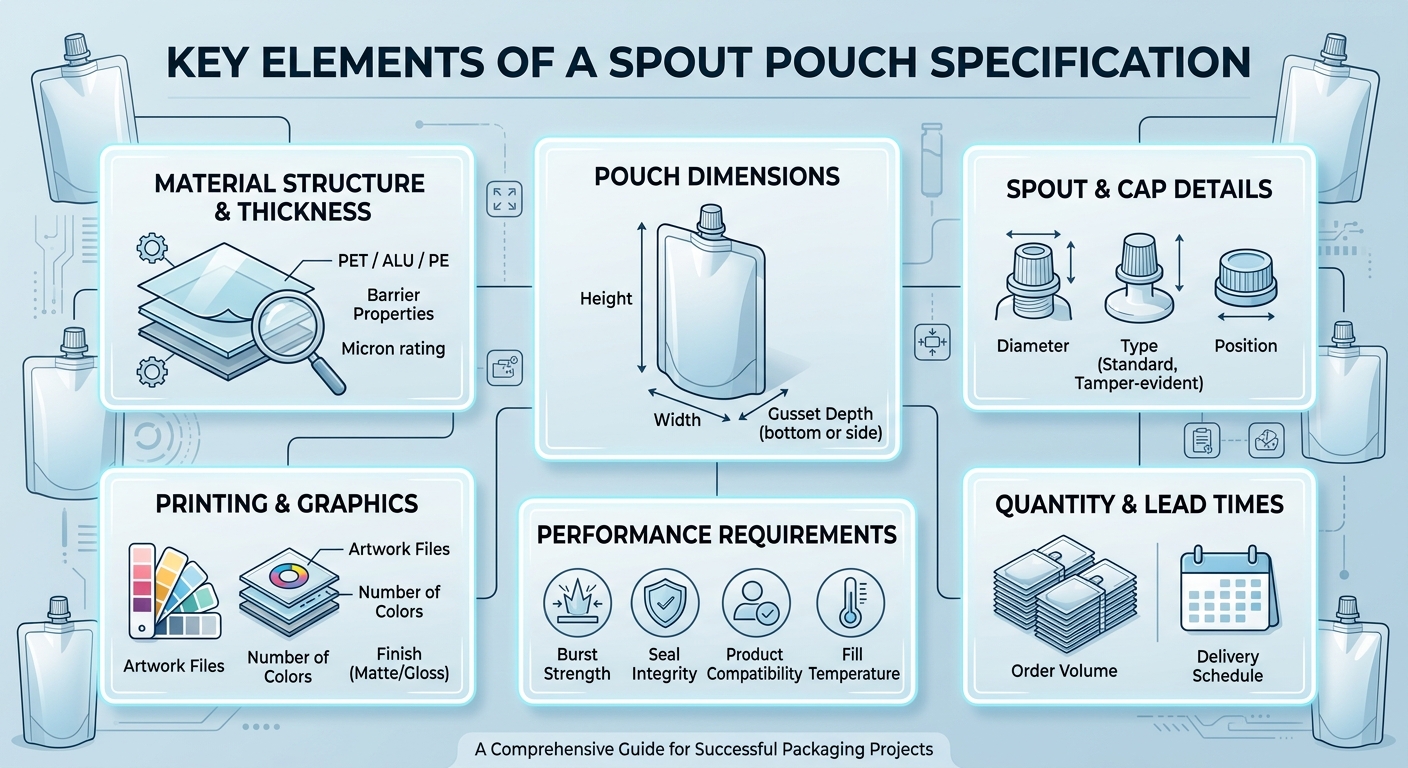
A complete closure specification helps a manufacturer assess feasibility, prepare samples, and quote accurately. Include as much of the following information as possible:
- Product name, formulation type, viscosity, solids, pH, and any known compatibility concerns
- Nominal fill volume, target dimensions, pouch orientation, and spout position
- Fitment opening diameter, neck finish, material requirements, and color preference
- Cap style, thread or retention design, flip-top or tethered requirement, and tamper-evident expectations
- Filling method, equipment interface, cap application method, and expected production speed
- Hot-fill, retort, pasteurization, freezing, or ambient-processing conditions
- Barrier, light-protection, and laminate requirements
- Artwork files, print colors, finish, and any shape or handle requirements
- Target order quantity, delivery market, sample quantity, and required documentation
Request a sample using the proposed cap and fitment, not merely a pouch with a similar appearance. Test opening, pouring, resealing, leakage, handling, and line compatibility with the product whenever possible. A structured RFQ can reduce missing information; buyers may also use this spout pouch RFQ checklist.
HUACANG Packaging has produced flexible packaging for international B2B buyers since 1998, including custom spout pouches, laminated bags, roll film, and bag-in-box packaging. Final closure recommendations should be confirmed against the specific product, pouch construction, filling process, and market requirements.