Table of Contents
- What Spout Pouch Seal Strength Means
- Critical Seal Zones in a Spout Pouch
- What Buyers Should Put in the Specification
- Comparing Seal and Integrity Test Methods
- Test Planning by Product and Process
- How Manufacturing Parameters Affect Seals
- Sampling, Conditioning, and Acceptance
- How to Interpret Seal Test Failures
- Seal Strength RFQ Checklist
Spout pouch seal strength should be specified by seal location, test method, sample condition, unit, acceptance criteria, and inspection frequency. This guide explains how buyers can create measurable requirements for pouch perimeter seals, spout-to-film seals, and filled-package integrity.
What Spout Pouch Seal Strength Means
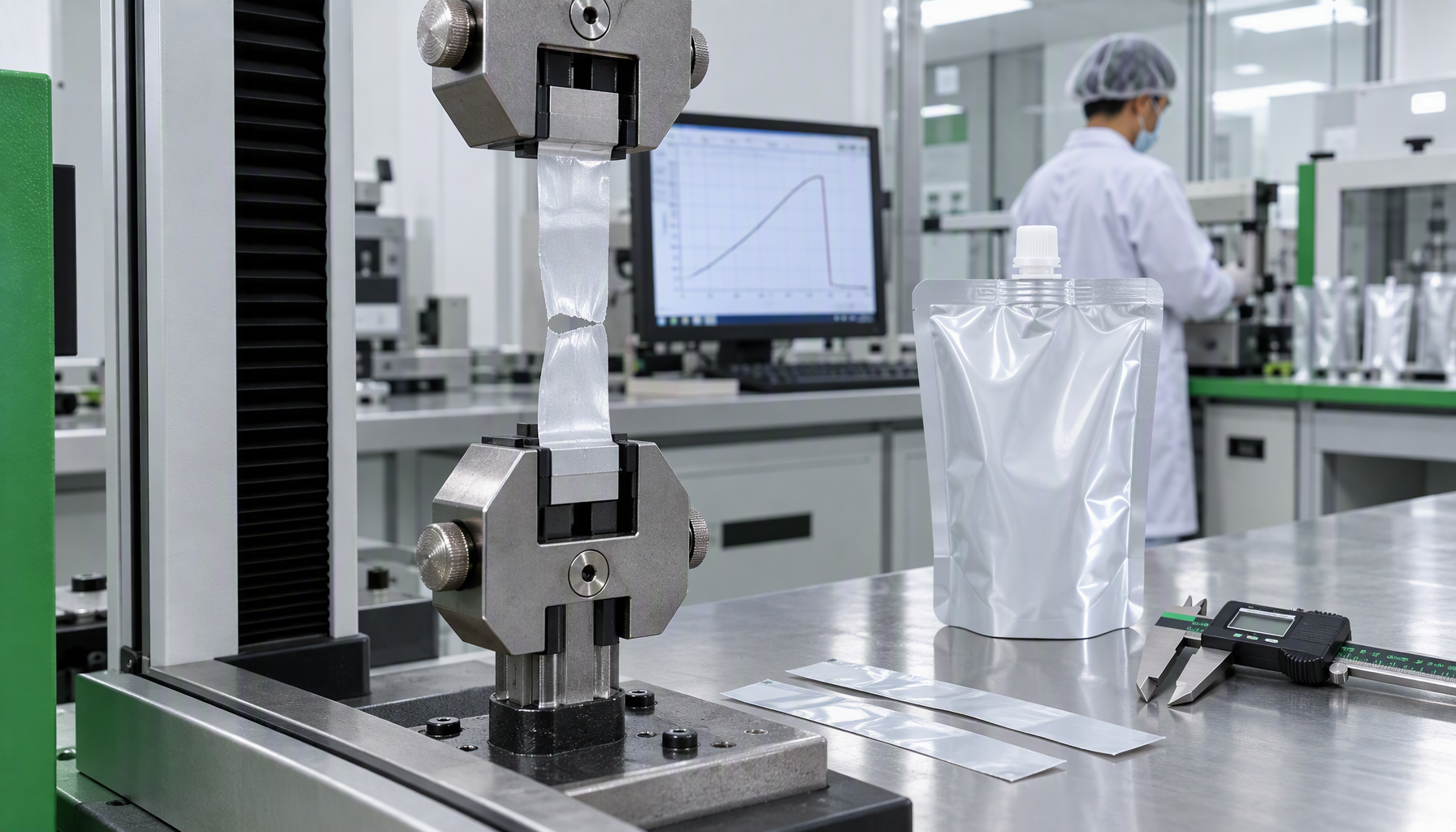
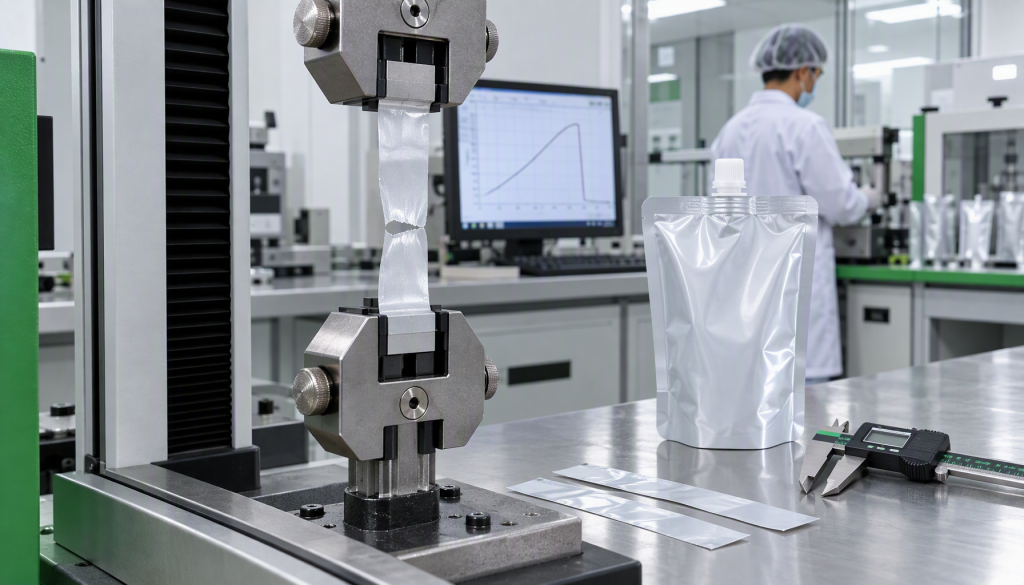
Spout pouch seal strength is the measured force required to separate a defined seal under stated test conditions. Buyers should specify the seal location, test method, specimen width, pull rate or instrument settings, conditioning, measurement unit, and acceptance criteria. A request such as “strong seals” is not measurable and does not establish whether the pouch is suitable for filling, handling, distribution, or use.
Seal strength is only one part of package performance. A peel test measures the mechanical strength of a cut seal specimen, while leak, burst, creep, drop, and filled-package tests evaluate different aspects of package integrity. A pouch can produce a high peel value yet still leak through a channel, wrinkle, contaminated area, or poorly sealed spout interface. Conversely, a controlled peel may be acceptable when it is intentional and the package still meets its integrity and distribution requirements.
The specification should therefore separate three questions: how strong is the seal, is the package leak-tight, and can the finished package survive its actual process and distribution conditions? These questions require complementary tests rather than one universal value.
Critical Seal Zones in a Spout Pouch
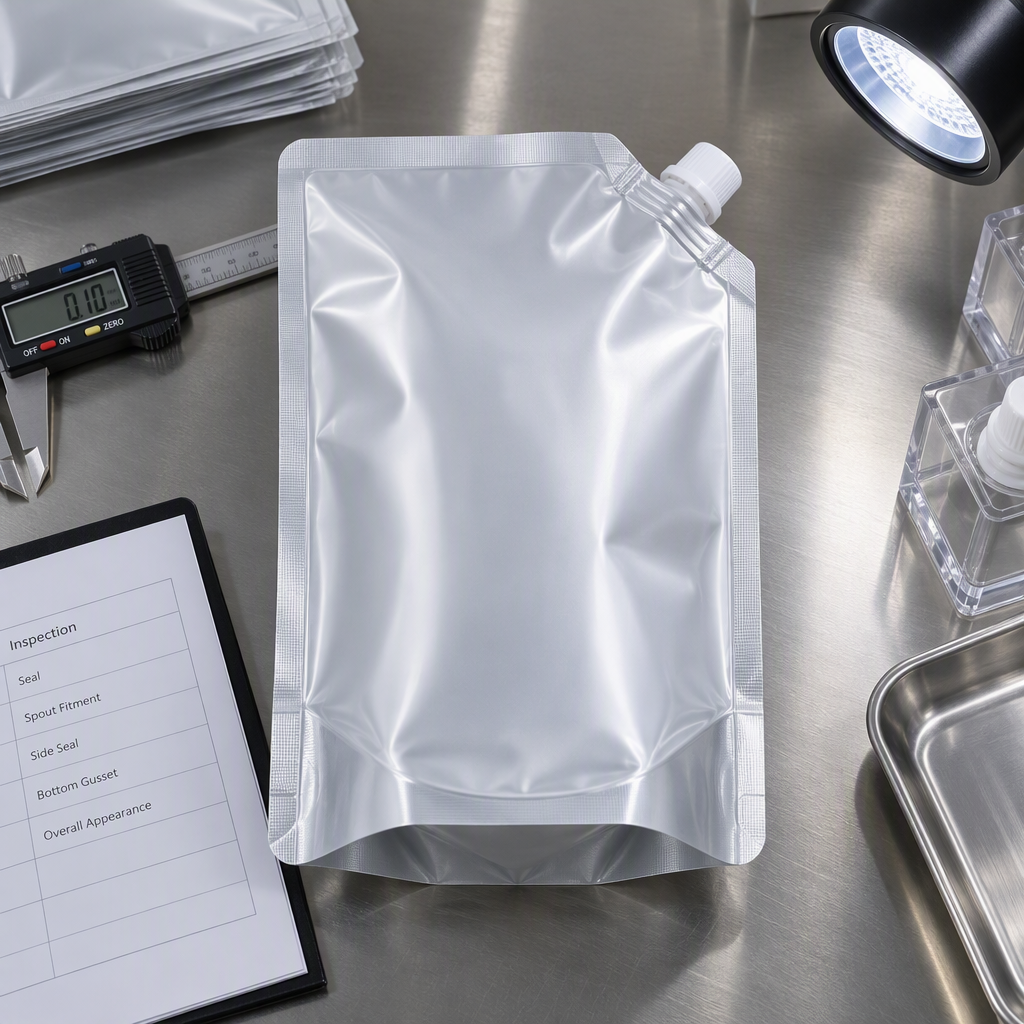
A spout pouch is not a single uniform seal. Its risk profile depends on the pouch style, film structure, fitment geometry, and filling process. Buyers should identify each seal zone on an approved drawing and avoid applying one result to every area without confirming that specimens can be prepared consistently.
- Side and bottom seals: Film-to-film heat seals that form the pouch body. Their continuity and width affect resistance to internal pressure and handling loads.
- Spout-to-film seal: The interface around the fitment boat or welding ribs. Changes in thickness and geometry make this area more difficult to evaluate with a conventional straight peel specimen.
- Top or fill seal: A seal completed by the filler when pouches are supplied open. Its performance depends on the buyer’s filling equipment, sealing jaws, product contamination controls, and operating window.
- Transitions and intersections: Areas where perimeter seals meet the spout seal, gusset, or another seal. Wrinkles and abrupt thickness changes can create localized channels.
- Closure interface: The cap, plug, liner, tamper-evident feature, and fitment threads form a separate liquid-tight system. Cap torque and closure leakage should not be treated as film seal strength.
Fitment dimensions, orientation, sealing surfaces, and handling features also influence process compatibility. Buyers integrating pouches with automated equipment can review this spout pouch filling line and fitment compatibility guide when defining the complete package system.
What Buyers Should Put in the Specification
A useful purchase specification connects each requirement to a reproducible procedure. Numerical limits should be based on trials using the selected laminate, fitment, contents, filling process, and distribution conditions. Generic values copied from another pouch may be inappropriate.
| Specification field | What to define | Why it matters |
|---|---|---|
| Seal location | Side, bottom, top, spout interface, gusset, and transition areas | Strength and failure modes can differ by location. |
| Test method | Named standard and any agreed modification | Different fixtures and procedures can produce noncomparable data. |
| Specimen details | Width, orientation, cut location, number per pouch, and grip configuration | Controls how force is applied to the seal. |
| Instrument settings | Pull rate, jaw separation, pressure ramp, dwell time, or vacuum level as applicable | Makes results reproducible between laboratories. |
| Conditioning | Time after sealing, temperature, humidity, filled or unfilled state, and test temperature | Seal behavior may change after cooling, aging, or product exposure. |
| Reported result | Peak force, average force, force per specimen width, failure mode, and data precision | A number without its reporting convention can be misleading. |
| Acceptance rule | Minimum individual value, lot average if relevant, prohibited failure modes, and retest procedure | Defines objective disposition of the lot. |
| Sampling plan | Lot definition, sample count, locations, frequency, and responsibility | Clarifies how production is represented. |
Units must be explicit. For example, N/15 mm and lbf/in are not interchangeable labels, even when values can be converted mathematically. The report should retain the original unit, specimen width, and method. Material construction should also be revision-controlled because sealant resin, thickness, adhesive cure, barrier layer, and fitment resin can affect performance. The guide to spout pouch material selection explains the functions of common laminate layers.
Comparing Seal and Integrity Test Methods

No single test characterizes every failure mechanism. The test plan should combine a quantitative seal measurement with package-level integrity checks selected for the application.
| Test category | What it evaluates | Typical use | Important limitation |
|---|---|---|---|
| Seal strength, such as ASTM F88/F88M | Force required to separate a prepared seal specimen | Comparing film-to-film seals, process conditions, and production consistency | Results depend on specimen geometry, tail configuration, and failure mode; irregular spout areas may require an agreed modified method. |
| Internal pressurization or burst, such as ASTM F1140/F1140M | Package response to increasing internal pressure | Locating the weakest area and comparing whole-package resistance | A burst value does not identify microscopic leakage and may be influenced by pouch geometry. |
| Creep or sustained pressure | Package response to a specified pressure for a defined time | Evaluating time-dependent seal behavior under internal loading | Pressure, duration, restraint, and pass criteria must be stated. |
| Vacuum bubble testing, such as ASTM D3078 where applicable | Gross leaks indicated by escaping gas under vacuum | Screening flexible packages that contain headspace gas | Applicability depends on the package and contents; it is not a direct strength measurement. |
| Bubble emission, such as ASTM F2096 | Gross leaks under internal pressure while submerged | Finding channels or holes in packages suited to the method | Requires defined pressurization and observation procedures and may be destructive. |
| Visual seal inspection, such as ASTM F1886/F1886M where applicable | Visible channels, wrinkles, incomplete seals, or contamination | Routine inspection and failure investigation | It cannot establish seal strength or detect every leak. |
| Drop and distribution testing | Performance of filled packages under handling and transport hazards | Validating the pouch, closure, headspace, secondary packaging, and shipping configuration together | Results apply to the tested configuration and conditioning. |
Standards should be referenced by the revision agreed by buyer and supplier. Any departure from the published procedure should be documented as a modified method. For additional method selection considerations, see the guide to spout pouch leak testing methods and standards.
Test Planning by Product and Process

The following table is a planning aid, not a source of universal pass values. Final requirements should be validated with the actual product, fill volume, headspace, cap, processing conditions, and shipping system.
| Application or process | Seal-related risks to evaluate | Useful validation focus |
|---|---|---|
| Ambient-filled liquid | Product contamination in the fill-seal area, drops, compression, and closure leakage | Seal strength by location, leak test, cap application checks, and filled-package drop testing |
| Viscous sauce or puree | Residue at the sealing surface, slow drainage, flex cracking, and fitment obstruction | Contaminated-seal trials where relevant, filled-package integrity, dispensing evaluation, and aging with actual contents |
| Hot fill | Reduced hot seal strength, film distortion, internal pressure or vacuum during cooling, and closure interaction | Tests at defined times and temperatures, cooling-cycle observation, leak testing, and filled-package distribution validation |
| Retort | Thermal and pressure stress, sealant changes, delamination, and fitment compatibility | Pre- and post-process seal and integrity testing under a validated thermal process |
| Refill product | Repeated handling, squeezing, storage orientation, and consumer dispensing loads | Compression, drop, leak, closure, and use-simulation testing |
| Large-format pouch | Higher filled mass, load concentration near the fitment, and secondary-pack interaction | Whole-package creep, drop, compression, and distribution testing at the intended fill volume |
Hot-fill projects require particular attention to the relationship between film, fitment, temperature, headspace, and cooling. The hot-fill spout pouch engineering guide covers these system-level decisions. Retort applications require a separately validated structure and process; buyers should consult the retort spout pouch materials and processing guide rather than applying ambient-fill criteria.
How Manufacturing Parameters Affect Seals

Heat sealing depends on a controlled combination of temperature, pressure, dwell time, cooling, and material contact. These are machine settings and process conditions, not interchangeable product specifications. A temperature setpoint alone does not describe the thermal energy reaching the seal interface.
- Temperature: The interface must receive enough heat for the sealant layers to bond without excessive distortion, thinning, or damage to other layers.
- Dwell time: Short contact may provide insufficient heat transfer. Longer contact changes line speed and can expose the laminate to additional heat.
- Pressure and jaw alignment: Pressure should be distributed across the intended seal. Misalignment, worn tooling, or uneven surfaces can create weak zones.
- Seal width and geometry: Narrow sections, transitions, and fitment ribs concentrate stress differently from straight perimeter seals.
- Surface condition: Product residue, oil, powder, condensation, folds, and wrinkles can interrupt the seal path.
- Cooling and handling: A seal may be vulnerable while hot. Tension, filling loads, capping, or stacking before adequate cooling can deform it.
- Material compatibility: The pouch sealant and fitment resin must be compatible with the selected joining process. Laminate thickness and stiffness influence heat transfer and conformance around the fitment.
During development, suppliers typically establish a sealing window rather than one nominal setpoint. Trials across practical parameter combinations help identify conditions that consistently meet strength, appearance, and integrity criteria. Production records should identify the approved recipe, equipment or line, material revision, and deviations.
Sampling, Conditioning, and Acceptance
Development validation and routine lot inspection serve different purposes. Development testing determines whether the package design and process are suitable. Routine inspection checks whether production remains consistent with the approved specification.
Define a lot by an operational boundary such as purchase order, material batch, printing or lamination run, pouch-making shift, or another agreed production unit. Samples should represent startup, normal production, and the end of a run when those stages are relevant. For peel tests, state how many pouches are sampled and how many specimens are taken from each seal location. Avoid presenting multiple strips from one pouch as though they were fully independent packages.
Conditioning requirements should identify when testing occurs after sealing and whether pouches are empty, water-filled, or filled with the actual product. For products that may interact with the sealant or fitment, agreed aging intervals can reveal changes not visible in immediate production tests. Accelerated protocols should be correlated to the product and package before they are used to support shelf-life decisions.
Acceptance criteria may combine minimum individual values, summary statistics, visual requirements, and package-level leak criteria. Record failure mode as well as force. Buyers should also define how nonconforming results are investigated, whether retesting is allowed, and what evidence is required for lot release. A formal spout pouch AQL sampling plan can cover visual and dimensional defects, but variable seal-strength data may require a separate sampling and acceptance rule.
How to Interpret Seal Test Failures
A force value is more useful when paired with the observed failure mode. Photographs and retained samples can help the buyer and converter determine whether the issue is isolated, systematic, or caused during filling.
- Adhesive separation at the seal interface: The two sealant surfaces separate along the seal. Review sealing conditions, contamination, material compatibility, and cooling.
- Film tear adjacent to the seal: The film breaks while the seal remains joined. This may show that the measured result is limited by the film rather than the interface, but package suitability still requires separate integrity testing.
- Delamination: Laminate layers separate during the pull. Adhesive cure, material construction, chemical exposure, heat history, and specimen preparation may need investigation.
- Channel or unsealed area: A localized path crosses the seal. Check wrinkles, folds, contamination, tooling condition, pressure distribution, and fitment transitions.
- Seal thinning or burn-through: Excess heat, pressure, dwell, or poor tooling alignment may deform the material and reduce robustness.
- Leak at the closure: Review cap torque, thread engagement, sealing surfaces, liner or plug design, and fitment damage. This is not automatically a heat-seal failure.
Compare failed samples with approved control samples and production records. Corrective action should address the demonstrated cause rather than simply increasing sealing temperature, which can introduce distortion or other failure modes. The broader guide to identifying and preventing spout pouch defects provides additional inspection context.
Seal Strength RFQ Checklist
Provide enough information for the pouch supplier to recommend a testable structure and prepare representative samples. A seal-related RFQ should include:
- Product type, ingredients relevant to package compatibility, viscosity, and any particulates
- Nominal fill volume, maximum fill mass, headspace, and expected storage orientation
- Ambient, cold, frozen, hot-fill, retort, or other processing conditions
- Maximum product temperature at contact with the pouch and seal areas
- Required pouch dimensions, film structure if predetermined, and seal layout
- Spout and cap drawings, resin information where available, opening size, location, and torque requirements
- Whether the supplier or buyer completes each seal
- Filling machine model, sealing jaw design, speed range, and existing process window
- Required test methods, conditioning, sample quantities, units, acceptance criteria, and report format
- Secondary packaging, case count, pallet pattern, distribution route, and handling hazards
- Artwork revision, forecast volume, order quantity, sample needs, and approval responsibilities
When no validated seal-strength limit exists, state that development trials are required. The supplier and buyer can then agree on candidate structures, prototype quantities, test conditions, and the evidence needed to establish the production specification.
FAQ
What is a good spout pouch seal strength value?
There is no universal value suitable for every spout pouch. The required strength depends on film structure, sealant, fitment, pouch dimensions, fill mass, product, process temperature, headspace, distribution conditions, and test configuration. Establish limits through trials and package validation, then record the test method, specimen width, units, conditioning, seal location, and permitted failure modes.
Is heat seal strength the same as leak resistance?
No. Heat seal strength measures the force required to separate a prepared seal specimen. Leak testing evaluates whether a hole, channel, closure defect, or incomplete seal allows product or gas to pass. Both may be needed because a mechanically strong seal can contain a localized leak path.
Which test method is commonly used for flexible package seal strength?
ASTM F88/F88M is commonly referenced for seal strength of flexible barrier materials. The parties must still define specimen width, seal location, tail holding technique, pull rate, conditioning, reporting convention, and failure mode. Spout-to-film geometry may require a documented modified method or a complementary whole-package test.
Should the spout seal and pouch perimeter seal have the same requirement?
Not automatically. The spout area has changes in geometry and material thickness that differ from straight film-to-film seals. Each critical zone should have an appropriate test procedure and acceptance criteria. Whole-package burst, creep, leak, and filled-package tests can supplement specimen testing around the fitment.
When should seal strength be tested after production?
The specification should define the interval after sealing and the conditioning environment. Immediate, cooled, aged, post-fill, and post-process results can differ. Hot-fill and retort packages should be assessed at stages relevant to their actual thermal cycle, while products that interact with the sealant may require agreed aging studies.
Can buyers specify only sealing temperature, pressure, and dwell time?
Process settings alone are insufficient because equipment, tooling, calibration, material, and heat transfer differ between lines. Specify measurable finished-package requirements as well as an approved process window. Changes to the laminate, fitment, tooling, line, or process should trigger a documented review and, where necessary, revalidation.
How should seal test results be reported?
A report should identify the pouch and material revision, production lot, seal location, method and revision, any method modifications, specimen width and orientation, equipment settings, conditioning, individual results, summary results, units, failure modes, test date, and disposition. Photographs are useful for unusual failures or spout transition defects.
Discuss Your Spout Pouch Seal Requirements
Contact HUACANG Packaging to discuss pouch structure, spout fitment, artwork, MOQ, samples, test expectations, and quote requirements for your application.