Table of Contents
- What a Cosmetic Spout Pouch Must Do
- Starting Specifications by Cosmetic Product Type
- Selecting the Laminate Structure
- Spout and Closure Options Compared
- Capacity, Pouch Shape, and Filling Compatibility
- Printing, Finish, and Artwork Requirements
- Validation and Quality Control
- Cosmetic Refill Pouch RFQ Checklist
A practical guide to cosmetic refill pouch specifications, including laminate structures, spout selection, capacity planning, filling compatibility, printing, and quality validation.
What a Cosmetic Spout Pouch Must Do
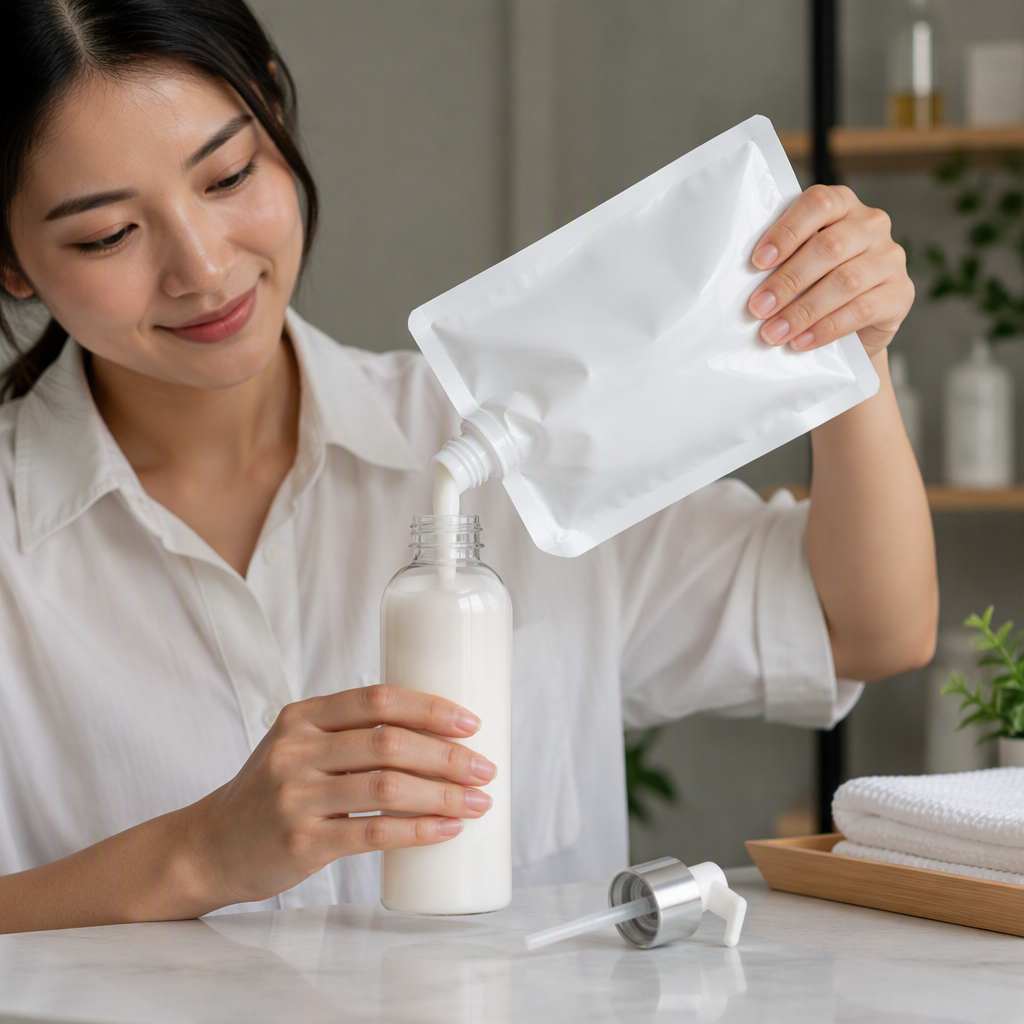
A cosmetic spout pouch for refill packaging should protect the formula, remain sealed during distribution, dispense cleanly, and connect reliably with the intended filling process. The final specification depends on product viscosity, ingredients, target fill volume, barrier requirements, spout geometry, closure design, printing, and distribution conditions.
This guide assumes a nonpressurized cosmetic or personal care product filled at ambient or moderately warm temperatures. It does not assume that a standard pouch is suitable for sterile products, aerosols, aggressive solvents, or hot filling. Formulas containing significant alcohol, essential oils, fragrances, pigments, or active ingredients require product-specific compatibility testing.
A refill pouch may be designed for one-time transfer into a bottle or for repeated dispensing. That decision affects the closure, pouch stability, tamper feature, oxygen exposure, and amount of product that can be evacuated.
Starting Specifications by Cosmetic Product Type

The following table provides discussion points for an initial RFQ. These are not universal specifications. Actual pouch dimensions, film thickness, fitment bore, and filling parameters must be confirmed with the formula and filling equipment.
| Cosmetic product | Common refill capacity range | Fitment starting point | Structure priority | Key validation focus |
|---|---|---|---|---|
| Shampoo and body wash | 250–1,000 mL | Medium bore screw cap or controlled-pour closure | Seal durability and puncture resistance | Leakage, drop performance, and dispensing rate |
| Conditioner and body lotion | 200–750 mL | Medium-to-large bore selected through flow testing | Product-contact compatibility and stiffness | Evacuation of viscous product and residue at the spout |
| Hand soap and cleansing gel | 200–1,000 mL | Screw cap, flip-top, or controlled-pour fitment | Seal consistency and handling strength | Cap security and repeated opening |
| Cream or mask refill | 100–500 mL | Large bore or dispensing fitment | Resistance to flexing and side-seal stress | Whether the formula can flow without excessive squeezing |
| Oil, serum, or concentrate | 30–250 mL | Small controlled-flow opening | Oil, fragrance, and aroma compatibility | Panel staining, swelling, odor change, and dosage control |
Capacity ranges describe common project sizes rather than fixed manufacturing limits. Product density and required headspace affect the pouch dimensions, so liquid volume alone is not enough to approve a dieline.
Selecting the Laminate Structure
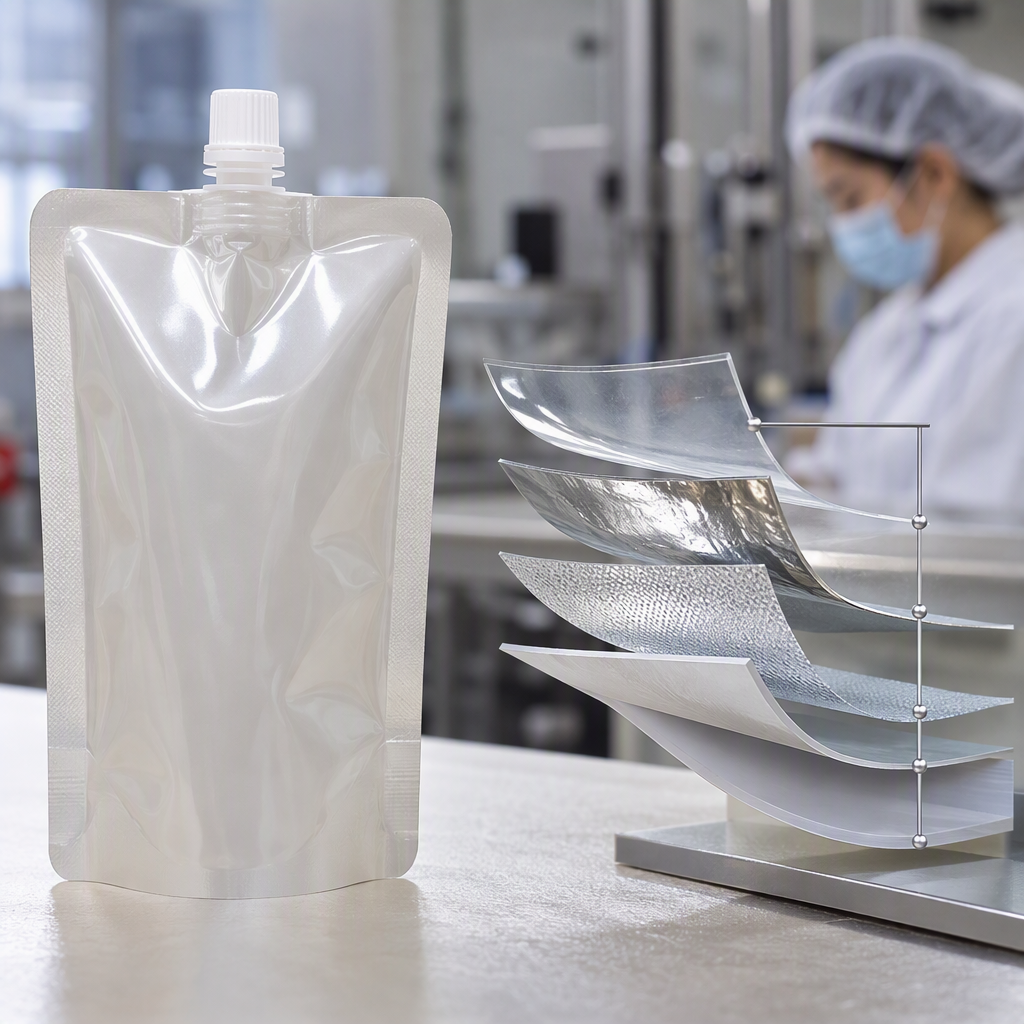
A cosmetic refill pouch normally uses a multilayer laminate in which each layer has a defined function. The outer web supports printing and handling, optional middle layers add barrier or toughness, and the inner sealant contacts the formula and forms the pouch seals.
- PET/PE: A practical starting construction for products that do not require elevated barrier or puncture resistance. Formula compatibility still requires confirmation.
- PET/NY/PE: Nylon can add toughness and flex resistance for larger pouches or demanding distribution, although its necessity depends on the application.
- PET/AL/NY/PE: Aluminum foil provides high light and gas barrier and creates an opaque package. Foil-containing structures must be assessed for flex cracking and are not suitable where product visibility is required.
- Barrier clear laminate: A transparent construction may incorporate a barrier layer such as EVOH. Performance depends on the complete structure, processing, and exposure conditions.
- Predominantly PE structure: A PE-based design may support certain recycling objectives, but barrier, stiffness, printing, seal performance, fitment compatibility, and local collection rules must all be evaluated.
Total thickness should be selected from filled-pack testing rather than copied from another pouch. Review the spout pouch material structure guide when comparing layer functions and barrier options.
Spout and Closure Options Compared

The fitment must match the product flow, intended refill behavior, cap application method, and pouch sealant. Nominal spout sizes are not necessarily interchangeable between suppliers; confirm the neck finish, flange geometry, cap thread, opening diameter, and fitment resin on the approved drawing.
| Fitment option | Best suited to | Advantages | Points to verify |
|---|---|---|---|
| Screw cap with pouring spout | Most one-time or occasional refills | Simple resealing and broad size selection | Bore size, cap torque, tamper feature, and drip behavior |
| Flip-top closure | Repeated controlled dispensing | Convenient opening without removing the cap | Hinge durability, orifice flow, and accidental opening risk |
| Narrow nozzle | Concentrates, oils, or targeted dispensing | Improved directional control | Slow filling or pouring, clogging, and dosage consistency |
| Large-bore spout | Conditioners, creams, and viscous gels | Lower resistance to product flow | Cap size, fitment weight, seal area, and line handling |
| Pump or dispensing assembly | Pouches used as the primary dispensing pack | Metered or convenient use when properly engineered | Dip-tube arrangement, priming, dosage, leakage, and transport locking |
Use the fitment, cap, pump, and dispenser selection guide to define closure details. Spout position also changes pouring and line orientation; compare corner-spout and top-spout pouch layouts before approving the dieline.
Capacity, Pouch Shape, and Filling Compatibility
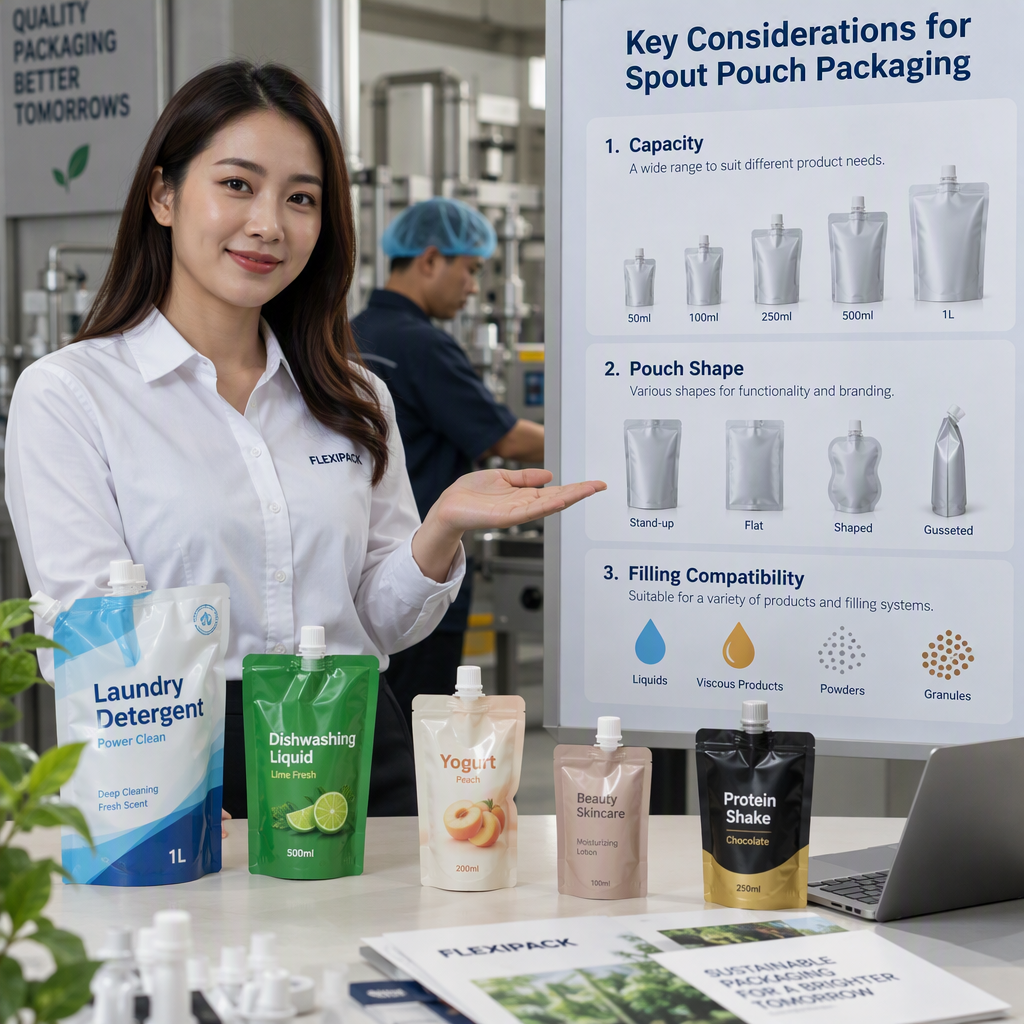
Specify both the nominal product volume and the target fill weight. The converter then needs product density, headspace requirements, and the desired external dimensions. A filled sample is more reliable than a theoretical volume calculation because gusset opening, seal width, fitment displacement, and product behavior affect usable capacity.
Common configurations include stand-up pouches with a bottom gusset and flatter three-side-seal formats. A stand-up design can support shelf presentation, while a flat refill can prioritize compact secondary packing. Handle cutouts may help with larger packs but reduce available film area and must not interfere with seals.
State whether the pouch will be filled through the spout or through an open edge that is sealed after filling. Also provide the filling temperature, nozzle dimensions, expected output, cap application method, conveyor support, and coding location. The spout pouch filling machine compatibility guide explains the information needed for line review.
Printing, Finish, and Artwork Requirements
Printed cosmetic pouches commonly use reverse printing, where graphics are protected within the laminate. Available printing methods, color controls, surface finishes, and economic run lengths depend on the converter and order plan.
Artwork should follow the approved dieline and show seal areas, gussets, spout position, eye marks, barcode quiet zones, date-code areas, and any transparent windows. Avoid placing small text or critical graphics across folds and distortion zones. Matte and gloss effects should be reviewed using physical samples because screen proofs do not reproduce film appearance or filled-pouch distortion.
Consult the custom spout pouch printing guide before submitting production artwork.
Validation and Quality Control

A pouch should be approved as a complete filled package, not only as an empty bag. Establish test conditions that represent filling, capping, storage, handling, and distribution.
- Formula compatibility: Expose the laminate, sealant, fitment, and cap to the actual formula. Check for swelling, delamination, softening, brittleness, staining, odor change, leakage, and formula changes over the intended evaluation period.
- Seal and leak testing: Evaluate side seals, bottom seals, spout welds, cap interfaces, and any post-fill seal. Test parameters should be documented and appropriate to the package.
- Drop and compression trials: Use filled pouches at defined orientations and temperatures that represent the planned distribution environment.
- Cap testing: Establish application and removal torque ranges using the specified cap and equipment. Verify tamper features separately where used.
- Dispensing trials: Measure flow, pouring control, clogging, refill time, residue, and product evacuation with intended users and receiving containers.
- Production inspection: Check dimensions, print, registration, seals, contamination, fitment position, cap condition, and functional leakage according to an agreed sampling plan.
Review practical spout pouch leak testing methods when preparing the validation plan. For lot acceptance, define critical, major, and minor defects using an agreed AQL sampling procedure for spout pouches.
Cosmetic Refill Pouch RFQ Checklist
A complete quotation request should include:
- Product name, ingredients or compatibility information, viscosity, density, and any sensitive components
- Nominal volume, target fill weight, expected headspace, and number of SKUs
- Preferred pouch style, approximate dimensions, spout position, and closure type
- Filling method, fill temperature, nozzle details, cap application process, and line speed
- Required barrier, opacity, window, surface finish, and printing expectations
- Distribution temperatures, carton arrangement, shipping route, and validation requirements
- Artwork status, order quantity, annual forecast, sample needs, and intended launch schedule
- Requested inspection documents and defect acceptance criteria
Do not finalize a cosmetic spout pouch from capacity and appearance alone. The formula, fitment, laminate, filling line, and test plan should be reviewed as one packaging system.
FAQ
What is the best film structure for a cosmetic spout pouch?
There is no single best structure for every cosmetic formula. PET/PE may suit some routine applications, while nylon, foil, or a transparent barrier layer may be added when toughness, light protection, or gas barrier is needed. Final selection requires compatibility and filled-package testing with the actual formula.
What spout size should be used for lotion or conditioner?
Start with a medium or large flow path, then conduct dispensing trials. The required opening depends on viscosity, thixotropic behavior, particles, refill speed, pouch size, and receiving-container opening. Supplier fitment sizes are not automatically interchangeable, so use an approved fitment drawing.
How much headspace does a cosmetic refill pouch need?
There is no universal headspace percentage. The appropriate amount depends on product expansion, fill accuracy, sealing method, pouch handling, and distribution temperature. Confirm usable capacity with the actual product on filling trials rather than relying only on nominal pouch volume.
Can the same refill pouch be used for multiple cosmetic formulas?
Only after each formula has been reviewed. Fragrance oils, alcohol, surfactants, pigments, essential oils, and active ingredients can interact differently with the sealant, adhesive, fitment, and closure. A structure approved for one formula should not automatically be approved for another.
Can a standard cosmetic spout pouch be hot filled?
Not automatically. Elevated-temperature filling can affect the film, adhesive, seals, fitment, cap, and pouch dimensions. Provide the actual product temperature, exposure time, cooling process, and line conditions so the package can be engineered and validated for that process.
Is a cosmetic refill pouch recyclable?
Recyclability depends on the complete material structure, fitment, closure, inks, adhesives, local collection systems, and applicable labeling rules. A predominantly PE construction may be considered for certain projects, but suitability and any recycling claim must be assessed for the intended market.
What samples should be approved before mass production?
Buyers should typically review the pouch dimensions, fitment and cap samples, unprinted or digitally printed prototypes, artwork proof, color references, and filled functional samples. Production-representative samples may still be required because prototypes do not always duplicate final printing, lamination, and sealing behavior.
Discuss Your Cosmetic Refill Pouch Requirements
Share your formula, pouch structure, spout fitment, artwork, MOQ, sample needs, and quote requirements with HUACANG Packaging for a technical project review.