Table of Contents
- What US Buyers Need to Establish
- How the US Food-Contact Framework Applies
- Documents to Request from a Pouch Supplier
- Selecting a Food-Contact Pouch Structure
- Application and Specification Starting Points
- Fitment and Closure Requirements
- Testing the Finished Package
- Supplier Qualification Checklist
- Information to Include in an RFQ
A practical guide to qualifying food-contact spout pouches for the US market, including material compliance, supplier documentation, application-specific structures, fitments, testing, and purchase specifications.
What US Buyers Need to Establish
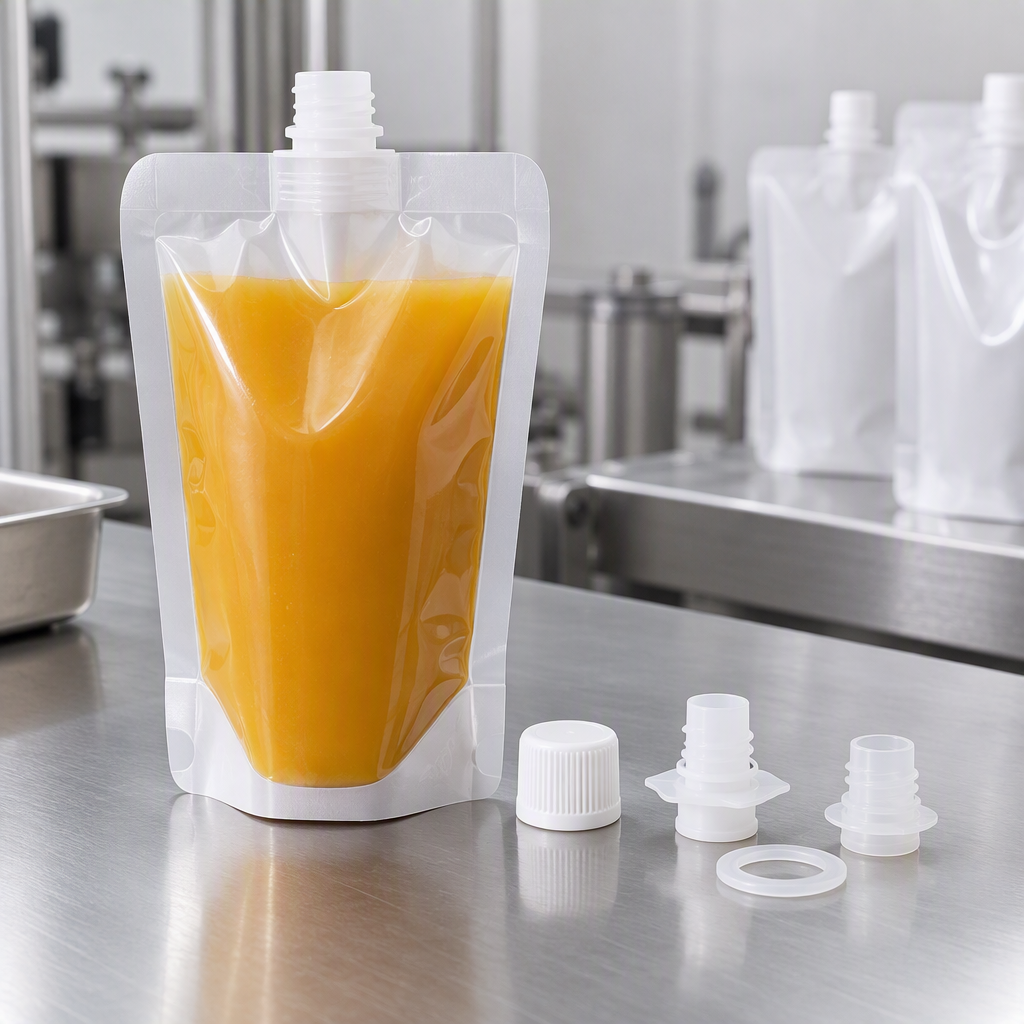
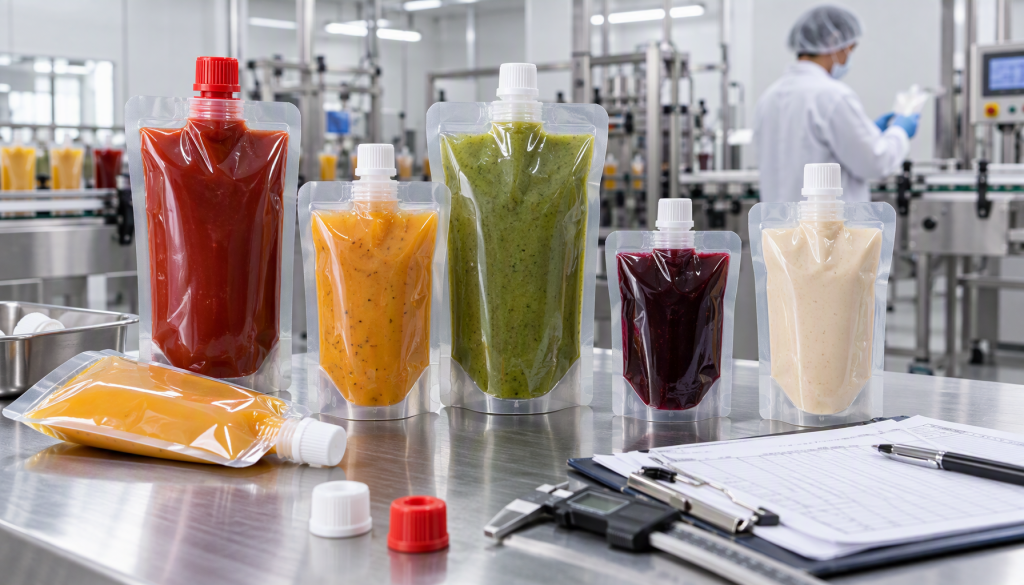
Food-contact spout pouches intended for the US market should be specified as a complete packaging system whose food-contact substances are suitable for the intended food type, temperature, contact time, and processing conditions. A general statement that a pouch is “FDA approved” is not enough. Buyers should identify every food-contact layer, adhesive, coating, fitment, gasket, and closure component, then obtain documentation supporting its permitted use under the applicable US regulatory basis.
This guide assumes the pouch will directly contact food sold in the United States. It addresses packaging qualification and procurement rather than finished-food labeling, facility registration, thermal-process filing, or state-specific chemical disclosure rules. The food company remains responsible for determining whether the finished package is lawful and suitable for its actual use.
The review should answer four questions early:
- What food will contact the pouch, and is it aqueous, acidic, alcoholic, fatty, dry, or a combination?
- Will the product be cold filled, ambient filled, hot filled, retorted, frozen, or processed aseptically?
- How long and at what temperatures will the food remain in contact with the package?
- Can the supplier trace the food-contact materials used in the production lot back to controlled specifications?
How the US Food-Contact Framework Applies
US food packaging requirements generally focus on the substances that may become components of food through contact with packaging. Relevant substances can include polymers, additives, colorants, adhesives, coatings, paper components, and other indirect food additives. A substance may have a regulatory basis in Title 21 of the Code of Federal Regulations, an effective Food Contact Notification, a Threshold of Regulation exemption, a prior sanction, or another applicable status.
The regulatory basis must cover the actual conditions of use. For example, documentation limited to refrigerated contact may not support a hot-fill or retort application. Likewise, a resin suitable for one food category is not automatically suitable for fatty foods, alcoholic products, or high-temperature processing.
Good manufacturing practice is also part of the assessment. Food-contact substances should be used only in the amount needed for their technical purpose and should meet suitable purity requirements. In a laminated pouch, the direct food-contact sealant is important, but buyers should also review substances behind functional barriers when migration, setoff, incomplete curing, or processing conditions could create unintended food exposure.
The FDA does not ordinarily issue a universal approval certificate for a finished custom pouch. Supplier declarations and supporting records should identify the materials, applicable regulatory citations or other basis, restrictions, and intended conditions of use. A Food Contact Notification may also be specific to the manufacturer or supplier covered by that notification, so a notification number should be verified against the actual material source.
Documents to Request from a Pouch Supplier

FDA food packaging documentation should be specific enough to connect the supplied pouch to its raw materials and intended use. The exact file set depends on the product and risk assessment, but a practical purchasing package commonly includes the following items.
| Document | What it should establish | Buyer review point |
|---|---|---|
| Food-contact declaration | Identity of relevant layers and components, regulatory basis, limitations, and conditions of use | Confirm it covers the food type, temperature, and contact duration |
| Material specification | Film construction, nominal thickness, sealant, barrier layer, adhesive system, and fitment resin | Match document revisions to the approved pouch specification |
| Safety data or technical data | Material identification and processing information where applicable | Do not treat an SDS or technical data sheet as a substitute for a food-contact declaration |
| Migration or extraction report | Test conditions, simulants, methods, results, and tested sample description | Check whether the tested structure represents the supplied construction and use conditions |
| Certificate of analysis or conformity | Lot-level or shipment-level confirmation against defined requirements | Agree in advance which attributes and lots the certificate covers |
| Traceability records | Links between finished pouch lots, production records, and controlled raw-material batches | Confirm records can support an investigation or withdrawal |
| Change-control statement | Process for notifying the buyer about material, source, formulation, or process changes | Define which changes require written approval before production |
Declarations should be current, signed or otherwise controlled, and issued by an organization with access to the underlying formulation and supply-chain information. If a supplier redacts confidential formulations, it should still provide enough information to establish compliance and limitations. Buyers may also use confidentiality agreements or qualified third-party reviews when detailed composition cannot be disclosed directly.
Selecting a Food-Contact Pouch Structure
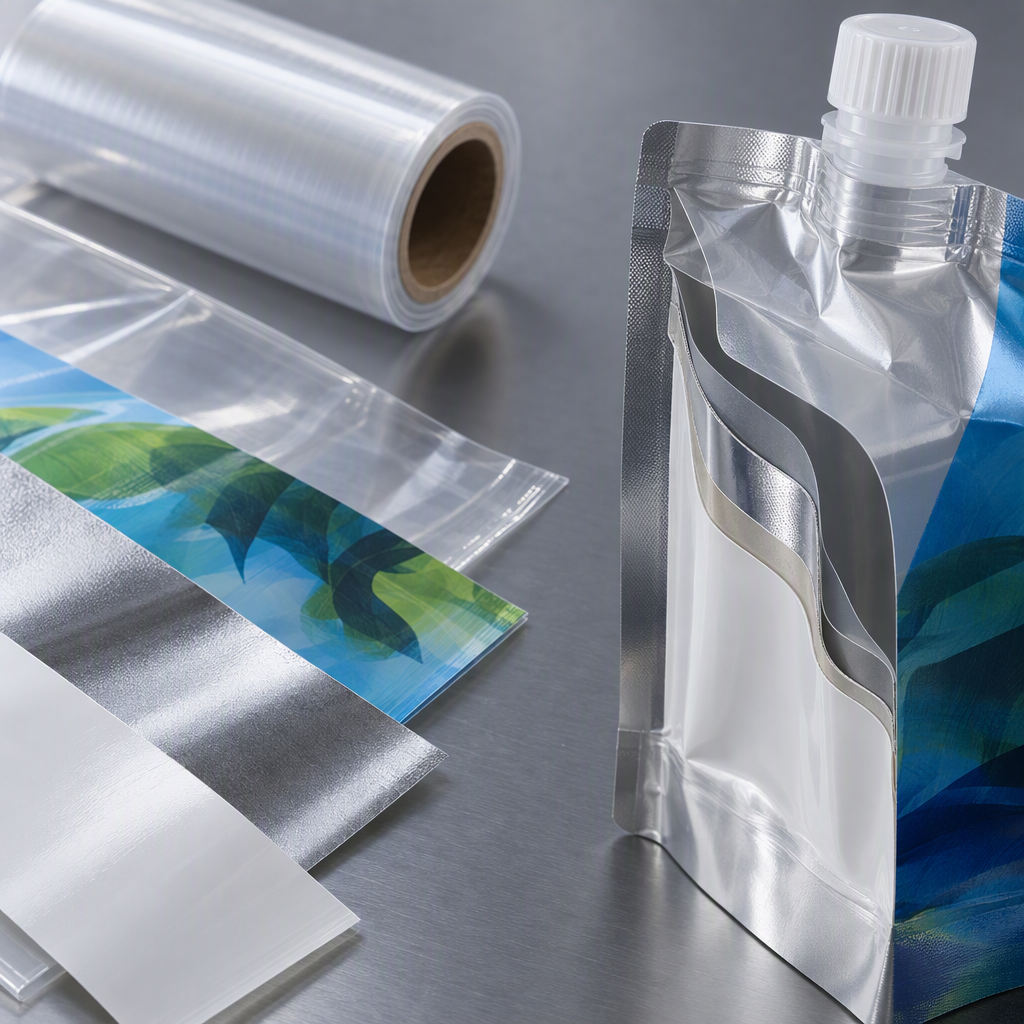
Food contact pouch materials should be selected from the product outward. The inner sealant layer directly contacts the food and must provide appropriate sealing, chemical resistance, and process-temperature performance. Outer and intermediate layers provide printability, stiffness, puncture resistance, oxygen barrier, moisture barrier, or light barrier. No single laminate is correct for every food.
Common structural roles include polyethylene as a sealant for many ambient or refrigerated products, polypropylene-based sealants where higher process temperatures are involved, PET for printability and dimensional stability, nylon for toughness and puncture resistance, EVOH for oxygen barrier, and aluminum foil for high oxygen and light barrier. These descriptions are functional starting points, not declarations that every grade or construction is appropriate for food contact.
Barrier requirements should be based on shelf-life objectives and product sensitivity. Oxygen-sensitive sauces may need an oxygen-barrier layer, while hygroscopic powders may place greater emphasis on water-vapor protection. Acid, oil, alcohol, flavor compounds, and essential oils can interact differently with sealants, adhesives, and fitments. Product compatibility trials are therefore necessary even when each individual component has a documented food-contact status.
For high-temperature processes, treat the package as an engineered system. The film, adhesive, ink, spout, cap, seals, and processing cycle must remain compatible. Buyers evaluating elevated-temperature filling can review the detailed guidance on hot-fill spout pouch film and seal engineering and, for in-package sterilization, the requirements for retort spout pouch materials and processing.
Application and Specification Starting Points
The following table is a screening tool, not a final material prescription. Final structures require review against the formulation, filling line, process, target shelf life, package size, and distribution environment.
| Food application | Typical process questions | Structure priorities | Fitment considerations |
|---|---|---|---|
| Cold-filled sauce or dressing | Is the product acidic, oily, refrigerated, or shelf stable? | Sealant compatibility, oxygen barrier where needed, oil and flavor resistance | Orifice matched to viscosity and particulates; tamper-evident closure if specified |
| Hot-filled puree or sauce | What is the fill temperature, hold time, cooling method, and acidity? | Thermal resistance, seal integrity while hot, controlled laminate bonding | Heat-compatible spout and cap with validated sealing parameters |
| Retorted food | What scheduled thermal process will be used? | Retort-compatible films, adhesive, barrier, and seals | Fitment designed and validated for the complete retort cycle |
| Beverage concentrate | Does the formula contain acid, alcohol, flavor oils, or oxygen-sensitive ingredients? | Flavor retention, chemical compatibility, oxygen barrier | Controlled dispensing and filling-line compatibility |
| Edible oil | How sensitive is the oil to oxygen and light? | Oil-resistant sealant plus oxygen and light barrier as required | Drip control, cap sealing, and pouring performance |
| Dry ingredient or concentrate | Is moisture pickup or powder ingress into the fitment a concern? | Moisture barrier, seal cleanliness, puncture resistance | Opening size and reclosure suitable for the product flow |
Viscosity and particulates directly affect orifice selection and consumer dispensing. The sauce pouch viscosity and dispensing guide explains how these variables influence the package specification.
Fitment and Closure Requirements
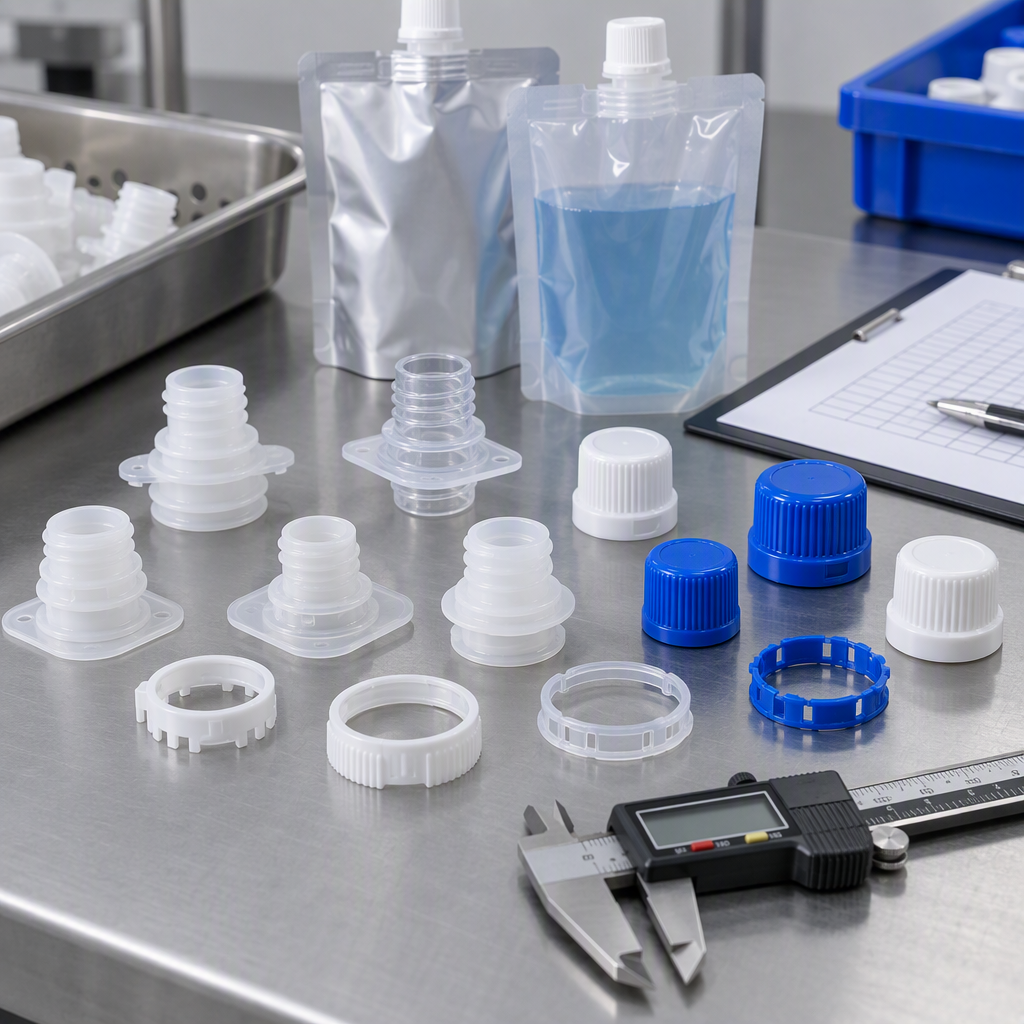
The spout, cap, liner, valve, gasket, and tamper-evident elements must be reviewed alongside the pouch film. Confirm the resin and colorant used for every food-contact component, including any component that may contact food during filling, inversion, transport, or dispensing.
Key dimensions include the fitment flange, welding profile, neck finish, cap thread, orifice diameter, and any rail or handling geometry used by the filling equipment. A food-contact declaration does not establish mechanical compatibility. The fitment still has to withstand insertion or sealing, filling pressure, capping torque, process temperature, handling, and repeated opening where applicable.
Closure selection should reflect the intended user and product. A small orifice can provide controlled dispensing but may obstruct thick products or particulates. A larger opening may fill faster but requires evaluation of pour control and cap sealing. Tamper evidence should be specified by design and inspection criteria rather than assumed from a cap description.
Before approving tooling or production, compare the fitment drawing with the filling and capping equipment. See the spout pouch filling-line compatibility guide for the dimensions and machine interfaces buyers should confirm, and review spout pouch caps, pumps, and dispensers when selecting the dispensing format.
Testing the Finished Package

Regulatory status and package performance are separate questions. A material can have an appropriate food-contact basis and still fail because of weak seals, product incompatibility, poor fitment welding, excessive transmission, or unsuitable processing conditions. Qualification should therefore use production-representative pouches filled with the actual product or a technically justified simulant.
A risk-based validation plan may include:
- Seal-strength testing at the pouch perimeter and fitment interface
- Leak, pressure, or vacuum testing appropriate to the package design
- Drop, compression, vibration, and shipping evaluation for the intended case pack
- Hot-fill, cooling, freezing, thawing, or retort trials under defined process limits
- Product compatibility and sensory review over the proposed shelf life
- Oxygen- and water-vapor-transmission evaluation where barrier is critical
- Cap application torque, removal torque, tamper-evidence, and dispensing tests
- Migration or extraction work when required by the regulatory assessment
Test reports should identify the exact pouch construction, fitment, cap, manufacturing lot, conditioning, equipment, method, acceptance criteria, and results. Testing an unprinted laboratory laminate may not represent a finished printed pouch made with production adhesives and inks. For package-integrity planning, consult the guide to spout pouch leak-testing methods.
Supplier Qualification Checklist
Food pouch supplier requirements should combine regulatory documentation with manufacturing controls. An overseas location does not change the buyer’s need to establish that the packaging is suitable for food sold in the United States.
- Define material control: Ask how approved resin, film, adhesive, ink, and fitment specifications are maintained and how incoming materials are verified.
- Review traceability: Confirm that finished pouch lots can be connected to production dates, equipment, inspection records, and relevant raw-material batches.
- Evaluate change control: Require advance notice for changes to formulations, layer thicknesses, suppliers, manufacturing sites, fitment molds, inks, adhesives, or processing parameters that could affect compliance or performance.
- Confirm hygiene controls: Review documented practices for personnel, cleaning, pest control, foreign-material prevention, storage, and handling of food-contact surfaces.
- Assess process control: Examine how lamination curing, pouch sealing, fitment insertion, cap application, printing, and inspection are controlled.
- Set defect criteria: Establish sampling plans and acceptance limits for dimensions, appearance, print, seal integrity, contamination, fitment alignment, and functional performance.
- Plan nonconformance handling: Define containment, investigation, corrective action, replacement, and communication expectations.
Third-party certifications may support supplier qualification, but they do not replace application-specific food-contact documentation or finished-package validation. Buyers should approve a signed specification and representative samples before mass production.
Information to Include in an RFQ
A useful RFQ gives the pouch manufacturer enough information to propose a structure without guessing about the application. Include the product name and ingredient characteristics relevant to packaging, such as pH range, fat or oil content, alcohol content, particulates, viscosity, and sensitivity to oxygen, moisture, or light.
Also provide the nominal fill volume and weight, pouch orientation, target dimensions, fill temperature, maximum process temperature and duration, cooling method, storage range, intended shelf life, distribution route, and secondary packaging. Identify the filling-machine model, fitment interface, capping method, line speed target, and whether pouches will be supplied with the cap installed.
Artwork information should cover print process, number of colors, finish, clear windows, coding areas, registration tolerances, and any required warning or traceability fields. Procurement details should state forecast volume, order frequency, requested MOQ, sample stages, test requirements, documentation requirements, destination, and Incoterm.
Finally, attach a controlled requirement sheet that distinguishes mandatory criteria from preferences. Request a dimensioned drawing, complete material structure, nominal thickness, fitment and cap specifications, regulatory declarations, test plan, sample approval process, and change-control commitment. This creates a clearer basis for comparing quotations and controlling future production.
FAQ
Are finished food-contact spout pouches FDA approved?
The phrase “FDA approved pouch” is usually too broad. FDA generally regulates the substances used in food-contact materials and their permitted conditions of use rather than issuing a universal approval certificate for each custom pouch. Buyers should request documentation identifying the applicable regulatory basis and restrictions for the pouch’s food-contact components.
Which parts of a spout pouch need food-contact review?
Review the direct-contact sealant, spout, cap, liner, valve, gasket, and any colorants or additives in those components. Adhesives, inks, coatings, and outer layers may also require assessment based on functional-barrier performance, migration potential, setoff, curing, processing, and foreseeable contact during filling or use.
Does a food-contact declaration prove that a pouch will work with my product?
No. A declaration addresses regulatory status under stated conditions; it does not prove seal integrity, barrier performance, shelf life, flavor compatibility, filling-line performance, or dispensing behavior. Those characteristics require a specification and application-specific validation.
Is migration testing always required for food-contact spout pouches?
Not in every case. The need depends on the regulatory basis, material construction, food type, temperature, duration, and risk assessment. When testing is used, the simulants and conditions should represent or conservatively cover the intended application, and the tested sample should match the production structure.
Can the same pouch structure be used for cold fill, hot fill, and retort?
Do not assume so. These processes impose different thermal, mechanical, seal, adhesive, and fitment requirements. A structure qualified for ambient or refrigerated use may not tolerate hot filling or retort processing. Each process should have defined limits and validation data.
What should a buyer check on a supplier's FDA documentation?
Check the material or component identity, issuer, document date and revision, regulatory citation or other basis, food categories, temperature and time limitations, restrictions, and whether the covered supplier and material grade match the proposed pouch. Resolve generic or ambiguous statements before approval.
What samples should be approved before ordering production pouches?
Approve material or unprinted samples for basic compatibility, fitment samples for machine trials, printed preproduction samples for artwork and construction, and filled-package samples for performance testing. The approved reference should be linked to a controlled drawing and specification rather than appearance alone.
Discuss Your US Food-Contact Pouch Specification
Contact HUACANG Packaging to discuss your product, pouch structure, spout fitment, artwork, MOQ, sample plan, documentation needs, and quotation requirements for the US market.