Table of Contents
- What Sauce Spout Pouches Need to Do
- Classify Sauce Flow Behavior Before Selecting a Fitment
- How to Choose a Sauce Dispensing Fitment
- Film, Seal, and Hot-Fill Considerations
- Validate Flow, Dosing, and Package Performance
- Sauce Pouch RFQ and Troubleshooting Checklist
Selecting sauce spout pouches requires more than choosing a pouch size. Product viscosity, temperature, particulates, fitment geometry, closure design, film structure, and dispensing behavior must be evaluated together.
What Sauce Spout Pouches Need to Do
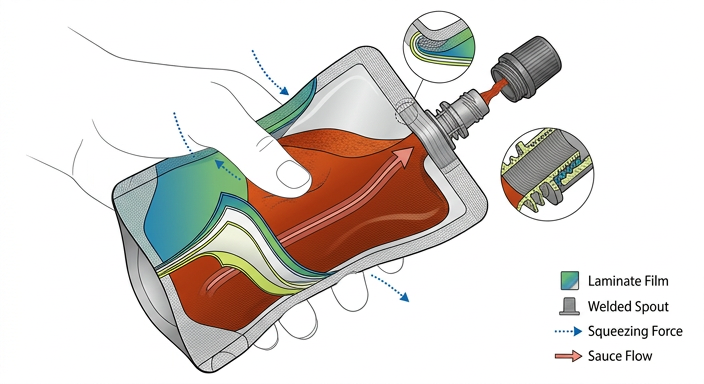
Sauce spout pouches should be specified as a complete dispensing system, not simply as a printed bag with a nozzle. The correct design depends on the sauce’s flow behavior, product temperature, particle size, target serving or dose, filling method, pouch orientation, and closure requirements. A smooth pourable sauce may work with a conventional spout and screw cap, while a thick or particulate-containing sauce may need a larger passage, a different nozzle profile, or a fitment designed for controlled dispensing.
For B2B buyers, the key question is not only whether the product can leave the pouch. The package must also fill reliably, seal without contamination, open cleanly, dispense at the intended rate, resist leakage during distribution, and remain practical when the pouch is nearly empty.
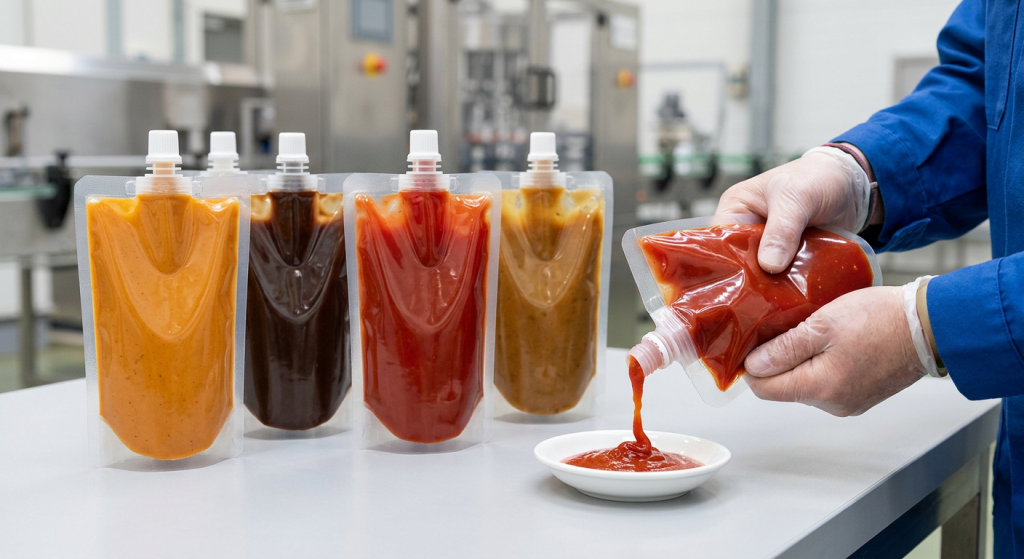
A condiment spout pouch may be used for ketchup, mayonnaise, barbecue sauce, chili sauce, dressings, marinades, syrups, purees, and other semi-liquid foods. These products can behave very differently even when their measured viscosity appears similar. Temperature, shear, suspended particles, oil content, acidity, and storage conditions all affect the result.
Core design questions
- What is the sauce’s apparent viscosity at filling, storage, and dispensing temperatures?
- Does the formula contain seeds, herbs, fruit pieces, pulp, spices, or other particles?
- Will the consumer squeeze, pour, invert, press, or use a pump?
- What dose or flow rate is expected?
- Does the product require hot filling, pasteurization, retort processing, or only ambient filling?
- How must the pouch be resealed between uses?
These answers establish the starting point for the pouch laminate, spout, cap, and validation plan.
Classify Sauce Flow Behavior Before Selecting a Fitment
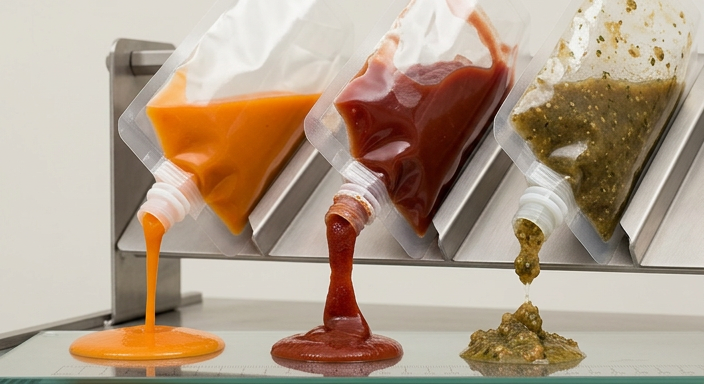
Viscosity describes resistance to flow, but sauce dispensing decisions cannot rely on a single number alone. Many food sauces are non-Newtonian: their apparent viscosity changes when they are stirred, pumped, squeezed, or poured. A laboratory reading is useful only when the test temperature, instrument, spindle or measurement geometry, speed, and method are recorded.
For packaging development, classify the product by how it behaves in actual use. The following categories are practical starting points rather than universal viscosity specifications:
- Pourable, smooth sauces: These generally flow under gravity or light squeezing. The main concerns are controlled pouring, cap cleanliness, drip behavior, and avoiding an opening that is too restrictive for the intended serving size.
- Thick or shear-thinning sauces: These may resist flow at rest but become easier to dispense under squeezing or pumping. A high viscosity spout pouch usually needs a passage with sufficient clearance and a pouch structure that can transmit user pressure without excessive effort.
- Particulate sauces: Relishes, chunky salsa, fruit preparations, and sauces containing seeds or herbs must be evaluated by maximum particle dimension, concentration, shape, and tendency to bridge at the opening. The largest relevant particle, not the average particle, should guide fitment trials.
- Sticky or string-forming sauces: Syrups, glazes, and some dressings can continue to stretch after the main flow stops. Nozzle length, outlet geometry, cap design, and the product’s temperature can influence residue and stringing.
- Temperature-sensitive sauces: A product may flow acceptably when warm but become difficult to dispense after refrigeration. Testing at the coldest expected use temperature is essential when the product is sold for chilled storage.
Ask the product team for viscosity or rheology data at relevant temperatures, but also request a representative production sample. If the formula changes during scale-up, repeat the dispensing evaluation. A small change in solids, starch, oil, or particle content can alter the required fitment.
When comparing supplier proposals, avoid treating two cP values as equivalent unless the measurement conditions are the same. The test method should be included in the packaging specification or RFQ.
How to Choose a Sauce Dispensing Fitment
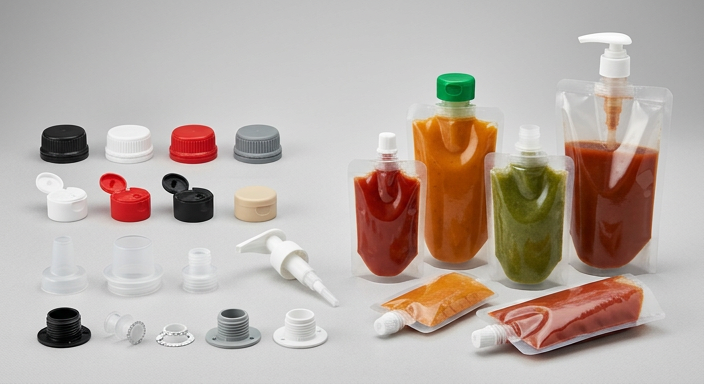
The fitment controls the product passage between the pouch and the user. Its bore, outlet shape, neck length, cap, and attachment method affect filling, opening, flow rate, residue, and resealing. A sauce dispensing fitment should therefore be selected using the product sample and the intended use method rather than by appearance alone.
Bore and outlet geometry
A narrow passage can help control a pourable product, but it may restrict thick sauces or allow particles to bridge. A larger passage may improve flow for a high viscosity spout pouch, although it can make portion control and cap cleanliness more difficult. The outlet should be evaluated with the largest expected particle and with product at its lowest dispensing temperature.
Closure selection
Screw caps are commonly considered when repeated opening and resealing are required. Flip-top or other closure formats may be useful when the package is opened frequently and one-handed access is important. Pump or dispenser fitments may be considered when the product requires measured portions or reduced direct contact, but the fitment must be compatible with the food formula, filling line, and cleaning or handling expectations.
Closure selection also involves cap retention, tamper evidence, torque, thread engagement, cap clearance, and the possibility of sauce contaminating the sealing surfaces. Review the options in this spout pouch closure and seal design guide before finalizing the component.
Spout location and pouch handling
Top, corner, and offset spout positions create different pouring angles and influence how the pouch collapses during use. A corner spout may support angled pouring, while a top spout may suit upright presentation or filling-line requirements. The chosen position should be tested with the final pouch dimensions, fill volume, headspace, graphics, and retail display orientation.
Fitment dimensions must also match the filling machine’s insertion, sealing, capping, and product-contact requirements. Confirm the neck specification, weld area, cap type, and acceptable tolerances before ordering production tooling or printed materials.
Film, Seal, and Hot-Fill Considerations
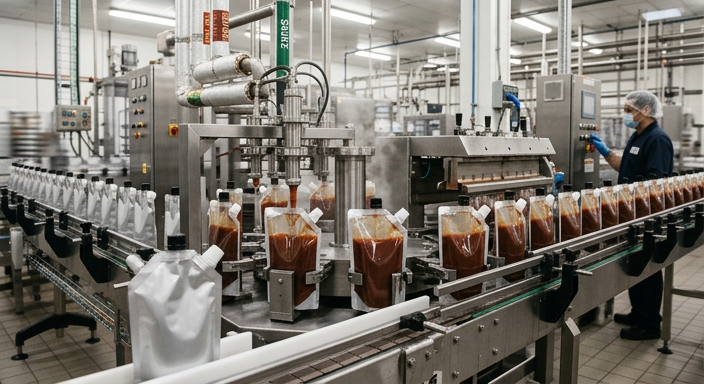
The pouch laminate must protect the sauce and tolerate the mechanical and thermal conditions of filling, storage, transport, and use. There is no single best film structure for every condiment. The specification should reflect oxygen, moisture, light, aroma, oil, acidity, temperature, shelf-life, puncture, and appearance requirements.
Laminate and sealant
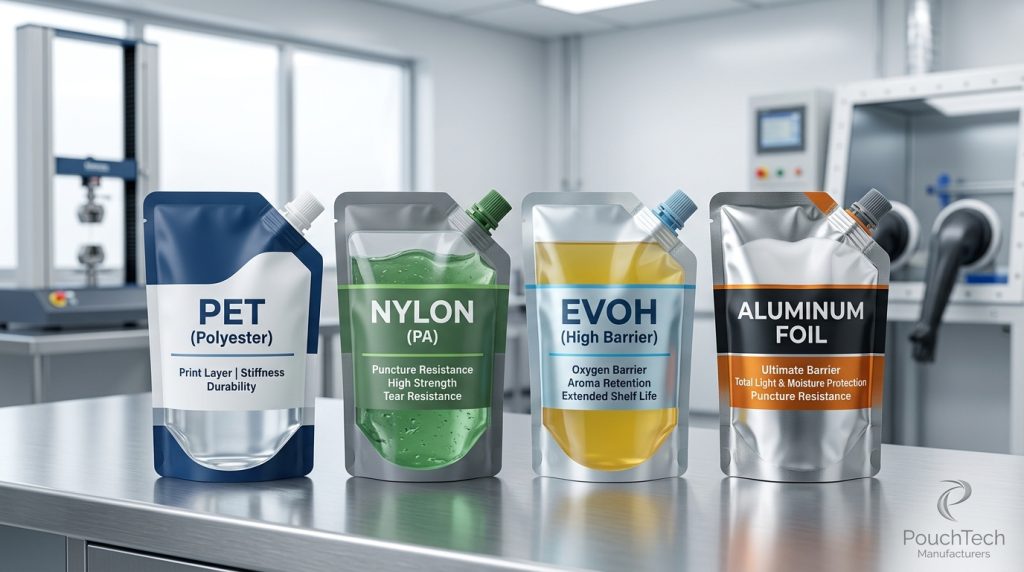
The outer layer provides print and handling performance, while one or more inner layers provide sealing and product contact. Barrier layers may be needed when the sauce is sensitive to oxygen, light, or aroma transfer. The sealant must be compatible with the formula and capable of producing consistent seals at the filling line’s operating window.
For squeezable sauces, consider flex-crack resistance, puncture resistance, stiffness, and how the laminate collapses as the product is removed. A structure that is too stiff may make dispensing uncomfortable; a structure that is too weak may be more vulnerable to handling damage. Specify the complete laminate thickness and test method rather than requesting an isolated film gauge. The spout pouch material thickness guide explains why total structure thickness matters.
Hot-fill sauce pouch requirements
If the sauce is filled hot, the package must be designed for the actual filling temperature, residence time, headspace, cooling method, and distribution conditions. A hot fill sauce pouch is not created by simply using a standard pouch with a spout. The film, sealant, spout material, fitment weld, cap, and sealing parameters all require compatibility review.
Hot-fill development should confirm product-contact suitability, dimensional stability, seal integrity after filling, cap installation, pouch cooling, and performance after storage. Do not assume that a hot-fill process is equivalent to retort processing; the thermal profile and package requirements may be different. Use the hot-fill spout pouch engineering guide when preparing process requirements for a supplier.
For any food application, the buyer should also identify the destination-market requirements for food-contact materials and retain the relevant supplier documentation. Compliance depends on the final structure, substances, intended use, and market—not on the phrase “food grade” alone.
Validate Flow, Dosing, and Package Performance
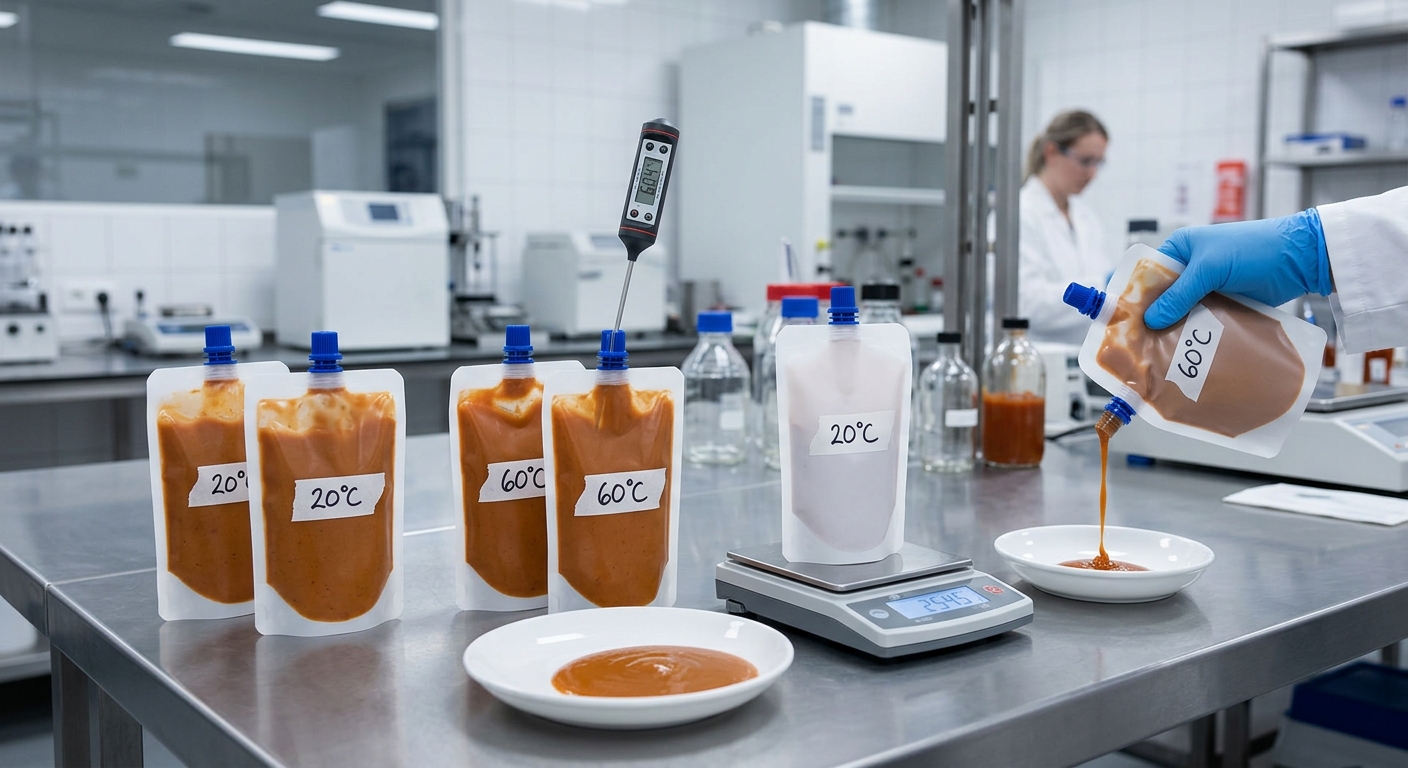
Dispensing validation should use filled samples made with the intended sauce formula, pouch structure, fitment, cap, and filling process. Empty-pouch demonstrations can show appearance and basic handling, but they cannot confirm flow rate, residue, air movement, seal contamination, or consumer effort.
Recommended dispensing checks
- Initial opening: Check tear or tamper-evident features, cap removal, outlet cleanliness, and whether the first squeeze produces a controlled stream.
- Flow at relevant temperatures: Test the product at the expected minimum, normal, and maximum dispensing temperatures. Include refrigerated conditions when applicable.
- Target dose: Record the time and user action needed to dispense a practical serving or specified mass. Test both gentle and firm squeezing if the product is intended for consumer use.
- Continuous flow: Observe surging, pulsing, air locks, bridging, splashing, and changes in flow as the pouch collapses.
- End-of-pack performance: Confirm whether the remaining sauce can be removed without excessive manipulation and whether the fitment remains usable when the pouch is nearly empty.
- Resealing: Close the pouch using the expected torque or closure action, then inspect for leakage, cap contamination, and flow on the next opening.
- Distribution condition: Combine dispensing checks with seal, drop, compression, and transport evaluations appropriate to the filled pack and supply chain.
For sauces with particles, test the largest specified particle and a representative production batch. For sauces that separate or change texture during storage, test after the planned storage interval as well as immediately after filling.
Record measurable acceptance criteria before trials begin. Examples include acceptable opening force, dose range, dispensing time, visible residue, leakage status, and cap retention. The limits should be agreed by the brand owner, filling operation, and packaging supplier.
Sauce Pouch RFQ and Troubleshooting Checklist
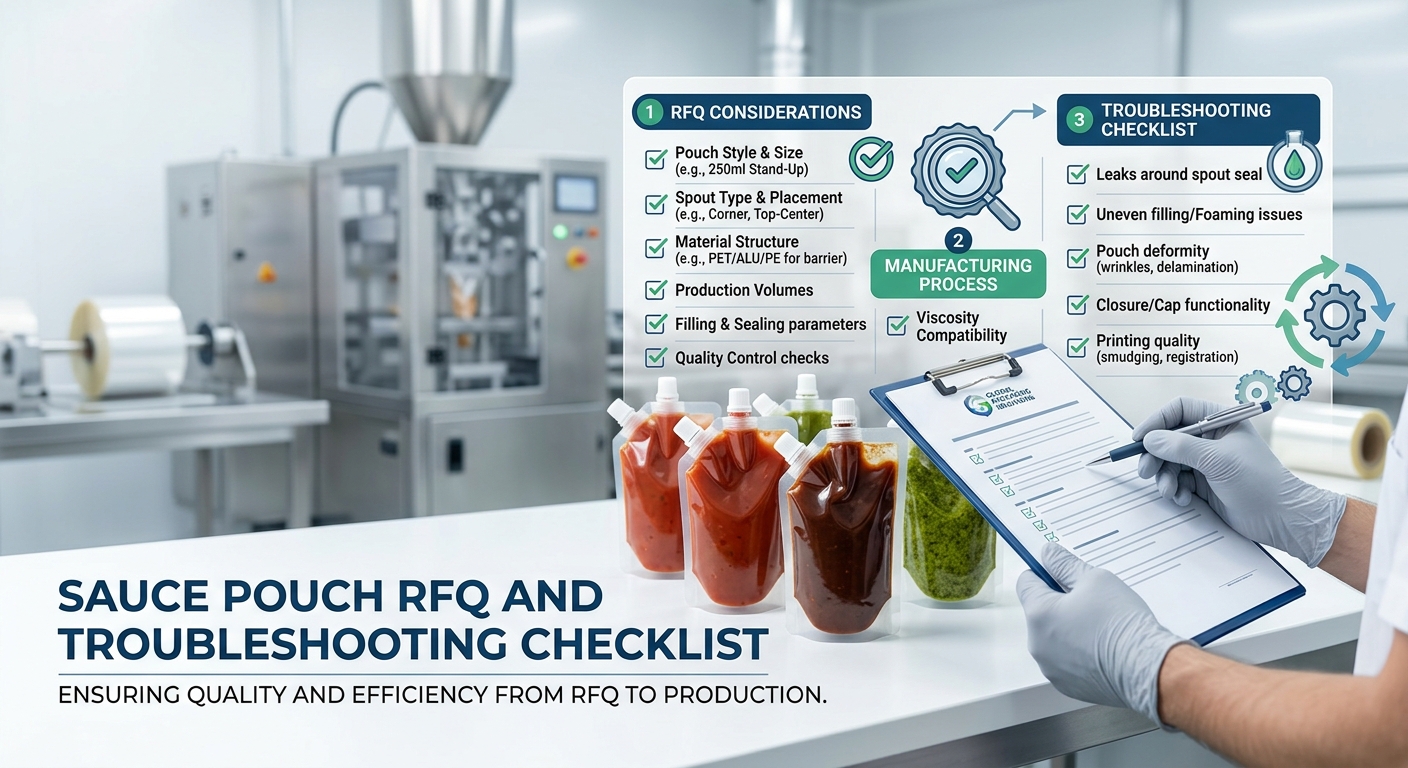
A complete RFQ helps the packaging supplier recommend a workable structure and reduces avoidable sample iterations. Include the following information:
- Product details: Sauce name, formula description, pH or acidity information where relevant, oil content, solids, particle type and maximum size, and any separation or settling behavior.
- Flow data: Viscosity or rheology results with instrument, test speed, geometry, and temperature. If data is unavailable, provide a representative product sample.
- Process conditions: Filling temperature, pasteurization or thermal process, fill speed, headspace, cooling method, and whether the pouch is filled through the spout or from the open top.
- Pack requirements: Nominal volume, target dimensions, pouch style, spout position, cap type, tamper evidence, display orientation, and required shelf life.
- Dispensing requirements: Pouring or squeezing method, target dose, expected user temperature, particle clearance, resealing frequency, and acceptable residue or dripping.
- Commercial details: Artwork process, print colors, order forecast, MOQ, sample quantity, delivery destination, and required technical documents.
Common dispensing problems
- Slow or blocked flow: Review the opening size, particle clearance, product temperature, air lock behavior, and fitment alignment.
- Excessive splashing: Review user pressure, outlet geometry, product temperature, and whether the opening is too large for the intended dose.
- Dripping or stringing: Evaluate the sauce’s rheology, nozzle residue, cap design, and the time allowed for flow to stop before closing.
- Leakage around the spout: Check fitment weld conditions, seal contamination, pouch stress, cap engagement, and distribution handling.
- Difficult end-of-pack use: Review pouch dimensions, laminate stiffness, spout location, fill level, and whether the consumer can direct the remaining product toward the fitment.
Final pouch dimensions should be confirmed with the intended fill volume and dispensing behavior. The spout pouch size and fitment guide can help organize those requirements before sampling.
The most reliable development path is to test two or more fitment options with the same filled sauce, then approve the pouch only after dispensing, sealing, thermal, and distribution results meet the agreed criteria.